As Justice William O. Douglas intoned over 50 years ago, “We are a religious people and our institutions presuppose a Supreme Being.” That truth was on full display at the inauguration of our 44th president, Barack Obama. The ceremonies were opened in prayer by the Rev. Rick Warren and closed in prayer by the Rev. Joseph Lowery. God’s name was invoked at the end of their swearing in by both Vice President Biden and President Obama, and President Obama referred in his inaugural address to Scripture and to God’s grace.
This honoring of religion was appropriate. I am one of those who thought I would never live to see the day when I would have the deeply gratifying experience of seeing an African American sworn in as president. From the religiously motivated abolitionists of the nineteenth century, to the Rev. Martin Luther King Jr., to the civil rights freedom fighters who marched from their churches into the streets, religion has played a crucial role in creating the path that Barack Obama has been able to walk.
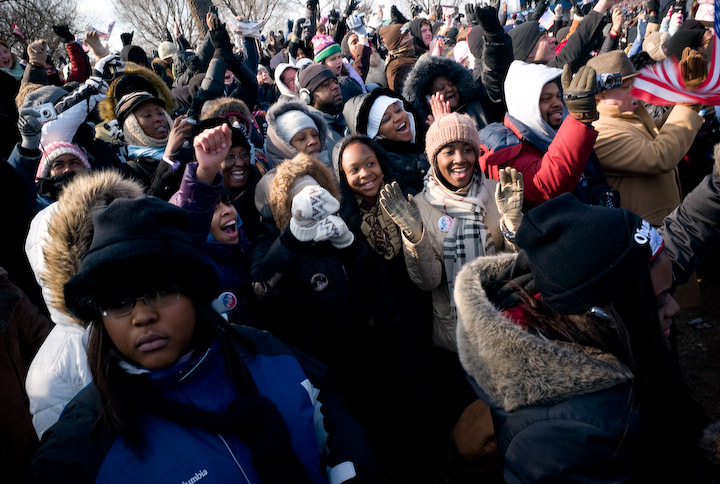
I am old enough to remember in the 1950s the often unseen, but crushingly real system of segregation in my own home town of Grand Rapids, Michigan. I was involved in an interracial group as an undergraduate and learned from my black peers about the restaurants where they would not be served and bowling alleys where they could not go. When stationed in Texas while in the army, I cringed at the public toilets and drinking fountains labeled “colored” and “white,” and in the 1960s I often despaired as many of my fellow evangelical Protestants opposed the Rev. Martin Luther King Jr. and the civil right movement.
And now January 20, 2009. As an evangelical, I believe in the reality of sin and evil in a world that is no longer as it is supposed to be. The racist history of our land is strong empirical evidence in support of the Christian doctrine of sin. Yet at the center of the Christian story there is not sin and fallenness, but redemption and salvation. Because of Jesus Christ (“God with us”) there is hope, even the audacious hope that mountains of racism can be moved. By the grace of God that President Obama referenced in his inaugural address, hope sometimes becomes a blazing reality, as it did on January 20.
–Stephen Monsma is a Senior Research Scholar at The Henry Institute at Calvin College.


thank you for writing this story. i remember as a little girl a sign in the back of a cafe we used to eat at stating colored also having to go through the back and not through the front of the business. my dad would always go through the back with us….when i asked him why the sign was there it made me made angry as a young child, i was proud of my father even then that he chose to go through the back instead also. I am thankful to be able to witness our first black president, even though i did not vote for barack i did like him, and could see what an outstanding man he is. i believe that we do all need to back our president, i believe that god will use him tremendously, what an amazing time in history we live in today……
Does no one see the sheer hypocrisy of this commentary? Mr. Monsma rightfully speaks of “the deeply gratifying experience of seeing an African American sworn in as president.” That’s because whites thought themselves better than blacks, and we now have a society where such racial arrogance has (largely) disappeared.
Yet we continue to have the same arrogance in terms of religion. Mr. Monsma “cringed” when the government implied that “colored” people weren’t good enough to drink at “white” water fountains, but rejoices in government sending the same message of inferiority to Atheists. (”This honoring of religion was appropriate.”)
After Justice Douglas wrote that “our institutions presuppose a Supreme Being,” he realized how his words were being misapplied, and how the Monotheists of the day were just as haughty as the Whites. Thus, he acknowledged his words a decade later, but highlighted that “if a religious leaven is to be worked into the affairs of our people, it is to be done by individuals and groups, not by the Government. This necessarily means, first, that the dogma, creed, scruples or practices of no religious group or sect are to be preferred over those of any others.”
In this nation, believing in God is no “better” than is being white. That equality in terms of race has finally been understood is a wonderful thing. Perhaps someday that same notion of equality will also be comprehended in terms of religious belief.
Christianity had to be dragged kicking and screaming to the Civil Rights movement. They did not lead it, but came in only after humanists led the way. Religion has supported slavery and prejudice throughout its long hypocrisy-filled history. And Newdow is correct; Christianity exhibits the same prejudice against non-Christians (the same for Muslims against non-Muslims)–particularly the non-religious–as was heaped on blacks in America for hundreds of years. The credit for our maturation as a people should not go to God, nor to Jesus, but to the humanist ideals of people of religion an dnon-religion that brought about change. Only in a nation with a secular government could this have happened. So leave God out if it.
The support for segregation by the vast majority of white Christians and the acceptance of it by many black Christians is truly a source of embarrassment. And all of us who call ourselves Christians should seriously ponder whether there is something about our faith that makes us complacent in the face of evil, or even complicit. Still, Mr. McElligott’s comments are absurd. The Civil Rights Movement of the 50’s and 60’s was largely a black church phenomenon. The truth, it seems to me, is that human beings are a complex mixture of good and evil and that mixture pervades all aspects of our existence, including religion and religious institutions. Similar, humanism and humanist values can also be employed both for good and for ill.
Obviously, Stephen Monsama’s age and experience closely parallels mine, reared an hour’s drive south of GR, experiencing segregation in Texas in the military (and elsewhere). I could have written that piece.
Tim McElligot expresses a widely held opinion that I find rather unreal. That secular society could only have evolved in a context that accepted the only truly humanist views of Jesus. No other system would allow equality of all religions, or no religious belief. Examine the conflicts around the world and wake up and smell the coffee.