Visit Your Local PBS Station PBS Home PBS Home Programs A-Z TV Schedules Watch Video Support PBS Shop PBS Search PBS

March 13th, 2009
Kathleen Norris

Get the Flash Player to see the wordTube Media Player.

BOB ABERNETHY, anchor: We have a profile today of the poet and writer Kathleen Norris, whose books have won her many admirers, especially among religious believers. After nearly 10 years of literary silence she has a new book out called “Acedia and Me.” Acedia, Norris says, is a kind of spiritual gloom that she has endured on and off since she was 15.

Kathleen Norris

KATHLEEN NORRIS (Author and Poet): It’s an ancient word that basically means the inability to care, even to the extent that you can’t care that you don’t care anymore. It’s sort of a really drastic, nasty form of indifference.

ABERNETHY: Norris first became popular in the ’90s with a story about her life on the Great Plains, to which she and her husband had moved from New York City. The book was called “Dakota.” In the Dakotas, and then at St. John’s Abbey in Minnesota, Norris discovered Benedictine monasteries and the ancient practice of chanting the psalms five times a day. She wrote about monastic life in “The Cloister Walk.” Next, in “Amazing Grace,” Norris offered her thoughts on Christian language, and in “The Virgin of Bennington” she wrote primarily about poetry.

“All thought of writing was shoved to the side.”

And then, nothing more. The books stopped coming. What happened was that Norris had to become a full-time caregiver — now, to her 91-year-old mother in Hawaii, where Norris grew up. Earlier, it was her father who needed care, and her sister, and especially her husband David, who suffered severe mental and physical illness for many years until his death from cancer in 2003.

Ms. NORRIS
: The last 10 years, I would say, have been really rough, and in some senses this book is a miracle to me because I was able to finish it at all. There were so many temptations, especially after my husband died, to just give up and say, “Why write at all? Why bother?” Which is — the ultimate question with acedia is “Why bother? Why care? Why do anything?” All thought of writing was sort of shoved to the side for me.

ABERNETHY: Norris thinks acedia is different from depression.

Ms. NORRIS: If I’m depressed I tend to know the reasons why. With acedia there is no cause. It just sort of pops up, and I might wake up in the morning thinking, “Oh, this is going to be a good day,” and then all of a sudden the thought, “No, it won’t be,” and maybe I shouldn’t get out of bed.

ABERNETHY: Slowly, eventually, Norris managed to get back to her book. On the day it was finally published, she was at the Washington National Cathedral recalling how hard the process had been.
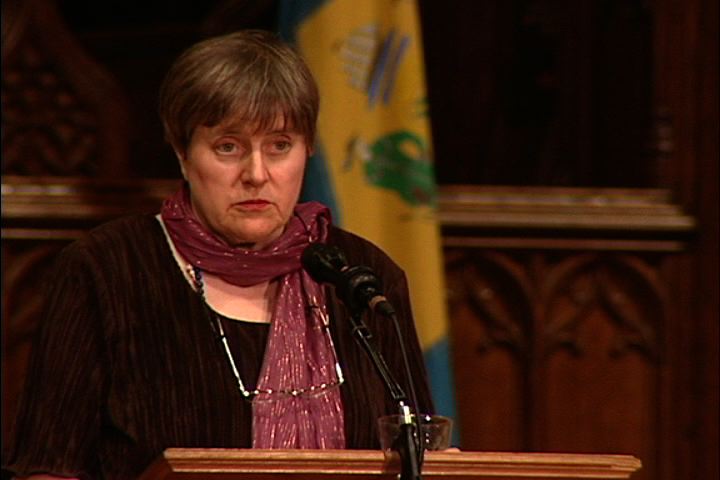
At Washington National Cathedral

Ms. NORRIS (speaking at Washington National Cathedral): Coming back to the project always felt like climbing a mountain in a raging hailstorm. On more days than I care to recall, I would settle for reading thrillers or even watching “America’s Next Top Model” marathons.

ABERNETHY: Norris had learned from the Benedictines that one way to combat the indifference of acedia was praying the psalms. Other remedies were physical work, exercise, and baking bread. Perhaps most important for her was accepting her family responsibilities.

Ms. NORRIS: One of the reasons I decided that I’d better not have children is because I really didn’t want to be a caregiver. So it is something that has been imposed on me, and I have really had to learn how to cope with that, how to be patient and loving instead of irritable and impatient and, believe me, it is a struggle, and I don’t always make it. To think, if I’m with this person, helping them do this ordinary task, like going to the bathroom, that’s the most important thing I can be doing with my life at the moment — to convince myself of that every day.

ABERNETHY: One thing that made Norris want to get the book finished and published was her sense that acedia might be a problem for the whole country.

Ms. NORRIS: I realized that acedia was not just a personal problem, but really it’s one that we suffer as a society. I think we often adopt that attitude of indifference because we’re being asked to care about so much. We just are exhausted.

ABERNETHY: Ever since she was a schoolgirl, Norris found refuge at Hawaii’s main public library, from which she borrows and returns books by the bagful. Meanwhile, she says she’s also learned a lot from taking care of others.

Ms. NORRIS: A friend asked me after my husband died, “Well, have you lost your faith?” And my gut reaction, my instant response was to say “Of course not.” I mean, people die. This is what happens. That’s not God out to get me. That’s just a fact of life is that people die. So it really — it didn’t shake my faith, really. It made me feel just more like everyone else in the universe. You know, people you love are going to suffer and die, and you somehow have to learn how to cope with that.

The opposite of acedia is love.

ABERNETHY: Norris says the opposite of acedia, and its most powerful antidote, is love.

Ms. NORRIS: I think part of the struggle just of everyday life is remembering that the love is there. It’s just, it’s a constant. And to wake up in the morning and realize that love is there in the world, it’s there in your relationships — if I can do that, that’s half the battle.

ABERNETHY: In Honolulu, Norris continues to take care of her mother. She says acedia remains a part of her, something she just has to live with. She would like to write more poems, she says, or in a perfect world she would follow a book on acedia with a comic novel. But she knows very well that the world is not perfect.

bookmark    print    email    comment/s (30)

(14 votes)
Loading ... Loading ...

Comments

30 comments

#1

An interesting piece, but it seems Ms. Norris is in denial about being depressed by using this term acedia. Simply acknowledging that we all grow old and infirm and die doesn’t mean we have no “reason” to be depressed when such events engulf us. She certainly has reason enough to be depressed given her many years of care giving for her husband and now her mother. I suppose it makes for a more interesting book title.

#2

Kathleen Norris’ new work, “Acedia and Me”, is highly welcomed! I have learned much about her, more about myself, in her writings. Her unfailing candor about her own humanity, accepting the moments as they come, and still bringing a poet’s heart to her understandings makes one value her as a guide through troubled waters! She knows the difference between acedia and depression, cousins though they be!

#3

I tend to agree with Len Sierra that Ms. Norris may be in denial about being depressed. One of the many understandings of depression is that it can be “anger turned inward”, punishing oneself for intolerable feelings. Her comments about her previous deliberate avoidance of and later “imposition” of succession of caregiving roles suggests there could be a need to confront a perhaps deeper than the usually expected level of resentment of the lifestyle changes caregiving has demanded.
There is a street expression: Keepin’ it real”. Perhaps one of God’s greatest blessings is that He helps us keep our sprituality “real” by presenting each of us with situations that reveal the temptation we all have to what has been called “cheap grace”. Warnings that trials will come and exhortations to embrase them are plentiful in Scripture as I am sure a scholar like Ms. Norris knows. But as we all learn it is one thing to “know” and quite another to “experience”.
I have read Ms. Norris’ previous books with both pleasure and benefit. I look forward to the same in reading her new effort.

#4

I know exclecty how she feels.I never had a name for it. I know when i am {depressed}. I have been a care giver fot 18 years. first for my husband while beening dignosed with M S then for my father now for my mother. I have a dead spot in me.I have tryed many ways to fill me. I just go through the motions of life. I have gone to many doctors. and i could nor explaine how or what i was feeling now i know. Len sierra does not have a clue on what he is talking about. He is like many people who think it is all in your head I have been getting this most of my life. I KNOW HOW I FEEL. Becky

#5

All I had to do to know that I, too, struggle almost daily with acedia, was to read the definition Ms. Norris gives. It is not depression. She is right to say that acedia is its own “gloom.” At least with depression one can find a reason for the depression, even if it is a chemical imbalance problem in the brain and/or from some event, some loss such as loss of a job or a loved one or one’s own mental or physical health. The list could be endless. However, acedia, as she defines it, offers us nothing to reach out and grab as an explanation for being in that state. It just is what it is – “a lack of caring about anything and not even caring that we don’t care.” As she says, one can awaken feeling upbeat only to fall off into the seeming abyss of acedia with its tantilizing enticement to just roll over, pull up the covers more tightly, and drift in and out of sleep. She is also right that love is the antidote and it is a powerful one. If I know someone is depending on me for “something” and cannot get that “something” without me, love will get me up and moving if it is just to accomplish that one act of giving to another. I believe that God is the one who provides the need of someone that enables me to push through my inertia to go and meet that need in Jesus’ name. I believe the person who is listed as “Comment #1″ does not, and never has, suffered from acedia or he could not comment as he did. I applaud Ms. Norris for pushing ahead and finishing the book. As with the other books by Ms. Norris that I have read, there are some of us in life to which nothing comes easy. Life is a constant struggle and mostly it is an inward struggle. I believe she will have a large audience who will finally understand what it is that has caused us to have to struggle to get up each day when a second or two before, we felt for an instant that the sun would shine deep within us and cause us to get up and, like millions of others, simply go through our day. I look forward to reading this important new book. I urge other believers in Christ who recognize acedia in their own lives to have the courage to read Ms. Norris’ book.

#6

Have to agree with Mr. Sierra, this woman is depressed and conflicted, pretty common among people exposed to the oppressive and contradictory regimen of the Catholic church. The church has always tacitly pressed it’s members into keeping its secrets and towing the line by instilling fear, promoting acquiescence to the status quo and insisting that grown adults maintain the primitive perspective of Catholic heuristics and wooden ethics they learned in childhood. This brand of fear and deception promoted as God’s truth tends to paralyse healthy individuals both in terms of emotional mobility and success in faith and life. Miss Norris’ “acedia” or inability to care is really the hallmark of arrested development, immaturity and emotional stuntedness ,again, often the hallmark of men and women who live to the strict and contradictory edicts of an expansive and politically demanding oligarchy which has always served it’s worst traditions. Additionally, her remedies are astonishingly irresponsible and in some circles might qualify as symptoms themselves. They seem homespun, likely the product of minimal consultation with others and smack of a real avoidance of seeking out the people who might actually help. Attributing her qualities to the entire rest of the world is the real closer, the true marker of the childish cognocentrism that colors this entire piece, a perspective that could only aspire to make the issue entirely about her with minimal detail or regard to the suffering around her. I see more of this kind of caretaking gladly rendered and generously given by people outside of this ilk and tradition than inside it and most people who write of their experiences of this kind find it a period of joy and personal learning that communicates a transcendence that is almost entirely absent in Miss Noriss’ humourless and ,ultimately, faithless synopsis.

#7

I think Len Sierra is absolutely correct.

#8

Having’depression” due to brain damage that responds to no medication, I viscerally responded when I heard “you can’t care that you don’t care anymore”. My solace comes from centering prayer, feeling that God loves and accepts me as I am, and then moving forward with life with a greater ability to extend the same to life. The idea of being present to interactions is also something I can do. I’m looking forward to more in the book. Thanks for this shift in focus.

#9

I agree with Len Sierra’s comment, and would add that endogenous (aka biological or chemical) depression is also an entity to be considered. Having treated it for over twenty years, and suffered from it, I know a bit more about it than many. One of the more salient features about this disorder is the “built-in”–if you will–sense that the sufferer has that there’s nothing that can be done. “No point in even trying.” This may explain why it takes so long for so many to seek attention. Treatments that are effective for endogenous depression are ineffective for what many call “reactive depression”, such as following a severe personal loss, etc. Mood-altering medications usually make endogenous depression worse. There is also some feeling that severe and/or prolonged stress may trigger an endogenous depressive episode.

This would seem to provide a possible alternate explanation for Ms Norris symptoms; nonetheless, it would appear that she has found an excellent method of dealing with her problems, and she is to be applauded for this.

W. L. Prichard, Jr. MD

#10

I think Len has it exactly backward. Acedia IS the problem, not depression, with which it is too often confused in this country, and hopelessly “treated” chemically, with shock or what have you. The confusion is due to our profound denial of death, the ordinary vicissitudes of life, and our being so caught up in profane, temporal existence at the expense of eternal verities, and our stunted or non-existent spiritual life. Mrs. Norris is exactly right: Acedia is the quintessential problem in contemporary American life. It is also a major root-cause of the countless addictions in this country and, in fact, our addictive lifestyle itself. Paul Corrao, M.D.

#11

I can understand the acedia. When one is caring for others day after day there is nothing left for oneself. Responibility takes the place of emotions. It is the most training experience even if it starts in love.

#12

Rob’s comments, with all due respect, strike me as highfalutin antiCatholic nonsense, all dressed up for polite company. The irony is that Mrs. Norris is formally Protestant (Presbyterian), not Catholic, if I am not mistaken.

#13

Reading the comments of those who responded to Ms. Norris’ application of the term “acedia” to her reaction to her life circumstances has prompted me to respond with the following warning.
A little story first: at a conference on the writings of the 16th century mystic John of the Cross, members of the audience were invited on the last evening to volunteer to sit in front and offer their further input. The five religious sisters who came forward to one by one describe experiencing symptoms of classic reactive depressions (depression not arising from chemical imbalances in the brain’s functiion but from a psychological reaction to life circumstances). They each ascribed their symptoms to an exclusively spiritual cause, naming their distress as an instance of what had just been presented as a what St. John of the Cross termed “The Dark Night of the Soul”.
At last a sister in the audience, who words were lent credibility by her own struggle with depression arising from terminal metastatic bone cancer, rose to speak. She minced no words. “Sisters”, she said, “You are seizing upon a 16th century mystic’s words to deceive yourselves and evade the struggle to discover the true basis of your depressive reactions. Perhaps you are reacting to a personal event or, perhaps, the many unwelcome changes in your circumstances as a religious sister are the cause. But, please, don’t explain you depression to yourself in a way that will prevent you from seeking the professional psychological help you need.”
I believe that sister would rise now to say the same thing about the potential misuse of the term “acedia”. Reactive depression is real, has specific symptoms and can be relieved by competent professional intervention. This will require painfully honest examination of feelings of anger and resentment that remain out of awareness because they are incompatitble with one’s self-image.
For the believer, there is a spritual dimension to reactive depression since, for that person, God is seen to be intimately involved in every detail of life. The sense of abandonment and betrayal can be an essential element in the depressive reaction.

#14

Acedia comes from our inability to accept that life is finite, that we cease to exist after death, that the belief in an afterlife is surious. Once we truly accept these truths, we are free to live fully in the here and now.

#15

I’ll give J.W. Wilkins credit: he, at least, minces no words in stating what he does not believe- much as I disagree with him. But the yearning for an answer to the mystery of existence, to some sense of ultimate justice, and to immortality of some kind are so pervasive in history and well-nigh universal now, that the barren, facile answer he proposes will never be accepted by the mass of humanity, and it is therefore functionally useless at the very least. Nor does it, by and large, inspire the kind of artistic creativity or moral and ethical heroism that authentic transcendent faith does. And I grant that there is merit in the remarks of Jean Sullivan, but the danger, as I see it, is to fall into the trap of Mr. Wilkins (and Rob?), judging the eternal and spiritual by the temporal and material, and then throwing the baby out with the bath water, capitulating completely to nihilism and secularism. And then there is the problem of suffering which cannot solved by secularism. Fundamentally, what is at issue here is the conflict between religion and science, the subtle but profound confusion between them in the modern mind, and the extent to which science has usurped and completely replaced traditional religion in our lives, even though it itself is based on faith of a sort, and is not immutable. Nor can we forget the enormous power of suggestion (sometimes also termed the ‘hex’ power) inherent in the psychological practitioner, the discipline itself, and the intimate encounter and setting in which therapy takes place (See “Why People Get Sick”, by Leader and Coffield) Furthermore, the powerful, synthetic, generally petroleum-derived chemicals which now abound in psychiatry have a considerable commercial motivation, are based on a very incomplete and imperfect knowledge and understanding of the mind and brain, have, as yet, unknown or poorly understood long term personal and societal effects; and invariable end up being used indefinitely- which Imber, in “Trusting Doctors” quoted Passmore characterizing as “substituting (freedom) for drug dependency.” Stanley Fish of the Higher Education Council has said that the age of liberalism through which we have been passing will now be replaced by the age of “religion”, in our time. Many references could be cited here, but one I’ll mention is “Human Destiny” by Lecomte du Nuoy. And finally, with respect to the situation Ms. Sullivan described, with all due respect, I would submit that the sister who spoke was mixing apples with oranges. Hers was the profound endogenous depression of terminal cancer, which probably has an organic basis. I do not think that can be compared with the presumably functional depression the other nuns were suffering from, and I would ask: were these issues ever discussed openly, in a community setting? Was Catholic or other faithful professional input ever sought? Were the lives of the sisters wholesome and healthy, by way of adequate exercise, optimal nutrition, rest, relaxation, outside pursuits; time for conversation, hobbies, artistic pursuits,animal companionship, input from the nuns themselves? For, in a word, fun? I think these communities could go a long way to solving these problems themselves, given the proper chance and circumstances. (P.S., If J.W. Wilkins is a “Dr.”, I apologize for not so addressing him) Paul Corrao, M.D.

#16

Dr. Corrao’s points are well made. His concluding comments regarding the wholesomeness of the lives of the sister’s who claimed to be suffering from a “Dark Night of the Soul” daily experience furthers my point.
Watching Ms. Norris’s interview, and reading the responses to it by others who came away persuaded by it that their own emotional distress was “acedia”, prompted my comments.
My background includes knowledge of both psychology and theology. I believe both of these perspectives can offer help with the suffering common in many lives. Neither should be substituted for the other. Moreover, in absolutely no sense was I suggesting that providing a chemical is the answer. Psychotherapy existed before the discovery of the benefits of a very selective use of chemicals to improve function in very specific mental impairments. The present circumstance of the overuse of these chemical tools is to be deplored.
The sister who spoke was not speaking exclusively from experience with her own endogenous depression arising from terminal cancer. She believed, and I agreed with her, that she recognized a danger that the sisters who identified their depressive reactions to their life situations as “Dark Nights of the Soul”, and were only interested in defining and exploring it in theological terms, were taking a denial-supportive refuge from seeking the professional psychological help they needed.

#17

Distinction and points well made, and accepted. My point is there is metaphysical “depression” without obvious physical or organic cause, and the medical profession, especially psychiatry, commonly ignores that since the reification of “mental illness” into a hard, physical, organic, chemical “disease”, the complete takeover of medicine its transformation by commercial and corporate interests, and the resulting exclusive reliance upon physical, profane methods of dealing with such distress. At least some of the nuns Ms. Sullivan referred to may very well have been in a spiritual crisis, such as the one Karen Armstrong described in “Down The Spiral Staircase”, and like her, they may even have made a wrong vocational choice. But consider how that would have been “managed” in the hands of the average psychiatrist or even psychologist, whose very disciplines tend to reject metaphysical or spiritual causation for mental distress or disease of almost any kind. I invite attention to the wonderful R & EW interview with Rev. Forrest Church online here. He is the son of the late, distinguished Sen. Frank Church from Idaho, and Rev. Church is one of the most distinguished U/U ministers in the country. He is also tragically suffering from metastatic cancer, which may be terminal for him at age 60, but he remains resolutely spiritual and a believer in his ultimate outlook. He maintains essentially that religion is the inevitable and necessary response to the metaphysical, spiritual challenge of being human. I’m a pathologist by specialty, and after over thirty years in the field, I can tell you that we are much too “scientifically” oriented, we are so convinced that there is an explainable, physical, material cause for every disease- which there is not- that we relentlessly pursue such a diagnosis, even to the point of forcing the issue at times, in our reports. That reflects fear of legal consequences, but more often, it is the result of our exclusive faith that science has all the answers and any spiritual dimension is obsolete. I think that is a profound characteristic of our national life as well. About sixty years ago, Prof. Barrett, the late prof. of philosophy at Columbia, wrote that the outstanding characteristic of the modern age was the progressive decline of religious influence in our daily lives. Most here are familiar with Ernest Becker’s “The Denial of Death.” How many of us really believe in G_D anymore? When have government or the courts really acted on the basis of transcendent faith? Look at how coarse and dishonest our national life has become. Forgive me for going on too long with this, but I still believe Mrs. Norris is right: Acedia is a much greater problem in our personal and national life than depression or related mood disorders, and I think she has made a genuine contribution with the work she has done and the book she has written.

#18

It is interesting to me how we all seem to settle ourselves around Kathleen Norris’s efforts to objectively sort through her very subjective experience.
Reacting, sometimes as though to a Rohrshach test, we seem to align our own subjective truths to her own and then relate these truths in objective fashion.
We really do not know, but we act and react as if we were certain in our religious or scientific descriptions of another’s described experience.
My own very subjective feeling on the matter is one of thanks for Kathleen, who has such an intelligent awareness of her situation and experiences, who offers us her interpretation of her feelings and finally: Thanks Kathleen for giving us a core – a piece of the heart of your truth – with which to explore the core – the heart of our own truth’s. Kathleen, I hope your efforts have assisted you in understanding your self and your place in the word as much as they have helped me find my own. For myself, there is some degree of comfort in this understanding and I hope you have found comfort there too. jp

#19

Jp, Again, with all due respect, you are employing fairly typical agnostic or atheistic, and self-oriented psychological verbiage to strip Mrs. Norris’ experience and writings of all general transcendent, philosophical, theological and epistemological meaning. “We really do not know”, you say, and you refer to “her very subjective experience.” Did you read her book, JP? If so, was Shakespeare’s “his very subjective experience”, without more general substance and truth? How about Dostoevski? Tolstoy? Goethe? Williams, O’Neill, Miller, and so forth? Mrs. Norris didn’t write a book solely about her “subjective experience” or “truth”. She drew upon the wisdom, work and insights of many others, as well as on scripture, to fashion a work which had – I submit-a much more universal scope than you, JP, allow. Thus, we do not “act and react as if we were certain in our religious or scientific descriptions of another’s described experience.” I don’t think she intended that at all, or that we who read her work react to it in that narrow, self-serving way. Mrs. Norris aspired to universal truths about the human condition, which could be a guide and assistance to us all, as all great literature does, and I think she succeeded in that quest.

#20

I listened to Ms Norris and Bob Abernathy very intently. My take is that we have one MIND (GOD) that we reflect daily. And He brings us daily
care for our multitude problems in ways that we can not fathom. I appreciated this program very much and thank you from the bottom of my heart. It is especially needed at this time of world turmoil. — Divine Love will heal the world!

#21

I fully understand what Ms. Norris thinks and feels. I’ve been there and still deal with it. Either you get it or you don’t. I hope she finds the slice of peace that has been granted me in the last two years. At the bottom of other peoples physical and emotional problems is you, Ms. Norris. I hope you find her and get a chance in this life to love and nurture her.

#22

From the perspective of a student preparing to be a clinical psychologist, and of one who has suffered intimately from depression, I would agree that Ms. Norris has merely assigned another word to describe what we already understand as depression. It is a mistake to presume that depression is always defined by feelings of anger or anguish. More often, depression manifests itself as severe apathy; an often infuriatingly intense feeling of apathy that cannot be shaken. It is so excessive at times that it eradicates all traces of an individual’s motivation even to roll out of bed and start the day’s routine. This is exactly what Ms. Norris has described, and this is undeniably and unequivocally depression. Any competent clinician would tell you the same thing.

#23

Ms. Norris certainly has every right to define how she feels with any words she chooses and only she really knows what specifically that encompasses. I agree that aecidia in clinical views, is encompassed in how we may define depression, which is a most complex, and individualized diagnosis in itself.
That being said I think the term aecidia predates the depression tag. I believe it was used to describe one of the seven deadly sins written by Dante in the early 1300’s. It was attached to, or interchanged with, the least desirable word sloth.
Ascedia afflicts those suffering from sloth, and may more accurately be a reflection of it’s more advanced stages Arguably more difficult, or unlikely to be treatable then sloth alone.
Does this describe depression’s symptoms? No doubt it could be called a form of depression, but aecidia is a truer, more original, and obviously a more personal definition used by Ms. Norris to convey something deeper. Semantically she is also correct when terminology is held to these tests.
I too agree we are projecting our own perspectives and experiences onto her descriptions, and views, by assuming to know either way. Nor do I believe that these were her reasons, or intentions for sharing these feelings, and descriptions in the first place. It appears to have a deeper, more theologically based intent.
Then I too am making a biased ass-u-me here, and it seems to be our nature to do so. Empathy reveals it’s truths we all share in common, and apparently for Ms. Norris provided her the strength, and power to persevere, and complete her writing in spite of it all. That she learned this through prayer and Scripture is all the more reason to respect her work, and admire her willingness to share these intimate, and private tribulations, to offer hope and inspiration to all of us who also may share in same, or similar woes as part of the human condition. No doubt her work will in time help others along these common paths that may be overcome, or endured in spite of obstacles, like depression, or fate.

#24

I am assuming all the people who think Ms. Norris is “in denial about being depressed” are making this judgement without having read any of her books, and especially not “Aceida & Me”,” in which she makes a distinction between acedia (which is in some ways a technical monastic term) and depression. If some of your respondents cannot make the distinction because they have not had experience with one or the other, then I say their lives have been singularly blessed!

#25

Kathleen Norris doesn’t deny that she has been depressed and has even sought help (meds and doctors), but she also thinks that acedia is different from depression, and I agree. I have suffered from depression, too, and from acedia as well, and I know the difference. I agree that as a society we have grown so fond of finding “causes” for our feelings and “cures” them that we have simply abdicated our responsibility as people to live through some things. We all do grow old and die(if we’re lucky) or die young if something out of the ordinary happens (disease/accident) and we have to live through those times, both when they happen in our own lives and in the lives of those we love. Acedia is very real, but sometimes it takes a finely tuned spiritual life to tell the difference between acedia and depression.

#26

I’m just starting to read “Dakota” and have trouble putting it down.I lived in Dakota until ‘60.Dr Christen was my husbands bro-inlaw so I’ve been to Lemon several times.We met John Norris in Hi.,and my John Taylor were good friends until Your dad passed.We loved the Dixie Band.We have so much to talk about and I don’t think this is the place for that.I would so love to talk with you.If this reaches you E-mail me please.

#27

Kathleen Norris is Right On… acedia, it is, and she certainly knows to consider and recognise depression as something different. Writers are among the human beings especially apt to know acedia, and depression, too, in some cases. She describes acedia rather well which is important given the inability of some to understand it including persons to jump to assumptions of depression, anger, conflicting emotions. Norris is well aware of all such possibilities. She has told others of Acedia.

#28

YES, the answer is Love.

#29

Thank you Kathleen Norris for using words so gracefully and teaching many of us, myself included,such a useful lesson. I do not sense any judgment here, simply identification of the qualities of acedia. Why must everything be turned into a disease or an imperfection by humans? The tide is low sometimes; the tide is high other times. Some nights the moon is full, other times it is a crystal curve and that’s it. Trees bloom and go bare. We accept this in nature-why will we not accept phases in our mortal span. These phenomena exist,I believe, for our faith and our edification. Thank you Kathllen Norris for conveying acedia so wonderfully well. Your insights tell not only of wisdom, but these words
are such a comfort, such a comfort.

#30

Kathleen Norris is a poet, and poets notice and name things for the rest us. From her personal experience she offers insights that resonate in other souls. As one of her readers, I’m very grateful that she undertakes the daily struggle to write. Her words and stories in themselves are a joy to read and she has given me a gift of increased self-understanding and courage. I also appreciate her memories of experiences similar to mine: living in Hawaii, growing up in a military family, and librarianship.

Post A Comment


Please note that the THIRTEEN editorial staff reserves the right to not post comments it deems to be inappropriate and/or malicious in nature, as well as edit comments for length, clarity and fairness. No solicitations or advertisements will be allowed. Users may link to other Web sites relevant to discussion, but most often links to commercial Web sites will not be permitted.

Submit

Related R & E Material:

Read more of Bob Abernethy's interview with Kathleen Norris

Read an excerpt from ACEDIA: A MARRIAGE, MONKS, AND A WRITER'S LIFE by Kathleen Norris.

Into Great Silence

Anne Lamott

Alice McDermott

Mary Gordon

Marilynne Robinson

Related Reading:

Books by Kathleen Norris:

ACEDIA & ME: A MARRIAGE, MONKS, AND A WRITER'S LIFE

THE VIRGIN OF BENNINGTON

DAKOTA: A SPIRITUAL GEOGRAPHY

MEDITATIONS ON MARY

THE QUOTIDIAN MYSTERIES: LAUNDRY, LITURGY, AND WOMEN'S WORK

AMAZING GRACE: A VOCABULARY OF FAITH

THE CLOISTER WALK

THE PSALMS with commentary by Kathleen Norris

Facebook Watch Now YouTube Listen Now

Produced by THIRTEEN WNET New York    ©2009 Educational Broadcasting Corporation. All rights reserved.

Funding for RELIGION & ETHICS NEWSWEEKLY is provided by Lilly Endowment. Additional funding is provided by individual supporters and by Mutual of America Life Insurance Company, The Henry Luce Foundation and The Corporation for Public Broadcasting.