MARY ALICE WILLIAMS: Our cover story, "Home from the Hajj," is the last chapter in our story of one man's journal of faith. Last April, almost two million Muslims converged on Mecca in Saudi Arabia for the hajj, the Islamic pilgrimage. One of this year's pilgrims is Abdul Alim Mubarak from Maplewood, New Jersey. We first met him as he prepared for this, his first hajj. Our correspondent Aniat Zamekdi then traveled with him to Saudi Arabia. Now, in the final report in the series, reporter Anisa Mehdi visited the Mubaraks back home, starting at a storefront Islamic Center in Newark.
ABDUL ALIM MUBARAK (Hajj Pilgrim): Sala'am aleikum, everybody. How's everybody doing today?

ANISA MEHDI: Abdul Alim Mubarak performed the hajj this year for the first time. Now back, volunteering again at this masjid, or mosque, in Newark, he finds teaching Sunday school is even more important to him than before his journey.
Mr. MUBARAK: It broadens your scope as a human being, because you find that all human beings are exactly the same. But at the same the time, we're different.
(To Class): Hajj. Right. Now, what exactly is hajj? Who can tell me what hajj is?
Unidentified Girl: A government.
Mr. MABARAK: I was sharing with the children and even the adults that were there, to instill their enthusiasm for making hajj.
(To Class) One day you all will get to make that journey as well.
Mr. MUBARAK: When you make your prostrations anywhere in the world you know you're facing the Ka'aba, right?
Unidentified Man #1: Right.
Mr. MUBARAK: But to be right there and you bow, and you make your -- right in front the Ka'aba itself.
Unidentified Man #1: It's awesome.
Mr. MUBARAK: It's awesome. It's awesome.
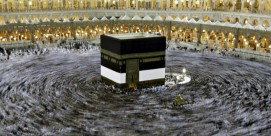
MEHDI: Imagine a crowd a quarter the size of New York City, only more diverse, all trying to do the same thing at the same time in the same place. The common language is Arabic, though not everybody speaks it well. The common goal -- the worship of God.
The world over, Muslims swear there is no God but one God. The world over, they face Mecca to pray five times a day. In Mecca is the Ka'aba, believed to be the first house of worship for the one God built on Earth.
Mr. MUBARAK: The Muslims don't worship the Ka'aba, they worship the Lord of the Ka'aba. And it's only a focal point.
MEHDI: The Ka'aba is in the center of the Haddam Al-Sharif, the noble sanctuary. Opening to the sky, three stories high, it's big enough to hold 750,000 worshippers at once, and if there's no room inside, outside will do.

Mr. MUBARAK: It's huge, and it's so imposing, you're dwarfed by it. The huge marble columns, the huge marble minarets, just dwarfs you. And you feel like this little tiny little ant, you know, walking in this vast expanse. And it empties out into this vast courtyard, and right before you, you see the Ka'aba. And it's like, this is it, this is what I've been praying towards. This is it.
MEHDI: The first act of the hajj is to walk around the Ka'aba seven times, following the example of the prophet Muhammad and his ancestor, Abraham, who is credited with raising the foundations for this holy house. Before you can walk around the Ka'aba, you must enter a state of spiritual purity called Ihram. For women it's a consciousness, an intention to perform hajj. But for men, there is also a special garb.
Mr. MUBARAK: Okay, this is what's called the Ihram, and what happens is -- these are two pieces of unstitched cloth. You put these two pieces of cloth on and you wear nothing else. No underwear, or perfumes, no colognes, no deodorant, no nothing.
MEHDI: There's a psychological vulnerability, I would imagine.
Mr. MUBARAK: Because you are exposed, but you're also into a state of consciousness, whereby you don't do any arguing with anybody, no intimate relationships with your wife, your whole being is geared to getting close to your Lord.
MEHDI: Now the women can pretty much wear whatever they want. Why do men have to wear just the two towels?
Mr. MUBARAK: It equalizes everybody. It's an ego thing. Men have large egos, we have large ambitions. So you don't know whether you're standing next to or talking with a CEO or a president or a beggar. Because in the eyesight of Allah, you're all the same.
MEHDI: All the same except for the culture clash in the hot crush of the crowd. Some folks say, "Excuse me," some elbow their way through.

Did you find yourself able to focus in spite of the crowd, in spite of the heat, in spite of the pushing?
Mr. MUBARAK: Sure I did. No question. That was very easy. You become so focused in your worship that you block everything out.
MEHDI: After circling the Ka'aba, comes running seven times between two hills called Safa and Marwa. The density of humanity makes the run more like a trudge. Pilgrims reenact a story found in both the Bible and the Qur'an. Abraham's second wife, Hagar, was left in the desert, desperate for water for their son, Ishmael. According to Islamic tradition, God provided the spring of Zamzam, which refreshes Mecca's visitors to this day.
It's on then to Mina for the night. En route, they chant, "Here I am, Oh, Lord" as hajjis have done for 14 centuries. Mina is a city of tents. Many with built-in air conditioning, thanks to the Saudi government. Pilgrims spend the night here preparing for a one-on-one with God at their next stop in the Valley of Arwah.
Mr. MUBARAK: It's a great equalizer, you know. No Howard Johnsons or Holiday Inns -- everybody is doing the exact same thing.
MEHDI: In years gone by, pilgrims trekked to Mecca, to Mina, and on to Arafat by horse, by camel, by foot. Nowadays they go by bus. Caravans of buses -- some 20,000 of them this year carried pilgrims from place to place.
Mr. MUBARAK: That whole experience is really patience and perseverance, you know, because it's stretching our patience past its limit and created new limits, you know, but I had to persevere. Why? Because it was for Allah.

MEHDI: The mood is subdued at Arafat. You see trees for the first time in days. Muslim legend has it Adam and Eve met here after they were expelled from Eden. The prophet Muhammad gave his final sermon on the Mount of Mercy at Arafat. It is said that here God answers all prayers. Being at Arafat gives Muslims a chance to meet one another. After all, there are people here from every nook and cranny on the Earth. This togetherness brings unity to the world's largest gathering of diverse peoples.
Unidentified Man #2: Yes. He's from Morocco.
Mr. MUBARAK: Oh, Morocco. When we talked amongst ourselves, we talked as human beings. We didn't talk as a Pakistani did to an American, or a European talking to an American. You talked as Muslims, as human beings to one another. The issue of race, the issue of ethnicity, the issue of nationalism was nonexistent.
MEHDI: Almost done with the rituals now, all that's left is to stone the devil. Pilgrims act out another episode in Abraham's life. According to the Qur'an, when God asked Abraham to sacrifice his son, Ishmael, Satan tried to get him not to. Abraham drove Satan away with stones.
Mr. MUBARAK: We are also stoning the devils in our own lives, because we're always tempted by the devil, every single moment of our lives. Inwardly, outwardly.
MEHDI: Do you feel him, them, raining on the back of your head? The pebbles?

Mr. MUBARAK: You know, it's really funny, I had a kufi on, right? And it's good to wear a kufi, because you felt some coming on your head, even when I was really concerned, I almost fell back, and I almost lost my glasses, and I almost stumbled and fell into the crowd, and for a brief moment, you know, I thought, okay, this may be it. You know, Allah knows best.
MEHDI: Back in Mecca, pilgrims visit the Ka'aba one last time, repeating the Tawah, the circumambulation, and the Sa'i, the search for water walk. Finally, after three weeks, this pilgrim comes home, back to his eager family.
AUDREY ROWE (Mubarak's Wife): I didn't see a stark change, and you know, you're looking the minute they come through the gate at the airport. Aside from a kind of standing a couple of inches taller, and having a glow.
Mr. MUBARAK: Underneath here is the phone booth, that's where I was calling you from.
Ms. ROWE: He bought a beautiful picture book to kind of supplement his own photos, to really kind of make it real for us.
Mr. MUBARAK: That little entrance right up in here.

Ms. ROWE: Yes. The insights he gained, not only spiritually, but culturally, you know, what it means to be African American in another setting.
SOLANA ROWE (Daughter): He told me that he saw a lot of poor people there, and he told me that he enjoyed himself and he wants, and he said the next time he goes, one day that he'll take me.
Ms. ROWE: I was just praying that he would get what he went for, and I get the impression that he got that and more.
MEHDI: He says he misses Mecca, sometimes to the point of tears.
Mr. MUBARAK: This was the land of the Muslims, the land that God has blessed.
MEHDI: But this is your home.
Mr. MUBARAK: But that's also my home now. That is my spiritual home now. When you go there with your heart wide open like an empty vessel, okay? And you come back full, just full of the spirit of God in you, and you come back full, it does something to you. And you begin to cry, and you begin to think about it, and it's just like it really just affects you in a profound way. Yes. It's really real.