Grades
6-12Objectives
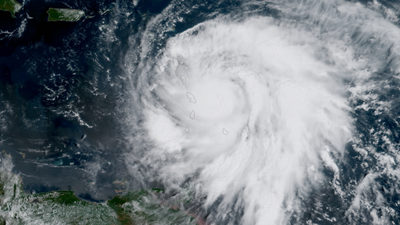
To examine the hyperactivity of the 2017 Atlantic hurricane season and explore how changes in the Earth's climate affect the severity of storms.Essential question
What might extreme storms during the 2017 hurricane season tell scientists about the role of climate change?Overview
Some notable facts about the 2017 Atlantic hurricane season:- Hurricane Harvey hit Houston, Texas with 50 inches of rain in a very short period of time.
- Hurricane Irma devastated the infrastructure in the Caribbean and Florida.
- Hurricane Maria hit Puerto Rico leaving about 60 percent of Puerto Rico without power months later.
- The 2017 hurricane season is one of the costliest on record with an estimated total of more than $367.56 billion in damages, nearly all due to Hurricanes Harvey, Irma and Maria.
- At least 198 people were killed in these three hurricanes. However, the number of deaths from Hurricane Maria is expected to rise as many deaths are believed to not have been recorded.
Warm up activity
-
Students will look at a website of the Earth that depicts wind speeds and pollution. The website 'Earth Nullschool' (
https://earth.nullschool.net/
) shows the forecast by supercomputers using an interactive animated map.
- Observe and discuss what is shown on the website, such as wind pattern, CO, CO2, and SO2.
- Based on the class discussion, students should jot down a few ideas that interested them to research in more depth. They don't need to settle on a topic just yet.
- Students should also check out the National Hurricane Center's website ( http://www.nhc.noaa.gov/ ) to check on current disturbances and the tropical weather outlook over the 5 days.
Main activity
Jigsaw and video activity:
- Divide the PBS NewsHour article, "First Harvey, now Irma. Why are so many hurricanes hitting the U.S.?" into 5 or 6 sections.
- In class, create groups of 5 or 6 students and assign each student to learn one segment. Be sure to give students only their assigned segment.
- Students should read their segment at least two times, so they understand it. Be sure to jot down a few key ideas.
- Form new groups by having one student from each jigsaw group join other students assigned to the same segment. Have students jot down one or two key points from each student's summary. Create a short list as to why so many hurricanes hit the U.S. and Caribbean in 2017.
-
Next, watch the video
"Did climate change make recent extreme storms worse?"
located at the bottom of the story, also posted below.
- Ask students to take notes on how extreme weather events (i.e. hurricanes) may be related to global warming as well as some of the challenges in contributing a specific event to global warming.
- Have students take another look at the essential question for this lesson. For the last part of the lesson, have students write down three questions they would like to ask the scientists featured in the video based on the essential question. Choose a few questions and have your class send them to the scientists (or look up climate science professors at a nearby college or university and send to them). Remind your students that curiosity and the ability to ask questions are a must for scientific inquiry!
David Jungblut taught 9th grade science at Oakcrest High School in Hamilton Township, New Jersey for 26 years before his retirement. He continues to teach classes at the community college level. Jungblut developed curricula based on a scientific investigation he conducted following Hurricane Katrina and published a book about his experiences which includes teaching activities . His main goal as a teacher which he shares with many scientists: Don't be afraid to ask questions.