Summary
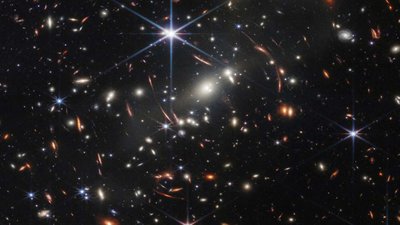
NASA shared new revelations Tuesday from the James Webb Space Telescope, the largest space observatory ever made. The new images capture distant galaxies, new stars and planets, and the furthest look into the birth of the cosmos ever recorded. For a transcript of this story, click here .Five Facts
- Who is interviewed in this piece and what is his background?
- How many feet in diameter is the James Webb Space Telescope's mirror?
- Where in the light spectrum does the James Webb Space Telescope look that the Hubble Space Telescope cannot?
- Why could identification of clouds on an exoplanet be significant?
- What is an example of a dying star that was captured by the telescope?
Focus Questions
The PBS correspondent said that seeing things that are not known in the James Webb Space Telescope is “exactly what we want to hear.” What does he mean by that? Why is it important for the scientific method to not always be able to identify everything we see? Media literacy : Why is Webb’s deputy scientist for communications shown in the video? How does she contribute to the overall idea of the Webb Space Telescope with what she says?For More
- The speed of light is 299,792,458 m/s. If the James Webb Space Telescope receives an image from a planet that is 1 million miles away (such as Earth), how long will it take to reach the telescope. Hint: 1 meter = 0.000621371 miles. The James Webb Space Telescope is fairly close to Earth and the universe is expanding. What does that tell us about the James Webb Space Telescope’s images? Why might scientists and astronomers say it is like looking into the past?
- Read this article that compares photos from the James Webb Space Telescope to the Hubble Space Telescope. Compare and contrast the photographs and their level of detail. Why might it be beneficial to have two space telescopes instead of only one?
- Look at this image gallery of the Webb Space Telescope images. What strikes you about the photographs? Can you pick out any nebulae, stars, galaxies or planets? What sections of the images do you not understand?
Ella Cohen, a rising junior at Washington-Liberty high school and intern at NewsHour Classroom, wrote today’s Daily News Lesson with editing by Vic Pasquantonio. Sign up for NewsHour Classroom’s ready-to-go Daily News Lessons delivered to your inbox each morning of the school year. Fill out this form to share your thoughts on today’s lesson.