Overview
Use this lesson to introduce students to how data and statistics can be used to spread misinformation online. Students will learn to recognize unsupported data or statistics and equip them with tools to fact-check data or statistics. Students will be able to address the following questions:
- Why is the context behind data or statistics important to know?
- What are some red flags that data shared online may be unreliable?
- How can I fact-check data that is shared online?
This lesson was developed by PBS NewsHour Student Reporting Labs in partnership with MediaWise and the Teen Fact-Checking Network, which are part of the Poynter Institute. This partnership has been made possible with support from Google.
Objectives
Students will be able to:
- Recognize data or statistics that do not have context.
- Find reliable information to verify data or statistics shared online.
- Explain why it is important to understand the context behind data or statistics shared online.
Subjects
media literacy, social studies, statisticsGrade Levels
Grades 6-12Supplemental Links
Standards
-
College, Career, and Civic Life Framework (C3)
College, Career, and Civic Life Framework (C3)
D3.1.9-12. Gather relevant information from multiple sources representing a wide range of views while using the origin, authority, structure, context, and corroborative value of the sources to guide the selection.
-
ISTE
Empowered Learner
Students leverage technology to take an active role in choosing, achieving, and demonstrating competency in their learning goals, informed by the learning sciences. (
)
Digital Citizenship
Students recognize the rights, responsibilities and opportunities of living, learning and working in an interconnected digital world, and they act and model in ways that are safe, legal and ethical. (
).
Analyze the legal and ethical responsibilities required in the arts, audio/visual technology and communications workplace.
-
CCTC
CCTC - AR 4.1 Civic and Political Institutions
In order to act responsibly and effectively, citizens must understand the important institutions of their society and the principles that these institutions are intended to reflect. That requires mastery of a body of knowledge about law, politics, and government. (NCSS D2.Civ.1.9-12 - D2.Civ.6.9-12)
Gathering and Evaluating Sources
Whether students are constructing opinions, explanation, or arguments, they will gather information from a variety of sources and evaluate the relevance of that information. (NCSS D3.1.9-12 - D3.2.9-12)
Overview
Nobel Laureate and economist Ronald Coase once wrote, "If you torture data long enough, it will confess to anything.” Statistics or data without context can often be at the root of online misinformation. This lesson will help students understand statistics and data in order to root out misinformation and without context shared online to make misinformation more credible and equip them with tools to fact-check it.
Key Vocabulary
- Data context — the set of circumstances that surrounds a collection of data.
- Reading upstream — the practice of finding the original source of a claim, so you're not basing your information on someone else's interpretation.
Materials
- Lesson summary
- Lesson slide deck
- Student handout
- Projector
- Computers and Internet Connection
ACTIVATOR
(SLIDE 1) — THINK, PAIR, SHARE (5 Minutes)
- What is the problem with comparing the 100% growth of one religion to 85% growth of another religion in this comic strip?
(SLIDE 1) Presenter Notes
- Project this image
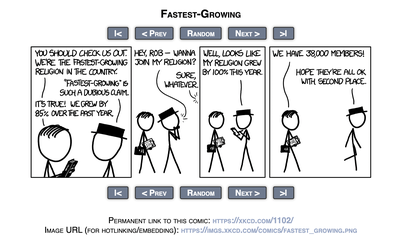
Source: https://xkcd.com/1102/
- Ask students to write down their thoughts, then discuss them with a partner (or small group). Then ask each group to share one example with the class.
(SLIDE 2) — KEY VOCABULARY (5 Minutes)
Data Context — the set of circumstances that surrounds a collection of data. What is the important context of the statistics cited in the Cartoon?
Reading Upstream — the practice of finding the original source of a claim, so you're not basing your information on someone else's interpretation.
(SLIDE 2) Presenter Notes
Preview the key vocabulary:
- Data Context — the set of circumstances that surrounds a collection of data. What is the important context of the statistics cited in the Cartoon?
- Reading Upstream — the practice of finding the original source of a claim, so you're not basing your information on someone else's interpretation.
(SLIDE 3) — HOW DOES THIS STUDENT LOAN REDUCTION STATISTIC STACK UP?
(SLIDE 3) Presenter Notes
- It may be fun to look at what things cost in 1973.
- Warren Gunnels is the Staff Director for Senator Bernie Sanders, who is chair of the Budget Committee. We’re going to fact-check his use of statistics in this post.
- Ask the students is they notice any issues without researching it first. Then ask them to research to fill out this chart on their handout with reputable sources.
Activity — Research Average Income and Cost of Items in 1973
Item 1973 2022 Source Weekly Wages Median Home Price Monthly Rent Tuition: University of California Hotdog Item of your choice:
(SLIDE 4) — MEDIAWISE FACT CHECK ABOUT THIS POST
(SLIDE 4) Presenter Notes
- Watch this video produced by the Mediawise Teen Fact-Checking team and take notes on your student handout
- What red flags signaled these statistics may be misleading?
- No sources were provided for the information
- What fact-checking techniques were used by the TFCN?
- Reading Upstream
- Read the comments
- How did their facts match your table of costs?
- Discuss
- If there are differences…why?
(Slide 5) — DISCUSSION OR EXIT OUT THE DOOR
What’s the Big Idea?
Nobel Laureate and economist Ronald Coase once wrote, "If you torture data long enough, it will confess to anything”. Explain in two-three full sentences how this quote applies to the Warren Gunnels post. Why is it important to understand the context of data?
(SLIDE 5) Presenter Notes
- Data can be twisted to support any position, even outrageous ones, especially without context.
- Unsupported data can lead to the spread of misinformation at best, and bad policy or worse.
- Data is meaningless without context.
Additional Resources
MediaWise “Is This Legit?” Series
- How To Combat Political Misinformation from PBS NewsHour Student Reporting Labs
- Fact-Checking Lesson for Student Journalists
- Misinformation Overload Interviews from PBS NewsHour Student Reporting Labs
- StoryMaker Media Literacy Learning
- Reuters Media Literacy Contest
MediaWise is a digital media literacy initiative of the Poynter Institute, a nonprofit, nonpartisan organization. Now in over 170 middle and high schools, PBS NewsHour Student Reporting Labs (SRL) is a national youth journalism program that trains teenagers across the country to produce stories that highlight the achievements and challenges today’s youth face.