Overview
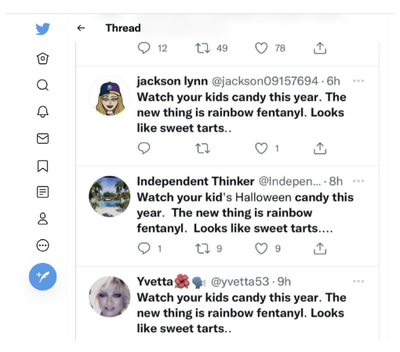
Trick or Truth: Do drug dealers target kids on Halloween? Students learn how to do an effective keyword search and find out why it’s important to be wary when social media posts evoke a strong emotion.
Objectives
Students will be able to:
- Explain what an effective long-tail keyword search includes.
- Explain why you should be wary of social media posts designed to evoke a strong emotional reaction.
Subjects
Media literacy, social studies, language arts, journalism
Estimated time
Up to 45 minutes for slide deck only, or up to 60 minutes with extensions
Downloadable lesson documents
Key vocabulary
- Long-tail keyword search – Series of words or phrases input into an Internet search engine to find information about a topic that:
- has four (4) or more words
- uses specific names or places
- targets the specific topic or claim
- aims for credible sources
Before you watch
What are some reasons people are more likely to share a social media post like this one?
While you watch
Preview the questions. Then watch the MediaWise Teen-Fact Checking Network (TFCN) video. According to the video…
- What long-tail keyword search did the MediaWise teen fact-checker use? (Circle One)
- “Halloween trick-or-treat safety”
- “Halloween candy dangers 2022”
- “Trick or treat candy”
- Why is Joel Best a credible source of information about Halloween candy?
- What information did the DEA release that contradicts the fear of fentanyl-laced candy?
After you watch
- Why do you think someone would share a post like this without evidence intentionally?
- Why do you think someone would share a post like this without evidence unintentionally?
- What are some ways to check if a source is credible? List four strategies.
Extension activity
Visit the PBS NewsHour homepage. Select a news story that interests you.
- Summarize the story in four to six complete sentences:
- Write an effective long-tail keyword search phrase using the definition above to find out more information about the topic from several other credible sources:
- List two other credible sources and one new thing you learned from each source:
- Source 1:
New information: - Source 2:
New information:
Background reading
- Fentanyl Drug Facts from the National Institute For Health
- Today’s Article: Rainbow fentanyl is the latest Halloween candy scare. Parents don’t actually need to worry.
- Is 'rainbow fentanyl' a threat to your kids this Halloween? Experts say no
- Everything You Need to Know About Long-Tail Keywords
About the next lesson
Be MediaWise Lesson 5: How to use lateral reading and click restraint to determine the credibility of a source.
Standards
Common Core ELA CC.8.5.6-8; CC.8.5.9-10.A; CC.8.5.11-12.A
Citing informational text.
College, Career, and Civic Life (C3) D3.1.6-12
Gather relevant information from multiple sources while using the origin, authority, structure, context, and corroborative value of the sources to guide the selection.
ISTE 6-12.1.4.a
Students: know and use a deliberate design process for generating ideas, testing theories, creating innovative artifacts or solving authentic problems.
Additional resources
- MediaWise “Is This Legit?” Series
- How To Combat Political Misinformation from PBS NewsHour Student Reporting Labs
- Fact-Checking Lesson for Student Journalists
- Misinformation Overload Interviews from PBS NewsHour Student Reporting Labs
- StoryMaker Media Literacy Learning
- Reuters Media Literacy Contest
- Journalism in Action , a history of journalism in the U.S., including political satire, from PBS NewsHour Classroom
These lessons were developed by PBS NewsHour Student Reporting Labs in partnership with MediaWise and the Teen Fact-Checking Network, which are part of the Poynter Institute. This partnership has been made possible with support from Google.
This lesson was published on October 27, 2022, and updated on June 3, 2026.
Sign up to receive our weekly newsletter with Daily News Lessons and community events.
To provide feedback on News Hour Classroom's resources, including this lesson, click here.