
by Agam Bhatia, 11th grade, Hopkinton High School, Hopkinton, Mass.
My experience designing my invention started in school, where my engineering teacher, Mr. Scott, gave us a project to help those who are accommodated by a wheelchair.
Whenever I come across a new project, I think about if I have any personal experience that could help me solve the problem. For this project, I took what I knew from my grandma's experience using a wheelchair. I had seen how the small size of her wheelchair's front wheels would come into harsh contact with the narrow, rigid bumps on elevator entrances. I knew this surface made the wheelchair less comfortable for grandmother. After settling on a problem, I then set my goals on a solution.
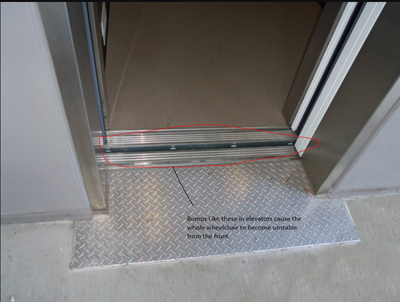
Picture of the floor of an elevator entrance with text that reads "Bumps like these in elevators cause the whole wheelchair to become unstable from the front." Photo by Agam Bhatia
My goal was to mitigate the effect of bumps on the front wheels to the actual wheelchair, so I set out in search of solutions. I first thought of replacing the front rigid wheel with a softer airless tire for minimal maintenance, but I soon realized that these tires would wear out and be hard to replace.
So, I decided to pursue my next solution, which was to redesign the entire front wheel to support a suspension system. Unlike airless wheels, if I were to make the suspension system, the springs would be easily replaceable to optimize for the user’s needs.
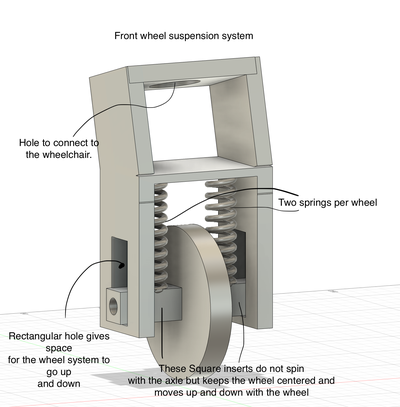
A CAD (computer-aided design) software image of Agam Bhatia's wheelchair suspension invention. The close-up image shows different elements, including: "Hole to connect to the wheelchair"; "Two springs per wheel"; "Rectangular hole gives space for the wheel system to go up and down"; and "The square inserts do not spin with the axle but keeps the wheel centered and moves up and down with the wheel." Photo by Agam Bhatia
To recreate the wheel in this way, I first looked at how front wheels currently look on a wheelchair and thought about how I would incorporate springs to the front wheels. Initially, I thought of putting the springs outside of the main frame of the front wheel. However, when I thought about my grandmother using her wheelchair in the real world, I thought that these springs would be susceptible to breaking from contact with harsh surfaces. I decided to encase the springs, which is how I was able to create my first CAD (computer-aided design) prototype of newly created front wheels.
About the author
Agam Bhatia is a junior at Hopkinton High School in Hopkinton, Mass.

Interested in designing your own invention? Take a look at teacher Doug Scott's Lesson plan: Opening more doors — Inventing ways to make schools more accessible.
Be sure to check out PBS News Hour Classroom's Invention Education collection, full of lessons and video stories featuring student inventors and their teachers. We also have an Invention Network, which brings together folks from various subjects and grade levels to discuss all things invention & innovation. Students welcome, too! Sign up here to learn more.
If you are a middle or high school student and would like to pitch a Student Voice idea to News Hour Classroom, contact vpasquantonio@newshour.org.
Sign up to receive our weekly newsletter with Daily News Lessons and community events.
To provide feedback on News Hour Classroom's resources, including this resource, click here.


