The 2025-26 Samsung Solve for Tomorrow competition held its National Finalist Pitch Event April 15 with 10 teams presenting their inventions to the judges. Check out the coverage here. The video story here is from the 2024-25 Samsung Solve for Tomorrow National Finalist Pitch Event, which was held on April 28, 2025, in Washington, D.C.
Samsung's Solve for Tomorrow is a national competition open to grades 6-12 that challenges students to create unique, STEM-based solutions for everyday problems affecting their local communities.
"In our home state of Arkansas, the lack of diagnostic clinics and just the lack of dental care there, means that the oral cancer mortality rate is higher than the national average."
During the 2024-25 National Finalist Pitch Event, PBS News Hour Classroom had the chance to observe student presentations of innovative projects ranging from weatherproof hearing aids for athletes that are hard of hearing to an app that can help identify oral cancer, making diagnoses more accessible.
We spoke with several students about the issues in their communities that influenced them to develop their projects and how they used STEM to bring their ideas to life.
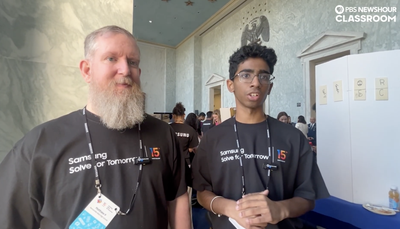
Credit: PBS News Hour Classroom screenshot of Veera Unnam and his teacher of the Bentonville West High School team.
"In our home state of Arkansas, the lack of diagnostic clinics and just the lack of dental care there, means that the oral cancer mortality rate is higher than the national average. This is because the current methods to diagnose oral cancer, biopsies and internal inspections, are incredibly expensive and intrusive. They literally cut off a part of your mouth and send that to a lab, which many people might not want to do," said Veera Unnam of the Bentonville West High School team.
"We collaborated with the University of Arkansas, the University of Peradeniya and the University of Shanghai in order to get a dataset of over 6,000 images of people's mouths with cancer, which allowed us to create our own AI model that was able to learn what a person's mouth with cancer and without cancer looked like."
According to Unnam, by providing a picture of a person's mouth and answering a few questions about risk factors, Team Bentonville West's app can provide you with a detailed diagnosis in just 15 seconds.
Danielle Yang from Bloomington High School South in Indiana spoke to us about her personal connection to her team's project and the importance of communicating with those affected during the process of developing a solution.
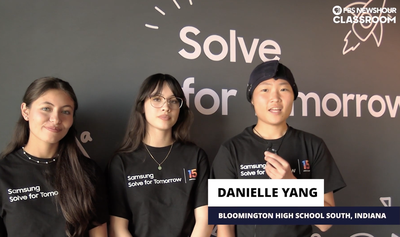
Screenshot: PBS News Hour Classroom
"I think, particularly, it's really important to reach out to the people who are affected by the problem because, personally speaking, I feel like my hearing loss is not something that I talk about a lot and it's not something that is really obvious to people who don't know me intimately but it really affects my life, it's really affected my upbringing," said Yang.
"I think, particularly, it's really important to reach out to the people who are affected by the problem..."
"I think that getting to know an issue and being able to solve it well also means really learning people's stories and learning about all those things that are not obvious to the naked eye, learning about those little things that people are too scared to talk about, they're too embarrassed to talk about. I think that's why it's really important that these stories are shared," Yang said.
Teachers and students can learn more about both last year's and this year's National Finalists, and find out how to get involved for next year's competition by visiting Samsung Solve for Tomorrow's website.


