NOTE: If you are short on time, watch the video and complete this See, Think, Wonder activity: What did you notice? What did the story make you think about? What would you want to learn more about?
SUMMARY
The first attack in the Trump administration’s campaign in the Caribbean has become the most contentious. A U.S. official tells PBS News the military struck an alleged drug boat four times on September 2. President Trump and Pete Hegseth defended the attack, but also distanced themselves from the follow-on strike that targeted people who weren’t killed by the first strike.
View the transcript of the story.
News alternative: Check out recent segments from the NewsHour, and choose the story you’re most interested in watching. You can make a Google doc copy of discussion questions that work for any of the stories here.
WARM-UP QUESTIONS
- Who is Pete Hegseth?
- Where are the boat strikes taking place?
- What are the potential legal issues involved in the Sept. 2 boat strike?
- Why is the U.S. attacking Venezuelan boats?
- How many Venezuelans have been killed in the 21 strikes the U.S. military has carried out since Sept. 2?
ESSENTIAL QUESTIONS
- Why do you think Secretary of Defense Pete Hegseth and President Donald Trump have tried to distant themselves from the second strike on Sept. 2?
- What do you think the U.S.'s policy should be as it pertains to alleged Venezuelan drug boats? What are some other ways the U.S. could curb the amount of drugs entering the U.S. from other countries?
Media literacy: In news stories, there's often a lot of information packed into a small space. At the very start of his clip, Rear Adm. James McPherson (Ret.), former U.S. Undersecretary of the Army, states, "So we will assume for our conversation that we are engaged in a legal conflict." What do you think McPherson meant by this statement? How could you find out more about the legality of the initial first strike on Sept. 2 or the subsequent 20 strikes that been conducted on Venezuelan boats?
WHAT STUDENTS CAN DO
**Learn more about the legality of the U.S. strikes on alleged Venezuelan drug boats by watching the following story:
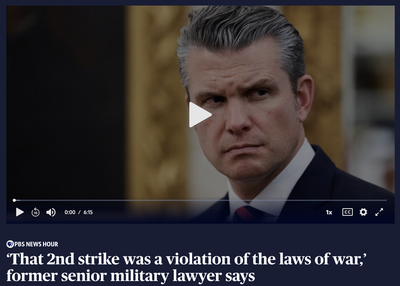
Credit: Screenshot PBS News Hour
Link: ‘That 2nd strike was a violation of the laws of war,’ former senior military lawyer says
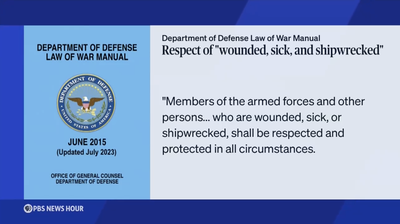
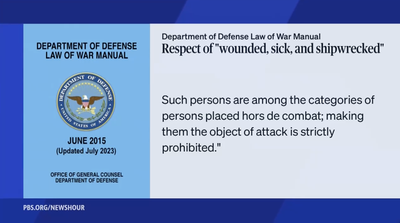
**Take another look at language from the Department of Defense Law of War Manual included in the segment:
**Next, read the Geneva Conventions and their Additional Protocols. According to the International Committee of the Red Cross (ICRC), "The 1949 Geneva Conventions and their Additional Protocols are international treaties that contain the most important rules limiting the barbarity of war. They protect people who do not take part in the fighting (civilians, medics, aid workers) and those who can no longer fight (wounded, sick and shipwrecked troops, prisoners of war)."
In a section titled, "The rules of war in a nutshell," the ICRC states, "People have always used violence to settle disputes, and all cultures through the ages have believed that there have to be limits on that violence if we are to prevent wars from descending into barbarity. For instance, there are rules protecting non-participants, prisoners and the wounded. These rules are set out in international humanitarian law. Yes, even wars have limits."
Ask students: Are you surprised to hear that there are various international laws and rules pertaining to war? Why or why not?
**You may also want to read the News Hour article All the U.S. military strikes against alleged drug boats.
Sign up to receive our weekly newsletter with Daily News Lessons and community events.
To provide feedback on News Hour Classroom's resources, including this lesson, click here.