NOTE: If you are short on time, watch the video and complete this See, Think, Wonder activity: What did you notice? What did the story make you think? What would you want to learn more about?
SUMMARY
Measles, one of the world’s most contagious diseases, was declared eliminated in the U.S. more than 25 years ago. However, measles cases have skyrocketed in the U.S. as vaccination rates continue to decline, a trend that accelerated during the pandemic. Stephanie Sy spoke with Caitlin Rivers, an epidemiologist at Johns Hopkins University, about the ramifications and reasons behind the outbreak.
View the transcript of the story.
News alternative: Check out recent segments from the News Hour, and choose the story you’re most interested in watching. You can make a Google doc copy of discussion questions that work for any of the stories here.
WARM-UP QUESTIONS
- When were the measles officially eliminated from the United States?
- Who is most vulnerable to measles?
- Where have the measles outbreaks occurred?
- How could measles be prevented?
- Why are cases of measles skyrocketing?
ESSENTIAL QUESTIONS
- What do you think state and federal government leaders in the U.S. need to do to maintain measles elimination status? How significant of a problem is it that some federal officials, including the advisory board member cited in the story, are providing information counter to medical science? What do you think the role of families and schools should be?
Media literacy: The stories opens and closes with information about the history of the U.S.'s measles elimination status. Take a look at the Reuters article European countries including UK lose measles elimination status. Why is the trend to not get vaccinated happening at a global level (note: the vast majority of people still get vaccinated and support vaccination)? How do organizations like the World Health Organization (WHO), which the U.S. recently left, help to address health challenges?
WHAT STUDENTS CAN DO
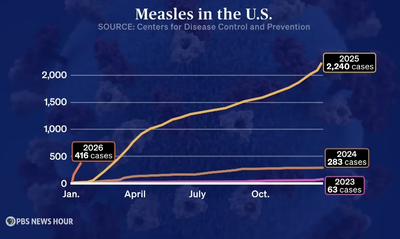
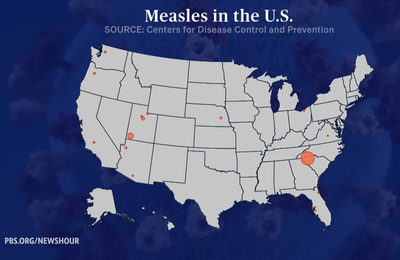
Examine the two charts below with a family member, peer or neighbor. What do you notice? If you wanted to research measles cases in your state, start with your state's department of health website. Take a look at Tennessee's site. What information is included on the page? How could you find out why certain areas have been more affected than others? What does the site say about vaccinations?
Credit: PBS News Hour screenshot
Credit: PBS News Hour screenshot
NEWS: THEN & NOW
The News: Then & Now section of the Daily News Lessons allows students to see connections between current and past news events. The activity provides historical context using primary sources from the Library of Congress.
See PBS News Hour Classroom's Journalism in Action website for interactive examples of how journalists covered key events in U.S. history while honing your primary source, civics and digital news literacy skills.
THEN
In 1955, Jonas Salk, an American medical researcher, was hailed as a hero for developing the polio vaccine. Refusing to patent his discovery, which would have made him a millionaire, Salk instead wanted to save as many lives as possible, including the millions of children who were at the highest risk of contracting polio.
See the 1955 Lincoln Times article reporting on Jonas Salk’s vaccination clinic, heralding the delivery of the “precious, lifesaving vaccine” to 1410 children as a “history-making day” below. You can learn more about the polio vaccine at our Journalism in Action interactive investigation linked here.
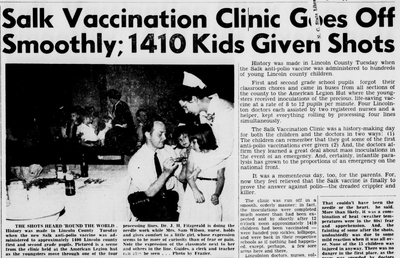
“Salk Vaccination Clinic Goes Off Smoothly; 1410 Kids Given Shots,” April 21, 1955, The Lincoln Times. Courtesy of the Library of Congress
Then, in 1963, Dr. John Enders and his colleagues at Boston Children’s Hospital developed the first measles vaccine by transforming the Edmonston-B strain of measles virus into a vaccine, which they then licensed in the United States. Later, in 1968, Dr. Maurice Hilleman, then director of vaccine research at Merck & Co., developed an improved, even weaker measles vaccine that is still in use today.
Prior to the development of the measles vaccine, nearly all children got measles by the time they were 15 years old, with an estimated 3 to 4 million people in the United States infected each year. However, after widespread use of the measles vaccine, disease rates reduced drastically, and by 2000, measles was officially declared eliminated in the United States, meaning there hadn’t been a continuous chain of transmission for over 12 months.
See below for an announcement by the Sidney Herald regarding the availability of the first vaccine, defined as “a live attenuated (weakened) virus” that could prevent measles infection if administered prior to exposure.
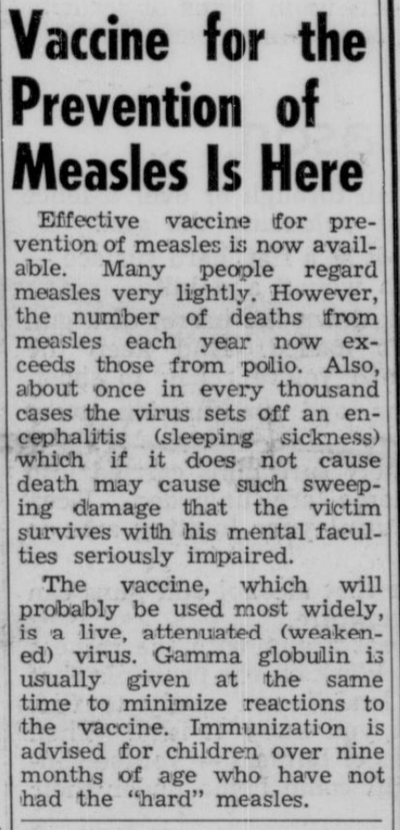
The Sidney Herald (Sidney, Mont.), October 2, 1963. Courtesy of the Library of Congress
(Linked here)
If you have more time, look at the primary artifacts collected in the National Museum of American History’s Antibody Initiative, particularly the “Polio” and “MMR” (measles) vaccines sections.
NOW
Measles, a disease declared eliminated in 2000, has been experiencing a resurgence in the United States in recent years, and the United States risks losing its measles elimination status. The measles outbreak began in West Texas, with the Centers for Disease Control and Prevention (CDC) having confirmed 2,144 measles cases, the most since 1991, across 44 states and nearly 50 separate outbreaks.
Caitlin Rivers, an epidemiologist at Johns Hopkins University, featured in the PBS News Hour segment above, finds that the people most vulnerable to measles outbreaks are those who are unvaccinated, with 94% of cases in 2025 being in unvaccinated people. She also underscores the need for greater access to health care and affordability, finding that while vaccine hesitancy has been rising and presents a legitimate concern, the groups with the lowest vaccine coverage are uninsured.
Discussion questions:
- Comparing the newspaper clippings to the PBS New Hour segment, what role does the media play in shaping the public’s understanding of and trust in vaccines, such as the measles and polio vaccines? How has that role changed or remained the same over time?
- How have public attitudes toward vaccines changed over time? What do you think are the driving factors for this change?
Sign up to receive our weekly newsletter with Daily News Lessons and community events.
To provide feedback on News Hour Classroom's resources, including this lesson, click here.