NOTE: If you are short on time, watch the video and complete this See, Think, Wonder activity: What did you notice? What did the story make you think about? What would you want to learn more about?
SUMMARY
If you’ve been following Miles O’Brien’s reports from Antarctica, you know he’s with an international group of researchers trying to measure what’s happening to the rapidly melting Thwaites Glacier. Their work has been trying to capture information in ways that have never been done before. O’Brien has an update on how all that turned out, for our Tipping Point series.
View the transcript of the story.
News alternative: Check out recent segments from the NewsHour, and choose the story you’re most interested in watching. You can make a Google doc copy of discussion questions that work for any of the stories here.
WARM-UP QUESTIONS
- Where were the scientists trying to get to with their instruments?
- Who are some of the individuals featured in this segment?
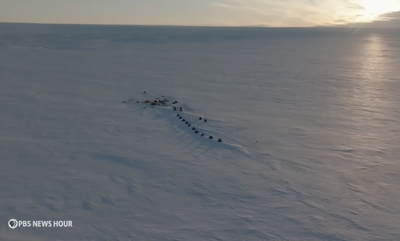
- Why did Miles O'Brien refer to this part of the Thwaites Glacier as "the perfect spot" to figure out why the ice is melting so fast? (see image below)
- What did the scientists discover when they broke through the bottom of the ice?
- How did the team deal with the obstacles they faced during the expedition, including the troubles with the mooring instruments?
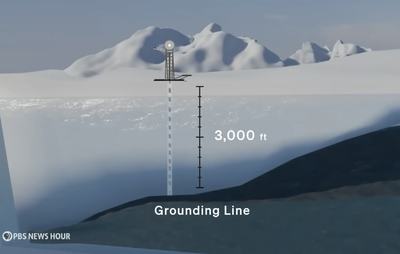
Credit: PBS News Hour screenshot
ESSENTIAL QUESTIONS
- How can you connect what is happening all the way in Antarctica to your own life?
- What did the expedition to Antarctica tell us about climate change?
- Do you think more expeditions to Antarctica to study the melting glaciers and the effects of climate change should be carried out? Why or why not?
- Why is it important to examine successes as well as failures of the expedition?
Media literacy: Take a look at the image shown at the end of the segment. Without thinking about it too much, what are your initial thoughts? Describe what you are looking at. How do you think this footage was shot and from what vantage point? This part of the video is referred to as "B-roll." B-roll is mainly used to cover the narration. How do you think this B-roll affects the essence of the story?
Credit: PBS News Hour
WHAT STUDENTS CAN DO
Join PBS News Hour's Miles O'Brien LIVE from Antarctica Tues. Feb. 10 at 12-pm ET along with our friends at PocketLab for a Zoom discussion on the expedition.
Students will:
- See how scientists study glaciers using ships, sensors and cutting-edge technology.
- Explore innovative solutions like undersea "sea curtains" to slow ice loss and protect coastlines.
- Hear glaciologists, oceanographers and engineers explain the questions driving their research.
- Learn how science and collaboration leads to real-world solutions to some of our biggest challenges.
Check out our previous video lessons on the expedition:
What researchers are learning as they drill into Antarctica's 'Doomsday Glacier'
Antarctic voyage explores why a massive glacier is melting
Shorts: 'We made it.' Ship arrives at Antarctica's 'Doomsday glacier'
Watch PBS News Hour's new program, Horizons, below with a friend, family member or neighbor. In this episode, we examine how ice in the Arctic and Antarctica plays a critical role in maintaining life on Earth, and it is melting faster than previously thought. This is threatening our planet with potentially massive sea-level rise, weather disruptions and further global warming. Horizons moderator William Brangham explores the fate of ice on Earth with science correspondent Miles O’Brien and glaciologist Erin Pettit.
Sign up to receive our weekly newsletter with Daily News Lessons and community events.
To provide feedback on News Hour Classroom's resources, including this lesson, click here.