Originally published June 25, 2025 and updated March 28, 2026:UPDATE:
The above video is from the June 25th No Kings protest!!
Keep reading for updates on the latest No Kings rally:
- The first 'No Kings' protest was held in towns and cities across the country on June 14, 2025; this is the focus of the lesson below.
- The second 'No Kings' protest took place on Oct. 18, 2025, which reportedly drew more than the 5 million protesters who took part in the June protest.
- On March 28, 2026, a third 'No Kings' protest took place across the U.S., this time with a focus on immigration enforcement and the war on Iran. Read the article 'No Kings' rallies draw crowds across U.S. and Europe as Springsteen headlines Minnesota demonstration about Saturday's protest, published on March 28, 2026.
- A special News: Then & Now activity has been added to the lesson (scroll to end) to help students better understand how the right to protest has been part of U.S. history since the founding of the republic.
SUMMARY
On June 14, 2025, protesters held rallies across the country opposing Trump’s agenda on the day of the president’s military parade. They cap a week of demonstrations against immigration raids that began in Los Angeles and spread nationwide. Saturday’s ‘No Kings’ protests were organized by a coalition of groups. John Yang speaks with Lisa Gilbert, the co-president of one of them, Public Citizen.
View the transcript of the story.
NOTE: If you are short on time, watch the video and complete this See, Think, Wonder activity: What did you notice? What did the story make you think about? What would you want to learn more about?
News alternative: Check out recent segments from the NewsHour, and choose the story you’re most interested in watching. You can make a Google doc copy of discussion questions that work for any of the stories here.
WARM-UP QUESTIONS
- Why did millions of people participate in the 'No Kings' protests across the country?
- What does the phrase 'No Kings' mean in the context of these demonstrations?
- Which city did not hold a 'No Kings' protest and why?
- How did protestors express their concerns, and what issues were they protesting?
- Who organized or led the protests, and what were they hoping to achieve?
ESSENTIAL QUESTIONS
- Do you think public protests are an effective way to bring attention to political concerns? Why or why not?
- Why might some people feel that presidential power has gone too far? Do you think it’s important to question government leaders? Explain your response.
Media literacy: What words or images in this story helped shape your opinion about the protests? How might the story feel different if it included voices from people who disagreed with the protest?
WHAT STUDENTS CAN DO
Watch the video below to learn more about Trump's military parade and how it compares to military parades of the past.
- What message do you think a military parade like this sends to other countries and to people in the U.S.?
- Do you think it's appropriate to display military strength through public events like parades? Why or why not?
NEWS: THEN & NOW
The News: Then & Now section of the Daily News Lessons allows students to see connections between current and past news events. The activity provides historical context using primary sources from the Library of Congress.
See PBS News Hour Classroom's Journalism in Action website for interactive examples of how journalists covered key events in U.S. history while honing your primary source, civics and digital news literacy skills.
THEN
The right to assemble and express one's view guaranteed under the First Amendment of the Constitution remains a critical part of United States history and identity. Read the 1961 article "SANE Marchers to Parade Through Town on Saturday," from the East Hartford Gazaette about a group of Connecticut residents protesting in favor of nuclear disarmament (reduction or withdrawal of military weapons).
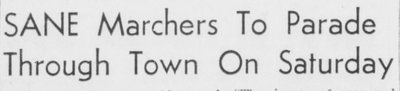
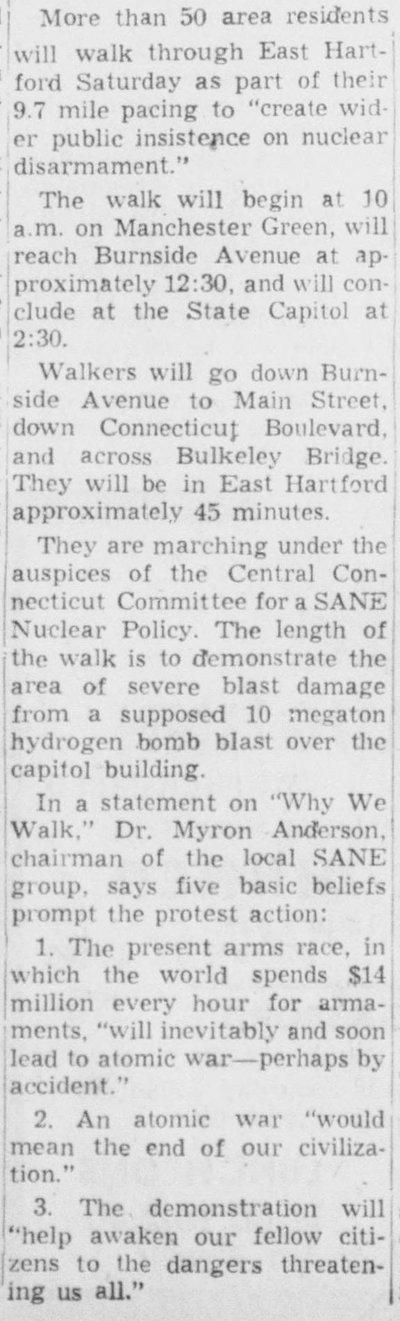
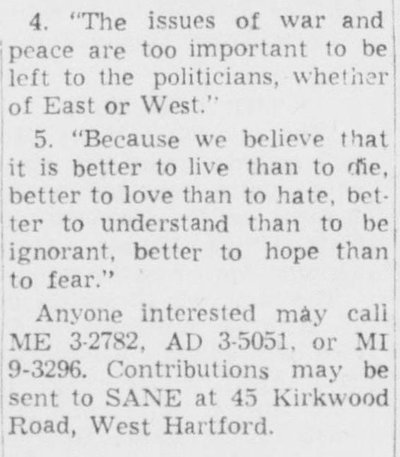
"SANE Marchers to parade through town on Saturday." The East Hartford Gazette. (New Britain, CT), Mar. 30 1961. https://www.loc.gov/item/sn85009852/1961-03-30/ed-1/.
NOW
Since the start of the U.S.-Israel war on Iran on Feb. 28, 2026, the topic of nuclear weapons has been making headline news, raising concerns and fears on the part of people throughout the globe.
In recent weeks, several teachers have shared with the News Hour Classroom team that their students are asking them questions about the possibility of a military draft, a question they have not had to address in their careers. Many of the protestors at the No Kings demonstrations on March 28, 2026, held signs in opposition to the Iran War, which remains unpopular among the majority of Americans.
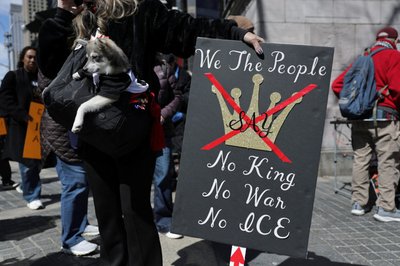
A demonstrator holds a placard as people gather for "No Kings" protest against U.S. President Donald Trump's administration policies, in New York City, New York, U.S., March 28, 2026. REUTERS/Jeenah Moon
Discussion questions:
- Is nuclear war or a military draft something you have ever thought about? Have you ever been given an opportunity to talk about your feelings around these issues at school or at home, or would you prefer not to?
- Dr. Myron Anderson of SANE issued a statement containing five points explaining "Why We Walk." Which points, if any, resonates with you the most and why?
- Do you think world leaders should once again focus on the discussion of nuclear disarmament (nuclear weapon manufacturing fell from 60-70,000 weapons to about 12,000 after the Cold War ended in 1991)? Explain.
Additional resources
- Nuclear Disarmament, Arms Control, and Deterrence — PBS KQED Above the Noise
- The Nuclear World — CFR Education
- Physicists predict a nuclear arms race, 1945 — Gilder Lehrman Institute of American History
Written by Gianfranco Beran, PBS News Hour Classroom's production assistant, and News Hour's Vic Pasquantonio.
Fill out this form to share your thoughts on Classroom’s resources.