SUMMARY
The incoming prime minister of Hungary struck a hopeful tone on Monday. Peter Magyar called for a swift transition of power and began to chart an ambitious course to reverse central pillars of Viktor Orbán’s rule. Stephanie Sy discussed how the results could reverberate around the globe with Kim Lane Scheppele, a professor at Princeton University who lived and worked in Hungary.
View the transcript of the story.
NOTE: If you are short on time, watch the video and complete this See, Think, Wonder activity: What did you notice? What did the story make you think about? What would you want to learn more about?
Timestamp: Watch from the START of the video above to 4m:15s for a summary of the election. The remainder of the segment explores the impact of this election on global politics.
News alternative: Check out recent segments from the News Hour, and choose the story you’re most interested in watching. You can make a Google doc copy of discussion questions that work for any of the stories here.
WARM-UP QUESTIONS
- When did Viktor Orbán first come to power in Hungary?
- Who is Peter Magyar, and what is his background?
- How will Magyar seek to redirect the future of Hungary? What changes has he promised to make?
- What are some of the actions Orbán took to increase his power and control over Hungary?
- Why might the Hungarian election impact the global political right, according to this segment?
ESSENTIAL QUESTIONS
- In this segment, professor Kim Lane Scheppele says, "I think the Trump administration has lost a friend and an ally." What evidence does she use to explain how Orbán was a key ally of President Trump's? Why do you think this alliance might have been important to Trump?
- How do you think Orbán's loss might impact U.S. relations with Europe in the future?
Media literacy: What else would you like to know about the connections between European political movements and the Trump administration? How could you find out more?
WHAT STUDENTS CAN DO
This segment suggests that Hungary became less democratic and less free during the leadership of Viktor Orbán. But what does it mean to be less democratic or free? Explore some of the places in the world that have shown democratic backsliding and discuss what links them. (Teachers, this activity is adapted from a Classroom lesson on Viktor Orbán.)
- Follow this link to Freedom House's complete list of countries, along with their "global freedom score."
- Choose any country you want that is described as "partly free" and do 5-10 minutes of internet research about that nation. Then answer the following questions:
- Who is the current president/prime minister/leader of your country? How long have they been in power?
- Why is this country in Freedom House's in-between category of "partly free"? Has it gotten more democratic (i.e. a dictatorship that has become a more stable democracy) or less democratic (i.e. a strong democracy that has become unstable) over time?
- Do a quick search for news stories about this nation and its democracy. Do you expect it to get more or less democratic over time?
- As a class, discuss — what are some common features of countries described as "partly free"?
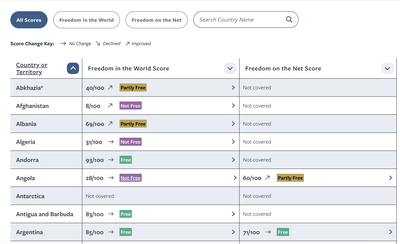
Source: https://freedomhouse.org/countries/freedom-world/scores
Sign up to receive our weekly newsletter with Daily News Lessons and community events.
To provide feedback on News Hour Classroom's resources, including this lesson, click here.