Editor's note: This segment aired July 18, 2019, and the majority of the lesson focuses on this past story when Dr. Lonnie Bunch III became head of the Smithsonian. However, we decided to create a Daily News Lesson now, given a 2026 White House report that criticized Smithsonian leadership as being too radical. See Bunch's response:
According to NPR, July 9, 2026:
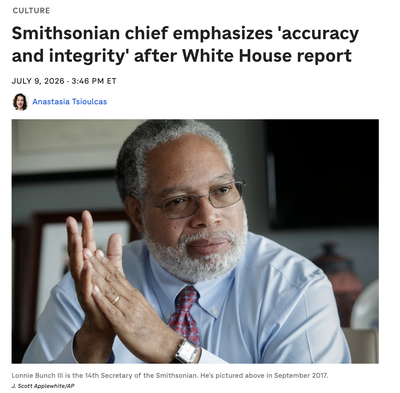
Courtesy: NPR News
"In a memo addressed to staffers sent Tuesday [July 7], the secretary of the Smithsonian, Lonnie G. Bunch III, defended the institution after the White House issued a 162-page report that characterizes the National Museum of American History as a place which has become 'subject to institutional capture by a radical, activist ideology that is fundamentally opposed to telling the noble, honest story of the great country we know and love.'
In his email, which NPR has obtained, Bunch wrote in part: 'While there will always be room for improvement, this report is not a fair characterization of the work and totality of the National Museum of American History. At the Smithsonian, our work is driven by scholarship, accuracy and an uncompromising commitment to tell the fullness of America's story. As public servants and the keepers of this institution, we are charged with helping a nation find understanding, hope and clarity and as part of that duty, we are dedicated to excellence, reflection and growth.'"
The rest of the lesson focuses on what the Smithsonian brings to Americans wanting to know about the country's past and Lonnie Bunch's new position as its head.
SUMMARY
(From 2019) Lonnie Bunch, founding director of the National Museum of African American History and Culture, has just become the 14th head of the Smithsonian Institution -- and its first black leader. He sits down with Judy Woodruff to discuss the challenges facing the world’s largest museum and research complex and why the Smithsonian is as much about today and tomorrow as it is about the past.
View the transcript of the story.
NOTE: If you are short on time, watch the video and complete this See, Think, Wonder activity: What did you notice? What did the story make you think about? What would you want to learn more about?
News alternative: Check our recent segments from the News Hour, and choose the story you’re most interested in watching. You can make a Google doc copy of discussion questions that work for any of the stories here.
WARM-UP QUESTIONS
- Who is Lonnie Bunch? What is his new position?
- What unique perspective does Bunch bring from his previous career experience?
- How does Bunch describe the mission of the Smithsonian as an institution?
- How many museums, centers and libraries are a part of the Smithsonian collection?
- What direction does Bunch envision the Smithsonian moving towards in the future regarding technology?
ESSENTIAL QUESTIONS
- What memory does Bunch recall as being foundational in his understanding of history and himself? How important is it that these experiences are discussed in context with American history?
- What importance does Bunch place on connecting history and our ancient past to problem-solving for the future? How does he propose engaging students and future generations?
Media literacy: This interview with Bunch allowed him to discuss his professional ambitions as well as his personal experiences. What does this add to the reporting of his historic appointment? What stands out from the way Bunch discusses history and how it’s informed his own life?
WHAT STUDENTS CAN DO
Explore the Smithsonian homepage and its various collections. Look at their ‘What interests you?’ section for more specific pages. Students should explore one in further detail and then discuss a key topic or article they viewed. Some guiding questions can be:
- What drew you to your specific article or page? Did you learn anything new or expand on what you already were interested in?
- Consider Bunch’s goal to lean more towards virtual learning and resources. Based on what you viewed and were able to learn, is his goal reasonable? How important is it to engage learners who may be located far away from the museums?
ADDITIONAL RESOURCES
As pointed out in the Editor's note above, there's been a lot of attention on the Smithsonian recently, with the federal government investigating the President's claims that the museums present a radical view of American history. The Smithsonian's response has been to emphasize the wide range of perspectives that make up American history. Read more below:
White House report brands Smithsonian leadership as radical activists who can't be trusted
Written by Alyssa Tinoco, News Hour Classroom intern, and PBS News Hour's Vic Pasquantonio
Sign up to receive our weekly newsletter with Daily News Lessons and community events.
To provide feedback on News Hour Classroom's resources, including this lesson, click here.