SUMMARY
Meta, the company behind Facebook and Instagram, has released a free artificial intelligence tool. The release was accompanied by a 14-page essay from CEO Mark Zuckerberg championing his view of how AI could transform our world and what protections are required. William Brangham discussed more with Mike Isaac of The New York Times.
View the transcript of the story.
NOTE: If you are short on time, watch the video and complete this See, Think, Wonder activity: What did you notice? What did the story make you think about? What would you want to learn more about?
News alternative: Check our recent segments from the News Hour, and choose the story you’re most interested in watching. You can make a Google doc copy of discussion questions that work for any of the stories here.
WARM-UP QUESTIONS
- Who is Mark Zuckerberg, and what is his background?
- What is the difference between open-source and closed-source software?
- Why do OpenAI and Anthropic, among others, argue for closed-source AI models? Why does Zuckerberg argue for open-source AI models?
- How can open-source AI models appear more safe according to guest Mike Isaac? How might closed-source AI models be more safe?
- Where have AI models been developed outside the U.S. that are cheap, effective and apparently open-source?
ESSENTIAL QUESTIONS
- After listening to this segment, do you think open- or closed-source AI models are safer? Why do you think so?
- What steps do you think are most important for the federal government can take to avoid dangers from AI, including software that threatens security and personal privacy? What steps should private companies like Anthropic or Meta take? Do you think local governments have a role to play?
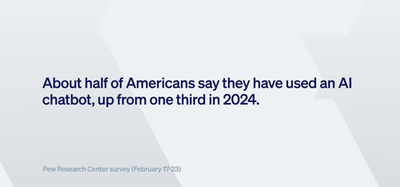
Media literacy: Examine the infographic below. Does the number of Americans who say they have used AI in the last year surprise you? How might you expect it to be different?
WHAT STUDENTS CAN DO
Are you and your peers more or less likely to use AI than the average American?
- First, answer the question in the infographic above — have you used an AI chatbot before?
- Next, count up the results in the class and determine the percent of the class that has used chatbots versus those who have not. Is the number higher or lower than the respondents to the Pew Research Survey from the infographic?
- As a class, discuss — why do you think the number is either higher or lower? Do you expect the fraction of the class that has used a chatbot will change significantly in the coming year?
- If there is time, students can also survey their parents (or at least guess whether they have used a chatbot or not). How does the fraction of parents that have used a chatbot compare to the number of students that have used a chatbot? What do you think explains the difference?
Sign up to receive our weekly newsletter with Daily News Lessons and community events.
To provide feedback on News Hour Classroom's resources, including this lesson, click here.