For a google doc version of this lesson, click here.
About PBS News Hour Classroom’s series with In Pursuit: Presidential leadership and civic virtue — what we can learn today from leadership of past presidents and first ladies
What if the civic virtues of past U.S. leaders held the key to shaping the next 250 years of American democracy?
This is the first of a series of 10 lessons that draws from More Perfect's In Pursuit initiative, featuring a series of essays by leading public figures today about what past U.S. presidents and first ladies can teach us about the first 250 years of the nation’s history — and how they can inspire us going forward.
Each lesson will guide students through a dialogue on individual civic virtues embodied by past leaders. At the end, students will have an opportunity to identify that virtue in their own lives through a short civic project. Student reflections can be sent to News Hour Classroom for possible publication!
These lessons are appropriate for civics, English, history, economics and media classrooms and can be used well beyond the 250th anniversary of the signing of the Declaration of Independence.
Overview
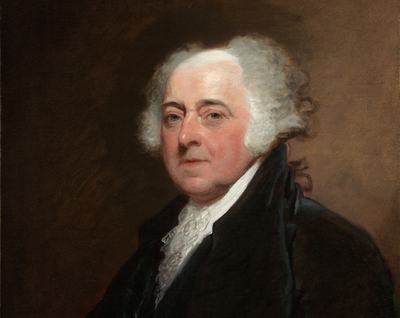
In this lesson, students will reflect on respect as a leadership trait as demonstrated by President John Adams. Students will first read excerpts from political scientist Danielle Allen’s In Pursuit essay “Great leaders succeed by choosing who else leads” and discuss ways respectful collaboration is an important civic virtue. Students will then watch a News Hour segment featuring Allen’s vision for democracy in a nation that continues to be a work in progress.
Estimated time: 50 minutes, plus extension activities
Subjects: Civics, history, English. media literacy
Warm-up activity (5 minutes)
Begin by reflecting on the following questions through a brief class discussion.
“How is respect an important civic virtue in a leader? How does demonstrating respect help people collaborate on achieving important goals?”
Main activity (45 minutes)
Part 1 (15 minutes)
Read the following excerpts from Danielle Allen’s In Pursuit Essay on John Adams and respectful collaboration. (Some classrooms may want to read the whole essay in class or as homework. If so, see additional questions under “extension activities”). After everyone has had time to read each excerpt, discuss the questions below the excerpts as a class or in small groups.
Excerpt 1
Adams arguably made his greatest impact through his choices of whom to place in positions of leadership and influence. In his years as a young lawyer in Boston, Adams developed the practice of writing down character studies of people he encountered. Independent-minded and cantankerous, he was nonetheless an exemplary judge of character and unafraid to delegate to those he deemed worthy. Beginning with the very creation of the new nation, Adams’ most significant achievements came from empowering others.
Excerpt 2:
In June 1776, Congress decided to set up a committee to draft the [Declaration of Independence’s] preamble. Many people would have jumped at the chance to articulate the principles that would define the American experiment. Instead, Adams ensured that Thomas Jefferson would be appointed head of the five-person drafting committee. Why? It’s true Adams was one of the busiest members of Congress, ultimately serving on ninety different committees. His real reasons, though, went beyond workload. As Adams claimed to have put it in a conversation with Jefferson: "Reason 1st. You are a Virginian and a Virginian ought to appear at the head of this business. Reason 2nd. I am obnoxious, suspected and unpopular; you are very much otherwise. Reason 3rd. You can write ten times better than I can."
Class discussion questions
- What approach did Adams take to understand his colleagues and their unique strengths?
- How was respect for his colleagues an important part of Adams’ approach to leadership?
Note: To help students understand what is meant by the civic virtue of “respect,” teachers may want to write on the board or project this definition from the Bill of Rights Institute: “Respect: Regard for and defending the equal rights and inherent dignity of all human beings, including oneself.”
Part 2 (15 minutes)
After finishing the In Pursuit essay activity, students should watch the following News Hour segment on Allen’s push for an On Common Purpose plan. If time is short, focus on the portion of the segment that runs from 3:32-7:49.
- As students watch, they should jot down answers to the following questions. These questions are intended to help students focus on key aspects of the segment.
- Who is Danielle Allen, and what is her background?
- What are some of the “red alerts” Allen noticed about civic life in the U.S.?
- Why was bipartisan action difficult to push through, according to Allen?
- How can civic life in the U.S. be more productive and solve common problems, according to Allen?
- What is the Institute of American Civics, and how does it seek to build mutual respect between people with different ideas about the best direction of the country?
- Briefly discuss as a class: How would Allen’s ideas promote better collaboration between people with different goals and ideas about the future of the country?
Part 3 (15 minutes)
Students should now respond to one of the two prompts below by writing a short response. If there is time left at the end of class, students can share their responses.
In 100 words or fewer, respond to one of the following prompts.
- Can you think of a leader in your community who leads through respect and collaboration? It could be someone at your school, or a relative, a neighbor or someone you know through local media. What is at least one example of how they lead by respecting colleagues, or even those with opposing views?
- How could life in your own community be made better through mutual respect and collaboration?
- Do you think changes in the structure of the government and election system will help create more respect between people? If so, what do you think would be the most important change to foster such respect?
These responses can be shared in class, expanded as an assignment or submitted for a chance to be published on News Hour Classroom (see extension activities below for more).
Extension activities
- Get published on News Hour Classroom! Send us your responses to Part 3 of this lesson for inclusion in the Student Voices section of our website. You may also submit a 90-second or shorter video diary for inclusion. For more information on submitting your work, see this student callout! All submissions should be sent via this form.
- Teachers may want to assign a longer essay to allow students to more fully develop their ideas from Part 3 of this lesson.
- Additional questions for those who choose to read the full In Pursuit essay:
- How did Adams balance trusting his own judgment and showing respect for the talents of those around him? What are some examples of trusting himself and trusting others presented in the essay?
- Is there evidence that Adams demonstrates equal respect to all fellow citizens? If so, what is that evidence?
- In Pursuit also features this essay by historian Joseph Ellis on First Lady Abigail Adams, John Adams’ wife. Students can read the essay and also address these additional questions in class or as an assignment.
- How did Abigail Adams challenge John Adams to expand his ideas of who deserves respect and how that respect could be demonstrated?
- How did Abigail and John Adams manage to collaborate on a vision of the future of the U.S. despite their differences of opinion?
Sign up to receive our weekly newsletter with Daily News Lessons and community events.
To provide feedback on News Hour Classroom's resources, including this lesson, click here.