Click here to access the Google doc version, which contain comic panels needs to complete the assignment. You will be prompted to make a copy first.
INTRODUCTION
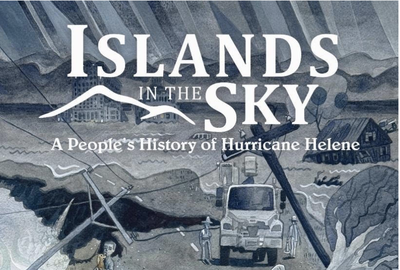
Cover of "Islands In The Sky A Peoples History Of Hurricane Helene." 2026. Credit: Comix Zone
In 2024, Hurricane Helene struck the Southeast United States, causing massive devastation and loss of life. This destruction impacted North Carolina particularly hard, but it did not destroy the sense of community and humanity in the area.
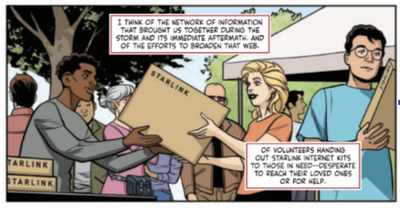
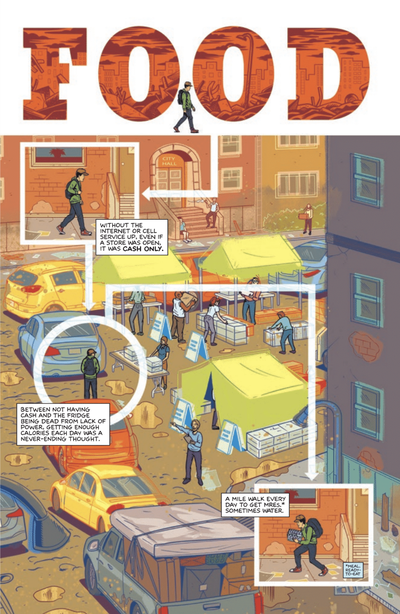
Andrew Aydin, co-author of the powerful March graphic novel trilogy based on the life and legacy of Congressman John Lewis, created a comic, "Islands in the Sky," to tell 11 accounts of the people impacted by Hurricane Helene. These first-hand narratives will emotionally involve students as they see not only the impact of climate change and the storm, but will also be inspired by how the community came together to help one another.
MATERIALS
"Islands in the Sky" published by Appalachia Comic Project
ESSENTIAL QUESTION
How did Hurricane Helene impact the Southeast United States?
ESTIMATED TIME
Two 50-minute classes
GRADES
6-12
WARM-UP ACTIVITY
Have students answer the following questions in pairs:
- What is climate change and what impact has it had on the world and you?
- What, if any, plans do you and your family have to prepare for weather events?
- What are some major weather related events you have experienced or learned about?
Watch the following video and write down 3 things that stuck out to you and two questions you have. Then discuss as a class.
MAIN ACTIVITY
Teachers should split the class into 11 expert groups and assign one of the comic excerpts from the following Google doc. Once the groups have had time to analyze and answer the accompanying questions, they will then share with students from other groups. Each expert group should then take time to jot down notes on the excerpt assigned in order to then present to the rest of the class. Once groups have finished preparing, they will share whole group on what they have learned and the impact that comic books have on audiences. Below is a breakdown of what students should do in small groups:
Step 1 — Analyze your assigned story excerpt, discuss, then answer the following questions. When done, turn and talk with other small groups on what you have read and learned.
Step 2 — Once small group discussion has ended, have students discuss the impact of putting these stories together in comic book form with the whole class.
EXTENSION ACTIVITIES
Using these comics as inspiration, students can then research and create their own primary source comics - either as a page or an entire comic book. The stories should be based on a local event of historical importance - it does not have to be a weather related event. Students can interview others who have first-hand knowledge of the event and tell their story as a comic. The comics can be hand-drawn. The story can also be reenacted by taking pictures, uploading them to PowerPoint and inserting thought or dialogue balloons on the images to help tell the story.
STANDARDS
C3 framwork:
D2.Civ.14.6-8. Compare historical and contemporary means of changing societies, and promoting the common good.
D2.Geo.8.6-8. Analyze how relationships between humans and environments extend or contract spatial patterns of settlement and movement.
D2.His.3.6-8. Use questions generated about individuals and groups to analyze why they, and the developments they shaped, are seen as historically significant.
ABOUT THE LESSON AUTHOR:
Tim Smyth is the Eisner nominated author of Teaching with Comics and Graphic Novels and high school social studies teacher, MS Reading Specialist, who travels the country giving professional development to educators on the power of teaching with comics. He shares many resources on his website, Teachingwithcomics.com.