 |
|
 |
 |
| GOVERNOR MARC RACICOT | |
 December 4 , 2000  |
|
|
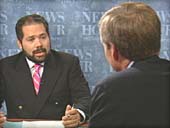
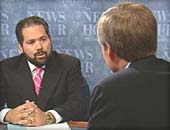
Montana Governor Marc Racicot offers his analysis of today's court rulings.
|


|
RAY SUAREZ: Joining us is Montana Governor Marc Racicot. Governor, welcome back to the program. GOV. MARC RACICOT: Thank you kindly. |
||||||||||||||||||||||||||||
| Still a political question? | |||||||||||||||||||||||||||||
|
GOV. MARC RACICOT: Well, I think it's inextricably interwoven, the two questions, that is. There's no question that you have a legal proceeding that has a profound political impact upon the country. So I think that it probably involves both of those dynamics engaged in this decision. RAY SUAREZ: Are those two clocks calibrated in slightly different ways? Are there political calculations made in the Bush camp that run independently of what the courts did today and may do tomorrow? GOV. MARC RACICOT: Well, I don't think you can run independently of what is going on in the judicial arena. This is just simply capable of disposing of all of the issues at any given moment in time. So, clearly you have to be involved with both. It's a very difficult challenge because on the one hand you're trying to make certain that you don't move too quickly. On the other hand you have to be prepared in the event that you are going to be called upon presumptively to lead. It's a bit of a difficult challenge.
GOV. MARC RACICOT: Well, I would have a very strong disagreement with how it's been described here this evening. It's just not that simple in terms of its distillation to say that somehow the Florida or the United States Supreme Court punted or it didn't make a decision today. The fact of the matter is by granting review in the first place, by having a speeded-up schedule, a hearing almost instantly and then almost instantly thereafter a ruling unanimously vacating the Florida judgment, sending, I think, a warning shot over the bow to the Florida court that if you were dealing with these issues namely whether or not the Article II considerations for the state legislature were in any way invaded or you violated the federal law by creating new standards after the ball game was complete, then you have to know that this case is coming back in this direction. That's a very, very substantial ruling. And the ruling before the circuit court in Florida today in Tallahassee is incredibly substantial because now all of the burdens of proof are assigned to the Gore team and they have a very, very large burden of proof to overcome at this moment in time. RAY SUAREZ: Let's take those cases one at a time. The Gore legal team and many of the Vice President's political supporters are saying, now it's just in the lap of the Supreme Court to explain their justification for their original ruling, this isn't time to set off the alarm bells. They'll explain what they did, and this court is loath to overturn a state court. But you don't see it that way?
|
 |
||||||||||||||||||||||||||||
| Countdown to closure | |||||||||||||||||||||||||||||
|
RAY SUAREZ: So do you agree with Congressman Nadler that this is just a question of maybe a week outside before it's wrapped up?
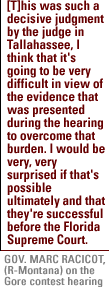
RAY SUAREZ: You're saying that by going up to the court of appeals, this isn't just a question of rearguing at a higher level the case that we've already seen presented? They have to, in your view, show that the lower trial court was... had abused the law, had not listened to the evidence? GOV. MARC RACICOT: I think you're absolutely right. I would probably phrase it in slightly different terms but I think you're essentially right. The bottom line is the rules that apply virtually every appellate court in this land are that you have to establish that the lower court erred in substantial fashion and by abusing discretion or not properly applying standards. And this was such a decisive judgment by the judge in Tallahassee, I think that it's going to be very difficult in view of the evidence that was presented during the hearing to overcome that burden. I would be very, very surprised if that's possible ultimately and that they're successful before the Florida Supreme Court. RAY SUAREZ: So what's the political prescription at this point -- wait and just let things run their course?
RAY SUAREZ: Governor Racicot, thanks for coming by. GOV. MARC RACICOT: Thank you. |
 |
||||||||||||||||||||||||||||
|
|
|||||||||||||||||||||||||||||
|
|
|||||||||||||||||||||||||||||



 RAY
SUAREZ: We just heard Representative Nadler say this isn't a political
question anymore. It's moving in its stately pace through the courts
and you just have to wait. Is this a political question?
RAY
SUAREZ: We just heard Representative Nadler say this isn't a political
question anymore. It's moving in its stately pace through the courts
and you just have to wait. Is this a political question? 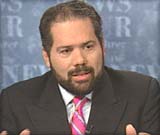 RAY
SUAREZ: Well, along with being a governor you're a former attorney general.
Would you caution patience on your own side of the net because this
is now going back to the Florida Supreme Court, because the Supreme
Court has to now reconsider what's been kicked back by the U.S. Supreme
Court?
RAY
SUAREZ: Well, along with being a governor you're a former attorney general.
Would you caution patience on your own side of the net because this
is now going back to the Florida Supreme Court, because the Supreme
Court has to now reconsider what's been kicked back by the U.S. Supreme
Court?  GOV.
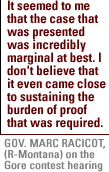
MARC RACICOT: I don't. I watched of course the presentation of the evidence
as all of America did. It seemed to me that the case that was presented
was incredibly marginal at best. I don't believe that it even came close
to sustaining the burden of proof that was required. The judge enunciated
the burden of proof and it's a fairly substantial burden. Now you not
only have to establish that burden but you have to convince the court
that this judge abused his discretion, in essence, and I just don't
think that the Florida court will move in that direction even though
they've been aggressive with other cases that have been before them.
GOV.
MARC RACICOT: I don't. I watched of course the presentation of the evidence
as all of America did. It seemed to me that the case that was presented
was incredibly marginal at best. I don't believe that it even came close
to sustaining the burden of proof that was required. The judge enunciated
the burden of proof and it's a fairly substantial burden. Now you not
only have to establish that burden but you have to convince the court
that this judge abused his discretion, in essence, and I just don't
think that the Florida court will move in that direction even though
they've been aggressive with other cases that have been before them.
 GOV.
MARC RACICOT: I think it's highly possible. I think the walls are closing
in here rather rapidly. I think it's highly possible if the Florida
Supreme Court does not want to engage in a process that calls for an
absolute reversal of their judgment under any circumstances by the United
States Supreme Court, because I don't know quite frankly how they can
invent something that doesn't in some way invade the province of Article
II or the federal statute that's applicable. And the ruling of Judge
Sauls, his appeal to the Supreme Court, and they do not see that there's
a clear evidence for reversal, you could end up with an intersection
of these dynamics before the end of the week, and that could be incredibly
important to the finality being brought to this particular process.
GOV.
MARC RACICOT: I think it's highly possible. I think the walls are closing
in here rather rapidly. I think it's highly possible if the Florida
Supreme Court does not want to engage in a process that calls for an
absolute reversal of their judgment under any circumstances by the United
States Supreme Court, because I don't know quite frankly how they can
invent something that doesn't in some way invade the province of Article
II or the federal statute that's applicable. And the ruling of Judge
Sauls, his appeal to the Supreme Court, and they do not see that there's
a clear evidence for reversal, you could end up with an intersection
of these dynamics before the end of the week, and that could be incredibly
important to the finality being brought to this particular process.
 GOV.
MARC RACICOT: Well, I think you are confined by those dynamics unfortunately
I think in this respects because it does leave the country somewhat
vulnerable to the possibility of not having enough time to prepare,
but that is the process. And the wonderful thing about this nation is
that it's large enough and flexible enough to be able to deal with these
principles in a thoughtful, civil way. And I suspect that's not true
all around the planet. So America is big enough to handle this. This
is the way it's being handled and I think in as constructive a way as
possible.
GOV.
MARC RACICOT: Well, I think you are confined by those dynamics unfortunately
I think in this respects because it does leave the country somewhat
vulnerable to the possibility of not having enough time to prepare,
but that is the process. And the wonderful thing about this nation is
that it's large enough and flexible enough to be able to deal with these
principles in a thoughtful, civil way. And I suspect that's not true
all around the planet. So America is big enough to handle this. This
is the way it's being handled and I think in as constructive a way as
possible.