 |
|
 |
 |
| END OF THE TRAIL | |
 March 9, 2000  |
|
|
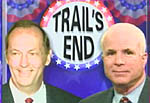
Arizona Sen. John McCain suspended his presidential campaign today, after Texas Gov. George Bush racked up impressive wins on Super Tuesday. Weekly Standard senior editor David Brooks and Boston Globe columnist Tom Oliphant assess McCain's decision.
|


|
JIM LEHRER: And again to David Brooks and Tom Oliphant. Tom, how would
you characterize the going of John McCain? 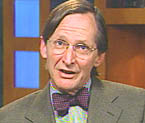
TOM OLIPHANT: Jim, I was thinking throughout that statement how much it reminded me about what it was like being around Ronald Reagan 24 years ago when he had so much difficulty coming to terms with his defeat by President Gerry Ford in a similar kind of campaign. McCain, as usual, was direct and concise but I thought cold as ice. |
||||||||||
| McCain left his options open | |||||||||||
|
JIM LEHRER: Cold as ice, David? DAVID BROOKS: Hmmm -- I thought there was a little more passion there.
I agree with the '76 parallel -- you know, when John McCain's hero,
Teddy Roosevelt left the Republican Party in 1912, he said 'We stand
in Armageddon in battle for the Lord.' I half expected something that
traumatic. Rally round the camera crews…boys, the straight talk
JIM LEHRER: Yeah, go ahead. TOM OLIPHANT: I would go even further. This statement was sprinkled with political phrases that just invite examination. For example, when you think you respect the results, you are making it very clear you're not ready to say you respect your opponent. When you say you wish him well, as McCain said, you are making very clear you're withholding your support for the moment. And when you say, he may very well win in November, what you're really saying for the moment is lots of luck. JIM LEHRER: What about when he says, 'I have never walked away from a fight' or something to that effect. I'm not walking away? TOM OLIPHANT: Right. Not only that, in that little passage, Jim, I thought he was equating his love for the Republican Party with his commitment to the cause of reform. And I think that makes it crystal clear that he is looking for ways, not as a candidate, to continue his advocacy. JIM LEHRER: Does he send a message to George W. Bush, David, in the process? DAVID BROOKS: He left open a third-party run. JIM LEHRER: You think he did? DAVID BROOKS: I think he left it slightly ajar. I know the Hezbollah members of his team want to go that way. But I think it's easy to see him getting 24 percent with a third-party run. It's impossible to see him winning and getting 40 percent. But I think he left open a number of things, even getting a vice presidential nod. But certainly moving the Republican Party in the reform direction. He thinks it has to go to survive on its own terms. He thinks without his people, the Republican Party is doomed. JIM LEHRER: Is he right? DAVID BROOKS: I happen to agree with him, yes. |
 |
||||||||||
| McCain isn't going away | |||||||||||
|
JIM LEHRER: Do you think that he has -- he must be dealt with now as a force within the Republican Party? Can he be ignored? DAVID BROOKS: I don't think he can be ignored. But it's not just him. I really think there is a group of voters out there, they started with Ross Perot -- they cohered around Colin Powell; they exist; they are out there. We call them independents but they are not really independents, they are patriotic reformers. And somehow George W. Bush or Al Gore have to appeal to them not only on policy grounds but on stylistic grounds. They have to be iconoclastic, which is really what McCain brings to it, a sense of independence and iconoclasm. Somebody has to break the old rigidities of the two existing parties.
JIM LEHRER: Like who? Who are you talking about? TOM OLIPHANT: Lindsey Graham in South Carolina, the secretary of state out here in California, Jones, who -- these are people who are not going to be anti-party party people through the summer and the fall. In addition, a good chunk of the McCain voters were just simply normal conservative Republicans who happened to be for McCain and gradually, I think, many of them will drift back to very natural support of Governor Bush. The people that I think David and I are talking about are a minority of McCain supporters, maybe a third to 40 percent of them, depending on the state, whose commitment, like McCain's, is to this cause of reform more than it is to party. And I think here Governor Bush has some very difficult decisions to make about how one appeals, reaches out to them without endangering the base of support Governor Bush got in the primaries from very conservative Republicans. JIM LEHRER: But in a general, practical way, David, you would agree then, and I think you would too, Tom, that whatever anybody else thinks about this or wants, John McCain is still going to be around and people are going to have to listen to him. DAVID BROOKS: I was struck talking to a lot of friends who hate McCain. I happen to like him. A lot of these people are very anti-McCain, very few very pro-Bush. In a sense this was a McCain referendum. You know, the Democratic turnout was the second lowest in 40 years. The Republican turnout was huge everywhere McCain campaigned, not only pro McCain. He brought out a lot of people who don't like him. So in some sense he still is a central story though today he bids us farewell. JIM LEHRER: All right. TOM OLIPHANT: If I could identify with David -- JIM LEHRER: Speaking of farewell, that was the throw-away but go ahead TOM OLIPHANT: I identify with -- many of my liberal friends are coming to dislike McCain for ideological reasons. But for all of that polarization, what still is so striking two days after the end of Super Tuesday is that the McCain force remains out there. You can still see it today. JIM LEHRER: Speaking of farewell, farewell Tom, farewell, David. |
 |
||||||||||

 express
rolls on -- but I think it was almost as dramatic. I think the sense
you got from McCain over the past years, a year ago it was basically
a normal presidential campaign, but McCain and the people around him
feel they are sitting atop some sort of crusade which is not just about
them but really is about reform, something larger than themselves. I
think they are really invested with the importance of this. And whichever
way he goes, and in this speech he left any direction open over the
next few months, I think that fervor, that almost religious fervor is
not to be underestimated.
express
rolls on -- but I think it was almost as dramatic. I think the sense
you got from McCain over the past years, a year ago it was basically
a normal presidential campaign, but McCain and the people around him
feel they are sitting atop some sort of crusade which is not just about
them but really is about reform, something larger than themselves. I
think they are really invested with the importance of this. And whichever
way he goes, and in this speech he left any direction open over the
next few months, I think that fervor, that almost religious fervor is
not to be underestimated. 
 TOM
OLIPHANT: David, I think you're absolutely right, but I think it's very
important to be as precise as possible about who these people are. Now,
they do not include the elected officials in Washington, big shots who
were nominally for McCain in the primaries. They're already starting
to drift back to the party, which is what you'd expect.
TOM
OLIPHANT: David, I think you're absolutely right, but I think it's very
important to be as precise as possible about who these people are. Now,
they do not include the elected officials in Washington, big shots who
were nominally for McCain in the primaries. They're already starting
to drift back to the party, which is what you'd expect.