

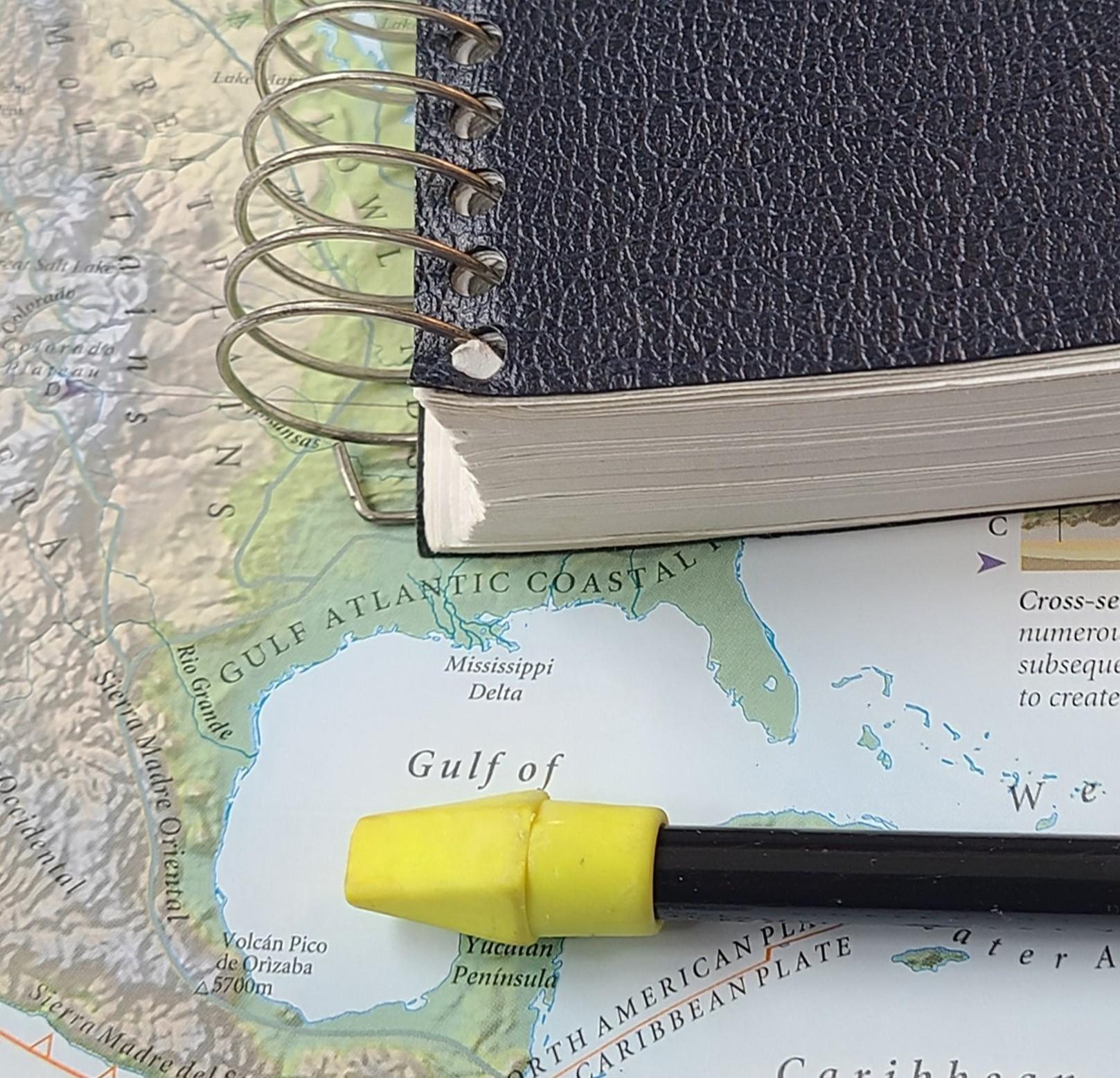
If you’re a journalist producing a story about, say, gulf oil, and you want to know the accepted way to refer to the body of water that laps up against Florida, Alabama, Mississippi, Louisiana and Texas, where do you turn? For reporters the answer is easy; that well-thumbed copy of the Associated Press’ ubiquitous Stylebook. The all-knowing guide dictates that this particular ocean basin is properly identified as “the Gulf of Mexico.”
That was always the globally accepted case, until the second presidency of Donald Trump, who renamed it the “Gulf of America” in an executive order that does not carry the force of law outside of the United States. Today, the AP instructs calling it by the name it has borne for the past 400 years while “acknowledging the name Trump has chosen,” noting that Trump’s authority is limited to the United States.
I’ll explain why in a minute.
In Journalism, ‘Style’ Is No Fad
But first, a quick history of the Stylebook: While you’re looking up the Gulf of Mexico entry, you can also glean from this trusty desk companion whether to capitalize the g in “gulf” when referring to gulf oil (no); whether and how to abbreviate the five states bordering the Gulf (with a big ‘G’)–no, you spell out the full names of states when referring to them alone in a story; and how to reference the Gulf of Mexico on second reference (“the Gulf” suffices).
The Stylebook often appears to be primarily a common-sense tool used by editors and reporters in English-language newsrooms. Thrifty on words, it tells you how to observe common rules of usage in your own quest to be pithy. To peruse it is almost to receive advice from Lou Grant, the fictional hard-nosed editor in the “Mary Tyler Moore Show” who’s always in a hurry to end a conversation. By the way, you didn’t ask, but the Stylebook instructs you to “put quotation marks around (the word ‘show’) only if it is part of the formal name. The word show may be dropped when it would be cumbersome, such as in a set of listings.” In journalism, style is not the mode of the day; it is permanent until formally changed by the guide whose style you have adopted (see also The Chicago Manual of Style). It is safe to say that most newspapers follow AP style.
The Stylebook is a compilation of rules. To follow them is to uphold thoroughly considered principles of consistency and accuracy. So, the manual is an amalgam of rules and principles, which makes sense since rules flow from principles.
Arguing Over Names--Do the Winners Get Naming Rights?
The “Gulf of America” flap is a perfect example of how we humans hammer out how we describe our world, and how the outcome of that contest implies (to some people, at least) winners and losers. For one thing, determining what name to use is a problem of principle.
The Trump administration chose to change a gulf’s name to project power. The AP determined not to adopt the name change because, in professional practice, it must balance several factors, like recognition of precedent, consistency and global standards, to name a few. In the choice-of-words department, then, for me to refer to this issue as a “flap” is a language issue because that word implies that there’s a disagreement (and the word flap in some contexts can connote that maybe it’s a trivial disagreement, although that’s not how I’m using it), whereas the Trump administration views the name change as settled law. I could, of course, sidestep this predicament by not referring to the issue as either a flap or as edict and simply write around it, but of what value would an essay be if it avoided the difficult issues? I choose to address the disagreement to advance what I think is an important part of keeping the public informed.
So, does the White House really care about the AP Stylebook? You don’t need to own a Stylebook or even know of its existence to see which side the AP came down on with regard to the Gulf. You just need to read the news, where usage rules come out in the wash. And when AP stuck with its existing position, President Trump was not pleased.
Signaling With Vocabulary
Raw information (names, numbers, scientific findings–and perhaps more importantly, financial and personal data) and the language we use to describe such info are forever in flux. Think about the power implications of being able to define certain terms used to describe “private” data and what can be done with them. Data, in the sense we know it, did not exist when the U.S. Constitution was written. Language evolves over generations. Data changes by the nano-second.
There has always been tension among people on opposing sides who seek to present important data in the style that suits their objectives, carefully choosing words that shape the raw information in a certain way, to show it in a different light. (To be clear, in the political arena, both “sides” of a political coin engage in this never-ending tug-of-war, deploying many of the same tactics and even enlisting some of the same words for different ends.) Think of the statement, “New York is a sanctuary city.” If you’re of a certain political stripe, “sanctuary city” is pejorative. Same with the word “woke.” To cite another example, using the term “diverse” legitimizes the principle of including many, regardless of their differences. The Trump administration believes the word “diverse” has led to overreach by “liberals,” so it is going to take away some of the power that word once carried by not using it in U.S. government publications and by threatening to withhold government grant funds from private entities that do.
The administration is quite up-front about these aims. At the PBS Pubic Editor’s office, we heard from many viewers in the time between Trump’s two presidencies who were offended by any news anchor or correspondent who referred to him as “President” Trump rather than the “former president” (as AP style would have them do). The Financial Times recently reported that the U.S. opposed using the term “Russian aggression” in G7 communiques when referring Russia's war in Ukraine. It’s not hard to figure out why. Everyone seems to agree that choice of words and names is worth the fight.
The Trump administration has begun de-emphasizing—and in some cases banishing where it can—words and phrases that have become freighted with political undertones or overtones from government websites, daily communications between federal employees, and in published documents. Words like “diversity” and “inclusion,” phrases like “gender-fluid,” “clean energy,” “climate change,” and acronyms like “DEI” and “BIPOC” are good, current examples.
The Importance of Semantics
Trump and his administration make no secret of their quest to refashion language used in governing our nation; in fact, he campaigned on it. The White House can't dictate how others use the language, but it can and does try.
When the AP declined to follow suit on Trump’s Gulf of America, its White House correspondent was banned from the Brady briefing room. This happened over protests of the AP itself and the White House Correspondents’ Association, which for 111 years (until this year) has determined which journalists get access to in-person briefings from the Oval Office. It's another norm busted by a norm-busting president who revels in breaking traditions he deems unfitting. The story of the press room ban has only grown bigger, and it is morphing into a story of overall press freedom.
The Information Itself Can Seem to Change When Terminology Changes
And then there is all that data. So much data everywhere! Everyone knows that governments of every stripe seek to present data—unemployment rates, GDP and inflation, for example—in ways that might further their agendas and make them look good. Surely, even President Jimmy Carter did it. The Chinese Communist Party regularly gets accused of doctoring economic data that it releases to the world in an alleged bid to make its economy look strong and its government look wise. And no one really talks about how the party uses sensitive data out of sight, but the whispers suggest a dark dystopia.
Ethically speaking, there is legitimate room to breathe within this process of evolving and updating data and language—editorial license and ethical leeway, if you will. There are some unethical and perhaps illegal ways of manipulating data, if not the language. There are ground rules about government publishing that can be ignored and broken. But it’s not always clear what factors go into calculating the gross domestic product, for example (should the GDP include or exclude government spending?) or which unemployment claims count toward the official unemployment rate reported by the Bureau of Labor Statistics.
To understand what lengths governments must, by law, go to in reporting their diurnal activities, one would have to study the Federal Register and the Code of Federal Regulations. Is there a protocol for withdrawing something from publication, or re-publishing it with changes? Yes, all that is too extensive to discuss here. Is everyone in the Executive branch following them? Hard to know without an extensive investigation.
Control of How We Talk
It pays to understand the consequences—intentional or not—that politics has on language and information—and how they work.
Sometimes, to control the data, you must control the language. While that has a nice Orwellian ring (who controls the “means of production”?), I have googled the phrase, and to my knowledge, it is newly minted. And I think it’s largely true. Maybe there is something about the Google search engine or my search techniques that caused me to miss some use of that phrase, hidden in plain sight. That’s part of my point: Technology companies like Google control a significant part of our daily communication with algorithms and their ubiquity. (The word “google” is now a verb.) If you can google it, people expect you to know it, even if you have to use a few keystrokes to find out. Some people even google during dinner conversations.
Over the longer term, the Associated Press, through its global reporting and yes, its Stylebook, exerted significant influence on language use and how information is presented, including how to refer to Google, its parent company and its search engine, in stories. Now, the digitization of much of humanity's information has put the AP Stylebook in a sea of text and numbers that anyone can search with Boolean logic. But it still exerts a strong influence on what you read and hear in the news.
A Vast Sea of Federal Information
So, it’s not surprising that Big Tech executives showed up behind Trump on the dais as he was sworn in as the 47th president. Draw your own conclusion, but note that Google decided to change its search engine and maps to reflect the new name of the Gulf. And as for the AP Stylebook? There was no one from the AP up there then, and now there is no one from AP in the White House briefing room.
The humble AP Stylebook has, in a way, found itself in the middle of a First Amendment struggle between the American public, the media and the White House, and it provides a window into what’s changing in America.
Once 52 pages–in 1970– the guidebook now has well over 400 pages, with a new bound edition dropping every year that reflects new entries added continuously online. However, as it has grown in page count, the Stylebook’s relative influence has shrunk, along with the legacy media that use it. A government could conceivably snuff it all out of existence one day.
The federal government controls a vast sea of information from which the public reaps vital statistics, market-moving economic data and scientific research, to name just a few examples. And that’s a good thing, since it is our government. When data was mostly in print, it would have been hard to purge information that was already published and physically disseminated over wide geography. On the internet, it may not be easy, but it’s definitely possible to expunge information from the public treasury of documents without people noticing. Is that happening? Government employees are instructed to scrub government websites of forbidden or discouraged terms, and when they edit web pages in HTML mode, might they be changing other published material that wouldn't otherwise comport with the new vocabulary? Even older publications that we thought were to remain untouched? Or will those old pieces be left in place to reveal the history of revisions? Are publications once cataloged on government websites disappearing?
Of course, none of this is new, and it is evolving. (In a future column, we’ll examine how malleable language and numbers are leaching into the information ecosystem.) There are protocols for editing online resources, particularly for government ones. But are the rules being followed? Is it happening more frequently in this politically charged atmosphere under an administration that promised to change the game's rules? And, how does all that compare to the standards and expectations we developed during the print age, when libraries had hard copies of everything? And don’t get me started on the language multiverse that includes the competing Chicago Manual Of Style.