


Can verified facts be biased?
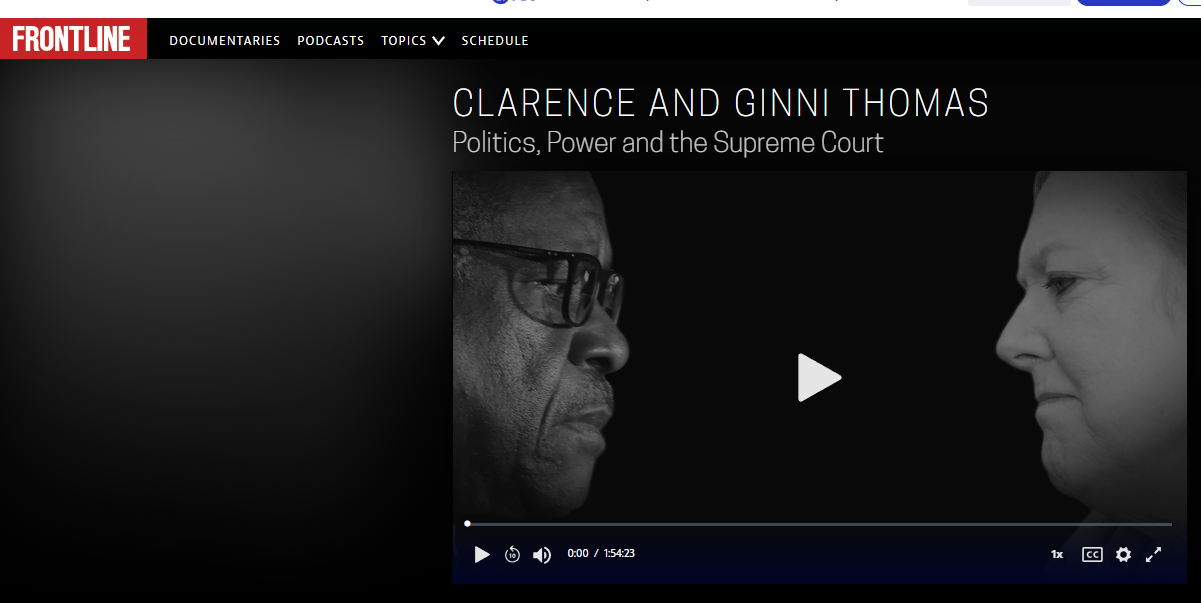
On May 9 Frontline aired the documentary, "Clarence and Ginni Thomas: Politics, Power and the Supreme Court.” The long presentation stands, in my view, as the most comprehensive film on the life and politics of the enigmatic U.S. Supreme Court Justice.
The program certainly struck a chord among viewers, many of whom took to social media to describe the portraits of Thomas and his wife as “scary” and “unsettling.”
For example:
- @SandraTrossbac1·
May 27
I just watched the Frontline story on Ginni and Clarence Thomas. SCARY
and
- @connieinmpls
May 21
We watched the PBS Frontline episode on Friday night and its really been on my mind. It’s very well done. No one loathes themselves more than Clarence Thomas. I also now understand why Ginny behaves in the way she does. Their power is unsettling.
The Frontline episode had interesting timing as far as many viewers were concerned, airing soon after revelations from a ProPublica investigation into Thomas’ close relationship with billionaire Harlan Crow. Turns out the Texas real estate mogul has bestowed thousands of dollars worth of vacations, homes, foundation donations – and even college tuition – on Thomas and his family.
It did not take long for a number of viewers – egged on by conservative commentators -- to clap back at PBS for having aired what they labeled as a skewed product of leftist bias.
"I did not find this program a documentary to the standards I have been accustomed to with PBS. It definitely was biased and left the impression of an abusive and angry person. I recall the Anita Hill incident and did not know at the time what to make of it. I expect there is truth on both sides. But I see no reason to present a one-sided picture of a person and call it a documentary. I was disappointed." -- Nancy Sutton, Charlotte, North Carolina
But at least one Twitter user claimed to have had a jaundiced view of the Thomases before seeing the documentary. His tweet seems to be saying that the details, even if unflattering, managed to humanize the Thomases in his eyes. See if you agree.
- @DavidMatheny1
May 22Replying to @frontlinepbs
I finally watched "ClarenceandGinni Thomas: Politics, Power and the Supreme Court" on PBS Frontline. Even before the bribery scandals, it was clear that both are extremely twisted philosophically. I now have some sympathy for how certain experiences warped them psychologically.
The Frontline piece was a separate production from the ProPublica investigation. Apart from references to the gifts scandal at the start and then in the last quarter of the one-hour and 54-minute film, its heart is the Thomas’ origin story and a deep examination of their character. In this, the film serves as a counterpoint to “Created Equal: Clarence Thomas in His Own Words,“ by politically conservative filmmaker Michael Pack, which aired in June of 2020 and which I defended at the time against complaints that the film was a biased air kiss for Thomas. I said in a column that Pack’s documentary was an appropriate example of the multiple dimensions of a story that you’ll see examined on PBS.
Questions for You, the Viewers
But the Frontline broadcast was a dive deeper than the usual episodes that run an hour or so. And, so our readers and viewers are clear: Frontline maintains a high bar of journalistic ethics. Facts are checked and rechecked, and even film footage borrowed from other sources is put through additional reviews to ensure authenticity and fair use. And then a staff attorney reviews Frontline documentaries to flag potential problems with facts and fairness.
So that leads us to some questions I hope our viewers can help us address: Can a storyline based on facts still be biased and unfair? Most of the first hour of the Frontline documentary presented a sympathetic story of Thomas’ childhood trauma and the discrimination he faced in Georgia and when he went off to university. So, where’s the biased portrait of the controversial justice? Is Frontline obliged to expressly say something like, “The subjects of this documentary dispute the findings” even if the findings are confirmed and reconfirmed? And, must journalists then offer documentary subjects time to present “their side of the story” without interruption or counterpoint, even if verified facts undermine their defense?
If you believe the documentary was lopsided in any direction (most people who felt it was uneven said it leaned against the Thomases), what specifically was it that made the film biased, assuming all the facts can be factually verified by an unconcerned third party? Is it context? Is it the tone of the narration? Was it shot in an unflattering light? Does it blow the facts out of proportion? Please give us details.
Text Us!
Text us by signing up here for our Subtext feed.