


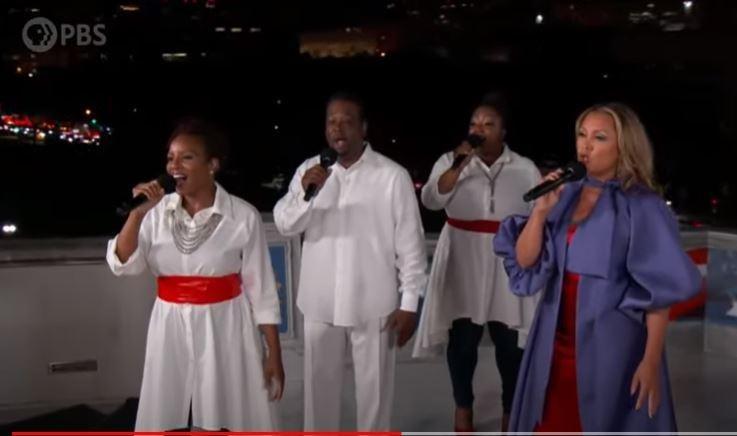
Outrage over a song written by and for African Americans more than a century ago — and performed on Independence Day on PBS — was misinformed and seemed manipulated; 'Lift Every Voice And Sing' is not a political chant, or a challenge to our official national anthem
Part of my job as public editor for PBS is identifying subjects or events that can become “teachable moments” for people who operate the public broadcasting system, and for our audiences. It is a privilege, really. There is immeasurable value in examining the context and evolution of a controversy to see if there is a lesson to be learned.
On July 4th, we came upon one such controversy.
On paper, my role is to represent viewers who have questions, concerns and complaints about PBS programming and the public media universe. But if I saw my job as strictly that, I would have published a column on July 5th reflecting the views of many viewers who objected to the performance of “Lift Every Voice And Sing” by the entertainer Vanessa Williams, who hosted A Capitol Fourth, the annual variety show and fireworks spectacular marking Independence Day.
But I paused. Here’s why:
Most of the outrage registered in our Public Editor email box seemed contrived. It did not feel right defending complaints I believed were misinformed and manipulated. On the 4th, and just after, we were hit by at least five dozen complaints, apparently spurred by conservative media gripes just ahead of Independence Day.
Some folks at PBS seemed upset that I was going to write about this episode. And, yes, I don’t relish giving any form of oxygen to messaging that comes with varying degrees of racism. (Although we archive them, we’ll never publish the overtly racist notes we routinely receive, aimed mostly at Black PBS journalists and creatives.)
So this column is about a teachable moment for a public that allowed itself to be turned into an ill-informed political mob.
The mail bag
Like so many of the loosely organized campaigns that have been aimed at us of late, the patriotic daze around “Lift Every Voice And Sing” took hold after a red-meat political tweet.
The tweet was from Steve Cortes of Newsmax, who said to his followers that we “have one national anthem… ” He had read an article in The Hill, which was a rehash of an article by the Associated Press that was a rundown of the musical acts planned for the 41st version of A Capitol Fourth. The news stories detailed Williams’ plan to sing “what has often been called the Black National Anthem,” and it noted her past social justice activism. This year’s show aired less than a month after Juneteenth became a national holiday celebrating June 19th, in 1865, when Union troops made it to Galveston, Texas, and spread word of the Emancipation Proclamation to Blacks who were still living in slavery.
But as news spread of the song’s inclusion in this year’s show, the facts were mangled beyond recognition. Some viewers who wrote in seemed utterly confused by the song’s origin and meaning:
“We have been avid PBS fans for many years and although I know you aren't responsible for national programs, this year's Capitol 4th was a disgrace! Vanessa Williams may be an adequate performer but turning the program into her own personal statement is a debacle!! On such an important day as July 4th, I hardly think her ending the program with the (Black Lives Matter) anthem could not have been in worst taste or more inappropriate! Shame on you...I thought you far above this type of agenda!!!”
-- Simma Robbins,
Scottsdale, AZ
Misfired patriotism
Here’s where critics and our complaining public got it so wrong:
Indeed, the song has, in over 121 years, come to be known as the Black National Anthem. But it is not — and was never intended to be — a rebuke to the United State’s’ official anthem. There wasn’t even an official U.S. National Anthem when “Lift Every Voice And Sing” was written and put to music.
The song is an American spiritual, with words of hope for a better future, penned not long after the end of the Civil War and the end of slavery.
The song originally was a poem, written in 1900, by James Weldon Johnson, then the head of the NAACP, the iconic civil rights organization. The first musical rendition was sung in honor of President Abraham Lincoln by children at the school in Florida where Johnson was principal.
Later, it was sung by Black soldiers fighting Nazi troops in Europe. I can’t think of a more patriotic way to show one’s allegiance to a nation: children singing in honor of a beloved president, or the singing of a rallying verse in the middle of a very scary war to defend our democracy.
Given its provenance, and proximity to Juneteenth, “Raise Every Voice and Sing” was quite an appropriate addition to this year’s July 4th show.
This is a sample of the lyrics from a song many letter writers said, in the name of patriotism, should not have been sung on PBS air:
“God of our weary years,
God of our silent tears,
Thou who has brought us thus far on the way;
Thou who has by Thy might
Led us into the light,
Keep us forever in the path, we pray. … “
The song, and Williams’ performance, were unfortunately and incorrectly portrayed as challenges to “The Star-Spangled Banner” — itself a war-born poem put to music that became this country’s official anthem in 1931.
OK, what’s the takeaway from this controversy? What’s the lesson for the complainers who insist that “there’s only one national anthem”?
You are right. There is only one national anthem. But you are wrong in suggesting that Vanessa Williams, or anyone at A Capitol Fourth or at PBS, ever suggested that “Lift Every Voice And Sing” is anything but a musical prayer written by and for African Americans not long after the end of slavery. To consider it “anti-American” or divisive is helpful only to those who seek to profit by stirring-up click-baiting matters of race.
And here’s my plea to you, dear viewers who didn’t bother to suss out the real story behind the song and just followed gurglings of ideologues who thrive on division:
Snap out of it! Hit the pause button. Spend a few minutes questioning the message and motives of anyone who professes outrage in your name.
And for heaven’s sake, actually watch a performance before you denounce it, rather than take someone else’s word that it’s offensive. Many of your emails decrying the song came in before the show actually went on the air. I can only conclude that you allowed yourselves to be manipulated by someone who wanted to get your dander up.