After the deadly shootings at Brown University and MIT, the panel discusses the law enforcement response and whether the federal government's focus on immigration enforcement impacted the investigation. Plus, President Trump faces some backlash after his comments about the murders of Rob and Michele Reiner.
Clip: The FBI's priorities under Kash Patel's leadership
Dec. 19, 2025 AT 8:29 p.m. EST
TRANSCRIPT
Notice: Transcripts are machine and human generated and lightly edited for accuracy. They may contain errors.
Jeffrey Goldberg: This week started off terribly, the anti-Jewish massacre in Australia, the deadly shootings at Brown University and MIT, the murders of Rob and Michelle Reiner. Weeks like this should cause us and our leaders to do some hard thinking about violence, hatred, mental health, guns, spiritual malaise, and the warping effects of technology and social media on our thinking and on our behavior.
Alternatively, if you're the president, you could just not have helpful thoughts at all, such as what happened this week. One prime example, while the nation from left to right mourned the loss of one of our country's most beloved filmmakers, the president decided it was a good moment to make the murders of the Reiners about his own grievances.
Donald Trump, U.S. President: Well, I wasn't a fan of his at all. He was a deranged person, as far as Trump is concerned.
You know, it was the Russia hoax. He was one of the people behind it. I think he hurt himself, career-wise. He became like a deranged person, Trump derangement syndrome. So, I was not a fan of Rob Reiner at all, in any way, shape or form. I thought he was very bad for our country.
Jeffrey Goldberg: I'll talk about all of this with our panel, Franklin Foer, a staff writer at The Atlantic. Zolan-Kanno Youngs is a White House correspondent for The New York Times, Jonathan Karl is the chief Washington correspondent for ABC News and the author of Retribution, Donald Trump, and the Campaign That Changed America, and Ashley Parker is a staff writer at The Atlantic.
So, let's talk first about the actual, parable events of the last week. The suspect in the Brown University and now MIT shootings has killed himself apparently after several days of intense anxiety during a manhunt. Jon, what broader lessons should we derive about from this incident, particularly as it relates to the law enforcement and social media components?
Jonathan Karl, Chief Washington Correspondent, ABC News: Well, look, this was not a shining moment, to say the least, for law enforcement. Let's remember that the case was cracked on Reddit, not by any investigators, local or federal. But I'd focus on the FBI here. Kash Patel went out and said that they had caught the shooter. And he went out and posted it on social media, on X. They had not caught the shooter yet. That was not true.
Who knows if that affect the course of the investigation, did that cause anybody to, you know, stop the search. But this was not the first time he had done exactly that. He did this with the killer of Charlie Kirk. He went out in that case, and before Tyler Robinson was apprehended, said that they got the guy, and they didn't have the guy.
So, what is the director of the FBI doing? Is he using this as an opportunity, tragedies like this, serious cases like this, to boost his Twitter followers to get more likes on social media? What's he trying to do?
And, look --
Jeffrey Goldberg: Are you asking that rhetorically?
Jonathan Karl: I'm -- rhetorically. But, I mean, there's a serious broader point, which is, what is the leadership of the FBI doing right now? I mean, we have --
Jeffrey Goldberg: Half of it is leaving.
Jonathan Karl: Well, yes, a bunch of it's leaving. The other half is working on reviewing the Epstein files. And the FBI leadership brought largely people out of the national security division to have the task of reviewing the FBI files for release.
So, what is not being looked at, what is not being dealt with, it's a lack of seriousness at the top of the FBI that may be really dangerous.
Jeffrey Goldberg: Frank, same type of question to you on the Sydney massacre. We've already had something like this in America, in Pittsburgh, the Squirrel Hill Synagogue massacre. How exposed is the American Jewish community to the sort of Islamist terrorism that we just saw on the beach outside Sydney?
Franklin Foer, Staff Writer, The Atlantic: I mean, I think of what's happened in Australia as kind of an object lesson of how things could be much worse than they are here for the American Jewish community. I know this because I have cousins in Australia who are Jewish. And ever since October 7th, they could feel kind of violence and terror getting ever close to them. They would write about how there was a fire bombing at a synagogue, or how there was a kosher deli that was attacked and how there were all sorts of incidents that were happening in their neighborhoods, in their communities to their daycare centers. And their frustration was that they felt exposed. They felt this --
Jeffrey Goldberg: It's kind of a check-offs gun-type situation, that the events were all there planted, and then this was the natural culmination.
Franklin Foer: It was a natural culmination. And it was hard to know exactly where it was coming from, because it was coming from both activists who were participating in -- who were captivated by the cause of the Palestinians. But it was also coming from these global forces. It was coming -- there was one attack that the Australians attributed to the Iranians. There was another -- this attack was obviously planned and implemented by members of ISIS. And so I think that there's so much coming.
And the failure of the government to act preemptively, I think, reflects a greater pathology that we see to a much lesser extent here, which is okay.
Jeffrey Goldberg: No, it's fine. But I -- you just reminded me, Jon is talking about FBI and the national security division. There's also in the counterterrorism area. A lot of those people in the FBI have been moved to Border Patrol, border enforcement, deportation issues. Yes, I mean, talk about that for a minute. It seems as if we went through a long period where counterterrorism was the dominant cause of the FBI, the dominant focus of the FBI. Now, it seems like they've moved in a completely different direction.
Zolan Kanno-Youngs, White House Correspondent, The New York Times: Oh, you've had a trend throughout this year where FBI analysts, not just FBI, but also DEA, have been redirected to support what this administration sees as the national security priority, that being the removal of undocumented immigrants.
And I've talked to Homeland Security officials, people in the law enforcement community who say that this has created gaps in the national security apparatus. And it's broad, right? Yes, it's those FBI analysts, it's criminal investigators being redirected to basically stand by and support ICE agents, but it's also Homeland HSI agents that do longer term investigations right into criminality. This is broad throughout the entire national security apparatus.
Jeffrey Goldberg: Right. Ashley, let me ask you about the president's response to the killing of the Reiners. This is a tragedy. It's a story about a brilliant filmmaker. Everybody loves his movies. Left wing, right wing, it doesn't matter what you are, everybody loves his movies. It's a story, it's a horrible story apparently about drug addiction and a family in crisis. The president's reaction was entirely about the president. We've seen this before, but have we seen it this floridly?
Ashley Parker, Staff Writer, The Atlantic: I mean, you played a clip at the beginning of the show. It's worth noting that those comments came after he put out a post on Truth Social that all but implied Rob Reiner by being a liberal Democratic activist, by being opposed to President Trump, sort of had it coming. Trump's initial take was Rob Reiner has been against me.
People got angry and he and his wife were murdered. I mean, there was no empathy. Not just a lack of empathy. It was such a crude, almost gleeful posting on social media that you saw cracks in Trump's coalition, which you rarely see. You saw Republicans and not just sort of mainstream Republicans. You saw members of MAGA who, to be fair, when Charlie Kirk had been assassinated, had said that the people celebrating this is disgusting. It's abhorrent. And then they see the leader of their own party doing that, and some of them had the conviction to say, you know, this isn't okay.
Now, to be clear, many of them didn't, but it was striking to see people --
Jeffrey Goldberg: James Wood, the actor, you know, who's a very big Trump supporter, who just loved Rob Reiner, was horrified, I think, by what the president said.
Ashley Parker: And Rob Reiner, too, it's worth noting, when Charlie Kirk was assassinated, he was one of the people who came out and said, I don't care what, you know, anyone's beliefs are. This is an abhorrent, grotesque act that should never happen to anyone.
Jonathan Karl: It reminded me of what he did after Nancy Pelosi's husband, Paul, was attacked with a hammer, I mean, almost killed in their home in San Francisco. And, you know, it was the same kind of thing. It reminded me -- look back at some of the statements that Trump has made every year on Veterans Day, where he talks about the suckers and the haters and the losers and all of this and, you know, Happy Veterans Day. So, it is consistent.
But this did feel like it went a step beyond, particularly coming in the context of coming after Charlie Kirk. And the sense that he was justifying or saying that, explaining why, which with absolutely no factual basis whatsoever, he was dead wrong, but suggesting that Reiner's political attacks on Trump were the reason why he was murdered with a knife by his own son.
Jeffrey Goldberg: Right. Zolan, I mean, one of the factors here is that his movies are very mainstream and universally beloved, and so people have positive associations, well, it doesn't matter what your politics are, with seeing those movies. But I'm wondering if there was -- do you see -- I mean, you study the man closely -- a degree in con like a degree of anger or like kind of freneticness in his responses to the Reiner death that was unusual? Because it did provoke this response among Republicans that you usually don't see.
Zolan Kanno-Youngs: Unusual in the sense that it was just so close to the actual tragedy, right? It was just hours after. But I do think this is part of a pattern? Like in times of tragedy, whether it's natural disasters, there's usually a sense of, you know, well, that state, what are they doing for me to get this aid, this federal support, whether it's tragedy of a murder as well.
The personal grievance tends to trump empathy. Empathy tends to get substituted for spite when it comes to this president.
Jeffrey Goldberg: Has he shown empathy?
Jonathan Karl: I mean, I think there have been flashes of him showing empathy, but they're very quick and short-lived.
Jeffrey Goldberg: Interesting.
Ashley Parker: And he'll sometimes show empathy, especially in natural disasters for red states and for his people. He's much more able to communicate empathy if he feels like it's a Trump supporter who has lost their home in a hurricane or a tornado.
Zolan Kanno-Youngs: There was an amazing scene right on his first week in office when he went to North Carolina and showed empathy to many Trump supporters who met him at the airport there. Later on that day, he went to California. And he said, well, look, yes, these fires just happened. Well, I also want these immigration policies put forward. And he also criticized Newsom days later. So, that difference of red to blue states, it's true.
FROM THIS EPISODE


Clip: Trump rewrites history in fast and furious prime-time speech
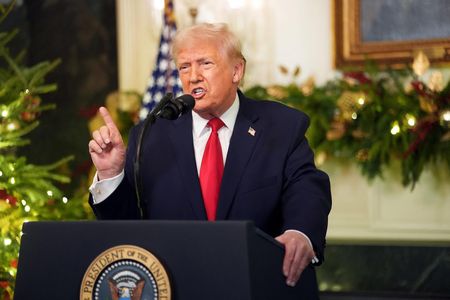
President Trump delivered a fast and furious prime-time address to the nation this week. The panel discusses his claims and the revealing interview his White House chief of staff gave to Vanity Fair.
Full Episode: Washington Week with The Atlantic full episode, 12/19/25
President Trump had a lot of thoughts this week about affordability, Rob Reiner, the Middle East, all of his White House predecessors, and he seems very angry these days. Join moderator Jeffrey Goldberg, Ashley Parker and Franklin Foer of The Atlantic, Zolan Kanno-Youngs of The New York Times and Jonathan Karl of ABC News to discuss this and more.


© 1996 - 2026 WETA. All Rights Reserved.
PBS is a 501(c)(3) not-for-profit organization