There are contradictory signals about President Trump's political strength. On the one hand, his poll numbers are in the basement. On the other hand, he still has the power to punish his Republican enemies, as he just did with Rep. Thomas Massey of Kentucky and Sen. Bill Cassidy of Louisiana.
Clip: Trump's political rampage
May. 22, 2026 AT 8:38 p.m. EDT
TRANSCRIPT
Notice: Transcripts are machine and human generated and lightly edited for accuracy. They may contain errors.
Jeffrey Goldberg: Good evening, and welcome to Washington Week.
Here's something that I think is reasonable to state. In previous presidencies, the weekend host of a cable television news and entertainment show might very well be offered an interview with the Secretary of Defense. But it's hard to imagine that he would be offered the job of Secretary of Defense. But this is what Donald Trump did when he chose Pete Hegseth for the role.
As you know, by the way, Hegseth has demanded to be called Secretary of War, hearkening back to the title used in World War II and earlier. But until Congress authorizes the name change, we will use the statutory title.
Hegseth has instituted so many other radical changes to the way the most powerful and lethal military in the history of the planet is run, that it is hard sometimes to rank these changes in terms of their lasting impact. But we'll try tonight with my guests. Helene Cooper, a National Security Correspondent at The New York Times, Jonathan Karl is the Chief Washington Correspondent for ABC News, Missy Ryan covers the Pentagon for The Atlantic, and Vivian Salama is a National Security Correspondent at The Atlantic.
Thank you all for joining me.
I wanted to start actually on domestic politics, because there's been obviously a lot of action this week. Just spend a couple of minutes on this. Vivian, there are a bunch of contradictory signals about President Trump's political strength. On the one hand, his poll number is in the basement. On the other, he still has the power to punish his Republican enemies, as he just did with Thomas Massie of Kentucky. In which way is all this trending? He's trying to knock out Senator John Cornyn now, much to the chagrin of Cornyn's many Republican allies in the Senate. Where is this heading?
Vivian Salama, Staff Writer, The Atlantic: If anything, the last month has proven to us that President Trump still has juice within the party. Even as his poll numbers go low to the lowest that they've ever been, even as he struggles to implement his domestic agenda, his foreign policy agenda, he still does have that juice.
And we've seen it in recent weeks with regard to a number of different primaries. Earlier this month, Indiana was particularly noteworthy because five or six challengers that President Trump endorsed all won the GOP primary there. And that was simply because they supported his redistricting push.
Now, all eyes were on Thomas Massie, in Kentucky in particular, because he's been so outspoken against President Trump in recent years. He has gone after him on everything, from --
Jeffrey Goldberg: Trump really did not like that guy.
Vivian Salama: And he did not like that guy. He's, he has criticized him left, right, and center. But Massie was one of the leading voices in the GOP with regard to releasing the Epstein files. He was very critical on the president's policies about Israel, and so all of that kind of culminated with this primary. A former Navy SEAL who challenged Massie was supported not only by the president, but you even had the Secretary of Defense, Pete Hegseth, go out there and support him, which is very unprecedented.
Jeffrey Goldberg: We'll get to that, yes.
Vivian Salama: And ultimately he lost.
Now, was it because of the fact that he had been so outspoken, or is it, again, part of this trend? We're going to ha- we're going to really know that going forward with regard to Texas next week.
Jeffrey Goldberg: Jon?
Jonathan Karl, Chief Washington Correspondent, ABC News: So, look, but a couple of things here. First of all, Trump does have still the control over the party. I mean, there's just no question about this. This is something that we also saw though in 2022, if you remember. He was in exile, out of power, kind of like written off as a spent force, and he went around and started endorsing in primaries, and he won in race after race after race.
And what happened in the fall? Well, Republicans suffered significant losses. They were up against running in a situation where you had President Biden with low approval rating, high inflation, all the conditions for a big red wave, and it didn't materialize, in part because many of those candidates, particularly Senate candidates, that Trump had either recruited or endorsed ended up losing. So, winning in primaries doesn't necessarily mean that he has the power that's going to come in the fall.
But one other thing is you have this phenomenon in Congress now because he's gone after not just -- you know, not just Cornyn. He went after Cassidy. Cassidy lost his primary. He's -- you know, he ran Marjorie Taylor Greene out of the House. He's now saying he wants a primary challenge against Lauren Boebert. He's going after Republicans who are insufficiently loyal in his term, including people that have been amazingly loyal to Donald Trump. And it's created this phenomenon where a lot of those or at least some of those people now have renewed courage to challenge him.
It's amazing the courage of the lame duck. Maybe we need like a new term, like the brave duck. But Cassidy, you know, Cassidy, who voted to confirm Bobby Kennedy against where he wanted to go, Cassidy comes out and defies Trump on war powers, and suddenly he's got an issue on his hands.
Jeffrey Goldberg: Brave Duck would be a great name for a Capitol Hill restaurant.
Jonathan Karl: Brave Duck.
Jeffrey Goldberg: If we ever -- if journalism doesn't work out for us, we might want to --
Jonathan Karl: Thom Tillis, look at him. I mean, he's -- they don't have to worry about him anymore because they're not running anymore.
Vivian Salama: There's one more underlying theme really quickly, though, and that's the redistricting opposition that some of these candidates have put up there. And in Indiana in particular, most of those candidates who won supported the president's midterm -- mid-cycle redistricting push. That could really remake the map, and that's a significant, significant effort by the president.
FROM THIS EPISODE


Clip: Hegseth’s turbulent time leading the U.S. military
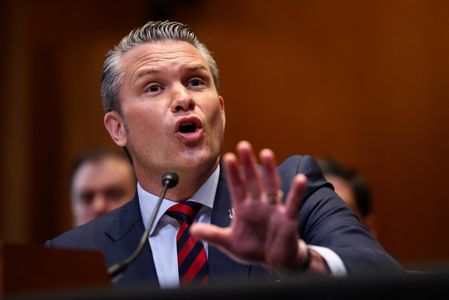
Defense Secretary Pete Hegseth has distinguished himself as President Trump’s most pugnacious Cabinet member and as a leading advocate of the war against Iran. He is also someone who is trying to reshape the military according to his own values and beliefs. The panel discusses Hegseth’s turbulent time leading the world’s most powerful military.
Full Episode: Washington Week with The Atlantic full episode, 5/22/26
Full Washington Week with the Atlantic broadcast from May 22, 2026.


© 1996 - 2026 WETA. All Rights Reserved.
PBS is a 501(c)(3) not-for-profit organization