In the 25 years since 9/11, we've learned how al-Qaeda planned the attacks and what it hoped to accomplish. The panel discusses how Osama bin Laden miscalculated America's response and eventually viewed the attack as a failure.
Clip: How bin Laden miscalculated America's response to 9/11
Sep. 11, 2026 AT 8:30 p.m. EDT
TRANSCRIPT
Notice: Transcripts are machine and human generated and lightly edited for accuracy. They may contain errors.
Jeffrey Goldberg: Graeme, I want to talk to you about the perpetrators. We'll have a broader discussion in a second about the longer term effect, impact of 9/11 on our country and the world. What did Al-Qaeda think it was going to accomplish, and what did it accomplish?
Graeme Wood, Staff Writer, The Atlantic: Yes. So, we actually have a lot of information about this, because bin Laden, when he was killed, his hard drive was taken, so we know what he was thinking right afterward. And he also was -- he was a chatterbox. He liked to talk to people about what he was planning to do.
And it turns out his theory of 9/11 was actually quite weird. He thought 9/11 was going to cause the United States just to leave the Middle East. It was going to cause popular uprisings in the United States against George W. Bush, against the government, and that within a few years there would be no more America in the Middle East, no more American bases.
So, it didn't work out that way. I believe over the last 25 years, there's been a pretty continuous American presence. It's gotten --
Jeffrey Goldberg: That's an understatement.
Graeme Wood: -- larger, not smaller. And so the theory that bin Laden had, it didn't work out that way at all. And, in fact, in the remaining years of his life, he just continually was expressing frustration that that did not go as planned. And, by the way, nobody's listening to me in my own organization. The organization's in tatters. It was a failure. So, in that sense, things did not go very well for the Al-Qaeda as it existed in the sort of bin Laden vision board of 2001.
Jeffrey Goldberg: Right. What is it now?
Graeme Wood: So the bad news is that there's a different Al-Qaeda. So, Al-Qaeda had its core group, whose plans didn't work out so well. But it also spawned all these affiliates, people who are basically flying the Al-Qaeda flag and have been very successful in different places in Africa, in the Arabian Peninsula.
And those Al-Qaedas, which may or may not really have allegiance to the remnants of the core, they control in some cases pretty much whole countries. In the case of Somalia, they threaten the whole governments in West Africa, and they're not going anywhere. We've got tens of thousands of people who call themselves Al-Qaeda, but have more local concerns than bin Laden had, who was always really mostly concerned about his own native country, Saudi Arabia, and America and Israel.
Jeffrey Goldberg: Was the assassination of bin Laden, apart from the obvious revenge, satisfaction, justice delivered to bin Laden, did that have a policy implication? Did that have a national security implication beyond the president, President Obama saying justice has been served, which 99 percent of Americans agree with?
Graeme Wood: What we know about what he was actually doing was he was plotting. He was giving ideas to people who had allegiance to him. But, really, he was a guy in an isolated compound. He had spent years of the period after 9/11 not even in contact with his own organization.
So, by the time he was killed, he was having some really interesting ideas, one of which, by the way, was shutting down the Strait of Hormuz. So, some of those ideas, it would be unfortunate if they came to pass.
Jeffrey Goldberg: Well, this is interesting that you mention this, because, you know, if you look at the impact of 9/11, if George W. Bush had not chosen a second war, Iraq, you might not have had a Barack Obama rise, become president. If you didn't have a Barack Obama, you might not have had the rise of Donald Trump. I mean, I'm not saying bin Laden planned the polarization of American politics, but history goes in strange ways.
And you were there. You're both watching the Bush administration at the time. We look back now and we think, what were the -- we ask, what were the biggest mistakes? And I'm curious to know, you watched them so closely, if they could have done something different, what would now, with the benefit of hindsight, what would they have done?
Ann Compton, Former White House Correspondent, ABC News: 20/20 hindsight.
Jeffrey Goldberg: Yes.
Ann Compton: If only. I think even those who participated in all of those successive presidencies knew that what happened in the war in Iraq, what happened with relations when President Obama, first trip he took was to Cairo, Arab Spring, the United States can't pull those strings and can't make those things happen, and the continuum of presidents didn't have a straight line foreign policy, made it up -- each president had to make up his own policy.
Jeffrey Goldberg: Right. Jon, bin Laden -- as Graeme said, bin Laden's goal was to drive the Americans from the Middle East. The opposite, it's almost that Godfather cliche, every time I think I'm out, they pull you back in. Right now, we're dealing with, in a way, the fallout from a decision by Al-Qaeda to murder large numbers of Americans.
Jonathan Lemire, Staff Writer, The Atlantic: Yes, I mean, no question. Not only in the immediate aftermath, of course. The U.S. surged into not just Afghanistan, but then Iraq and all of the ramifications thereof, straining alliances. You have ISIS came of birth out of that.
But then to your point earlier, I mean, Donald Trump was elected president. I was there on the campaign trail in 2016, and it was a backlash to Barack Obama to be sure, our nation's first black president. But also one of the sort of underrated lines that really resonated with people on the campaign trail was his, I will not get into these sorts of wars.
America was so tired of being in Afghanistan and being in Iraq through the Bush years and, you know, through the Obama years that Trump was saying, this will never happen again, and people believed him. And, of course, what we have now seen here in his second term, he has very much gone against that, broken that promise. And, again, suddenly, the U.S. finds itself in a conflict in the Middle East with no obvious way out.
Jeffrey Goldberg: Right. Graeme, I mean, that seems like an interesting a point. In a way, have American policymakers walked into traps that extremists in the Middle East didn't even know they were setting in a kind of way?
Graeme Wood: Yes, I think that's the important part, that they had no idea that this is how it's going to go. They didn't predict the failures that we would have. Instead they thought we would fail in different ways.
And it's funny to look back in the years immediately after 9/11 when bin Laden, as an evil genius, as a twirling mustache genius who had these traps set for us, that's kind of how it looked. But now in retrospect, now that we know a bit more about what he was thinking, it's more like he had no idea what was going to happen, and he had no idea how foolishly we would ourselves react to some of the things that happened.
Jeffrey Goldberg: Well, let me flip that a little bit and ask you this. It's been 25 years. We haven't had a successful large-scale Islamist terror attack on the United States. We make fun of the TSA, but there hasn't been an airplane hijacking.
We have done, as a country, some things right. Is that fair?
Graeme Wood: Oh, yes. I mean, it's important to see exactly what Al-Qaeda has managed to do in the last 25 years. And just as on the day we didn't know whether they were going to do a lot more, we probably thought in the next 25 years they would do something. In fact, they've had only one Al-Qaeda-operated attack. It was 2019, killed three people.
So, we've done a pretty good job of stopping them, mostly by disrupting their networks in the places where they've operated. And then in the few plots that they've actually operationalized, they have literally fizzled, except in that one case in 2019.
Jeffrey Goldberg: Right. Sally, I want, and maybe we could end on this point, because I do want to bring it back to the victims, but also the heroes, fire department heroes. Obviously, they've been heroes through the 25 years of wars in the in the Middle East, American heroes risking life and limb for their fellow soldiers. You look at that day, not just the firefighters, the people on the on the United flight that, that crashed in Pennsylvania prevented some terrible catastrophe from happening.
Talk a little bit about resilience and the resilience of New York City, the resilience of the fire department, the resilience of the of the survivor families, Pennsylvania, the Pentagon and New York, of course. It's a good time to remember how many people behaved in the most exemplary fashion possible.
Sally Jenkins, Staff Writer, The Atlantic: Yes. I mean, the crime rate fell, remember that, in New York City after 9/11?
Let me talk about hindsight for one minute though, because the New York City Fire Department engaged in a lot of really tormenting second-guessing of itself. Should they have pulled the firefighters out of both towers earlier? You know, what was their response? What were their failures? Their radios were horrible.
And Liam Flaherty, who's now a captain of one of the rescue units said, you know, he said, one of the things that we sat around talking about was the fact that, okay, let's say we had pulled units out of the buildings sooner. He said, now, the fire department is doing what? Standing across the street watching those buildings burn and fall? He said, that would've been the worst day in the history of the New York Fire Department from another perspective.
And so hindsight really is such a complicated thing and that quote stayed with me as much as anything I reported on this story.
Jeffrey Goldberg: Right.
Sally Jenkins: But to the resilience of New York, the regrowth of the New York City Fire Department and people like Liam Flaherty, who was a young firefighter tormented by self-doubt, who's now a leader in the department, Kevin Dowdell's kids, the same, one of the great things about the fire department is it has a culture of taking care of its own. They take care of each other.
Kevin Dowdell's sons were -- the job of raising them was finished by New York City firefighters. They had hundreds of fathers driving them to school, cleaning their gutters, much better than the U.S. military takes care of its own, much by a mile.
Jeffrey Goldberg: Right.
Sally Jenkins: The U.S. military could learn a lot from the New York City Fire Department and how they were able to survive 9/11, rebuild, and re-raise a generation of leaders.
Jeffrey Goldberg: Right. Well, thank you for that, and thank you to everyone for participating in this. I wanted this discussion to focus on geopolitics to some degree, but I didn't want to neglect the horrible human cost and the stories of heroism. Almost 3,000 innocent people were murdered that day, and as far as I'm concerned, we can never talk about them enough.
I hope we've succeeded in remembering these innocent people, mothers, fathers, sons, daughters, wives and husbands, who were stolen from us a quarter century ago. Their memory should be a blessing for all of us.
FROM THIS EPISODE

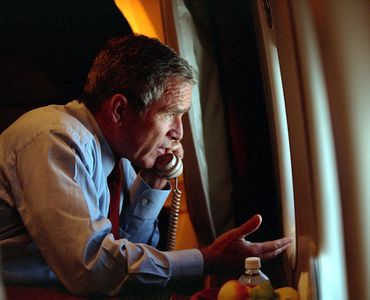
Clip: Reporters reflect on covering 9/11 as it happened
Ann Compton is a former White House correspondent for ABC News. On Sept. 11, 2001, she was the pool reporter traveling with President Bush. Compton and Jeffrey Goldberg discuss learning about the attacks, the president's movements on Air Force One and returning to Washington on the night of 9/11.
Full Episode: Washington Week with The Atlantic full episode, 9/11/26
Full Washington Week with the Atlantic broadcast from September 11, 2026.


© 1996 - 2026 WETA. All Rights Reserved.
PBS is a 501(c)(3) not-for-profit organization