Every state has its own preoccupations this election season, but diesel fuel, gas prices, data centers and corruption seem to be undergirding issues. The panel discusses how Trump’s policies and popularity are affecting the battle for control of Congress.
Clip: Trump’s policies put Republicans on the defensive
Oct. 09, 2026 AT 10:02 p.m. EDT
TRANSCRIPT
Notice: Transcripts are machine and human generated and lightly edited for accuracy. They may contain errors.
JEFFREY GOLDBERG: Let's talk about the undergirding issues. Every state has its own preoccupations, but, diesel fuel, gasoline prices, data centers --
ANNIE LINSKEY: And corruption.
JEFFREY GOLDBERG: And -- no, go ahead.
ANNIE LINSKEY: Yes.
ADAM HARRIS: Well, yes.
JEFFREY GOLDBERG: There's time for both, if you can. Go ahead.
ANNIE LINSKEY: Okay, we can both do corruption.
ADAM HARRIS: I think, yes, we can both do corruption. I think it's just indicative of the ways that all of the things that we're talking about now, in the same way that, you know, any midterm election's going to be a referendum on the president's policies, what we're seeing right now is a referendum on the president's policies over the last two years, right?
You have the war in Iran that he can't tether to Joe Biden and say, oh, your prices are up because of Joe Biden, because that's fuel as a result of something that nobody -- most Americans wouldn't have known about last year, which is the Strait of Hormuz, right?
If you ran a poll from January of 2025 or 2020, even this year, and said, you know, have you ever heard of the Strait of Hormuz? Most people would say no. But now they can tether the president's policies specifically from the war on down.
It's why you see folks, like Husted, sort of trying to walk away, or Mike Rogers walking away from the president and trying to sever that tie, and the administration sort of letting them do that.
JEFFREY GOLDBERG: Right. If -- alternate history here, if he hadn't gone to war with Iran and then, I don't want to say lose because it's not a loss yet, but it's not a win, and the Iranians hadn't discovered for themselves that, oh, we can stop oil from moving through the Strait of Hormuz, they knew that a long time ago actually, would we even be having this conversation about the Republicans on the defensive?
ANNIE LINSKEY: I think that's such a good question, and it's a topic that comes up repeatedly when I talk to my Republican sources, who -- some of whom are very close to Trump, very close to the administration. And they have been saying candidly since -- really since March, this war is going to kill us. This war is killing us.
And they point -- they say that they could have overcome the tariffs, even some of the immigration roundups, which have become very unpopular, which we haven't talked about. But, you know, surprisingly, immigration has been an area where Trump has lost.
JEFFREY GOLDBERG: Well, he's certainly losing what he -- whatever he gained in Hispanic votes, obviously.
ANNIE LINSKEY: Yes. But they really feel that the war and the increase in prices, and the increase specifically to your point in diesel prices, because that is what drives up the food costs and is hitting so hard in these farm states.
JONATHAN KARL: Yes, the farm states, it's -- I mean, heard it over and over again --
ANNIE LINSKEY: And you see it this week with Trump.
JONATHAN KAR: -- in Kansas, you see it in Iowa.
ANNIE LINSKEY: Yes.
JEFFREY GOLDBERG: Yes.
ANNIE LINSKEY: He took two major moves this week. One, you know, just today to lift sanctions on Russia, to allow Russian diesel fuel to come and sort of come to the aid. And also his E.O. on the red dye diesel --
JONATHAN KARL: Which the farmers will tell you does nothing.
JEFFREY GOLDBERG: Right. Jon, I wanted to ask you about that. I mean, he's now importing diesel, small amount of diesel, from Russia, which I should point out imports soldiers from North Korea to fight the U.S.-backed Ukrainian government. It's quite a move.
Is it going to make any difference in diesel prices? And even if you can move diesel prices in two or three weeks, is it too late? Is this thing fixed?
JONATHAN KARL: Look I think that the Russia deal actually is going to make a big difference, not with diesel prices, but it's going to help Russia. You know, it's a lifeline to the Russian economy. It'll have a much greater impact there, which is why you saw the reaction you saw from Zelenskyy today. I mean, about as, you know, strong a reaction back on this. This is not something that's going to move the needle in the United States on diesel prices.
JEFFREY GOLDBERG: Right.
JONATHAN KARL: But it does move the needle perhaps in Ukraine.
JEFFREY GOLDBERG: Carrie, I have a question about, and this is sort of like political, like fantasy football kind of thing, but -- and it's nobody's -- I'm not saying it's any of our fantasies. It's just interesting. The Senate could be 51-49, right? We could come out of this at 51-49. Does Fetterman of Pennsylvania jump the Republican Party, which would, of course, make the Senate 51-50, because Vance would be the tie-breaking vote? Is that a possibility that Fetterman would actually jump if the Republicans promised him enough?
CARRIE DANN: I mean, I will say I have -- John Fetterman has been asked this question probably five dozen times, right? It is not a recent development.
JEFFREY GOLDBERG: Right.
CARRIE DANN: Whether it was in the context of it being the control of the Senate or just generally because of some of the votes that he's taken and because of the way that he's -- specifically that he's talked about the Israel issue. He has said absolutely not every single time that I have seen him been asked.
I don't want to speculate what happens when all of that pressure is on him because there will be an immense --
JEFFREY GOLDBERG: It's pressure and it's inducement.
CARRIE DANN: An immense amount of pressure on him. We can just point to the record in the past of him saying --
ANNIE LINSKEY: Well, I mean, you can see from his perspective he, because of these votes that he's taken, he has, has very little, and if you could probably say no path to get through a Democratic primary if he were to run again. You do -- you have seen polling that shows he is more popular in his home state among Republicans than Democrats.
And also if you just watch him on the Hill, you know, you see him hanging out with Republicans, whether it's Katie Britt or Dave McCormick. I mean, he seems to have more of a natural affinity there. So, you can understand why, you know, the ingredients are so certainly there.
JONATHAN KARL: And there's a reason he's been asked the question five dozen times. I mean, he is friendly with Republicans, sure. He spoke at the Republican convention, midterm convention in Dallas. I mean, this is --
JEFFREY GOLDBERG: You're like Sherlock Holmes.
JONATHAN KARL: I think there's a possibility he's going to switch parties.
JEFFREY GOLDBERG: Noticing a pattern now, aren't we?
JONATHAN KARL: You know, I mean, we all saw this happen. We'll say because we're old enough to, you know, in 2001 when Jim Jeffords, who was the Republican senator from the state of Vermont, it was a 50/50 Senate.
JEFFREY GOLDBERG: You broke that story.
JONATHAN KARL: Yes.
JEFFREY GOLDBERG: Yes.
JONATHAN KARL: And --
JEFFREY GOLDBERG: I remember that, since you reminded me. Yes, I remember that, yes, big story.
JONATHAN KARL: You know, but the pressure and the reward can be quite high.
JEFFREY GOLDBERG: Right. I want to talk about the president in our remaining few minutes. I just want to note that the president posted on Truth Social the following message on Thursday. The White House considers anyone that uses the term artificial intelligence, as opposed to the highly accepted new and more accurate term super intelligence, the enemy. So, he's clearly focused on the midterm elections as a consequent. I mean, he's really getting right at the heart of the matter.
I mean, this is on -- I mean, you two are in the White House all the time. What are they saying about the president's attention to this, and does he even care?
ANNIE LINSKEY: Yes. I mean, look, yes, he does care. I mean, he does care. And I think there is a little bit more -- you know, there's a little bit more kind of deeper under the surface here.
I mean, you know, one thing I would say -- I mean, first of all, he's going to spend a lot of the next month on the road, and he is traveling to these states.
JEFFREY GOLDBERG: He's going to Alaska.
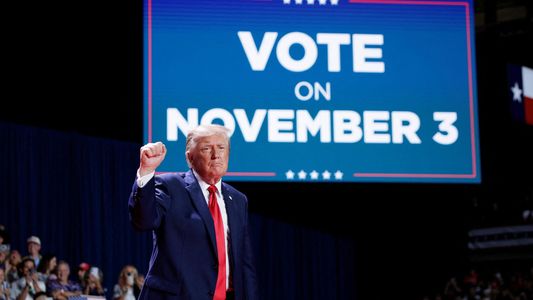
ANNIE LINSKEY: He's going to Alaska, and there's a reason for that. He knows that he is the best person at turning out this MAGA coalition, and the Republicans are right about that.
And if you talk to people at the White House, they will say to you, look, we have heard these naysayers before. We have heard Washington write us off in 2016, and, you know, I can go through -- we're all familiar with the elections. They say that we are on -- we're playing on a red playing field, that these are Republican voters. These races are going to narrow. The polling will narrow.
You talk to Democrats, and they will tell you the same thing, that these races are going to come closer together towards the end.
JEFFREY GOLDBERG: Right.
ANNIE LINSKEY: And they have the money. They have a lot more money.
JEFFREY GOLDBERG: If he loses Congress, Adam, this is a large essay question that I'd like you to answer in 60 seconds, but what does it mean for him and his party?
ADAM HARRIS: I mean, as a lame duck, right? I think it means investigations. I think what we saw right before the House broke for recess, where you had Pete Hegseth brought up for, you know, impeachment, right?
JEFFREY GOLDBERG: Right.
ADAM HARRIS: I think what we will see is several investigations, potential impeachment inquiries into both cabinet members and the president. And, effectively, it's jamming up any semblance of an agenda or success in an agenda that he would see for the next two years.
JEFFREY GOLDBERG: Right. Jon, last word to you on this because you've obviously covered the man himself.
JONATHAN KARL: Yes.
JEFFREY GOLDBERG: How would he react to the loss of Congress?
JONATHAN KARL: I mean, I think that's the big question, is how does Trump -- what are the last two years of a Trump presidency look like with his back against his wall, looking at a Democratic Congress that is gunning for him? And we've seen what he's like with a back against the wall and I think most dramatically we saw that after he lost the 2020 election. And he drove that fight further than anybody could have imagined he would drive it to January 6th.
And I don't know. There's going to be two paths he can take. He can take that path. God knows what that means.
JEFFREY GOLDBERG: You mean just sort of self-radicalizing kind of way?
JONATHAN KARL: Yes. And just dig in and war with -- remember, the Congress and the president have to actually work together to like make the government function. They have to pass --
JEFFREY GOLDBERG: I've read books about that, yes.
JONATHAN KARL: Yes. So, I mean, the last time this happened, we saw the longest shutdown in American history.
JEFFREY GOLDBERG: Right.
JONATHAN KARL: So, does he go in that direction, or is it the dealmaker? Does he feel like, you know, just like I can get a deal with the Iranians, which he hasn't quite pulled off yet? But he loves to, you know, to deal with the people you can't deal with. Does he make a deal with Democrats?
JEFFREY GOLDBERG: Right. Well, we'll find out soon enough. I mean, we are going to have to leave it there, though. I want to thank our guests for joining me, and thank you at home for watching us.
Be sure to join us next week for a special hour-long Washington Week on the fight to control Congress. We'll be broadcasting from the battleground state of Texas, the home of one of the country's most expensive and closely watched Senate races.
I'm Jeffrey Goldberg. Good night from Washington.
FROM THIS EPISODE


Clip: Why the map of battleground states is shifting in surprising ways
Election forecaster Nate Silver is giving the Democrats a 93% chance of winning the House and a 74% chance of winning the Senate. Join moderator Jeffrey Goldberg, Carrie Dann of the Cook Political Report with Amy Walter, Adam Harris of Radio Atlantic, Jonathan Karl of ABC News and Annie Linskey of The Wall Street Journal to discuss Democrats’ chances and President Donald Trump’s unpopularity.
Full Episode: Washington Week with The Atlantic full episode, 10/9/26
Full Washington Week with the Atlantic broadcast from October 9, 2026.


© 1996 - 2026 WETA. All Rights Reserved.
PBS is a 501(c)(3) not-for-profit organization