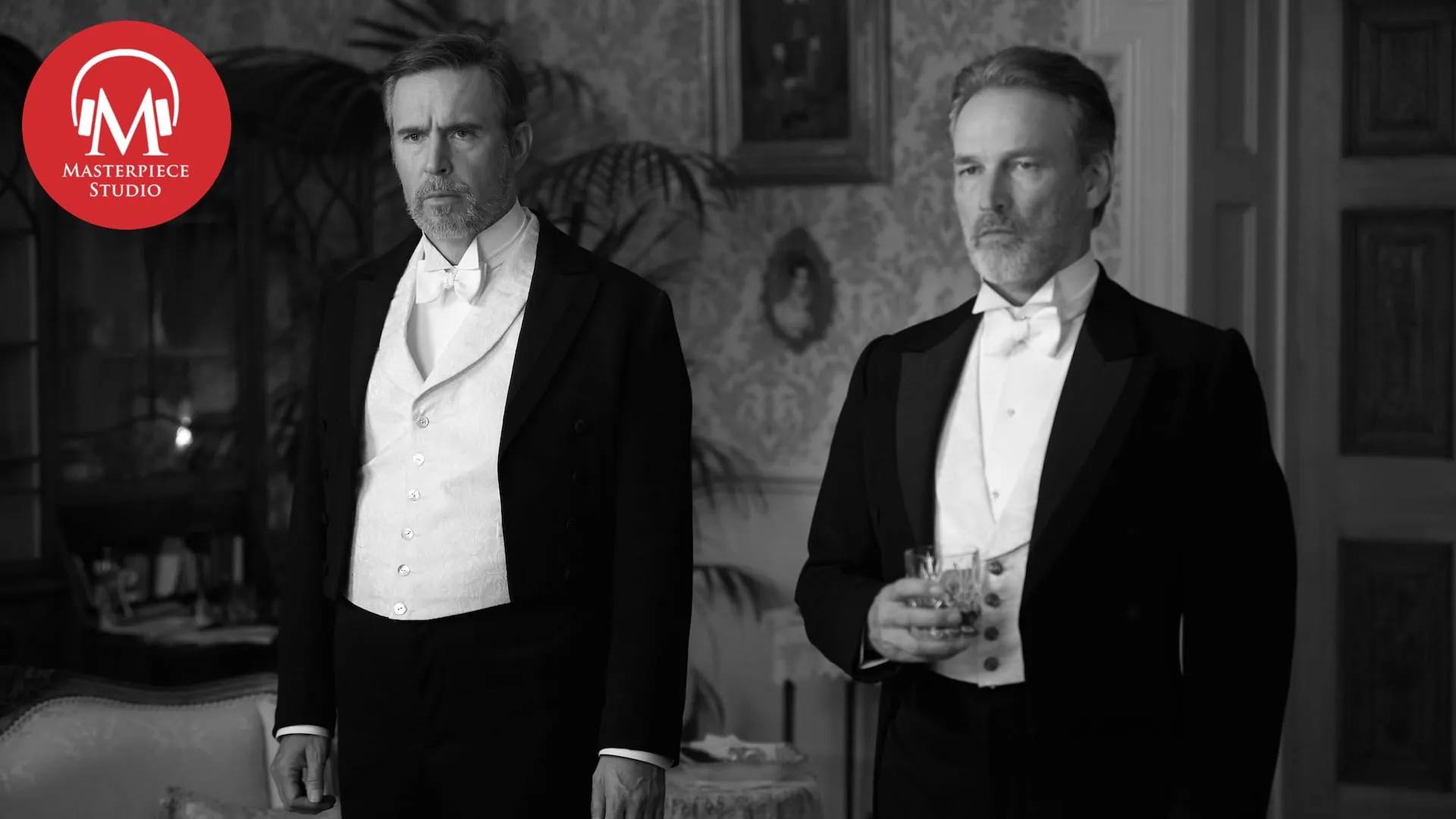
Stephen Moyer and Jack Davenport, The Forsytes, Season 1
Released April 26, 2026 28:32
WARNING: This episode contains spoilers for Episode 6 of The Forsytes Season 1.
On screen, actors Stephen Moyer and Jack Davenport play brothers and bitter rivals Jolyon Forsyte Sr. and James Forsyte. But off screen, the two couldn’t be closer. In this episode, we talk with Stephen and Jack about being neighbors, playing golf, raising children, and how their off-screen friendship of 35+ years informs their on-screen dynamic.
This script has been lightly edited for clarity.
Jace Lacob: I’m Jace Lacob and you’re listening to MASTERPIECE Studio.
When it comes to bitter rivalries, none are quite as heated as that between Jolyon Forsyte Senior and his younger brother James. Then again, sibling rivalry has its own rule book. From vacation destinations to dinnerware, these two spare no opportunity for jabs or jousts.
CLIP
James: I was thinking to go to Bath next month.
Jolyon Sr: What nonsense. Harrogate’s far superior, if you really know your waters.
James: Is this, sure this is real Old Worcester? Think my brother’s been diddled.
Beneath their banter lies real tension and resentment. As the eldest son, Jolyon Sr. heads the family business, the reputable stockbroking firm, Forsyte & Co., a position his younger brother James has been coveting for years. As such, Jolyon Sr. and James have both consciously and unconsciously passed this dynamic down to their sons, Jolyon and Soames. Just as James strives to surpass Jolyon Sr., Soames takes any chance he can to undermine his cousin, heir apparent young Jolyon. And of course, he has the support of his father, James.
CLIP
Frances: The Carterets and Latimers are confirmed but for some reason the Armstrongs have sent their regrets.
Jolyon: I can think of a few reasons. Four pits, 2,000 jobs, and a family in mourning.
Soames: Need we revisit this?
Jolyon: Oh, I realise it’s inconvenient to be reminded.
Soames: We can’t afford to be sentimental.
Jolyon: Can we afford to be human?
Frances: Do excuse us.
Soames: A disagreement at the office.
James: Yes. Usual story. Soames the pragmatist, Jo the hothead. Most unseemly. Sets a very poor example to the clerks.
In time, we learn that Jolyon Sr. and James’ rivalry is a bit more complicated than we were previously led to believe. It wasn’t just the head seat at Forsytes & Co. for which they were competing.
CLIP
Ann: I once knew a couple of young men who pursued the same girl, simply so the other wouldn’t get her.
Jolyon Sr: Let me fetch you a drink.
Today, we’re joined by actors Stephen Moyer and Jack Davenport to talk about how they leverage their off-screen friendship to deepen their on-screen rivalry.
Jace Lacob: And this week we are joined by The Forsytes stars Stephen Moyer and Jack Davenport. Welcome.
Jack Davenport: Hi there.
Stephen Moyer: Hi there. How are you doing, guys?
Jack Davenport: How are you?
Jace Lacob: Good. How are you lot doing?
Jack Davenport: Good, thanks.
Stephen Moyer: We're good.
Jace Lacob: So before we get into The Forsytes, I want to rewind and talk about the two of you and your friendship, which goes all the way back to 1998, when you met on a Channel 4 vampire drama that I was obsessed with at the time called Ultraviolet. What do you remember of your first meeting?
Stephen Moyer: It's very, very nice to know that there's one of you out there who loved that show. I actually do not remember meeting Jack for the first time. I do remember some specific locations and some—
Jack Davenport: Do you remember that playground?
Stephen Moyer: Yeah.
Jack Davenport: That freezing cold playground.
Stephen Moyer: Yeah, yeah.
Jack Davenport: We were sort of seen at night next to a jungle gym and we were freezing. That's all I can remember.
Stephen Moyer: And I had… very kindly Tina Turner had lent me her hair. I remember reading that script and I'd been in America for a bit, and I remember reading that script and going, oh, this is good. This is a great part. I'm not in it as much as Jack, but I was very excited to go and do that job. And Jack and I became friends. As it happens, and interestingly, it turns out that we had actually been in each other's orbits at the time at the end of 1991. I had left drama school in July 1991 and my first job was at the National Theatre of Wales in a place called Theatr Clwyd in Mold, if you can believe it. I promise you that that is what it's called.
Jack Davenport: A town called Mold.
Stephen Moyer: It was a town called Mold. And it's very onomatopoeic.
Jack Davenport: It sure is!
Stephen Moyer: But it's where the National Theatre of Wales is. And I was doing Oliver. Having gone to drama school to do drama and try to get away from musicals, my first job out of drama school was a musical. And in the Black Box Theatre next door, they were doing a rather good production of Hamlet, with, I think Toby Jones, one of Toby Jones's first jobs.
Jack Davenport: It was his first job.
Stephen Moyer: His first job. One of Rhys Ifans’ first jobs. And a young Jack Davenport.
Jack Davenport: 18 year old phenom. So, you know, from little acorns. And here we are now.
Stephen Moyer: I mean, in truth, we have known each other our entire careers, which is kind of nuts, really.
Jack Davenport: That is nuts. So 35 plus years.
Stephen Moyer: Yeah, 35 plus years.
Jace Lacob: That's mad. And now mighty oaks.
Jack Davenport: I wouldn't, I yeah, you know, maybe sapling struggling against the harsh northeastern wind.
Stephen Moyer: I would say a very old gnarly oak that's hollow in the middle when I'm thinking of Jack.
Jack Davenport: There we go. That's nice, yes.
Jace Lacob: That's quite nice. So I went back and watched the first episode of Ultraviolet this morning for the first time in years.
Jack Davenport: Good lord!
Jace Lacob: I did.
Stephen Moyer: Where did you find it? Where did you find this VHS?
Jace Lacob: Channel 4 on demand.
Stephen Moyer: Are you serious?
Jace Lacob: Yeah.
Jack Davenport: Wow.
Jace Lacob: It's on there. It's on there. And yes, you have fantastic hair in that.
Jack Davenport: Doesn’t he?
Stephen Moyer: That’s the only thing that you can remember about this.
Jack Davenport: I know. Mufasa’s in the house.
Jace Lacob: Looking back at that time, if you don't remember the exact first meeting, what were your first impressions of each other on that set?
Stephen Moyer: Jack was quite famous, actually. And I had done some rather sketchy work around and about. I'd been doing quite a lot of theater and I'd done some other bits of television. Jack probably didn't know who I was from Adam. I did know who Jack was because Jack had done some really great work. And so I was actually rather pleased to be in his company until he—
Jack Davenport: Started talking.
Stephen Moyer: Until he started talking! Until about halfway through the shoot, I don't think Jack remembers this as well as I do, but you'll see why in a minute. We both were down to the last two to play the character that Jack ended up getting in The Talented Mr. Ripley. And I didn't know he was going to be there the day that I had gone in to do my final reading with Anthony. And I saw this little leg bobbing about through the door and I was like, that's Jack Davenport's foot. I was so angry. But he saw me on the way out, and I went in and I had a lovely meeting with Anthony. And then a couple of days later, Jack came to my door. Do you remember this?
Jack Davenport: I do vaguely.
Stephen Moyer: Jack basically came to my door and knocked on the door, and he apologized profusely and was extremely kind about the fact that he had got the part. And I thought that that was a very noble thing to do, and it stayed with me. And many years later, we'd see each other around and about. And many years later we were living in Los Angeles, about a stone's throw from each other and our friendship sort of just carried on from there. And it's been lovely. And getting to do this again, it's very nice to work with people that you know. It's very nice to play characters who despise each other when you secretly kind of love each other. It's very apt for siblings, really.
Jace Lacob: Jack, if Stephen hadn't become an actor, what do you think he would have succeeded at doing professionally?
Jack Davenport: That's a loaded question.
Stephen Moyer: I can't wait!
Jack Davenport: Actually, no I'll be nice about this. Actually, Steve has many strings to his bow. He plays music. He's a great photographer. He writes very well. He's a director in his own right. He's infuriatingly, what you would call a multi-hyphenate at this point. So in many ways he doesn't have to be an actor anymore, which would be a relief for us all. But in the absence of him nobly stepping aside and putting us all out of our misery, any of those. No, he's very, very good at lots of things, which drives me insane.
Jace Lacob: And Stephen, likewise, what about Jack? Let's turn the tables. What would he have excelled at outside of acting? Say, This Life, Ripley, hadn't happened, what would he be doing?
Stephen Moyer: I think he'd be an excellent antique salesman, because he's very good at talking about old things that bear no resemblance to the real world.
Jack Davenport: There you go.
Stephen Moyer: No, he doesn't agree with me when I say this, but he is incredibly bright and can speak beautifully about things. And I think he'd be an incredible reviewer of theater, film, book, anything. I think he'd be a fantastic Times or literary film critic or book critic.
Jack Davenport: Of course, the subtext of that is, those that do, do. Those that can't, are critics.
Jace Lacob: I love the backhanded compliments. They're flying.
Jack Davenport: So backhanded it's turned into an insult!
Jace Lacob: So, The Forsytes is only the second time that the two of you have appeared on screen together. You're playing brothers Jolyon Sr. and James Forsyte. And like Jolyon Sr and James in The Forsytes, you apparently lived next door to each other in Bristol during production of Season One of the Forsytes. How has your friendship changed since the time you first met?
Jack Davenport: Oh my God. I mean, look when we first worked, we were idiot children, really, and behaved accordingly. We're parents. We're obviously much older. We've had the incredible good fortune to continue working in this benighted profession. I think we have a modicum of perspective that we certainly didn't have back then. And I think also, and this sort of slightly plays into the playing of brothers in the show, it's quite an English thing that if you're constantly mocking someone that's often a real form of endearment.
But I think as we've gotten older, in the nicest possible way, especially playing these characters, we can throw any kind of metaphorical knife at the other one's forehead as hard as we like, and the other one broadly delights in the fact that someone's throwing something so sharp so hard at the other one. And I think that comes with a bit of age and experience. Sometimes actors can get a bit too confronted by that. But I'm always looking forward to whatever terrible thing Steve's going to do to me. And then I think of things to do back to him.
Stephen Moyer: Just to pony onto that, I think that as young men about town, watching our forebears and the people that we looked up to, wander around every single drinking establishment within W1 in London, we were very good at doing that together.
Jack Davenport: Oh yeah.
Stephen Moyer: And we have moved on from that. And it is a flash of time to suddenly sitting here in this hotel room that we are in, remembering who we were and who we are now.
I will say this, I had already signed on to this job when Jack was then approached to play my brother. They had told me that they were going to approach him, I was very happy about it. And, I had had a shoulder injury for quite a long time, and I’d sort of, post pandemic, gone into this slightly irritated hole where I couldn't move my body around anymore. And Jack got in touch with me and said, are you going to do this thing? Are you going to go to England and do this thing? And I was like, yeah, I think I am. He said, I've just looked at the schedule that they've sent me, and we're working 32 days out of about the 60, but we've got to be there the whole time. And I was like, yeah. He said, I'm thinking, golf. And I said, it's interesting that you should say that, I'm thinking the same thing.
I love working, he loves working, but also having time off and being able to do something together where we are still scathing and we're still shouting at each other and still being stupid is really lovely. So it's been rather joyous to be able to continue our friendship in that way.
Jace Lacob: You mentioned tossing around metaphorical knives at each other's foreheads. Jack, is it true that you pushed for Steven's character to be called “Old Jolyon” rather than Jolyon Sr., as he's called in Debbie Horsfield’s scripts?
Jack Davenport: When I say pushed, that's a slight misrepresentation. The initial draft of the script, it was written as “Old Jolyon”, which I thought was entirely apropos, given that Steve is incredibly old. But for some reason, and casting no aspersions, suddenly I get a rewrite, and you know in the script sometimes when there's rewrites, there's little star in the margin for what's been changed. I got this script and I started flicking through it and I'm like, well, there don't seem to be any rewrites of any dialogue. And then I start to notice a pattern forming, and there's only stars next to where who used to be entirely appropriately, “Old Jolyon” is now “Jolyon Sr”, which of course implies some form of, I don't know, depth of character, solidity, profundity. Well, I think we should lean into the kind of shivering decrepitude with which I am faced every morning before they plaster on the makeup and wheel him out and his dicky shoulder. I thought he was going to tell that story. He goes, even with a broken shoulder, I still beat Jack at golf repeatedly. So no, ask Debbie Horsfield. It's Old Jolyon. And in the books!
Stephen Moyer: So I had gone and had a look at the books, and the character is described as “bald and dome headed”.
Jack Davenport: What's your point?
Stephen Moyer: And it's “Old Jolyon”. And my point when I got back and we were Zooming together, I was like, people aren't going to understand what Old Jolyon means. Everybody's always somebody junior or somebody senior at this point. It feels to me that it would be more appropriate for a modern audience, purely to be able to understand what they were talking about, Old Jolyon wouldn't make sense because I cut such a youthful figure. So I thought that senior worked better, and I may have made it contractual. I can't quite remember now.
Jack Davenport: Yes, and I've since been trying to make it contractual to reverse it, but that's not really getting any traction.
Jace Lacob: So, dome head.
Jack Davenport: Thank you. There we go!
Stephen Moyer: By the way. By the way, I did make a—
Jack Davenport: It writes itself, Jace. You see that?
Stephen Moyer: I did create a musical playlist of what my character would listen to, and—
Jack Davenport: Slipknot.
Stephen Moyer: Slipknot, yeah. And it's called “Dome Head”. And there's some very beautiful music in there. I rather like doing that, trying to work out what my character would read and what he would have read, what he would have listened to, what he would have seen. And, this particular track list is called “Dome Head”. So, I'm leaning into it even with all of this wonderful hair on my head.
Jace Lacob: On the subject of music, there's a lot of guff about the younger Jolyon being an artist, his paintings revealing a sensitive artistic side.
Stephen Moyer: Could you describe what you mean by guff?
Jack Davenport: No, no, no, guff is guff is a very good word.
Jace Lacob: Guff. There's guff.
Jack Davenport: Pure guff.
Jace Lacob: Pure guff. About the younger Jolyon, his paintings have this sensitive artistic side that is at odds with the family business of making money. But Jolyon Sr. also seems to express himself through his art as well, through music. Does that connect him to his son or alienate him?
Stephen Moyer: They were trying to find a connection. I think they were trying to create an understanding that perhaps Old Jolyon, to make Jack happy…
Jack Davenport: Ah. That's better.
Stephen Moyer: ...Old Jolyon had perhaps had an artistic side in his life that he had put away and that he had done absolutely what was expected of him as the older son and taken over the company, and taking his father's work and moving it on and growing it even and doing everything that was expected of him. And yet, we see him quite introspectively sitting at the piano and I think that the idea of that was to show that there was an element of him perhaps, an element of regret in what he had expected his son to do. So, they had asked me if I would do that, and I thought it was a nice color to add to Jolyon, which doesn't actually exist in the books.
MIDROLL
Jace Lacob: Jack, to look at James for a second, he seems to look down on everything and everyone who isn't his son, Soames, with whom he's set up in constant competition with his cousin. But Soames has none of Jolyon’s art about him. He's all market analysis rather than Manet or Monet. Does James view his son and heir as an extension of himself or as an individual?
Jack Davenport: I think the former. I mean, James is like a walking blind spot. His cluelessness knows no bounds. And of course, part of the issue is that Soames to him is absolutely an extension of himself because this is his chance to right what he sees as the genetic wrong of his piano playing older brother, running the company merely by virtue of the fact that he was born a few years, well, actually many years before James.
And of course, that way complete madness lies. And we sort of joke, Josh and I, when we shoot these many, many party scenes and dinner scenes and what have you, all the time, we’re made to stand together. Everywhere we go, I'm like right there with him. And he can't shake me off because I'm constantly meddling and fiddling and pushing and prodding. And I think probably James could have benefited from some analysis because this is… yes, exactly, you've actually, I might steal that idea, you're quite right, he absolutely sees Soames as an extension of himself and not as an individual in his own right. And it is absolutely his undoing.
Jace Lacob: Probably. Jolyon Sr. and James have a bitter rivalry, the basis of which remains a mystery for much of Series One of The Forsytes until we learn that they feuded over a woman, Alexandra. Does that explain a lot of the enmity, a lot of the bitterness between these two brothers having warred over the same woman?
Stephen Moyer: I don't know if that is the case. I like to think that at a certain point in their lives, that there was great camaraderie between them and great love and great friendship, and that they were each other's worlds, actually. I think that Jolyon Sr., when he looks back at the idea of what that is, that connectivity to Alexandra, he doesn't see James having the same relationship that he had. He doesn't feel that it held the same weight in his hands as it did for himself. So he just negates its existence in that way. He knows that it's there, but I think he just doesn't believe that it was as strong as it was for him.
Jack Davenport: My guess is that Jolyon and Alexandra had a thing, our dad put a stop to it, and in James's pathological desire to just get one up on his brother in any way, shape or form, in my head, it's like James probably completely misrepresented why Jolyon had broken it off with her and bad mouthed him. And so it's not even that they see it differently, it is different. I think James only cares really about himself and to some degree Soames getting the big job. That's all he thinks about. He's solipsistic to the nth degree.
Jace Lacob: On this note of fatherhood, you're both fathers in real life. You both have sons. I have a 12 year old son. Has the experience of playing these damaging fathers changed the way you approach parenting your real life sons? Has it made you reevaluate any of your own parenting philosophies or choices you would make?
Jack Davenport: I mean, look, one of the things that the show, and again, that Debbie has wanted to do is, recenter the female characters in a way that they're not in the books and in some of the earlier adaptations of the books. And obviously, styles change. And even my own father would be astonished at the different way that I've raised my son. Because we're both married to very strong, self-actualized women. It's a partnership of equals and we do it together. And you'll get no complaints from me. I wouldn't have had it any other way. But it's a cultural sea change. So, in some ways, if there had been anything about James's parenting style that I recognized in myself, I'd have been a bit alarmed, if I'm honest. So yeah, I don't think it's maybe reevaluated. It's just added to the list of things not to do, I guess.
Stephen Moyer: I can't put it better than that. As people who often have to work away from home, and Jack's been through his fair share of this, when you have to go away and work away for like two or three months at a time, the level of guilt that you feel when you get back and therefore is equal to or not greater than the amount of presents that you bring back from the place that you've been to where you were enjoying your job, but being away from your children. So they get lavished. And mums will tell you this from all over the globe, when dad gets back, he's the champion because he brings all of those presents and he's there for a weekend and he does all of the things and he wears the kids out, and then he goes back to work again. And you try not to make it so, but often it is. But it's a very different thing from not being there at all. And I don't think that we have ever been that. So I don't think I think of this in terms of…
Jack Davenport: I don't think either of these characters were aware of their sons until they were about 16.
Stephen Moyer: Yeah. They would have been away.
Jack Davenport: That's the truth.
Stephen Moyer: They would have been away at school.
Jace Lacob: We learn in Episode Six that there is another Forsyte out there, Harry Faulkner, the son of Alexandra and one of these two Forsyte brothers who loved her in their youth. What did you make of this twist, and how does it further intensify the rivalry between the brothers?
Jack Davenport: Questions of illegitimacy are horrifying to people who value their place in society as much as these people do. Speaking from my own character, I cannot wait for James to step on a massive rake eventually and get smacked in the face because he's so quick to take the moral high ground about everything to do with other people. And there's this thing coming towards him that he has no idea about, which I think, if you play characters as unpleasant as I am, what you want to see is them getting their comeuppance to some degree. As do I. If it's just unremitting sneering and eye rolling, which I can do almost ad nauseum…
Stephen Moyer: He's doing it now.
Jack Davenport: I'm doing it now. I also welcome the moment where he will be, dare I say it, vulnerable, because we have—
Stephen Moyer: Hubristically challenged.
Jace Lacob: Hubristically challenged.
Jack Davenport: There you go.
Jace Lacob: Wow. The mysterious Alexandra will be played in series two by the great Sarah Alexander, making this a Coupling reunion for our beloved Steve and Susan. Jack, how great was it to be reunited with Sarah, and was this a piece of stunt casting or coincidence?
Jack Davenport: I don't think it was stunt casting, I think it was that she was the best person for the job. She's also in a show with Steve currently playing his love interest. So it's curiouser and curiouser. But I spent four years of my life with Sarah doing what now is a rather anachronistic format, which is the multi-camera studio sitcom, which is a very odd format and a lovely one. And it's like you're sort of putting on a little play every week. And so yeah, it was lovely. It was really lovely. And also, we've all lived quite a lot of life since we were last working together. So, there was a fair amount of catching up to do, which was equally delightful.
Jace Lacob: Stephen, it's Jolyon who learns of Harry's existence from Ann, who covered Harry's losses herself, while James is still very much in the dark. Does this give Jolyon a new source of power to hold over his brother?
Stephen Moyer: Yes, and I think it's quite interesting in the way that Francesca's character bestows this information because she is setting off a domino that she doesn't realize is going to have huge repercussions. She's trying to do it to quell Jolyon Sr.'s behavior by explaining that the two of us, when we were younger, had done things too. By explaining that she's covered the debt, she starts off a catalogue of events that ultimately will be her fault. I think the thing about Jolyon Sr. is that it doesn't even occur to him when she mentions Harry, that Harry can be anybody else's other than his. So I don't think that he's really thinking about James at that point. I think he's thinking about the fact that he's been a widower for twenty years.
Jace Lacob: Stephen Moyer and Jack Davenport, thank you very much.
Jack Davenport: Thank you.
Next time, in a town roughly 76 km away and 76 years in the future, we check in with Grantchester’s premier crime-solving duo, Reverend Alphy Kottaram and Detective Inspector Geordie Keating.
CLIP
Geordie: It’ll be to do with your mum.
Alphy: What will?
Geordie: The dream.
Alphy: Mira.
Geordie: Mira, sorry. You have a big day coming up.
Alphy: Ah, it’s not that big.
Geordie: You must be nervous.
Alphy: I’m excited.
Join us on Sunday, June 14th for the final season premiere of Grantchester. But first, the cast and writer of The Forsytes wraps up Season 1 and gives a taste of what to expect from Season 2 of The Forsytes coming to MASTERPIECE in 2027.
The Forsytes Podcasts
7 More Podcasts


MASTERPIECE Newsletter
Sign up to get the latest news on your favorite dramas and mysteries, as well as exclusive content, video, sweepstakes and more.