Life at the Real Downton Abbey: 10 Questions for Lady Carnarvon
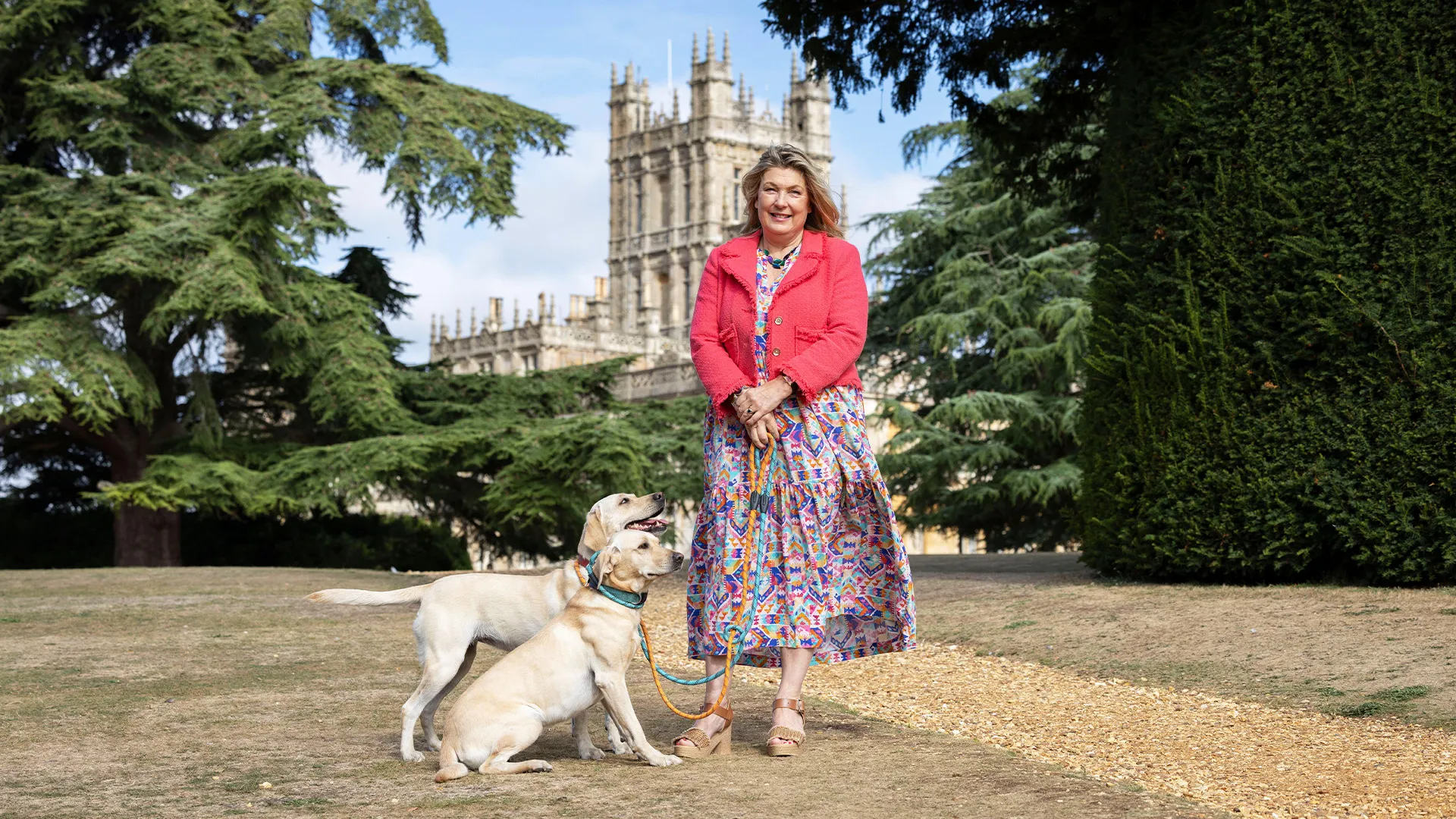
What is it actually like to live inside the real Downton Abbey? For 25 years, Lady Fiona Carnarvon, the 8th Countess of Carnarvon, has called the iconic Highclere Castle her home. In this interview with MASTERPIECE, she discusses her newest book, A Year at Highclere Castle, and recalls life on the busy set during filming. Read on to discover the biggest public misconception about the historic estate, the Maggie Smith moment she still thinks about, and a charmingly unglamorous anecdote that offers a glimpse of the real Highclere.
MASTERPIECE:
You've written a number of books chronicling Highclere's rich history and traditions. So why this book now?
Lady Caranarvon:
I thought it was a wonderful time to look back on the journey from 2010 when we were first filming Downton Abbey. Now’s an ideal point in time to reflect, contemplate, and also write some of the real-life goings on at Highclere. Not just the past, but the current challenges and the laughter and the hilarity and what goes wrong, which I think is as much fun as what goes right.
MASTERPIECE:
What does your writing routine look like when you're also managing this working estate and welcoming the public?
Lady Caranarvon:
I'm often writing at teatime, because I can cover some of the visitor or property business like broken drains or the broken washing machine in the morning, and I'm not holding people up. After lunch, I tend to try and disappear upstairs. I have a writing room on the top floor of the castle, which is a bit of an effort for anyone to come to. And the rule is that they have to bring me a cup of tea, or later on, a glass of something bubbly or they can't come up. I go up there with a couple of our Labradors because I know they’ll need little breaks as I do, too. It’s a lovely place and I love putting on some classical music—its rhythms help my brain relax and that's how I then get into the writing.
MASTERPIECE:
Tell us about living in a place that exists simultaneously as home, historical artifact, and a fictional universe for millions of people.
Lady Caranarvon:
Well, it's a bit of a muddle, actually! I think the thing to do is to grasp the muddle and make the best of it. … At the start, it was quite weird, because we'd have coaches [tourism buses] turning up with “Downton Abbey” on them instead of “Highclere Castle.”
And for some of our guides who'd been here for 20 years, they said, "Oh, Lady Carnarvon, this is terrible." And I said, "Well, don't think of it like that. Let's adjust and think whatever makes people happy to come here, let's welcome that." I think it's just relaxing into it, which took us all a little bit of time, but I think we've found our modus vivendi and it works well. It's about making people happy, giving people a timeout. It is a world apart here and I think you see that in reality, and I hope through my books, and also in the TV show. So I think they come together, which is great.
MASTERPIECE:
Is there a common misconception people have about life inside a stately home like yours?
Lady Caranarvon:
Yes. I think they think we have money, and we don't. Much of what we do on social media [about the castle] will instead make people appreciate that I'm standing there in my cotton socks like anybody else, thinking, "Okay, how are we going to earn the money to pay the salaries this month?" There is no secret sauce. It's all of us working together. And there's both short-term, medium-term, and long-term strategy, but there is no hidden trust.
It's definitely a challenge, but that doesn't mean one shouldn't pick up the challenge. I hope that some of what I'm writing and sharing makes people understand that, along with the outdoor views and the most beautiful architecture in front of me, I also have quite a few responsibilities and there's nobody to help. …. There is no governmental help, there's no historical help. We don't have any fairy godmothers. I'm always looking, but I haven't found one yet, so it's just up to us.
MASTERPIECE:
What is the least Downton Abbey-like thing that happens there regularly?
Lady Caranarvon:
Well, the sight of me getting in a tracksuit to bicycle around the estate is not very Downton Abbey, but I did that this morning, all the while thinking, "Oh my god, I'm unfit." But off I went, because there's an amazing oak tree, which I adore, and I wanted to work out how old it was. I propped my bike in the grass and propped my phone on the bike and managed to film, I think, much of an Instagram post of me moving around the tree with my arms outstretched, measuring its girth. … I don't imagine Lady Grantham would do that in Downton Abbey, though she might have something to say about it. By the time I finished, my bright green tracksuit was rather filthy, but I quite liked the outing, and I pushed my bike back again.
MASTERPIECE:
Like Lord Grantham, you own Labrador retrievers. What did your dogs get out of Downton Abby’s filming there?
Lady Caranarvon:
Food! The dogs loved the trestle tables. It's extraordinary how they knew the sound of all the different lorries, and they knew where they parked, and they'd be found running over there. And then at the end of an evening when I'd go out for a walk and everyone was gone, it'd be just the dogs and I; they knew where all the bins were. So, I’d go out with eight dogs and come back with three—that was fairly disastrous.
MASTERPIECE:
Is there an interaction with a cast member that comes to mind most often?
Lady Caranarvon:
Well, it was such an honor to welcome Maggie Smith to the house; that was extraordinary. I remember standing with her on one of the early filming days when Matthew Crawley was arriving with his mother. And Maggie Smith sort of turned to me, I think she was just musing out loud, saying, "I wonder whether I should shake hands or not?" And it's funny, those small moments now, which I clearly remember. I don't think she was looking for an answer, and I can't even remember if I said anything, but there were moments like that which I now hold very dear.
MASTERPIECE:
Which downstairs Downton Abbey character would you hire in a heartbeat to join your staff?
Lady Caranarvon:
Oh actually, I think most of them, because they were just so charming and fun. Lesley Nicol, Mrs. Patmore, is utter heaven—she’s been a guest here—but she can't in fact boil an egg. I’d hire her for sure but bring her straight upstairs. Jim Carter [Mr. Carson] was charming. Sophie McShera [Daisy] was also just such a nice person. So was Jo Froggatt [Anna].
I saw more of the downstairs cast because they were usually waiting outside all day. There’d be a big scene in the dining room, with all the posh, upstairs people in there for hours on, 11 hours at a time, and you'd have the downstairs actors hanging around all bloody day because they had to go and say, "You rang me, Lord?" or whatever.
MASTERPIECE:
Was there a visual moment for you when Highclere Castle itself became a character in Downton Abbey’s story?
Lady Caranarvon:
I'm not sure. Sometimes I think it's the scenes outside Highclere on the lawns—that sense of going under the cedar trees. The scene at the end of the first season when Hugh Bonneville announced the First World War; that was so moving and emotional. And the many scenes on what we still call Lady Mary's bench, just looking past the bench into the landscape and up at the hillside. So funnily enough, it's often looking out, looking out from the castle, which I very much liked.
MASTERPIECE:
After reflecting on life at Highclere across the course of a year in your new book, what do you understand differently about the castle?
Lady Caranarvon:
I just think the more I understand something, the more I know it, the more I love it, and perhaps the better I share it.