
Tessa Peake-Jones Interview: Saying Goodbye to Grantchester’s Mrs. C.
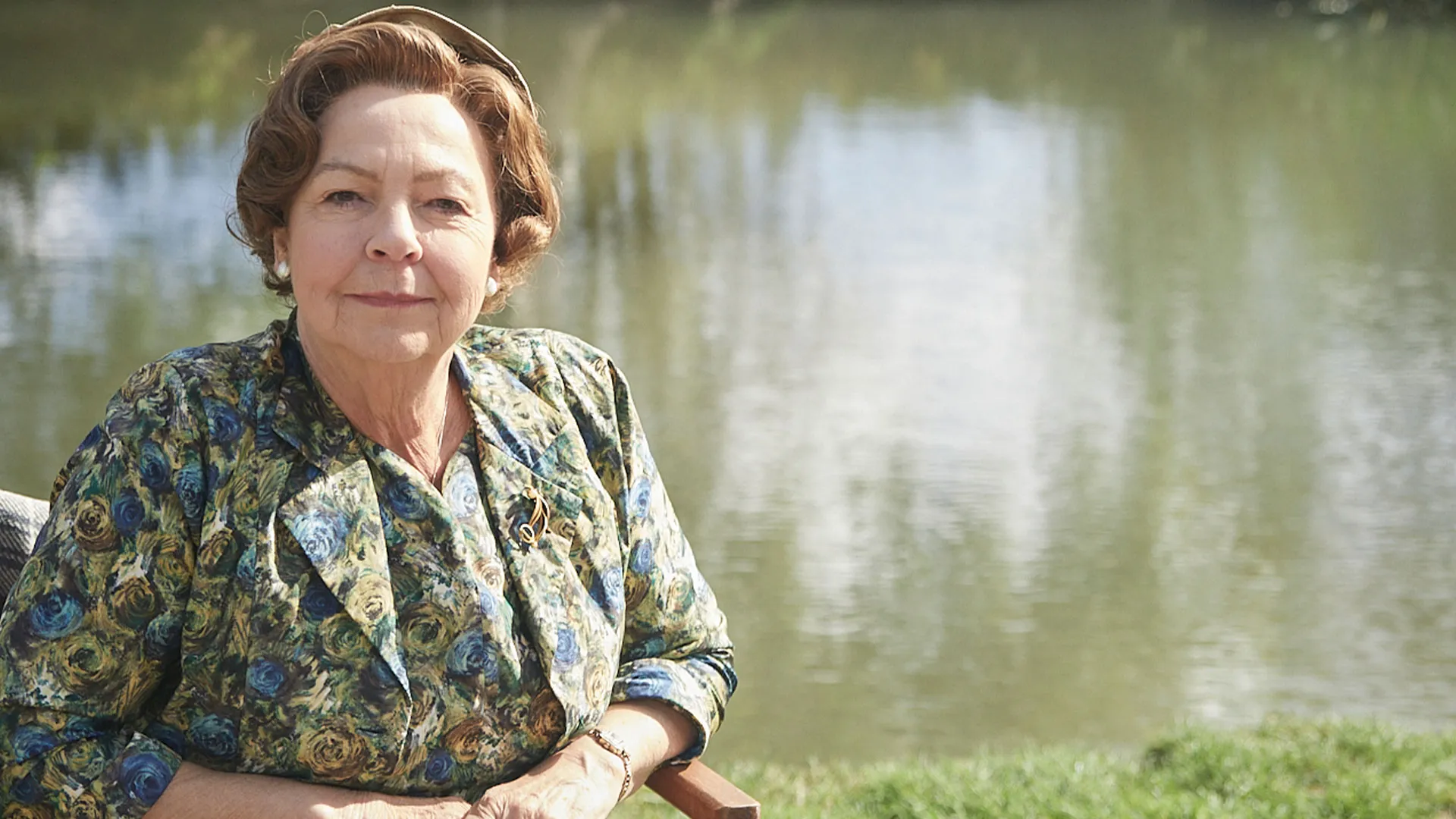
From the very first episode to the very last, Tessa Peake-Jones has been there for it all! Read our June 2026 interview with the star behind the marvelous Mrs. C. to learn more about what it was like filming the 11th and final season of Grantchester, which storylines she was most moved by, and her enduring friendships with her co-stars.
MASTERPIECE:
What do you remember from your very first day working on Grantchester?
Tessa Peake-Jones:
We [the cast and crew] had not really met each other before. A few of us had gone out for dinner the night before in Cambridge, and that was the first time the producer, the writer, the director, and some of the cast were all together. I remember thinking, "Wow, I wonder how long we're all going to know each other for," because of course, when you start a job you never know.
On Monday morning we were in the garden of the vicarage, and I think it was James Norton there, myself, Al Weaver, and Robson Green. We were about to do a scene, and Robson said, "How long do we all think this series will go on?" And we went, "Well, we don't know. It seems quite good. But who knows how long it will go on?"
He said, "Wouldn't it be funny if it's going on so long that we get really old on it, we become gray haired and we have walking sticks?" And we all hooted with laughter...Now here we are, not quite with walking sticks, but certainly 11 years older.
MASTERPIECE:
Is there a particular Mrs. C. storyline that you connected with or moved you most?
Tessa Peake-Jones:
I suppose in terms of Mrs. C. and her journey in life, it was in Season 7 when she worried she might die after the cancer diagnosis. I think that was quite important in terms of her storyline because, not only was it about facing her mortality, it was also about how she came together with the people that meant the most to her, especially with Leonard and the two of them facing those hospital appointments together. I think that was very meaningful and interesting that she chose him and not Jack Chapman to go to the hospital with her.
MASTERPIECE:
What are you proudest of when it comes to Mrs. C.'s evolution over the years?
Tessa Peake-Jones:
I think it's lovely that someone who started Season 1 as a fairly opinionated, grumpy, narrow-minded woman, [one] who was not really able to budge in her opinions, and [was] lonely...You look at her in Season 11, and she's fulfilled in a way, I think, she never knew. She has a family she certainly never dreamt she'd have.
There will always be things she's going to have an opinion about, and that won't change. But she's certainly more open-minded and accepting of other people's ways of life than I could ever have imagined her being in Season 1. So, I suppose I'm most proud that she has, through the young people on the show and Jack Chapman, learned to grow and accept and change her mind about things. Life's pretty good for her by the end.
MASTERPIECE:
What's one storyline that did not involve Mrs. C. that really moved you?
Tessa Peake-Jones:
Lots. But...I think [Leonard's] going to prison in Season 6 and...being made to feel ashamed of his homosexuality. I think that was incredibly powerful. People were incredibly moved by that, people who felt it was good that that topic was being brought to light, and that [homosexuality] was at that time illegal, that it was punishable, that there was such bigotry about it.
Some people will say, "Oh you know, you're in the entertainment business. You're not saving lives, you're not surgeons." Well, we're not. But I think when topics can reach — whether it's in the theater or on screen — people that have had exactly that, a way of life where they have felt punished or suffered in some way and can see it being acted out and can then respond and say very bravely, "This happened to me or this was..." I think, in that way, we offer a rather good therapy for people, don't we?
MASTERPIECE:
Can you talk a bit about your friendship with Al Weaver?
Tessa Peake-Jones:
I'd known Al when he was a drama student. He was 21. At the drama school he went to, they would ask working actors to come in and advise people that were about [graduate]. I was given Al Weaver. I remember him being an incredibly good, talented actor then, but he didn't listen to a word I said. We've often talked about it since. But I remember thinking, "Oh, he's going to go far. He'll be all right." And here we are almost 20 years later working together on this program, which is gorgeous.
MASTERPIECE:
What was it like when you first read the scripts for Season 11?
Tessa Peake-Jones:
Sad. We didn't know [the season] overall because we'd be given the scripts in blocks. I believe we got the first three, and then we'd heard rumors about the rest, but we didn't really know because some of them weren't written yet. Then we received the middle two next, then the final three. It was a very odd knowing there'd never be another after that. We were all feeling a mix between, "Let's make the most of this because it's the last one we'll ever be together sharing," while at the same time going, "Oh, this is quite sad," and "Where are the storylines going to go?"
MASTERPIECE:
What was it like filming the final episode?
Tessa Peake-Jones:
Our final day of filming was very odd. They got us all in together, which was lovely. It was a mix of laughter, tears...and then at the very end, all of us were just hugging and crying and taking lots of photographs with everyone on the crew, because a lot of our crew have been with us through the whole series. It's been a bit of an adventure for all of us as a team, not just the actors.
MASTERPIECE:
What has it been like working with Robson Green all these years?
Tessa Peake-Jones:
I've never known anyone with quite so much energy. He does more in a day than any of us do. He's always got about seven projects on the go. He's got his own company. At lunchtime, he'll be talking endlessly to other people or doing emails, and yet he's got the energy to commit and be concentrated on the job he's doing as well. And he knows every single member of that crew, a hundred people, before he starts the job.
That is how professional Robson Green is. He's incredibly good at leading a company and making sure everyone feels very welcomed. Sometimes on jobs, it can be quite hard. I mean, if you come in just perhaps for one day or one episode, you don't know everyone, and everyone seems to be getting on, and having a little banter, and you think, "Oh, here am I." Robson's always been incredibly good at making sure, in the makeup trailer in the beginning of a day, that he introduces himself to whoever is new, and makes sure that everyone on set knows them. He's very, very good at that.
MASTERPIECE:
There was a heat wave in the U.K. this summer, and we know that Grantchester was usually filmed during summer. What was it like to film in those warmer months?
Tessa Peake-Jones:
We had [another heat wave] in 2022, which reminded me...I don't think it was quite as hot as it is at the moment, but it was really hot. I remember we were doing a scene where Geordie had turned up at the vicarage. We were about to film the scene, and we had to stand in the corridor outside the kitchen. Robson and I were waiting to come in for the queue, and he had arrived in his suit, his coat, a hat. He stood really still in front of me, and it was boiling; they had brought in air conditioning and fans. But obviously they had to turn them off for filming because of the noise.
As we were about to go on, I said, "Robson, are you okay?" Because he hadn't moved for quite a while. He said, "I've worked out that if I just don't move any muscle in my body, I won't feel as hot." And I thought, "You poor thing." We wear layers and layers. And I was standing there with a wooly cardigan, a dress, a pinny. You know? So, heavens knows if we'd been working this summer, it would've been really awful!
MASTERPIECE:
You've been in a number of mystery series, including a new project that you're currently filming. Do you think you, Tessa Peake-Jones, could solve a murder now?
Tessa Peake-Jones:
I don't know about that. I'm quite forensic in certain areas. So, I think I'd be quite good at picking up certain facts and clues. Trouble is, I only ever see the best in people. Even if I met a serial killer, I'd think, "Oh, well, he's okay. He's probably had a difficult life." I don't think I'd necessarily go, "Come on, Tessa, face it. This person is not good." So, I have a feeling I probably would be a bit naive in that way.
MASTERPIECE:
You were recently in the West End play Invisible Me. What's the biggest difference between stage and film acting? Do you prefer one over the other?
Tessa Peake-Jones:
I don't prefer one over the other. I love doing both. I'm eternally grateful for any work I get offered. I think to be in your 60s and still have a career as an actor is marvelous.
My ideal year would be to do half of one and half of the other. I was so thrilled to do Invisible Me because I hadn't done theater for three years because I was doing either Grantchester or other tellies. So, I'd really missed it. It was in a small studio space, so the audience was very close, and it was very intimate. I realized how much I'd missed it.
Personally, I'm not sure there is a difference...Basically, in both forms, you hope you have writing that tells the truth of whoever that person is you're playing. You tell the truth of those lines. And for me, whether that's in a theater or on screen, it doesn't really matter. You've just got to tell the truth.