An international research team has pushed the boundaries of growing human embryos in the lab. The embryos survived in culture dishes past the point where a normal embryo would have to implant in the wall of the uterus to survive.
Scientists achieved this breakthrough by changing the way they grew the embryos. At fertility clinics and research centers, scientists usually keep embryos in low-oxygen conditions, which help them survive the first seven days of development. But after those first few days, the low oxygen doesn’t seem to make a difference, and the embryos die off.
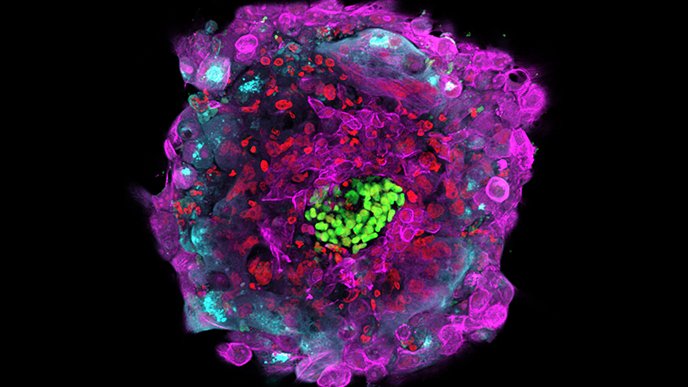
Instead, a team of researchers at the University of Cambridge kept their embryos in an oxygen concentration similar to that of normal air. Their colleagues at Rockefeller University in New York pioneered an artificial structure on which the embryos can implant. They then tried out the new method on extra embryos donated by infertility clinics. To their surprise, the embryos continued to develop past the implantation stage—all without a human uterus. This gave scientists their first look at this mysterious and important stage of development. During these few days, the embryos began to form the central cavity that would eventually become the body’s digestive tract.
The scientific advance has touched off a vigorous debate on if and how the new method should be used. Here’s James Gallagher, reporting for the BBC:


There is international agreement that experiments should not allow embryos to develop past 14 days.
This research is pushing right up against the legal limits and some scientists are already making the case for the 14-day limit to be reviewed.
Prof Azim Surani, from the Gurdon Institute, said: “In my opinion, there has been a case to allow culture beyond 14 days even before these papers appeared.”
The 14-day limit is decades old and is thought to represent the first point at which an embryo becomes an “individual” as it can no longer form a twin.
The researchers stopped their embryos’ growth at 13 days to comply with the regulation. Growing embryos past this point might help scientists figure out why half of artificially implanted embryos die . The fraught bioethics debate around this new study could decide whether biologists can explore human development past the two-week mark, and whether fertility clinics can make use of the new techniques.
