Planet Earth’s stunning diversity of 4,500 minerals may be thanks to its stunning diversity of life, according to a recent theory proposed by minerologists.
Rocks helped give life its start—serving as storehouses of chemicals and workbenches atop which the key processes sparked the complex reactions that now power living things—so it only seems fair that life may have returned the favor. “Rocks create, life creates rocks. They’re intertwined in ways that are just now coming into focus,” Robert Hazen, a research scientist at the Carnegie Institution of Washington’s Geophysical Laboratory, told NOVA.
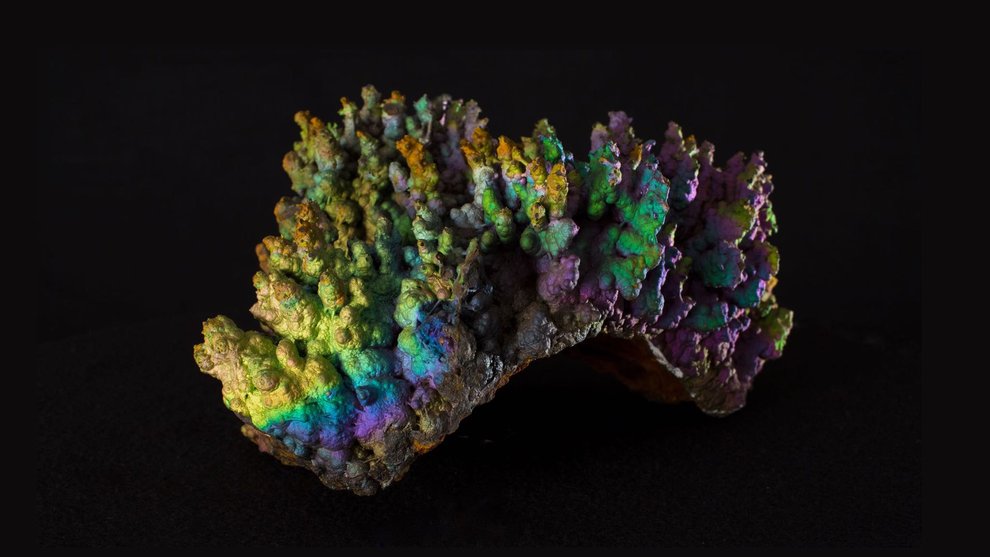
According to Hazen and his colleagues, who have published a slew of papers on the theory over the past several years, up to two-thirds of minerals on Earth may be the result of oxidation, a chemical reaction that occurs when one element loses electrons to another. The reaction was first discovered with oxygen as the oxidizing agent, hence the name, though other elements such as chlorine (Cl 2 ) can also act as oxidizers.
But it was oxygen that played an outsize role in Earth’s history. About 2.5 billion years ago, O
2 was released as a waste product by newly photosynthesizing algae. Within the span of about 300 million years, those microbes had boosted oxygen from nothing to 1% of the atmosphere, Hazen said. It was a rapid shift that would have wide reaching consequences.
As O 2 came into contact with iron dissolved in the ocean, it precipitated a rusty rain that sank to the bottom. Today, those vast swaths of Precambrian rust are still found in the trillions of tons of iron ore that are locked in banded formations around the world.
Other elements were similarly affected. Two-thirds of Earth’s minerals are the result of oxidation, Hazen said, and most oxygen on Earth was created by life.
“As a mineralogist when I look at earth history. I see big new transitions, I see the moon forming impact, I see the formation of oceans and so forth,” Hazen said. “But nothing, nothing matches what life and oxygen did to create new minerals.”
