This Week’s NOVA Next Feature Article
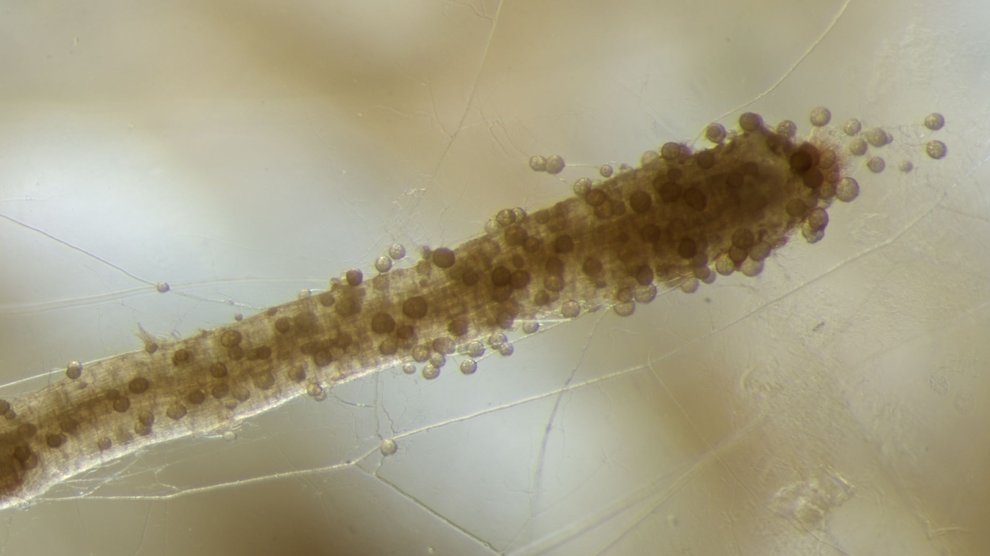
To feed a planet of 9 billion, scientists are breeding mycorrhizal fungi that promise to boost crop yields by unlocking more nutrients in the soil. NOVA Next contributor Cynthia Graber
In other news from NOVA and around the web:
- Ocean acidification is perhaps the biggest threat to marine life today. That’s why two Australian biologists are building underwater biodomes .
- With commercialization of the Arctic Ocean heating up, we’re coming to realize that we’re not prepared to deal with likely oil spills.
- See how a vast submarine “waterfall” off Antarctica helps drive ocean currents around the world. Watch “Earth From Space” streaming online .
- Check out this NASA visualization of the world’s surface currents.
- Most of Earth’s water may actually be locked in a reservoir 400 miles underground .
- Four colliding galaxy clusters are unleashing particles with the power of 1 million Large Hadron Colliders. Oh, and gravitational lensing from the wreck is also poised to give Hubble a massive boost .
- What if we could rid the body of HIV by reprogramming a patient’s own white blood cells ? Scientists think they know one way to do it.
- A supercomputer has tricked humans into thinking it’s a 13-year-old boy, allegedly making it the first machine to pass the Turing test. But did it, really ?
- Astronomer Jill Tarter told NOVA’s Secret Life of Scientists about the moment she discovered that Carl Sagan used her life as a basis for the film “Contact.”
- The White House is letting people nominate areas of the ocean (off U.S. land) and parts of the Great Lakes to be considered national marine sanctuaries .
- In Israel, scientists are making two devices—a smart contact lens and an iPhone app—to help blind people “see,” reports The New York Times. Experts in the United States, though, are turning to bat echolocation for inspiration.
- Chicago just convicted a thief using facial recognition tech. But are there limits to facial recognition? NOVA Next investigates .
- This Friday the 13th, witness an eerie “ honey moon .”
- The Guardian lists 10 questions science must attempt to answer. What do you think?
- Road salt is changing the bodies and brains of butterflies.
- A new theory suggests that male faces evolved to withstand fist fights.
- There’s new evidence of a world that crashed into Earth billions of years ago, forming our moon.
- Some bounce back from stress, while others don’t. Differences in brain cell connections could explain why.

Did you miss "Earth From Space" this week? Watch it streaming online.
