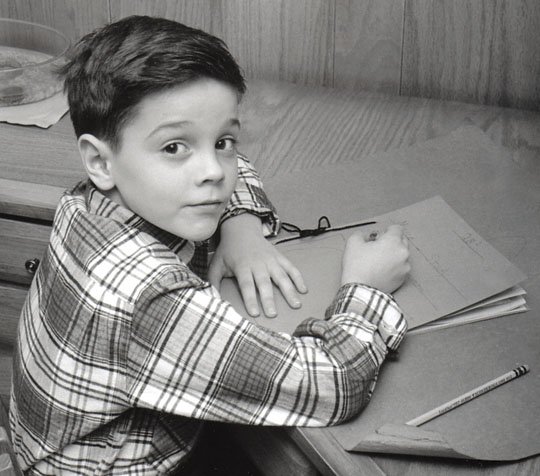
When it comes to children’s learning, are we focusing too much on schools—and not enough on parents?
Receive emails about upcoming NOVA programs and related content, as well as featured reporting about current events through a science lens.
“There is, quite rightly, a cacophonous debate on how to reform schools, open up colleges, and widen access to pre-K learning,” notes a new
article
, “Parenting, Politics, and Social Mobility,” published by the Brookings Institution, a Washington think tank. “But too little attention is paid to another divide affecting social mobility—the parenting gap.”
Talking to kids improves their capacity for learning.
Given all the roiling debates about how America’s children should be taught, it may come as a surprise to learn that students spend
less than 15% of their time
in school. While there’s no doubt that school is important, a clutch of recent studies reminds us that parents are even more so. A
40.htm?utm_source=Brilliant%3A+The+New+Science+of+Smart+Newsletter&utm;_campaign=abbb925eee-Brilliant_Report_16_1_2012&utm;_medium=email&utm;_term=0_9c734401c1-abbb925eee-306129765">
study
by researchers at North Carolina State University, Brigham Young University and the University of California-Irvine, for example, finds that parental involvement—checking homework, attending school meetings and events, discussing school activities at home—has a more powerful influence on students’ academic performance than anything about the school the students attend.
Review of Economics and Statistics
, reports that the effort put forth by parents (reading stories aloud, meeting with teachers) has a bigger impact on their children’s educational achievement than the effort expended by either teachers or the students themselves. And a third
52.htm?utm_source=Brilliant%3A+The+New+Science+of+Smart+Newsletter&utm_campaign=abbb925eee-Brilliant_Report_16_1_2012&utm_medium=email&utm_term=0_9c734401c1-abbb925eee-306129765">
study
concludes that schools would have to increase their spending by more than $1,000 per pupil in order to achieve the same results that are gained with parental involvement (not likely in this stretched economic era).
So parents matter—a point made clear by decades of
425&utm_source=Brilliant%3A+The+New+Science+of+Smart+Newsletter&utm_campaign=abbb925eee-Brilliant_Report_16_1_2012&utm_medium=email&utm_term=0_9c734401c1-abbb925eee-306129765">
research
showing that a major part of the academic advantage held by children from affluent families comes from the “concerted cultivation of children” as compared to the more laissez-faire style of parenting common in working-class families. But this research also reveals something else: that parents, of all backgrounds, don’t need to buy expensive educational toys or digital devices for their kids in order to give them an edge. They don’t need to chauffeur their offspring to enrichment classes or test-prep courses. What they need to do with their children is much simpler: talk.
But not just any talk. Although well-known
research
by psychologists Betty Hart and Todd Risley has shown that professional parents talk more to their children than less-affluent parents—a lot more,
resulting
in a 30 million “word gap” by the time children reach age three—more recent research is refining our sense of exactly what kinds of talk at home foster children’s success at school. For example, a
study
conducted by researchers at the
UCLA
School of Public Health and published in the journal
Pediatrics
found that two-way adult-child conversations were six times as potent in promoting language development as interludes in which the adult did all the talking.
Engaging in this reciprocal back-and-forth gives children a chance to try out language for themselves, and also gives them the sense that their thoughts and opinions matter. As they grow older, this feeling helps middle- and upper-class kids develop into assertive advocates for their own interests, while working-class students tend to avoid asking for help or arguing their own case with teachers, according to
research
presented at American Sociological Association conference last year.
The content of parents’ conversations with kids matters, too. Children who hear talk about counting and numbers at home start school with much more extensive mathematical knowledge,
report
researchers from the University of Chicago—knowledge that predicts future achievement in the subject. Psychologist Susan Levine, who led the study on number words, has also found that the amount of talk young children hear about the spatial properties of the physical world—how big or small or round or sharp objects are—predicts kids’ problem-solving abilities as they prepare to enter kindergarten.
While the conversations parents have with their children change as kids grow older, the effect of these exchanges on academic achievement remains strong. And again, the
way
mothers and fathers talk to their middle-school students makes a difference. Research by Nancy Hill, a professor at Harvard University’s Graduate School of Education,
finds
that parents play an important role in what Hill calls “academic socialization”—setting expectations and making connections between current behavior and future goals (going to college, getting a good job).
Engaging in these sorts of conversations, Hill reports, has a greater impact on educational accomplishment than volunteering at a child’s school or going to
PTA
meetings, or even taking children to libraries and museums. When it comes to fostering students’ success, it seems, it’s not so much what parents do as what they say.
How can parents support the “academic socialization” of their children? Share your thoughts on my
blog
, or browse past issues of the Brilliant Report by clicking
here
.