
|
|
Two-way radio
Wherever a firefighter is, communication is essential.
Firefighters wear two-way radios at all times, which they
use to talk to each other and their dispatcher.
back to top
|


|
|
Leather boots and rubber boots
Leather boots (worn by Tom) are the traditional footwear of
the firefighter. They are significantly lighter than rubber
boots and offer more ankle support, reducing leg fatigue,
which can be important when climbing stairs in a high-rise
fire situation.
Rubber boots (worn by Ed) have strong pull loops at the top
of the boot, allowing firefighters to quickly pull them on.
They have a heavy felt lining for comfort and protection,
steel toes, and slip-resistant soles.
When firefighters are at their station they keep the shank
of their boots inside the cuff of their turnout pants and
position them next to the fire trucks so they can don their
boots and pants in one swift motion when responding to a
call.
back to top
|

|
|
Turnout pants
Turnout pants, also called bunker pants, are made of many
different layers of fire-resistant synthetic materials, such
as Nomex, Dermoflex, neoprene, and Kevlar, which protect
firefighters from extreme heat. A firefighter's turnout
pants are held up by suspenders, which make them easy to get
into and comfortable to wear.
back to top
|

|
|
Hood
Similar to a ski mask, the so-called "anti-flash" hood
protects the firefighter's neck and head from extreme heat
and flames with a single layer of fire-resistant Nomex
material. The hood can also be used as a crude air filter in
smoky environments.
back to top
|

|
|
Helmet
Following tradition, a firefighter's helmet is made out of
leather, lined with a hard protective shell. The helmet is
stitched to create vertical ribs across its top, which
protect the head from blows to the side. A long bill on the
back of the helmet keeps water and debris from dropping into
the firefighter's coat. Inside the helmet are built-in flaps
to protect the ears. Many helmets have flip-up face shields
attached to the brim, which provide face and eye protection
without inhibiting vision. On the front of a firefighter's
helmet a shield denotes the wearer's rank and engine company
number.
back to top
|

|
|
Turnout coat
Firefighters' heavy turnout coats, which weigh over 20
pounds, are made of a combination of fire-resistant
synthetic materials, such as Nomex, Dermoflex, neoprene, and
Kevlar. The coats are emblazoned with fluorescent stripes,
reflectors, and the firefighter's last name, which make the
wearer easy to see and identify. Turnout coats, also called
bunker coats, have ample pocket space for storing small
tools.
back to top
|


|
|
SCBA tank and SCBA mask
The self-contained breathing apparatus, or SCBA, delivers
clean, cool air to firefighters in atmospheres of hot,
noxious gases and smoke. Weighing more than 30 pounds, the
SCBA (seen here in yellow) adds significantly to a
firefighter's load.
The SCBA is similar to the SCUBA gear used by divers, but
instead of delivering air on demand as with underwater
breathing devices, the SCBA offers a constantly flowing
stream of air (a so-called "open circuit") through the
firefighter's face mask so he or she does not have to inhale
to initiate airflow. Depending on the nature of the fire, a
firefighter will carry a tank that holds between 30 minutes
and one hour of air.
back to top
|

|
|
PASS motion alarm
All firefighters wear PASS ("Personal Alert Safety System")
motion alarms, which are activated automatically when there
is airflow from the SCBA. The PASS alarm
sounds when its bearer does not move for at least 30
seconds, letting others know he may be unconscious or
trapped and signaling his location. The alarm's high-pitched
squeal gets increasingly louder until it is manually turned
off. Some new model PASS devices also monitor ambient air
temperature.
back to top
|

|
|
Flashlight
Firefighters carry flashlights or wear them on their
helmets. Their flashlights are specially made so that they
will not spark and ignite flammable gases.
back to top
|

|
|
Gloves
Firefighting gloves are made from pigskin. They are durable
and shrink-resistant if they become wet.
back to top
|

|
|
Rabbit tool
The Rabbit tool, aka the Hurst hydraulic spreader, enables
firefighters to quickly cut through or pull apart twisted
wreckage and pry open doors. The Rabbit tool is similar to
the Jaws of Life but is significantly lighter and therefore
more portable. It also does not require a connection to a
fire truck to operate, making it more likely to be used in a
high-rise scenario.
back to top
|

|
|
Rake
Also known as the pike pole or plaster hook, the rake is a
long-handled forcible entry tool useful for reaching up high
or to other inaccessible locations in a building.
back to top
|

|
|
Irons
Firefighters fit their axe and Halligen tool together when
they carry them and call both tools "irons." The axe (seen
in red and yellow) is used to break through locked doors and
scatter combustible material. The Halligen tool (seen in
silver) is useful for prying doors and windows open to gain
entrance to or ventilate buildings.
back to top
|

|
|
Fire extinguisher
In a high-rise fire, a firefighter would carry a fire
extinguisher for putting out relatively small spot fires
inside the building.
back to top
|

|
|
Hose
Hoses come in a variety of diameters, which are chosen
according to the specific size and nature of the fire. In a
high-rise situation, firefighters would carry a
two-and-a-half-inch hose, like the one Ed is carrying, made
of Kevlar with a rubber inner core. Most likely, a high-rise
would have water spigots for hook-up at various locations
within the building. The standard length of a hose is 50
feet.
back to top
|

|
|
Thermal-imaging camera
The most hi-tech tool in a firefighter's toolkit, the
handheld thermal-imaging camera (a Bullard model is seen
here) allows firefighters to locate a trapped person in a
poor-visibility situation or detect a smouldering fire
behind a wall. In the latter case, a building may sustain
less structural damage, because the camera allows
firefighters to pinpoint areas in need of targeted water or
wall removal.
The camera works by imaging the levels of heat in a room,
from very dark (coolest) to very light (hottest). A
firefighter searching for a victim in a fire would look for
dark areas; when searching for a hot spot behind a wall, he
would look for light areas.
back to top
|

|
|
Safety Line
Firefighters carry a Kevlar safety line, usually 200 feet in
length, for use in finding their way out of a smoke-filled
space. The line can be used between two or more firefighters
in a building or between a firefighter and a victim.
back to top
|


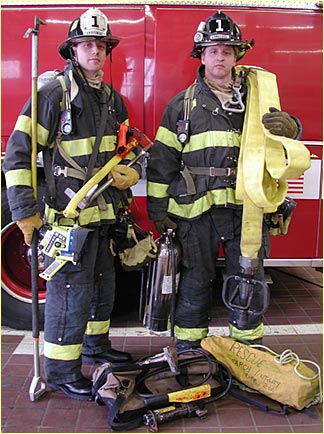 Meet Tom Carroll (left) and Ed Fales. Tom is a lieutenant and Ed is
a firefighter and paramedic with Engine Company 1 in Cambridge,
Massachusetts.
Meet Tom Carroll (left) and Ed Fales. Tom is a lieutenant and Ed is
a firefighter and paramedic with Engine Company 1 in Cambridge,
Massachusetts.

