
+ "Inside the Kingdom"
24-25 September, Riyadh
from Martin Smith
|  |
+ Inside the Kingdom | |
| |
+ My Baffling Question | |
| |
+ An Obedient Dissident | |
| |
+ An Audience with the Crown Prince | |
 | |
| |
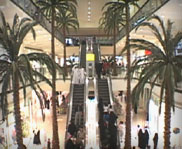
I traveled here during the Gulf War, but 12 years ago globalization was nowhere near as apparent. Today, on the main streets and inside the malls I see Starbucks, Burger King, McDonald's, Baskin Robbins, Wendy's, Pizza Hut, KFC, Body Shop, Armani Exchange, Saks Fifth Avenue, Hugo Boss, Swatch, J.C. Penney, Nike, Sony and Benetton. And they are just a few of the globo food and sundry stores open for business. Except for the people, the mosques, and all the signs in Arabic, the place looks and feels like Phoenix, Arizona. Dry, hot and impossibly sunny clear skies. The city sprawls for miles, predominantly a mixture of low-built buildings and housing punctuated by occasional glass and steel office towers and large block government complexes.
Around 4 million people live here and they race about on huge, noisy, four and six lane roadways. There are no pedestrians, bicyclists, or camel carts. Not here. This city is as sterile and air-conditioned as a space colony on planet Venus or Mercury. People spend little time outside, walking only those short distances between their homes, offices and shopping malls to their cars where they drive with windows rolled up tight and air conditioning on max with full fan. And for some unknown reason they drive like there is no tomorrow -- as if Saddam Hussein has just launched a nuclear attack. In fact, Saudi drivers (who, by the way, are all exclusively men) are so wild that all intersection traffic lights have been set to allow only one lane to cross at a time. This prevents them from making a left turn into oncoming traffic. It helps, but drivers still regularly make left turns from the far right lane and right turns from the far left. It takes getting used to.
| |
 | |
| |
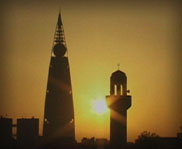
| Sunset in Riyadh. | |
| |
Chris Durrance, my associate producer, has been here for three weeks setting up appointments and getting permissions. In fact, he has worked for a year to prepare our way here. It hasn't been easy. This place may look like Arizona but its attitude toward foreign TV journalists has until only very recently been more like that of pre-1989 Albania. Closed. There are still few if any foreign news bureaus here. Not even from Arab countries. No wire services, no CNN or BBC office. The Saudis like control. It's a country which was completely a tribal culture only 40 years ago; it doesn't trust outsiders.
But now there are some small changes taking place. With post-9/11 suspicions and distrust of Saudi Arabia running at all-time highs, there are some members of the royal family who realize they need to open up a bit. "We see the world is changing," one prince told me, "and we see we are in the information age. There are few real secrets anymore. We need to stop fooling ourselves." The result of such sentiments is that some princes are inviting and sponsoring TV news crews. Print reporters have had limited access here for years, but now TV journalists, starved of access, are lining up in Washington D.C. at the Saudi Arabian embassy for visas. I am told the backlog of requests is long.
The process of opening up is a slow one and it is not the case that every one here, including many of the royals agree that openness is desirable or necessary. In truth, we discover, that few Saudi officials have any idea what openness really means. In their conception, reporting should be more about PR than true honesty. It is frustrating for us. Not only do many people not want to talk, the most simple tasks remain impossible. When we arrive, Chris tells Scott that we are still waiting for permission to film from the roof of the hotel. It doesn't seem to matter, that the application was placed a few weeks back. Still no word.
| |
|  |
| |
| Mall in Riyadh. | |
| |
Finally, inexplicably, we are denied permission to visit the Kingdom building, but we do get an invitation to visit Riyadh's second highest structure, the Faisaliah. We film there on the night of my first full day in town. I am standing in the warm breeze on the observation deck looking out at the city 60 stories below. Suspended above me is a huge glass ball, inside of which is a futuristic restaurant. Vaguely and sadly, it reminds me of Windows on the World, the restaurant at the top of one of the World Trade Center Towers in New York. As a New Yorker, I had dined there on a few occasions.
When we exit the building I notice that Scott is filming a sign at the entrance. I go over to see what he is doing. The lens is close up on a plaque commemorating the grand opening of the Faisaliah. Below in smaller letters, it reads: "Constructed by Saudi bin Ladin Group." I am left thinking how odd it is that the money the bin Laden family earned constructing so many of Riyadh's office buildings and mosques went to destroy the Twin Towers in New York and to damage the Pentagon in Washington. For after all, the enmity between Saudi Arabia and America lies behind a facade of sameness -- Saudi Arabia seems to like looking like America. Driving American cars. But, I think, how many Saudis eating at McDonald's and shopping at Saks Fifth Avenue will tell me how they feel persecuted by Americans for being Muslims?
In the next days, I will learn that Osama bin Laden is considered a hero for school children and that many of them have begun asking their parents to stop taking them to Burger King and Wendy's, to boycott Western products. They've had a year to think about events post 9/11 and this is their reaction.
home - introduction - mapping the journey
inside the tribal areas - ground zero: pakistan
discussion - interviews - producer's dispatches - readings & links
producer's chat - teachers' guide - tapes & transcripts - press reaction - credits - privacy policy
FRONTLINE - wgbh - pbs
photograph ©afp/corbis
web site copyright 1995-2014
WGBH educational foundation