

Read Transcript EXPAND
BIANNA GOLODRYGA: Now, hopes for a diplomatic resolution to the war in Iran have stalled after tensions in the Gulf flared again early Wednesday morning. Iranian strikes on Kuwait have caused widespread damage. One person was killed and more than 60 wounded in the attack that hit Kuwait’s airport.
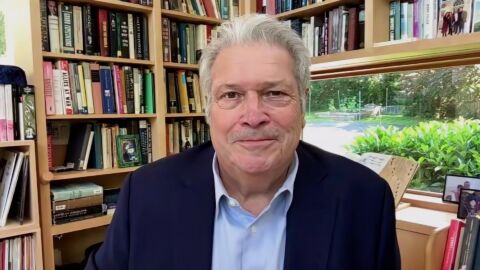
Meanwhile, the U.S. military carried out its own strikes near the Strait of Hormuz. In a new piece for The Atlantic, foreign policy scholar Robert Kagan argues that Iran’s leverage in the Strait leaves the U.S. with few options. He explains why to Walter Isaacson.
WALTER ISAACSON: Thank you, Bianna. And Robert Kagan, welcome to the show.
ROBERT KAGAN: Thank you.
ISAACSON: This war in Iran has gone on for four months now. Does it surprise you it’s gone on that long?
KAGAN: Well, in some ways it hasn’t gone on that long. I mean, in some respects, the war ended in March after the Israelis hit the Iranian Pars oil field and the Iranians retaliated by hitting the Qatari gas industrial complex. Trump ordered an end to attacks on Iranian energy facilities, and then went into a ceasefire. And really nothing has changed since then. Trump says a million things one way or another. He is gonna attack, he’s not gonna attack. But if you look at what’s actually happened it’s clear that Trump is unwilling to escalate. And so we’ve been in this kind of sort of cold war situation with nothing really happening for four months, other than the fact that the Strait has been closed.
ISAACSON: Well, other than the fact that the strait has been closed is a pretty big other thing. What happens there?
KAGAN: Well, we can clearly see now what the future looks like. Iran is in control of the strait. There seems to be no prospect the United States is gonna be able to open the strait by military force. Trump clearly doesn’t want to do that. Which means the straight will be open but under new management. It’ll be under Iranian management, which means they will control who gets in and who gets out, how quickly, and at what price, because they’re certainly going to charge for it eventually. And this gives Iran enormous leverage in the region and in the world. And we’re already seeing that leverage playing out today with the crisis in Lebanon and how Trump is handling that.
ISAACSON: So what should the administration do, or what can it do? Because this seems like a pretty bad stalemate of an outcome.
KAGAN: I don’t see any particular options. I think we have already lost this war. It’s just a question of when do we acknowledge it. Trump, of course, doesn’t want to acknowledge it at all, which is why we’re sort of in this stasis, sort of paralysis right now. But I don’t see any options for the United States. This mistake unfortunately is going to be a lasting mistake with lasting strategic consequences.
ISAACSON: If the Strait of Hormuz is open, sort of under new management, I think you put it, with Iran sort of controlling it. What does that mean?
KAGAN: Well, it means that the power relationship in the region will shift dramatically. I mean, before the war began, Israel was by far the strongest power in the region. Iran was decimated, weak, isolated. After the war – with Iran in control of the strait – Iran is gonna be calling the shots. You’ll see the Gulf states cutting deals with Iran. They’ve already begun to do so. And you’ll see Iran exercising influence over Israel’s behavior as it is doing right now in Lebanon. Iran wanted an end to Israel’s bombing of Beirut. They demanded it, and Trump called up Bibi Netanyahu and told him to cut it out, that that’s the future. Israel’s gonna find itself tremendously isolated. Iran is gonna be in a position to have leverage over countries as far away as Japan and Korea, who are of course, utterly dependent on access to the energy supplies of the Gulf, which Iran will be able to control that access.
ISAACSON: Well, let me summarize what I think you just said about where we stand now is that Iran will effectively control the strait, the enriched uranium, I assume, will not be taken out. They will help control of what Israel can do in Southern Lebanon. And there’s not been a regime change except for to a younger, more radical regime. That seems absolutely unacceptable. Is there any alternative? Is there anything that can be done?
KAGAN: Unfortunately, just because something is unacceptable doesn’t mean that we’re not gonna have to accept it. And again, look, I suppose there is some kind of war that the United States could fight, which would be a multi-month war, at the very least. It would require risking losing ships, you know, in the strait. When you convoy in a contested area, you lose ships. In addition to which I don’t think that the strait will be safe again as long as this regime is in power. And so if you really wanted to, I suppose, solve the problem – although I’m not sure what kind of solution it is – you’d have to invade and occupy Iran and stay there for a long time so that you had a new regime. And I just think there’s no way the American people are interested in doing that. And I’m not even sure I would recommend doing that at this point, because the costs are gonna be enormous. So, you know, we have to accept the fact that this is a loss. I mean, we have lost in the past, we’ve lost previous wars in Vietnam, obviously. Unfortunately, this one has much as we’ve been discussing, much greater strategic ramifications than the loss in Vietnam did, actually.
ISAACSON: Well, if you’re Trump and you hear what you just said, I think his instinct – it’s very hard for me to know – would be, okay, let’s bomb, let’s hit more targets, let’s destroy even some infrastructure until they relent. Is that a possible approach?
KAGAN: It really isn’t. And I don’t think he has – that’s not what I’m guessing he’s gonna do. What he would, what he would like to do is hope that the American people somehow can forget about all this. So he’s telling, you know, his, his latest statements are relaxed. It’s gonna take time. It always works out. He says and I think he would like to change the subject and move on. But you know, even an increased bombing campaign is not gonna solve the problem. I mean, we bombed around very effectively, it seemed, for 37 days without changing their course. I don’t know what the occasional tit for tat bombing is going to accomplish, in addition to which we cannot solve the problem, which is at the heart of this, that we cannot prevent Iran from wreaking untold destruction on its neighbors in the Gulf. And also, and perhaps, you know, from the world’s point of view, just as importantly, the energy infrastructure. Iran is capable of destroying energy infrastructure in such a way that it could take years, if not longer, maybe even a decade to repair, which would have implications for the global economy that are disastrous.
ISAACSON: How come nobody could foresee, or they did not foresee that this could be a total fiasco the way you’ve just described it?
KAGAN: Well, I think that it should have been foreseen. After all, Trump is not the first president to face the Iran problem, and he’s certainly not the first, you know, sort of hawkish American president to face the Iran problem. But if you look at what the decisions made by the two Bush administrations and all the other Democratic administrations, they all decided that this was a threat. I’m sure that Trump’s military advisors and maybe the CIA warned him that this could happen. They would be remiss in their jobs if they didn’t. But he didn’t listen because he’s Donald Trump. He saw a glittering object. Bibi Netanyahu presented with this possibility for a big win. And he will go down in history and have his head on Mount Rushmore for getting rid of the Ayatollah and the Iranian regime. And he didn’t think too much about day two, obviously.
ISAACSON: Well, you said it was an opportunity that Prime Minister Benjamin Netanyahu presented to him. To what extent do you think that Prime Minister Netanyahu pushed him into this?
KAGAN: Well, I don’t know how hard he had to push, but he certainly enticed him into this. I mean, it’s clear that he came to the White House and, and recommended this plan. I mean, reports are that people like Rubio and the CIA director said that they didn’t think this was gonna work, and Trump did it anyway. But it’s clear that this was an Israeli idea, which I gotta say the the tragic irony from Israel’s point of view is that I think this is gonna turn out to be the biggest setback in Israeli, you know, biggest strategic setback in Israeli history. And it was definitely an Israeli decision to go ahead and do it.
ISAACSON: Yeah. You talk about in your piece that this will be the biggest strategic setback in Israel’s entire history. Explain why.
KAGAN: Well, just because Israel’s arch enemy, I mean, what Israel considers an existential threat is now in a stronger position than it’s ever been before. Because as we’ve been discussing, because of its control of the strait, which means it’s gonna be able to manipulate other powers around the world in ways that it wants. So if Israel does anything that Iran doesn’t like, Iran can force the rest of the world, put pressure on Israel as again, it’s happening right now right before our eyes. This is the future. So Israel’s gonna be highly constrained on what it can do against Hezbollah and Hamas in Gaza, because Iran will be able to pull the string on oil supply, oil and gas supplies. If Israel does something that it doesn’t like. That’s a very weak position.
Plus Israel is now gonna be more isolated than it’s ever been before. Because in addition to the fact that the whole world is now – you look at the UN Security Council resolution yesterday, it was unanimous except for the United States. And support in the United States for Israel is at the lowest point, I think probably in its history. Neither party is very pro-Israel and Trump – and I think this is important – Trump is now turning against Israel. He may turn his MAGA followers against Israel too. And anyone who assumes that MAGA is diehard supporters of Israel and can’t be shifted if Trump gets annoyed with Netanyahu, are mistaken. So Israel, I just think Israel’s gonna find itself in a very isolated – Israel’s used to being somewhat isolated. This is more isolated because I don’t think they have the United States behind their back anymore.
ISAACSON: You paint a pretty dire, very dire picture of what it means for the United States’ strategic interest. And Israel’s, it also seems like it’s pretty devastating to the strategic interests of the Gulf States, the Saudis, the UAE and others. Are they gonna just sit back and watch this happen?
KAGAN: Well, they, what their response is gonna be, they’re gonna have to cut deals with Iran. And they are, of course, some of them are already doing that. Oman is clearly working with Iran. I saw that the Qatari foreign minister talked about making at least a temporary deal with Iran. They’re gonna have to come around. I don’t know, the United a Emirates seems to be still sort of in the Israeli camp. I don’t know how long that’ll last, but the others are not. And it was pretty clear at least from what we picked up, that the Saudis in particular were not in favor of this war. They could see very clearly over the course of the war that the United States prioritized Israel’s defense over the Gulf State’s defense. I mean, look, if you’re the Gulf State now, you put all your money on the United States. The United States then initiated this war at Israel’s behest and the war has been disastrous for the Gulf States, disastrous for their economies. So, you know, I don’t see why they don’t react to that by turning both to Iran, but also to China which is an important player, an increasingly important player in the region, partly because of its alliance with Iran. And so you’re gonna see an overall shift in the balance of power away from the United States and Israel and toward other powers in the region.
ISAACSON: There’s one thing I don’t get about this really dire scenario you’ve just painted, which is, if this is the case, why is oil so cheap in a way, why isn’t it $150 a barrel?
KAGAN: Well, I’m not an energy expert, but I understand that if you actually needed to buy, if you needed to buy a barrel of oil today, it costs something like $150 or $140, because that’s what the actual price of oil is. The oil prices we’re looking at are oil futures. And I’ll tell you one thing that Donald Trump has been an absolute genius at, and he gets an A plus for it, is manipulating the market and manipulating market expectations and watching oil future prices go up and down based on whether Donald Trump says there’s gonna be an agreement or not, has been pretty amusing because Donald Trump is now pulled the, you know, Lucy and Charlie Brown football trick now about seven times. The market goes for it every single time.
So these prices are not reflective of the reality. And now you even see major figures like Exxon top executives warning that the inventory levels, the world oil inventory levels, which have been basically keeping supply going – there was a lot of oil out there in the system. And there were of course, the strategic oil reserves of various countries, including the United States, which have been drawn down heavily. I think Japan’s is drawn down as far as it’s ever been, and what the energy experts are warning is that we’re gonna hit a point in the next two or three weeks where the inventory is really gone. And that’s the point at which they’re anticipating oil price shocks. Some people say $150, some people say $200 a barrel. And we’re definitely talking in any case, about gas prices in the United States, potentially hitting $6 a gallon.
ISAACSON: But isn’t that what the future price is supposed to reflect what people think will be happening a month and two months from now?
KAGAN: Yes, and people are mistaken, unfortunately. I think there’s a lot of – people are having a lot of, a very hard time imagining the outcome that we’re talking about here, which is where the United States has just lost. I mean, you know, Americans, there’s a great assumption – and if you watch sort of Fox News and you listen to a lot of Trump supporters, you’d think we were winning this thing. We’ve got Iran on the run. It’s just a matter of time. We’re squeezing them to death. We’re such a big, powerful country. And the answer of course is the opposite. But people can’t imagine a situation where we’ve really, we’ve really lost control of the situation and therefore are not gonna have the kind of agreement. Everybody’s assuming that it’ll get back to the status quo ante, and that the strait will be open, literally open, but as we’ve been saying, it’s gonna be open, but open under Iranian control, and that’s gonna be a different kettle of fish.
ISAACSON: The main reason we got into this situation at first, or so they said, was to stop Iran from becoming a nuclear power and maybe even get the enriched uranium out. Now we’re just talking about can we try to get the strait open? Is that totally – is Iran going to become a nuclear power now?
KAGAN: Well, first of all, it’s less important now, whether they do or they don’t, because their nuclear program is of less utility to them as a lever in the international system than control of the strait. The control of strait is greater than a nuclear weapon. But on the other hand, they also have no incentive to make any concessions on the nuclear issue. Now, you know, they have been saying for decades that they have no intention of building a nuclear weapon. So I’m wondering whether Donald Trump could have them say that yet again, and then declare victory and go home. He’s gotta find some way to declare victory. So it’s possible they’ll give him that. But the reality is Iran is not gonna make any fundamental concessions on the uranium or on anything else.
ISAACSON: Well, let me ask you the big strategic question, which is what does this do to America’s alliances around the world? And to what extent does that affect our competition, I’ll call it, with China?
KAGAN: And with Russia I would say. I mean, you know, the war itself takes place already in a context of the United States destroying our alliance relationships. I mean, we’re pulling our troops out of Europe. We’ve made it clear that we are not going to be responsible for providing security to our allies, which has been our main mission for 80 years. And so those alliances are falling down. And in Asia too, where we haven’t pulled out, we have over the course of this war, drawn down huge amounts of military capability, which are intended to deal with a China, Taiwan scenario or, or another kind of Asian scenario. So everybody can see how weakened we are, which means that countries like Japan are gonna have to go their own way.
So that was sort of all that was sort of in place. The Iran war has exacerbated all of that because in addition to us making it clear that we’re not gonna defend our allies, we also are not capable of playing the role that we’ve played for 80 years in keeping, you know, international waterways open. That was a major American task. It’s one reason why nations in the world depended on us, and therefore listen to us. I mean, you know, we always are unhappy about the degree to which nations depend on us, but it also gives us enormous influence. That influence is going to be gone as nations go their own way, as we prove that we are incapable of finishing a war we started, as we prove that we are incapable of dealing with – by the way – a pretty lesser power that was already very weak. I mean, again, a lot of sort of war boosters on the Republican side were bragging about how much damage we’ve done and how China and Russia are gonna be scared of us. I’m sorry, that is not the lesson of this war. The lesson of this war is that we took on a very weak and damaged power and have not been able to complete the job. I think the world is gonna see what that means.
ISAACSON: Robert Kagan, thank you so much for joining us.
KAGAN: Thank you.
About This Episode EXPAND
Politico columnist Jonathan Martin discusses the results of primary elections across America and what races to keep an eye on as we approach the midterms. Dominic Erdozain explores what it means to be a patriot even during times of deep anger and polarization. Robert Kagan, Senior Fellow at the Brookings Institution, on why he says the U.S. has already lost the war in Iran.
WATCH FULL EPISODE