
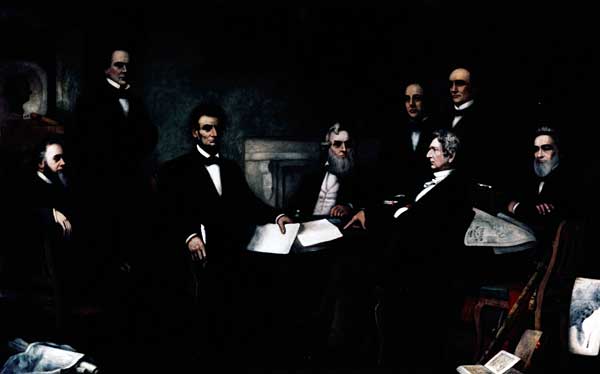
Lincoln Reads the Emancipation Proclamation. Francis Bicknell Carpenter lived in the White House for weeks in 1864 researching this painting. To help him, a camera operator from Mathew Brady’s studio (probably Anthony Berger) photographed Carpenter with his legs crossed as the pose for William Seward. A photograph of Lincoln taken that same day, February 9, 1864, was used for the portrayal of Lincoln, and portraits by Carpenter of each individual cabinet member were used for the group scene. The finished painting was unveiled on July 22, 1864. |
9. Lincoln was an abolitionist in the years preceding his presidency.
True
False
FALSE. The man known as “The Great Emancipator” was not always intent on the abolishment of slavery. Lincoln was raised to hold anti-slavery views and was against the expansion of slavery, but didn’t think that the Constitution gave the federal government the right to interfere with slavery in the states. His views on slavery were developed mostly for political and economic reasons. Additionally, in the mid-19th century it would have been an unwise political strategy to hold strong abolitionist views – if he had, Lincoln may never have been elected president!
The intentions of the Emancipation Proclamation are also steeped in ambiguity – did it actually free any slaves? The language of the document indicated that slaves would be freed in those states currently rebelling against the Union, but those states did not recognize Lincoln’s authority and thus did not adhere to the Proclamation. It’s suggested that the Emancipation Proclamation was intended as a political maneuver to preserve the Union, and had little to do with the slaves. Regardless of Lincoln’s earlier views and intentions, he did ultimately sign into effect the 13th Amendment, permanently ending slavery in the United States.

 © 2026 Educational Broadcasting Corporation. All rights reserved.
 LOOKING FOR LINCOLN is a film by Kunhardt-McGee Productions, Inkwell Films
and THIRTEEN for WNET.ORG in association with Ark Media.
LOOKING FOR LINCOLN is a film by Kunhardt-McGee Productions, Inkwell Films
and THIRTEEN for WNET.ORG in association with Ark Media.Sole corporate funding for LOOKING FOR LINCOLN is provided by State Farm®.
Major funding is provided by CPB and PBS. Additional funding for education outreach is provided by the Motorola Foundation.