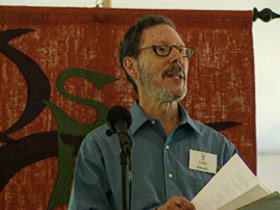
Exploring Religious America, Part Five: Comments and Analysis


BOB ABERNETHY, (anchor): For the last four weeks, in a special series, we have been “Exploring Religious America” through stories of religious believers and seekers, and in a special poll conducted last month with U.S. NEWS & WORLD REPORT. Today, we want to explore some of the questions raised in our series.

commentsanalysis-post01-candles

For instance, today’s America has been called the most religiously diverse nation on Earth. What does that mean for those who believe theirs is the only way to salvation?

Rev. JAMES MERRITT (President, Southern Baptist Convention): As a Christian, believing that Christ is not just a good way to heaven, or the best way to heaven, or even the Baptist way to heaven; but he is the only way to heaven. We can’t compromise that singular belief.

ABERNETHY: We reported the rapid growth of Evangelicals and Pentecostals, millions of Americans for whom the spiritual experience of worship is central to everything they do.

DANI BENTLE (Evangelical Protestant): It’s daily things, daily situations where we bring God into it or we bring Christ into it. And that’s how we live. I mean, every day.

ABERNETHY: We also reported on the essence of being Roman Catholic.

commentsanalysis-post02-pentecostal

EILEEN DURKIN (Roman Catholic): Catholicism is more than pronouncements for me. It’s life. It’s lived. It’s the people I’m with. It’s the experience of Jesus Christ in my life.

ABERNETHY: The emphasis on personal spiritual experience is also central to the large number of seekers outside traditional religion.

MARILYN MAGUIRE (Spiritual Seeker): If you want to hear the voice of God, or whatever a person wants to call this higher power, it’s important to listen, to be still.

ABERNETHY: With me to talk about some of the issues of American religious life are John Green, a political scientist at the University of Akron. And, joining us by satellite, Robert Franklin, president of the Interdenominational Theological Center in Atlanta; and Peter Steinfels, historian and writer of the Beliefs column in THE NEW YORK TIMES.

Welcome to each of you. Peter, we reported that Catholics to whom we spoke said that no matter how furious they are over the sex abuse scandal their fundamental faith has not changed. What do you see developing among American Catholics in response to this crisis?

commentsanalysis-post04-steinfels

PETER STEINFELS (THE NEW YORK TIMES): Well, there’s certainly anger, there is a lot of confusion about what has happened in the sex abuse crisis, and I think there’s a general desire for greater accountability beyond the issue of the sex abuse crisis. I wonder, however, how easy it will be to take any of these feelings and to translate them into practical, institutional changes, into organizational reform. Simply because of the size of the Church, because of its diversity, because of the fact that many of the groups that had been most outspoken on this issue have high profiles as either conservative or liberal and they are distrusted by one another and by people in the middle of the road. But, I think we should remember that there are people very involved in church life, and priests as well as laity that have been extremely affected by this crisis, who may get the ball moving.

Dr. JOHN GREEN (Political Scientist, University of Akron): I just had a question for Peter, if I might. Peter, there are some longstanding disputes in the Roman Catholic Church. What effect do you think these problems will have on those disputes?

Mr. STEINFELS: Well, I think that if questions like ordaining women or celibacy occupy the front burner in this issue — in the way the Church addresses it — it actually may delay action more than help it along. Because those are such large questions involving a global Church, that more intermediate steps that possibly could be achieved may be bypassed.

ABERNETHY: Robert Franklin in Atlanta, I was impressed in our survey and in our stories by how important religious experience is, to Protestants, to Catholics, and we see the same thing in seekers outside the churches. What message does that send in your judgement? What message does that send to the more formal, traditional, Protestant churches?

Dr. ROBERT FRANKLIN (President, Interdenominational Theological Center, Atlanta): I think that Americans want religion that is experienced and felt. They want a God that is imminent in their lives, that provides meaning and assurance to them as they face the challenges of the day. Rather than a more abstract, distant God who is somehow found in their creeds and hymns.

commentsanalysis-post06-bob

ABERNETHY: John Green, does the apparently growing importance of spiritual religious experience mean that there is a decline in the importance of beliefs and doctrines?

Dr. GREEN: Yes, I think it does — particularly traditional beliefs and doctrines. We live in a consumer society. We have a lot of emphasis on individual choice, and I think we’ve seen many of those traditional beliefs be replaced by something that’s more tangible, about which people have more choice and control over.

ABERNETHY: Another question that interests me particularly is whether America’s new religious diversity — more and more different religions — is a challenge to anyone’s faith. If we respect the truth of other religions, can we remain committed to the truth of our own?

Dr. GREEN: I think it puts a lot of pressure on people’s beliefs. This ethic of tolerance that we saw in the poll, I think, is on the whole a good thing — that people respect each other. But it means now that they have to have good reasons for their own beliefs. They can’t simply accept what was handed down from the past.

ABERNETHY: Peter Steinfels, can we be both tolerant of other religions and faithful to our own?

Mr. STEINFELS: Well, I think we can. I think that it will put, in John Green’s words, pressure on some beliefs more than others and we will see questions of who can be saved perhaps modified or affected more than questions like the nature of the Trinity for Christians. But I wonder whether this pluralism in this diversity won’t affect not only certain beliefs, but it will affect the intensity or the way that people hold all their beliefs — whether they will hold them with a greater degree of tentativeness even while they still say that they hold them.

ABERNETHY: One of the things that some polls have indicated is that we can, at the same time, hold the belief that our religion is true and that there is truth in all religions — that we do this — that we don’t seem to find any conflict with that.

commentsanalysis-post03-green

Dr. GREEN: That’s a really interesting change. Conventional wisdom on this is that if you hold strong truths, then you tend to deny the truth of other religions and I think the poll shows that that doesn’t seem to be the case as much.

ABERNETHY: Dr. Franklin?

Dr. FRANKLIN: I just point out the best of our moral exemplars — from Mahatma Gandhi to Martin Luther King, Jr. — helped to embody that sense that you could embrace absolute truth but also respect other traditions, even learn from and absorb them as well.

ABERNETHY: Bob, after 9-11, there was a spike in church and synagogue attendance, and then after a few weeks it went back to normal again. What did you make of that?

Dr. FRANKLIN: I thought that really indicated that religion worked for people in a significant way. Religion provided us with the songs we needed to sing, the words we needed to proclaim, the rituals we needed to enact, at a difficult moment in our personal and national life, and enabled us to move from chaos to community.

ABERNETHY: John Green, you’ve studied and analyzed the fine print of the poll numbers. What did you see? What did you find there?

Dr. GREEN: One of the most interesting things was an apparent disjunction between the great deal of tolerance that individuals in all the religious traditions expressed towards other faiths, but at the same time, a real ignorance of other faiths — many people admitting that they didn’t understand the beliefs of other groups and had never even met another member of that group. And that was really kind of interesting. It made me wonder how real that tolerance was, how tested it was. Because it is easy to be tolerant of someone that you don’t know and therefore you don’t disagree with.

ABERNETHY: Do you think we are committed enough to fundamental theological truth so that this really matters?

Dr. GREEN: Really good question, and I think the jury is still out on that one.

ABERNETHY: Bob?

commentsanalysis-post05-franklin

Dr. FRANKLIN: I am pleased that interfaith dialogue is going on throughout the nation in the wake of 9-11. We all know that there has been negative expressions towards Islam and Muslims and yet responsible leaders in every community have invited and sponsored interfaith dialogue. I think that needs to continue and that’s a good sign about the health of American religion.

ABERNETHY: Peter Steinfels, very quickly, in our series we spent a lot of time listening to and talking with people for whom religion is absolutely central in their lives, an enormous point in the thing. But, there are others for whom religion is a problem. Did we miss something?

Mr. STEINFELS: Well, I think it’s good to keep in mind that religion is not only a source of consolation and meaning, putting life together, but that religion can be a source of turmoil, confusion, conflict, psychological and spiritual conflict within marriages, and conflict between generations. And, that’s not necessarily all bad — that seems to be part of mature living and struggling, but it’s a dimension that we need to keep in mind when we take an overview of religion in the United States.

ABERNETHY: That’s a good point. Our thanks to John Green of the University of Akron, to Robert Franklin of the Interdenominational Theological Center in Atlanta, and Peter Steinfels of THE NEW YORK TIMES.

Kristin Hahn Interview

ON THE ROAD IN SPIRITUAL AMERICA

Read an interview with Kristin Hahn, author of the new book IN SEARCH OF GRACE: A RELIGIOUS OUTSIDER’S JOURNEY ACROSS AMERICA’S LANDSCAPE OF FAITH (William Morrow):

What is religion, what is spirituality, and what is the difference between the two?

p_hahn_img

In the introduction to IN SEARCH OF GRACE, I share the conversation-stopper I had with Dr. Elizabeth Kubler-Ross when she chided me for interchanging the words “religious” and “spiritual” in my questions to her. From her perspective, “religion” encompasses belief in doctrine too often driven by fear of eternal consequences, whereas “spirituality” speaks to an individual’s direct experience, something of a more empirical nature. Dr. Kubler-Ross was my first interview, so I hadn’t yet gathered my own experiences to argue otherwise. Four years later, however, having delved into twenty different faiths from various geographical niches across the country, I’d now respectfully say to Dr. Kubler-Ross that even within the most “institutional” religions, I found somewhere at their core an intensely spiritual inclination to engage the ethereal in a distinctly independent and direct way. And in the heart of this kind of believer is a consciousness of their moment-to-moment decision to be the kind of person who boldly patterns life around the elusiveness of faith. Be it a monk or nun of East or West tradition, or a Mormon missionary, or an Amish farmer, or a Hindu yogi, this heightened consciousness is attained through the discipline and cumulative effect of daily practice, such as prayer, fasting, meditation, ceremony, proselytizing, or prostrating.

To me, religion is a set of beliefs; spirituality is what we make of them. To be a spiritual person is to be an optimist of the highest order, to trust in certain truths that often defy the realms of literalism and science. For spiritual optimists of every creed who don’t just paint by numbers, but choose to remain poised in an “awake” state of mind and action, daily life is defined by the most active stillness imaginable.

Your book includes a foray into the monastic world. Is the “new” spirituality in America as much about the retrieval of ancient, perhaps neglected contemplative spiritual practices as it is about searching for spirituality in the strange, the new, the unfamiliar and exotic? And is it still possible for the great sermon, the moving hymn, the recited creed, the standard liturgy to be a deeply spiritual experience in America?

Spending time with Benedictine monks and nuns, and Buddhists avowed to contemplative life, I encountered a definite interest in unearthing the neglected practices of their traditions. I found this to be the case particularly among younger nuns and monks. Two twenty-something Benedictine nuns spoke of the ancient and pointedly mystical practice called “lectio divina.” As it was explained to me, one sits for a period of time in a state of meditative prayer and then reads a “randomly” selected passage from the Bible or one of the spiritual classics. It is believed the passage will “speak” to its recipient in a very personal way as a message of wisdom, guidance or joy from the Holy Spirit. This kind of communion lends itself to the idea that a single sentence, or even word, can be interpreted differently by individuals under varying circumstances, and this defines the divine collaboration between reader and the Word, the vertical and direct connection between each believer and the one God. Lectio divina is an extracurricular practice that can help nurture one’s ability to sense and receive such a Presence. And though it was not on the daily schedule of devotion, the nuns I spoke to made time for it.

Because (ideally) every generation is represented in an abbey, young nuns can turn not only to the written word for guidance, but to their elder housemates who often have intimate knowledge of forgotten practices. And the older nuns are then exposed to a new, energized, and curious generation of believers who are often more inclined to openly share their feelings, their fears and doubts, their questions and experiences. This kind of intersection seems to be a source of constant renewal for those living in a monastic setting.

After three years of intensive research and firsthand experiences, I was struck again and again by how eclectic Americans are when it comes to their pursuit and expressions of faith. These days “new” spirituality includes old and new paths, though “new” often means repackaged, refashioned old. I found this to be the case with “postmodern” religions like Scientology and book-driven spiritual movements like CONVERSATIONS WITH GOD. Scientology’s founder, L. Ron Hubbard, drew from every old tradition he uncovered over decades of researching mystical religions and the science of the human mind. Assembling foundational religious beliefs such as man as eternal spirit, reincarnation, and karma (cause and effect), Hubbard wrote his own creation story with self-determination as the thrust of its accompanying practice. The futuristic vibe, incremental revelation, and inexhaustible volumes of “technology” are all appealing to those who are perhaps looking for something “new and different.” And yet the fundamental concepts behind Scientology’s practices and ethics are actually not that mysterious or unique.

One of America’s predominant themes is to refurbish the old, to reinvent and renovate, to dust off and restore the antique, to make forgotten things valuable again. So it makes sense that many of us would keep that approach when it comes to our faith.

Who are some of the other people, what are some of the practices, traditions and places that didn’t get into your book on the American spiritual scene but just as well might have?

To be frank, when I heard about Brad Gooch’s book, I got a little nervous; one, he’s by far a more seasoned writer, and two, I feared we had covered similar ground in our attempts to capture spirituality in America. I was relieved when I read his book and found that — while he remains the superior writer and we do share some of the same questions and curiosities — we somehow (by the grace of God?) approached different circles of faith and interviewees, and chose distinct scopes of investigation — his more concentrated, whereas I went for the broader, bigger picture. For example, I tried to interview Gurumayi but could never make it happen when she was in the U.S. I thought of approaching Deepak Chopra and considered focusing my monastic chapter on the Trappists and Trappistines (all of whom appear in Brad’s book) but, more by chance than anything else, I chose other roads. I sent out hundreds of letters, made hundreds of follow-up phone calls in an attempt to secure interviews and invite myself to various ceremonies and into sanctuaries, but my experiences and observations were largely dictated by the willingness and availability of those I contacted.

There were a number of faiths — mostly offshoots of primary faiths –that I researched and considered, but eventually the length of the book just became too unwieldy. So I shelved a lot of material with the hopes of a second volume. One religious order that I was really taken by but ultimately did not include in the book was Sufism, a mystical outgrowth of Islam. (Brad Gooch very adeptly covers Sufism in GODTALK.) I really loved the time I spent with a group of Sufis in the Boston area. We would meet once a week for a world religion ritual, lighting a candle in honor of each of the primary faiths and then reading a section from their sacred texts. I was blown away by the level of love and respect these individuals expressed for all of humanity and every belief system, bearing no judgment of another’s perspective or choices. The Sufis I met believe that all paths lead to the same ecstatic place of Oneness.

I also explored Quakers with a focus on their most foundational practice of pacifism. Again, for the sake of space, pages had to be cut. I also dipped my toe into some of the more alternative faiths that have sprung up over the last few decades, like religions centered around a belief in UFOs and communication with extra-terrestrials. In the end, I felt these kinds of religious movements were more suited to a book specifically dedicated to alternative faiths. I was more interested in isolating accessible religious practices and looking into the effects — real or perceived — that they had on their practitioners.

One disappointment I have about the composition of the book is the ratio of women to men. Most of the women I invited to be interviewed declined. Some of them are well known, like Marianne Williamson, and others are reverends and rabbis who, like the Rev. Peter Gomes, moved me with their sermons. (The exception to this frustration was Mrs. Virginia Harris, the chairman of the Christian Science Board of Directors, who very openly allowed me to interview her. She is, essentially, the only female head of a world religion.) I suppose it’s just a matter of bad timing or a case of the particular women I approached feeling overextended, but I never seemed to have a problem finding men who were willing to talk. I tried very hard to balance the ratio by focusing on lay women from different faiths such as in the chapters dedicated to Mormonism, Islam, and Wicca.

p_special_bookcover

I can’t help but ask about the arresting photograph on the jacket cover of the book. Is there a story behind this image? What does it say to you, and what does it have to do with what you learned about American spirituality while writing IN SEARCH OF GRACE?

After I turned in the manuscript for IN SEARCH OF GRACE, my editor and I struggled to come up with an idea for a jacket cover image that would be universal enough to represent — or at least not offend — the twenty distinct faiths explored in the book. She came across a photograph and sent it to me and we agreed our search was over. The sepia image is of a nondescript woman wading into a vast body of water. We see her from the waist down, her slow steps causing ripples to form layers of circles around her ankles. The surface of the water is illuminated by the golden light of a setting sun, but underneath is deep darkness.

Many creation myths include birth from some source of water, life emerging from the dark depths into light. And, of course, biologically speaking, we humans are about 85% water. Water is also the essence of baptism or rebirth, and not just in the traditional Christian sense. For me, the process of writing this book — of submerging myself in a multitude of faiths and their practices — was a kind of baptism. I indeed felt encircled by what I was stepping into, each tradition offering so many layers to be peeled.

In the image, the woman’s arms are slightly lifted in a way that, to me, suggests not trepidation, but openness. I think as an unaffiliated outsider to religious affiliation, the strongest quality I brought to the writing of IN SEARCH OF GRACE is an openness and a simple curiosity that is not weighted by too much religious “baggage” or judgment; whatever preconceived notions I had stemmed from my exposure to popular culture, and I come clean about these in each chapter.

Because the religious waters I waded into were unfamiliar to me, much of the time I felt as if I’d stepped into a deep, dark morass; I was often overwhelmed by the extensiveness of each of the twenty faiths and felt as if I could easily spend my lifetime investigating any one of them. So because I felt that my ladle had to be big and sturdy, I was forced to spend a lot of time feeling simply swamped by the volume of information and experiences I was trying to hold and distill. It was my interest and focus to look at the big picture, to try and ascertain what was unique to a variety of faiths and what was common among them, looking at each through an experiential lens. The idea was to venture out there into what was, for me, the great unknown, to saturate and then bring back an informative and entertaining record that would ultimately be easily digestible for those who are perhaps as unfamiliar with the territory as I was.

I believe the body of water in the book’s cover image represents the commonality and highest intention — the integration, eternity, unity, and oneness — behind each of the faiths I feel fortunate to have encountered. And the culmination of the book is a literal birth, but you’ll have to read the epilogue for details.

Do you still think of yourself as a religious outsider, and is there something peculiarly American, perhaps, about being a religious outsider? By definition, religion is something that “binds,” you write, and you conclude that it doesn’t just “come to those who wait.” Other than the bonds of motherhood, after the last few years of “vagabonding” across America’s landscape of faith, what binds you religiously, spiritually?

In one sense, yes, I still feel like a religious outsider in that I am not a card-carrying member of a religious institution. I have not taken religious vows; I have not sought refuge in the teachings of the Buddha; I have not “reunited” with “my” guru; I have not been saved in any formal sense. And yet, I feel a familiarity with the religions I was exposed to; I now feel comfortable in just about any house of worship.

Surrendering one’s self to God or to a Higher Power, worshipping the Goddess, or bowing to the Buddha — these have all been demystified and humanized for me. I no longer look at people who wear robes and habits, or who live in a communal setting, or who don a turban or shave their heads, or who walk door-to-door in the blazing sun with books in hand and wonder, “Why in the world would someone give up their life to do that?” Researching and writing this book has given me a better understanding of the reasons people sacrifice certain “American” freedoms in exchange for certain spiritual freedoms. I’ve come to see that we’re all surrendering ourselves to one thing or another: our jobs, our ambitions, our car payments, our children, our insecurities, our secrets. When I saw firsthand the beauty and peace that faith brings to many peoples’ lives, particularly through the cumulative effect of practice, my outsider status shifted a few degrees.

I’ve always considered myself to be a person of faith, though I’ve never had formal structure or guidance. I’ve met a number of religious people of every creed who consider my perspective and approach to be illegitimate, or at least misguided and incomplete; a lot of people actually expressed pity for me and what they saw as my lack of clarity, as in I hadn’t yet seen their light. But that’s why faith is so personal; no one else can evaluate or quantify it for you.

I think religious “outsiders” are common in America because in this country we are caught between our need to be individuals and our desire to be part of something larger than just ourselves; it is a conflict innate in freedom. Many of us are wary of anything we perceive as constraining or controlling. And because many of us do not live in the same city or state or even country as our parents and close relatives, we’re fractured, and that carries over into the religious traditions our ancestors assumed we’d willingly inherit. Overall, we just don’t have the kind of cohesiveness and continuity that fosters multi-generational faith, the kind that’s imbedded. That said, I am now less wary of organized religious expression than before I wrote IN SEARCH OF GRACE, though I remain cautious about group-think. I hope someday to walk into a sanctuary and realize, “Ahh, I’m home.” But, so far, the only place that makes me feel that way is my own little home where I live with my son and husband. Besides feeling spiritually challenged and expanded by them, I am occasionally ventilated by my vinyasa (Hatha) yoga classes, which remind me, above all, to breathe and get out of my own way!

Brad Gooch Interview

ON THE ROAD IN SPIRITUAL AMERICA

Read an interview with Brad Gooch, author of the new book GODTALK: TRAVELS IN SPIRITUAL AMERICA (Alfred A. Knopf). It was conducted via e-mail this week while he was on a speaking tour in California and Washington:

What is religion, what is spirituality, and what is the difference between them?

A professor of philosophy who specializes in Tibetan Buddhism recently told me that her professor at Barnard in the sixties used to say that religious experience is a sphere. On its outer rim of ritual, dogma, doctrine, and language, religions are the most different. As you proceed in to a core of “mystical” practices of prayer and meditation they become more similar. I feel that “religion” is a term emphasizing the colorful outer rim, and “spirituality” the term people are using for the inner core of interactive practices.

p_gooch1

“Spirituality” is a useful label in an increasingly non-denominational age. The other evening at a reading at East-West Bookstore in Mountain View, outside of San Francisco, a man in the second row reported that in Santa Cruz more and more churches were being formed. These churches, he said, were Christian but were entirely non-denominational and connected to no establishment larger than their own community. I’d just come from Dallas where large “cathedrals,” advertised on billboards along the highway, were also congregation-specific and weren’t aligned with any larger Christian denomination. I’d signed books at the Cathedral of Hope, a gay cathedral affiliated with the Metropolitan Community Church, a denomination, but a gay denomination, which confounds the old notion of denomination in its very premise of an identity spirituality.

The poet Frank O’Hara wrote that, “politics is face to face.” I find spirituality to be face to face these days, too. People are drawn to siddha yoga because their friends are. Others are drawn to leaders with whom they feel comfortable — Deepak Chopra, Mel White. In small towns and cities, members often pick a church because of proximity. Few teenagers could elucidate the difference between a Presbyterian and a Congregationalist, for instance. This shift from dogma, doctrine, and denomination to experience and practice is a shift in emphasis from what we’ve called “religion” toward what we’re calling “spirituality.”

Like the term “gay,” “spirituality” can be an annoying, cloying term or label for the very seekers most engaged. But, like the term “gay” again, it’s gained the widest usage and everyone basically understands its meaning and its distinction from “religion.”

GODTALK includes a foray into the world of Christian monasticism. Is the “new” spirituality in America as much about the retrieval of ancient, perhaps neglected contemplative spiritual practices as it is about searching for spirituality in the strange, the new, the unfamiliar, and exotic? Is it still possible for the great sermon, the moving hymn, the recited creed, the standard liturgy to be a deeply spiritual experience in America? And is there a story behind the dedication of your book to the memory of Canon Edward West?

When I was in my early twenties in the early 1970s, a recent Columbia College grad living in Paris, I was seized with a burning desire to be a monk, a Trappist monk. I was very into all things medieval, especially St. Thomas Aquinas. When I returned to the U.S., I did visit the Trappist Abbey of Gethsemani, Kentucky, which I returned to in writing GODTALK. I eventually joined a semi-monastic community of men and women, The Trees, affiliated with the Cathedral of St. John the Divine in New York City. Most significant in that period, though, was my meeting Canon Edward West, a canon at the Cathedral, who satisfied my mystical longings by teaching me the Jesus Prayer and becoming my confessor, but who also talked me down from an accident waiting to happen — I wasn’t really cut out for the monastic life. It was more of a late adolescent fantasy. He actually moved me gradually toward traditional church-going, and to an integration of my celestial impulses with the daily round. My favorite of his comments to me: “A Christian is someone who’s met one.” Hence, the dedication of my book to him.

I do think that while the number of monks may be dwindling, the guesthouses of monasteries are full. You need to book a year in advance to go on retreat in many contemplative monasteries in America. I think just in the time I’ve taken writing the book, many American frequent-flyer pilgrims have transformed from tourists to travelers. They’re more attuned to the traditional contexts of their religious experiences. American Tibetan Buddhists are now often learning Sanskrit. American Sufis are more often learning Arabic or going on hajj to Mecca. Christian monasteries are a rich repository of ancient, traditional prayers, hymns, practices, and attitudes that those filling the guesthouses are finding to have a refreshed resonance. Many seekers do indeed wind up back where they started after a period of checking out other options, becoming educated spiritual consumers, and then finding a renewed value in hymns, liturgy, and the Bible itself, both Torah and Prophets for Jews, and the Gospels for Christians.

Who are some of the other people, what are some of the practices, traditions and places that didn’t get into this book on the American spiritual scene but just as well might have?

Choosing was one of the greater challenges in writing GODTALK. At first I was entranced by some spectacular movements such as Promise Keepers, which has become yesterday’s news. I wanted to write about the Kaballah, which is Jewish mysticism, and Tibetan Buddhism, but they seemed simply overexposed in the mid-90s. The decision there was purely journalistic, and I could easily have included them.

The structure of GODTALK is more a collection of short stories than a sweeping novel. It’s modular. I could certainly see it unfolding out even more. Right now, I would write about the African religions, and Santeria, being practiced in America mostly by African-Americans and Latinos, but by others as well. The pantheon of African deities such as Shango fascinates me. Based on what the gentleman reported at my reading the other evening, I might well write about the proliferating non-denominational churches in Santa Cruz. I think I would now also circle back as well to write about a Protestant church, a Catholic parish, and a Jewish synagogue in small-town or suburban America. I’d be interested to see how the issues I’ve been sampling are registering in these former paradigms.

Someone at a reading I gave in Miami said that he was an atheist, and that when he realized his atheism in middle age he experienced the same sort of joy, relief, transcendence, and coherence that he read about in an account of spiritual conversion. I think that atheism is a responsible attempt to deal with the big questions raised by religions and qualifies as a spiritual “movement,” and an underreported one.

One of the Muslims you interviewed says, “As Islam in America evolves, it’s going to have an effect on how the religion is practiced in other parts of the world.” That seems so sanguine. Based on all your interviews and travels and reporting, do you agree? Does a battle among interpretations of Islam still loom? And beyond Islam, are you optimistic about the whole interfaith enterprise in the U.S. that has seemed to pick up steam in the wake of 9-11? (Recent national polling by RELIGION &: ETHICS NEWSWEEKLY and U.S. NEWS & WORLD REPORT revealed than religious tolerance in the U.S. is based less on familiarity and knowledge of one another religiously and much more on indifference and deep unfamiliarity with world religions in America; at the same time, strong majorities of Americans say they believe there is truth in all religions.)

I actually handed in my manuscript for GODTALK on about September 10, so much of the Islam chapter was reported before 9/11. I did go back and check in with the principals and updated parts. But I’m actually glad for the timing. I think it would be more difficult today to “infiltrate” as easily into Muslim communities, as paranoia is high. Likewise, I might have found it more difficult to see Islam through much else than the single frame of terrorism and fundamentalism. I was able to be more open and clear-eyed. Some of those interviewed, however, might also transpose their statements a bit. Sanguinity and optimism about interfaith efforts between Muslims, Jews, and Christians might sound too stretched at the moment.

That said, darkness sometimes creates light in social history. I know that when AIDS was so associated with gays during the 1980s it seemed the worst possible development for a group that had been fighting for over a decade for tolerance and an impartial hearing. Nevertheless the moving of the topic to talk shows and headlines, with bold-faced names, actually led to a greater knowledge about gay life and eventually to WILL & GRACE. Certainly Americans are far more knowledgeable about Islam than they were before 9/11. Perhaps this great familiarity will lead to a more natural interfaith attitude. Who knows?

Maybe I’ve been spending too much of my book tour on the West Coast, but certainly the message I’ve been hearing has been of greater sophistication about religious relativity. William James’s notion of the “varieties of religious experience,” or [Aldous] Huxley’s of a “perennial philosophy” seem to have made the transition from elitist philosophy to what I’m thinking of — not disparagingly — as pop spirituality, or popular spirituality. I suppose I’ve naturally been spending time with those “strong majorities” you mention.

Any parting thoughts on the interpretive side of the stories you tell in the book rather than the narrative and descriptive side of this “free trade agreement” of religious rituals and spiritual practices that you say has taken hold in the U.S.? Just what does it all signal? How do you explain the appeal of these many and various beliefs, and what do you think such a spiritual free trade agreement will mean for American society down the road?

I can only see the interfacing of traditions continuing. I hear more people describe themselves as Buddhapalians, or Quaker and Episcopalian, or various hybrids. More and more Roman Catholics are “cafeteria Catholics,” despite the papal warning. Some of this mixing and matching is just easy dabbling. But often people are being quite responsible in their search. As my “media escort” said to me driving back from a reading at a bookstore outside of Seattle, “It’s easier just to have one religion to identify with and belong to. Lots of people want that. As soon as you start looking around, you’re taking responsibility for your own spirituality. And that can be unsettling.” She was expressing the anxiety of such spirituality.

America seems to be a main locale where global spirituality is being explored. In America the connections between spirituality and sexuality, gender, money and power are being exposed and talked about in new ways. Do you need to be poor to be truly spiritual? Can you be gay and be religious? Why are men designated leaders in some religions? I feel we’re at the tipping point of a Reformation not simply of the Roman Catholic Church, as was undertaken by Martin Luther, but of all religions and spiritual traditions simultaneously. Whether we actually tip remains to be seen.

Exploring Religious America, Part Four: Spirituality


BOB ABERNETHY, anchor: Now, part four of our series EXPLORING RELIGIOUS AMERICA. Today, the broad interest in spirituality — within churches and apart from them.

According to the Gallup organization, between 1984 and 1998 there was a phenomenal jump in the number of people who said they felt a need for greater spiritual growth — from 56 percent to 82 percent, in just 14 years.

In our RELIGION & ETHICS NEWSWEEKLY poll, conducted last month with U.S. NEWS & WORLD REPORT, we asked people whether they think belief or individual spiritual experience is the most important part of religion. Almost 70 percent of Christians said individual spiritual experience.

spirituality-post01-edwards

The word “spirituality” refers to such experience, especially, for many people, awareness of the presence of God.

Tilden Edwards, an Episcopal priest who founded the Shalem Institute for Spiritual Formation in Washington, D.C., gives the word a wider meaning.

Reverend TILDEN EDWARDS (Shalem Institute for Spiritual Formation): It has to do with the way we probe and respond to that deepest yearning in us for the infinite, for that which is more than all the finite things that life gives us, It is, I think, part of our intrinsic human nature to have this longing for something more.

ABERNETHY: In the Catholic mass, the Eucharist is a profound spiritual experience for many Catholic worshippers. Evangelical Protestants and Pentecostals say they often experience the presence of the Holy Spirit in prayer and praise. Many mainline Protestants say they are moved by great preaching and music and scripture. But in recent years, some traditional Protestants have also wanted a deeper sense of God’s presence.

Rev. EDWARDS: I think almost all Protestant executives, clergy, and many lay people would say that, indeed, something has been missing for us in terms of assisting us with a direct, immediate relationship to God. There’s been an imbalance, you know, between the head and the heart that’s being rectified, I think, in all traditions.

spirituality-post02-monks

ABERNETHY: So, while not leaving their own worship traditions, some Protestants and others have sought out the ancient spiritual practices of Asian religions, of Roman Catholicism, and of the Eastern Orthodox.

Seekers are exploring the chants of Catholic monks — and Catholic sacred reading. Some learn to pray with the icons of the Eastern Orthodox; or to be more mindful while doing Buddhist slow walking; or to seek clarity through the physical exercises of yoga.

Most commonly, new spiritual seekers gather in small meditation groups to learn to become more aware of the sacred, and they do this, often, with the help of trained spiritual directors. Many Protestants also have discovered quiet spiritual retreats, often at Catholic retreat centers.

Simultaneously, especially in the Far West, people who are not part of any church have pieced together elements from many traditions to create spiritual practices of their own. A common expression is, “I am spiritual, but not religious.”

Also, experts say, as assorted spiritual teachers have emerged, along with an enormous number of new spiritual books, organized religion lost its monopoly over spirituality.


BOB ABERNETHY: A closer look now at the similar experiences of spiritual seekers both apart from organized religion and within it. Lucky Severson begins his report on Orcas Island in the state of Washington.

LUCKY SEVERSON: How do you hear God? In messages? How?

MARILYN MCGUIRE: Well I think in all kinds of ways we hear God. The wind blows and I hear God. I hear a bird sing in the morning. I hear a baby cry. You know, I see your smile.

LUCKY SEVERSON: Some people take a walk and only get exercise. Marilyn McGuire gets rejuvenated physically and spiritually. She communes with nature as if she were at an altar.

spirituality-post03-mcguireforest

Ms. MCGUIRE: The altar is kind of in the mind, the consciousness and sacredness of life is with everything we do. It isn’t just part of some ceremony that happens once a week.

SEVERSON: It is, no doubt, easier for her to commune with nature considering where she lives, how she lives, among the tall pines in the San Juan Islands, in the state of Washington. She came here alone 20 years ago, divorced, her kids grown. Now she’s a grandmother. A far cry and a long distance from Alabama, where she was a well-connected state chairwoman of the Nixon for President campaign. She attended church regularly, but she was not fulfilled.

Ms. MCGUIRE: It was like, I am being told the wrong story by well intended people. But I knew there was more to the meaning of life. And more to relationships, and more to everything.

SEVERSON: Life took on a special meaning when she got meningitis and almost died.

Ms. MCGUIRE: I had horrible headaches, terrible, terrible pain with this meningitis. And at one point, I was out of my body looking down on my body. It was a strange thing and a very peaceful sensation. It would have been really okay to have just gone, because it was total peace. Somehow I was not able to leave. So, suddenly, life took on more importance to me and the way I lived my life.

SEVERSON: Today Marilyn McGuire lives her life the way an increasing number of Americans would like to live theirs — becoming more spiritual, but not necessarily through organized religion. She started studying eastern philosophy and yoga which helps her relax into the silence of meditation, which she now does religiously.

spirituality-post04-mcguire

Ms. MCGUIRE: Eventually you will still your mind, you will still your body, and you will still your heartbeat. And in that still place you can’t be angry. In that still place you are thinking nice thoughts for the most part.

SEVERSON: Nothing spiritual in that?

Ms. MCGUIRE: Well it depends. Because in the still mind, God speaks. You can’t hear God. You can’t hear the voice if your mind is so busy with it’s own thoughts. So if you want to hear this voice of God or whatever it is you call this higher power, then it is important to listen and to be still.

SEVERSON: Nowhere is the lack of organized religion more pronounced than here in the state of Washington. According to a recent survey, one out of four Washingtonians say they have no religion at all. And fewer than half say anyone in their family is affiliated with a church. With more and more inspirational literature on the market we are becoming a nation of independent spiritual seekers, more inclined to be guided by our own experience than what we hear from the pulpit.

spirituality-post05-clarkroof

Dr. WADE CLARK ROOF (Professor, University of California, Santa Barbara): I think our trust in the clergy is to a considerable extent affected by the decline of trust more generally. I think it began particularly in the 1960s, the 1970s, and it was first noticed in the decline of trust in the political authority.

SEVERSON: Professor Roof has written a book about the trend away from organized religion called, SPIRITUAL MARKETPLACE: BABY BOOMERS AND THE REMAKING OF AMERICAN RELIGION. Some observations:

Dr. ROOF: Many spiritual seekers perceive organized religion as narrow-minded, closed-minded, not open to their doubts, their questions about life. I do think that the sense of stress that so many people today feel is clearly related to the search for trying to find some quiet time.

SEVERSON: Meanwhile, people in traditional churches are searching for meaning and a more personal connection with God in new ways. Some find it in the rituals of eastern religions. Others in the ancient practices of Catholicism. But Pastor Thomas Williamsen of the Gloria Dei Lutheran Church outside Annapolis, Maryland says many churches haven’t responded to this need.

spirituality-post06-williamsen

Reverend THOMAS WILLIAMSEN (Pastor, Gloria Dei Lutheran Church): I think that everybody is somewhat on some holy quest. Built into each person is an ancient longing and a yearning to belong. The Church sometimes gets so tied up into controlling what people believe that they forget religion really is about a relationship with God. And so the church has not taken that quest seriously.

SEVERSON: Not many years ago, Pastor Williamsen might have been considered a renegade.

Rev. WILLIAMSEN: I was never really satisfied with just the traditional understanding about who God was. Although I am Lutheran down to my toes theologically, there is something more than just a theological understanding about who God is.

SEVERSON: The pastor says he didn’t know he was on a search until he went away to a retreat. And at the retreat, he learned about silence.

Rev. WILLIAMSEN: In the silence something special happened on that retreat. I know this is goofy, but I felt God’s presence in a way that I never had before.

SEVERSON: He says some members of his congregation still think he’s goofy, especially now that he offers members a weekly evening service of centering prayer, what others might call chanting and meditation. He demonstrates the chanting with the church’s pastoral counselor Susan Coale.

spirituality-post07-williamsenchant

Rev. WILLIAMSEN: Now if you sing that for four or five minutes, it starts to slow you down and quiet you just a little bit. The chant just helps ready ourselves for the silence and for the quiet.

SEVERSON: A newcomer to the pastor’s centering prayer service might wonder if this was the wrong church. But the members who come say it has enriched their lives.

PAT MOSER: It really centers you and makes you feel whole and complete again.

CHAD CLAPSADDLE: If I miss it for one reason or another my week isn’t the same. It’s a really wonderful chance to sit and relax and be in God’s presence.

Rev. WILLIAMSEN: Somehow when you are done you feel touched by an energy that I will call God. And I think that is true of mediators throughout the world. Everyone in that silent, deep place is touched by the same reality, that when we are finally able to silence ourselves, God is able to touch us in a very deep and meaningful place.

spirituality-post08-books

SEVERSON: For many Americans, seeking spirituality is a natural progression from the culture of self-improvement and therapy.

Prof. ROOF: I think there is probably a relationship between a therapeutic culture and spiritual seeking. We are in a culture that is deeply therapeutic in the sense that we seek to find ways that our own sense of self can be enhanced in our work, in our marriages, in our families.

SEVERSON: Maybe that’s why spirituality has become such a big business. Take a look at the exhibits and reading material at this huge book Expo in New York. It’s why Marilyn McGuire started a non-profit company several years ago marketing books and products that promote spiritual growth and environmental values.

SEVERSON: What are people like you searching for?

Ms. MCGUIRE: I think to be vital and alive and well. And it is not the me, me, me, and my, my, you know, selfish kind of thing. It is so that we can carry on the work we do. So we can be better parents to our children and grandchildren and so we can take better care of one another.

spirituality-post09-wuthnow

SEVERSON: Taking care of one another may not be the prevailing image of the so-called me-generation of spiritual seekers, but the prevailing image of being self-absorbed and selfish may not be correct.

Dr. ROBERT WUTHNOW (Sociologist, Princeton University): We found that many people who have been maybe first of all praying and meditating and trying to discover some form of spirituality that helped them were then led almost naturally to serve other people, sometimes in very dramatic ways.

Ms. MCGUIRE: It’s not all about me, but the only person that we are really responsible for is ourselves. You know people, the ministers of the church and others, are trying to take care of you and me and a whole flock of people. But it’s got to begin here.

SEVERSON: What Marilyn McGuire has found here, Pastor Thomas Williamsen hopes and prays, sometimes in silence, that other spiritual seekers will find, here. I’m Lucky Severson in Arnold, Maryland.


BOB ABERNETHY: Many religious leaders have been highly critical of the kinds of spiritual exploration — in church and out — that is, in their view, self-centered, shallow, and unconcerned about the needs of others.

Phyllis Tickle is a religion writer and editor in Tennessee.

PHYLLIS TICKLE (Contributing Religion Editor, PUBLISHERS WEEKLY): It asks nothing, makes no demands. You can live in that only so long before its sheer sweetness will kill you. It’s like eating too much icing.

spirituality-post10-franklin

ABERNETHY: Robert Franklin is President of the Interdenominational Theological Center in Atlanta.

Reverend ROBERT FRANKLIN (President, Interdenominational Theological Center): There are messages in all of the great religious faiths that remind us that suffering is part of the human experience and has to be grappled with. That death and mortality are realities. And today’s popular culture and too much of today’s superficial religion simply seeks to avoid that entire dimension of human experience.

ABERNETHY: On the other hand, spiritual practitioners independent of traditional religion insist that their outlook is both God-centered and compassionate. Marianne Williamson is a popular writer and speaker on spirituality.

MARIANNE WILLIAMSON (Author, A RETURN TO LOVE): As we find our closer connection to God we naturally discover our enthusiasm and our desire for service to others, so when you turn your attention to God you by definition turn your attention to love of people because that is God’s first law.

spirituality-post11-williamson

ABERNETHY: Seekers outside the Church and those within often differ over how to name the object of their search — the traditional God, or something more impersonal. Nevertheless, historian of religion Martin Marty sees spiritual seekers and traditional churches on converging paths.

Dr. MARTIN MARTY (Religion Historian and Professor Emeritus, University of Chicago): All of a sudden we find that both the secular world and the already religious world are moving into a whole new understanding. They simply aren’t satisfied by the meanings they get from daily practical life. They think there must be some bigger story. And that they have to experience that bigger story. And they’re going to find it somewhere. If their own church doesn’t do it they’re going to find it at a mega bookstore, they’re going to find it at summer retreats or weekend retreats or whatever. And, of course, the churches have adapted greatly and they have gone into much more of an experiential and exuberant approach to worship.

ABERNETHY: That’s our report on spirituality — in churches and outside them: part four in our series “Exploring Religious America.” Next week, a look back at the major questions that grow out of the reports in our series so far.

Brian Doyle’s Memoir “Altar Boy”

Read an excerpt from Brian Doyle’s memoir “Altar Boy.” It appears in RESURRECTING GRACE: REMEMBERING CATHOLIC CHILDHOODS, a collection of essays edited by Marilyn Sewell and published by Beacon Press:

On mornings when I had the six o’clock Mass, I would awake in the woolly dark and leave my brothers snoring like bears and pedal through the empty streets with my fists clenched in my jacket pockets and my collar turned up against the whip of dawn. The church was silent and dark. The only light in it was the tabernacle lamp, and the only sign of human life the stray Styrofoam coffee cups filled with cigarette butts in the back entry of the church, the spoor of the Nocturnal Adoration Society, which met once a month to conduct a vigil before the Blessed Sacrament, which reposed inside a monstrance on the altar; teams of men would arrive every hour and replace the team in the church, each team yawning as it passed the other, each exchanging muted greetings, a handshake here and there in the dark air, the men checking their watches and settling down on their knees like old horses waiting for dawn.

There were seven lay societies: the Altar Society (for women), the Blessed Virgin Sodality (for young women), the Holy Name Society (for men), the Legion of Mary, the Mothers’ Club, the Nocturnal Adoration Society, and the Rosary Society (for women).

While my ambition was someday to join my father in the Nocturnal Adoration Society, my admiration was highest for the Altar Society, whose members worked like bees to keep the church and its accoutrements sparkling. “It was they who undertook the laundering of altar linens, communion cloths and surplices, the polishing of the brass candelabra and altar vases, as well as the disposal of withered flowers, ferns, and pot plants,” the Irish writer Mary Lavin recounts in her story “A Voice from the Dead.” They were an efficient lot, friendly but brisk, and the good Lord himself could not help a boy who got in their way when they were stripping the altar linens; more than once I was shouldered against the cold wall of the sacristy by a brisk Altar Society woman with an armful of God’s laundry, on her way purposefully, moving through the waters of the day like a battleship, toward her dank basement laundry room and the magic Maytag thundering away down there like the monstrous engine in a tramp steamer.

Exploring Religious America, Part Three: Catholicism in America


BOB ABERNETHY: Now, part three in our series, “Exploring Religious America.” Earlier, we looked at the new diversity of religions in this country. Last week, at American Protestantism.

Today, Roman Catholics, the largest single group of American Christians. There are more than 60 million U.S. Catholics — 40 percent of all the Christians in the country.

catholicism-post01-protest

Since last January, when the story broke in Boston, Catholics have been infuriated by the news that hundreds of U.S. priests have had to step down because of evidence and accusations that, over the past 20 years, they had sexual relations with children and adolescents, and that many Church officials covered it up.

ROSEMARY RADFORD REUTHER (Garrett Evangelical Seminary, Evanston, Illinois): People who were known to have these problems were shifted around, and the people in the next parish or the next diocese were not told. The anger is really with the hierarchy.

ABERNETHY: But despite their anger, at least for now, polls and interviews say Catholics remain as devoted as ever to their essential beliefs and practices. We asked Catholic scholar and biographer of John Paul the Second, George Weigel, to sum up the doctrine that is at the heart of Catholic faith.

GEORGE WEIGEL (Biographer of John Paul II): I would say the essence of Catholicism is Jesus Christ, the sure conviction that in Jesus of Nazareth, God entered human history in the person of His son, for the salvation of the world.

catholicism-post02-johnpaul

ABERNETHY: The Pope, elected by the Cardinals, leads the Church in its two primary missions. It interprets Scripture to teach Catholics how to live so they’ll have eternal life.

Then, the Church’s priests administer the sacraments through which, Catholics say, God grants them the grace and strength to live as the Church teaches. Father Richard McBrien is a theologian at the University of Notre Dame.

Father RICHARD MCBRIEN (Theologian, University of Notre Dame): Catholicism is a tradition with sacramental vision. It sees God in all things, not as a reality separate from the natural world. He created it. Our only access to God is through things of the earth, and each other.

Mr. WEIGEL: In a Catholic vision of reality everything discloses something else. Water and salt in baptism disclose the salvation of God — at work in an individual life. Bread and wine in the eucharist become the body and blood of Christ. Stuff counts in Catholicism.

ABERNETHY: Confirmation is another of the seven sacraments. So is marriage or, for priests, ordination. There is confession, or reconciliation, and blessing the sick and dying.

Father Andrew Greeley, a Catholic sociologist at the University of Chicago, says there is also another pillar of being Catholic.

catholicism-post03-greeley

Father ANDREW GREELEY (Catholic sociologist, University of Chicago): Catholics are Catholics because they like being Catholic. They like the stories. Christmas, Easter, the saints, the angels, the mother of Jesus. Some people might think they’ve become cliches through the century, and maybe for some they have.

But for most Catholic lay folks, no. The images and the stories are what hold us in the Church — despite, sometimes, our leadership.

ABERNETHY: There is also in American Catholicism a strong sense of family identity, a legacy, perhaps, of the many years when most Catholics were immigrants, primarily from Ireland, Italy, and Germany. It was their Church that not only ministered to them spiritually but built a vast infrastructure of Catholic institutions to help them — schools, hospitals, charities, and other associations.

By 1960, when John F. Kennedy was elected the nation’s first Catholic president, many Catholics had become well-educated and assimilated. Anti-Catholic discrimination largely disappeared and, on many fronts, independent-minded Catholics insisted on their rights to disregard and even protest some Vatican teachings. According to Andrew Greeley, these independents are:

Fr. GREELEY: People that have decided they are going to be Catholic on their own terms. They are Catholic; they are strongly Catholic; they like being Catholic. But they are not going to let Church leadership dictate the terms of belonging.


ABERNETHY: So, although many Catholics ignore some Church teachings and are angry about the scandal, at the same time they remain loyal to their tradition and deeply devout. Judy Valente reports from Chicago.

JUDY VALENTE: St. Mary of the Woods Church and School, on the northwest side of Chicago. Parishioners have gathered for a St. Patrick’s day party. This neighborhood has a lot of Catholics, and a lot of Irish-Americans. Next door in the gym, two of the daughters of Eileen Durkin and her husband John are performing an Irish dance.

EILEEN DURKIN: My faith is — it’s what I breathe. It’s the lens through which I view my life. Taking care of my children, doing any other work I do, I try to treat people with respect. All those things are from my faith identity. I asked my daughter the other day what it meant to her to be Catholic, and she said, “celebration.”

When we do the sacraments, when we do baptism, we always have a celebration. Baptism for me is that initial reminder that this child is loved, and that this child is a member of a larger family than our own.

catholicism-post04-durkins

VALENTE: Eileen was one of seven children. Now she has five of her own.

Ms. DURKIN: We say grace every day at meals. We pray with our children, individually, before we put each one down to bed. My prayer life is constant, and constantly in need of improvement. I talk to God at various parts of the day. I will either thank God or I will beseech God.

VALENTE: Like many Catholics, she has a special reverence for the Virgin Mary — for her, the model of a woman who knew joy, and who suffered.

Ms. DURKIN (Praying): Remember, O most gracious Virgin Mary, that never was it known that anyone who fled to thy protection, implored thy help, or sought thy intercession, was left unaided. That prayer is particularly moving in my life, because it was one of the last prayers that my dad said when he was dying.

catholicism-post05-eileen

(Praying): To thee I come, before thee I stand, sinful and sorrowful. Oh mother of the word incarnate, despise not my petitions, but in your mercy hear and answer me.

It was his childhood prayer. And it was just a wonderful thing for me to see that he had something from his childhood, he had a faith from his childhood that he brought with him and that was comforting to him, and inspiring to him at this, at this point of his death.

VALENTE: A profound sadness has come over Durkin because of the sexual abuse scandals. And she is angry. Her anger is directed not so much at the perpetrators as at those who covered up.

Ms. DURKIN: I just want change. I want things to move on — but not move on without change. I want there to be some kind of atonement. Our money has been squandered, our good will. It’s been embarrassing. I’m worried about the Church’s social mission and how that might lose credibility. And I think there should be apologies made to the priests and sisters who are out there doing very good work and who are tainted by this.

VALENTE: Durkin says the conduct of some priests, and the cover-up, have no effect on the strength of her faith. Nor do some of the Church pronouncements on moral issues. She can disagree with them, and still be a good Catholic.

Ms. DURKIN: Because Catholicism is more to me than just pronouncements — it’s life. It’s lived. It’s the people I’m with. It’s the experience of Jesus Christ in my life. I think there are good people out there trying to live their lives in the world, respectfully, in committed relationships. The Church has to listen to people who are in homosexual relationships, in premarital relationships, people who may be using birth control.

catholicism-post06-inchurch

VALENTE: Sunday morning. It is a five-minute walk from home to St. Mary of the Woods Church.

Ms. DURKIN: I bring whatever is in my life to Mass. So, if things are going well, I’m bringing it all to Mass. If things are going poorly, I’m bringing it all to Mass.

PRIEST AT MASS: …gather us together…

Ms. DURKIN: My husband and I met at church. Certainly part of our courtship was an understanding that faith was important to each of us.

PRIEST AT MASS: Next, they took the man born blind to the pharisees. It was the Sabbath.

Ms. DURKIN: I love to listen to the stories of the scripture.

PRIEST AT MASS: They threw him out of the synagogue. When Jesus heard, he asked him…

Ms. DURKIN: I’ve heard the stories before because they’re repeated every couple of years, but I’m a different person every time, so each time the story hits me in a new way. And then the homily — I’m usually sitting there as I’m listening to the homily thinking how am I going to apply this to my life. That’s a very active thought time for me.

catholicism-post07-consecration

VALENTE: After the homily, the consecration of the host. Priest at Mass: He broke the bread, gave it to his disciples and said, take this all of you and eat it. This is my body, which will be given up for you.

Ms. DURKIN: This is it. This is a visible symbol of what it’s all about, because this is a reflection of the body of Christ. I’m always aware that as the host is held up, that it is going to be broken, and that Jesus died, that he was crucified, that he was broken, but that he was made whole again, and that this is reflecting our lives and that our lives are broken and our lives are blessed, and that we have the potential to be made whole again. For me it’s the real presence of the body of Christ in this piece of bread.

PRIEST AT MASS: Let us proclaim the mystery of faith.

Ms. DURKIN: I like the mystery. I like the truth of the myth as much as the truth of the matter…

PRIEST AT MASS: The peace of the Lord be with you always.

Ms. DURKIN: The sign of peace is just — I think it’s a reconciling first with my family, whoever’s there and that’s just a concrete way, you know, to give one of my kids a kiss and say “the peace of Christ be with you” and then to reach, to reach around to the people around us.

PRIEST AT MASS: Lord I am not worthy to receive you.

catholicism-post08-communion

Ms. DURKIN: We have communion… we walk forward to receive the body and blood of Christ… it’s a mini-pilgrimage. Each of these people, whether I know them or not, they have this entire depth that I may not see, and other people may not see, but they have a life, and they may have somebody who is sick in their lives, they may have somebody who was just born in their families. I know that I’ve got a lot going on in my life, and they’ve got it too, and we’re in this together.

VALENTE: In terms of salvation and the afterlife, how do you view non-Catholics?

Ms. DURKIN: When I was in second grade, I had a nun who told us that all good people could go to heaven. I believe that God loves all people, and that issues of the after-life and salvation are best left to God.

PRIEST AT MASS: The Lord be with you.

VALENTE: The final blessing by the priest, as the mass ends.

Ms. DURKIN: I feel refreshed. I feel renewed, I feel empowered. Go out into the world and be more joyous. Be more loving. Be more forgiving. Be more compassionate. Do the work of God in your daily lives. That’s my Catholicism. That’s what I believe, that light is stronger than dark, that life is stronger than death. Love stronger than hate.


ABERNETHY: One of the ironies of American Catholicism is that the Church that was once primarily a Church of immigrants — who moved into the mainstream of America and the middle class — is now, once again, to a growing degree, a Church of immigrants. Recent surveys estimate that Hispanics now make up from 15 to 30 percent of all American Catholics. One forecast says Hispanics could comprise half the Church in 15 years.

The Hispanic Catholic experience, now. Again, Judy Valente.

JUDY VALENTE: This neighborhood on Chicago’s west side was once home to east European immigrants. Now it is called La Villita — “little village.”

catholicism-post09-epiphany

LETICIA ESTRADA: Our Community is primarily Mexican. We make the church… and being able to be within my own community, family, friends, neighbors, to share that with them means a lot.

VALENTE: Leticia Estrada and her husband, Fernando, moved several miles away a few years ago but still come back to the church of their childhood, the Church of the Epiphany — the church of their immigrant parents.

Ms. ESTRADA: Ever since I can remember, I’ve been going to Epiphany and that’s the church I’ve known. I did my first communion, and this is where I stood way back when I was in third grade.

VALENTE: And this is where she chose to get married.

Ms. ESTRADA: Now I’m an adult and now I’m coming back and being able to do another sacrament and say “this is the person I want to marry.” It kind of comes full circle for me.

VALENTE: The Virgin Mary is highly revered throughout the Latino community. After saying her vows, Leticia placed roses at a shrine to the Virgin…

catholicism-post10-mcquinn

Ms. ESTRADA: She’s Jesus’ mother but she’s also my mother, and being able to thank her, to thank her for helping me find somebody in my life to share the rest of my life with.

VALENTE: The pastor at the Church of the Epiphany is a Spanish-speaking Irish American. Three of the four masses at the parish are now in Spanish.

Ms. ESTRADA: If you’re Catholic and you’re Hispanic, there’s no separation, in my opinion. It’s hard for me to even think of being anything else. My Mom, she many years ago would only have — be able to go to an English Mass. There was no such thing as a Spanish Mass.

It’s filled with people of devotion, people who want to be there, and who want to pray and who want to be closer to God.

VALENTE: When the priest consecrates the host and the wine, do you think you’re really seeing the presence of God there?

Ms. ESTRADA: Oh, most definitely, most definitely. I don’t want to call it a miracle, but something very close to it. And it’s not a piece of bread, that’s not what it is. It’s Christ. That’s his body. That’s what I’m there for.

VALENTE: After mass, the community gathers in the church basement for a Mexican breakfast.

Ms. ESTRADA: I went to Epiphany school and so did my husband. We graduated from there. Giving back to community, that’s pretty much what we’re doing.

catholicism-post11-estrada

Father PETER MCQUINN: The Latino community in the Catholic Church is thriving.

Ms. ESTRADA: God, Jesus, faith in the spirit, I think is a much more tangible, living thing, part of the regular everyday life. The Latino community, I think, much more than in the Anglo community, sees God, Jesus, the Church, living our lives as Christians, on a daily basis.

VALENTE: Later, at home, Leticia displays a daily reminder of her faith.

Ms. ESTRADA: I got him from Mexico and I brought him back. You can’t really find baby Jesus this big here in the United States. He’s blessed by the priest. It is a religious symbol to me and, actually, to a lot of Hispanics and a lot of Mexicans. My mom instilled that in me. She has one in her home. Before I go to work I’ll go and I’ll just touch him, look at him, make the sign of the cross. And just hope that I have a good day. That’s what I ask of him — to look after me, during the day.


ABERNETHY: The most immediate issue facing the American Church, is, again, what to do about the sex abuse scandal.

Pope John Paul II called U.S. Church leaders to Rome to discuss what should be done. Now, the U.S. bishops are preparing to meet next month to come up with new policies. They are getting advice from all sides. The bishops hear from liberal Catholics that part of the problem is the Church’s tradition of all-male, top-down, behind-closed-doors management. Liberals say they want more democracy and openness.

Sr. CAROLYN FARRELL (Loyola University, Chicago): A more collaborative, inclusive spirit, not just what the Bishop says. Let’s have some input. I think we need women’s voices at the table.

ABERNETHY: Others note that there are 13,000 fewer priests today than 15 years ago, to serve a larger Catholic population. They think the bishops should address both the scandal and the priest shortage, and urge the Vatican to ordain women and let priests marry.

catholicism-post13-weigel

In our new RELIGION & ETHICS NEWSWEEKLY poll, conducted last month with U.S. NEWS & WORLD REPORT, we asked Catholics whether they think priests should be allowed to marry. Eighty-one percent of young adults said yes. Fewer than half of older Catholics said yes.

Conservative Catholics like to observe that their 2000-year-old Church is independent of public opinion. George Weigel wants the Church to become more traditional, and, he says, more faithful.

Mr. WEIGEL: It seems to me pluperfectly, blindingly obvious that this crisis is a crisis of fidelity. The way out of this is not “Catholic Lite”. It’s real Catholicism, full Catholicism. And I think that’s exactly what’s going to come out of this, a reinvigoration of classic Catholic faith.

ABERNETHY: Whether the bishops can even come close to meeting all the conflicting expectations that are building remains to be seen. Their meeting opens in Dallas on June 13.

That’s our report on American Catholics. There’s much more, including more poll findings about Catholics, on our Web site. You can also answer our poll questions for yourself.

Next time, our series “Exploring Religious America” continues with a look at the new importance of “spirituality” within churches and apart from them.

Rosemary Radford Ruether Extended Interview

Read more of Judy Valente’s interview with Rosemary Radford Ruether:

Q: What are the implications at the present time of these scandals in the Church?

rosemaryruether-extended-post01

A: People are quite dismayed and quite angry. It’s a common topic for sermons. We had a sermon at our church last Sunday. Basically, the priest said that we need to stop scapegoating people. In other words, let’s not go blaming homosexuals. There is no evidence that this is caused by homosexuality. We need to deal more appropriately with the real problems, and not by trying to find somebody to blame.

Q: What impact do you think it’s having on people right now?

A: My sense is that people are angry, but they’re primarily angry at the way in which the hierarchy has dealt with this, rather than necessarily angry with priests as a whole.

Q: What aspect do you think they’re angry at?

A: They’re angry at the cover-up and the fact that people who were known to have these problems were shifted around, and the people in the next parish or the next diocese were not told. The anger is really with the hierarchy, primarily.

Q: Is the problem worse than it appears? Do you believe there’s more bad news to come?

A: I think there’s more bad news [about] pedophilia, but there’s a much wider issue that is not being dealt with, and that is the abuse of girls, of young women, and a whole underworld of priestly sexuality that is just being denied.

Q: Why do you think that’s not being dealt with?

A: Maybe because men are interested in men’s issues. I don’t really know, but it’s very clear that most of us know very well that there’s also abuse of young women. In many parts of the world, and I don’t know if this is true in the United States, there is a whole issue of how nuns are sexually harassed and even raped by priests.

Q: Can you offer any explanation why this would have been denied or relegated to the sidelines?

A: The issue of the rape or sexual forcing of nuns came out as a big story a few years ago in Africa, and that’s not being mentioned at all in this whole issue.

Q: Are you convinced the Vatican realizes the depth of the problem?

A: No, they don’t realize it at all. I think they see it primarily [as] managing an institutional image, which tends to be the way institutions respond generally, and this is no surprise. I think they see some pressure for change of celibacy, so they’re really not dealing with the issue that concerns most people in the laity.

Q: Is it too early to assess the long-term impact of the scandals?

A: I don’t think we know that, because it will depend a lot on how the hierarchy adapts — if they really widen the consultation to real experts and the laity. If they restore trust in that kind of way, you could have one effect, but if they continue to stonewall and try to blame homosexuals and the victims themselves, to suggest that somehow these people that were victimized were negligent, as Cardinal Law apparently said, then people will get angrier.

Q: What will it take to restore the trust?

A: Real consultation with experts and a broad sense of allowing the laity themselves to enter into consultation, rather than trying to close ranks [and] defend the hierarchical institution.

Q: Do you think change will begin at the parish level? Will this result in, perhaps, a greater role for the laity?

A: I’m not sure the parish is the level. I think actually what you are going to see are organizing efforts by networks of lay organizations. National organizations like the one called Action, or perhaps local laity, like the businessmen in Chicago. I think you’re going to have organizational movements of that kind, that are neither the hierarchy nor simply at the parish level.

Q: What do you think will change?

A: There are two options: dealing with the real failures, which is the hierarchical cover-up, or [its] continuation. Which of these is chosen will make a lot of difference — [you could] continue to have people increasingly angry and then organizing real boycotting of funds and so on, or you could have developments that will restore trust.

Q: If the appearance of stonewalling continues, what will happen?

A: Clearly, some boycotts of contributions are one possibility, but perhaps there will be more people convinced that we simply need to change the whole profile of the priesthood.

Q: Do you think there’ll be breakaway groups from the Church?

A: Well, there are always breakaway groups from the Church, but that doesn’t actually change the institutional structure that much.

Q: Are there signs that Catholics are withholding contributions in serious proportions, or is this just a lot of blowing smoke?

A: There clearly is a group suggesting that, and I have no idea how widespread it is. A lot of people, and I would include myself in this, are not really interested in denying funds to their own parish if they’re pleased with their parish. They want to support their own programs in their own parish. What they’d like to do is deny funds to the bishop and the Vatican. In other words, it’s really the hierarchy that they see as the problem.

Q: Do you think it’s a mistake to withhold contributions?

A: Withholding contributions definitely will get the hierarchy’s attention, if nothing else. But you have to be sure that you’re simply not scapegoating the local community, [which is] actually paying the price for a lot of this. In other words, the contributions of the laity are being used to pay people off, and that’s distorting the funds available for [the people’s] own programs. People want to discriminate; they want to make statements that will call the hierarchy to attention without necessarily scapegoating their own local communities.

Q: The Vatican, at one point, suggested this was an American problem, yet, as you mentioned, there are problems in other countries. Do you think bishops in other countries are looking the other way?

A: I think it’s a global problem, but there are many places where the issue is really the abuse of women and girls. It’s a major problem in Africa, because a certain number of priests want to have sex with nuns because they’re celibate and therefore assumed to be clean, to avoid prostitutes who might have AIDS. I know from being in India that there is also a problem of sexual harassment of nuns. The Vatican didn’t want to deal with this at all. But it’s a much broader issue. I think pedophilia is actually widespread globally as well, but it’s simply that churches [abroad] have not dealt with it. What makes it an American issue is that we actually have organized to go to secular law, and that has forced the issue open. In many countries where the Church is more of a state church, that is difficult to do.

Q: Do you think the Vatican views the American situation with some suspicion — that this is really a back-door effort by liberals to get change on the agenda? And will that prevent meaningful changes from taking place?

A: I think that that was the initial take on it. I don’t think that’s the take anymore. The pope, in any case, has been apprised that this is not a sufficient response. I think, initially, he was suspicious that this was a way of challenging celibacy, and he’s not at all open to that. I think he’s become convinced that there is a real problem of pedophilia that he had to deal with.

Q: Can the reforms being demanded by liberal Catholics lead to a discussion of changes that for now aren’t on the table? For example, married priesthood and ordination of women?

A: I’m not sure that a married priesthood and the ordination of women ought to simply flow from pedophilia. I think that’s a much broader issue. There is, you might say, a connection in the sense that people come to feel that the present socialization of priests into a celibate culture creates an immature group of people and, increasingly, a pool of people not sufficient in numbers, and so on. That creates more demand to broaden the people who are able to be ordained. That’s the connection. Those issues need to be discussed in a much wider context and not simply as a response to pedophilia.

Q: Women’s ordination has been brought up in relation to the scandals. Isn’t this a doctrinal matter on which the Church can’t change its teaching?

A: The Church can change its teaching, but essentially, you have a pope who doesn’t want to listen to the arguments, scripturally and theologically, that have been quite well developed by theologians and scriptural scholars. A few years ago, when the Vatican put out a statement that this could not be changed, biblical theologians said that this is not responsible biblical interpretation. The arguments are out there very clearly, and the question is simply to have a pope who is willing to listen to them rather than a pope who’s not willing to recognize that these arguments really don’t hold water. Obviously, they don’t hold water even historically — the ordination of married men was the predominant Church practice for the first thousand years.

Q: It’s reported that priests have wives in Latin America. There are, of course, married priests in the Eastern rite of the Catholic Church. How can the Church defend this double standard?

A: The demand for celibacy in the West was, I think, a mistake to begin with. It was an effort to put what was basically a monastic tradition onto the regular priesthood, and to force the regular priesthood not to marry. It never worked. Through the Middle Ages, the ordinary parish priests kept right on having wives and children, but they were juridically declared to be concubines and bastards, and it never changed. The Reformation, of course, just revolted against these laws, but they didn’t really change from a celibate to a married priesthood, because that had never really changed. This effort to make the priesthood celibate has never worked. Even today in the United States, there’s a whole underground world of priests who actually have wives and children, but they live in double worlds.

Q: Do you think that the celibate priesthood is scripturally sound?

A: No, because celibacy belongs to monasticism. It does not belong to the priesthood. It’s not a part of the New Testament. The New Testament clearly envisions a married priesthood.

Q: What do the American bishops have to do when they meet in Dallas to convince the laity that there will be fundamental change?

A: I think that they have to say a word of self-critique. They have to stop trying to scapegoat homosexuals, and they have to clearly say, “We have not handled this appropriately.”

Q: What is the likely effect on the priesthood? Do you think that fewer men will want to be ordained now?

A: It could be that fewer men will want to be ordained. The problem is having less and less healthy candidates. The whole celibate culture, I think, has created a situation where healthier men don’t want to be a part of that. That’s part of the atmosphere that has created this problem. It’s not that homosexuals as a group have a tendency to pedophilia, but rather, if you create a certain culture that’s designed to prevent people from really dealing with their own sexuality, it creates a kind of immature personality. There’s a connection that’s been analyzed a lot between a certain kind of celibate, clerical culture and the tendency to prevent men from mature self-development. I think there’s a connection there, but not that somehow celibacy itself is a cause of pedophilia.

Q: Are you for celibacy in any form?

A: I think it’s appropriate for monastic life; it’s not appropriate for the priesthood.

Q: Finally, how might this affect the legacy of the pope?

A: I don’t know that it would affect the legacy of the pope. It might affect the legacy of Cardinal Law in Boston.

Father Richard McBrien Extended Interview

Read excerpts from Judy Valente’s interview with Richard McBrien:

On religious America:

richardmcbrien-extended-post01

By one standard, the United States is one of the most religious countries in the entire world, if you take religious by conventional criteria — going to church, confessing a belief in God, doing religious things — prayers, prayer groups, reading the Bible. But “religious” in terms of what’s in one heart, that is having a real faith, a real understanding of the sacred, the transcendent. That’s not measurable, and I don’t know how religious we are. I’ve been a Catholic Christian all my life, and I wince and sometimes I gag when I hear the name of Jesus or see the name of Jesus on cable television or on billboards or bumperstcickers. Those are moments I feel much more akin to an agnostic than a Christian. Because I don’t see much relationship between Jesus-talk and invoking the name of Jesus … with the carpenter’s son of Nazareth, the one who got himself executed at a relatively young age because he stood up against people who, in a sense, were in the religion business, who went around with their tassels and their religious accoutrements and were always judging everybody else, looking down their noses at other people. Jesus excoriated those people as hypocrites who put the law ahead of justice and mercy and kindness. Some of the most exclusively religious people are also some of the most reactionary people when it comes to respect for people who are different from them — whether it be gays or lesbians or people of color, people of different ethnic background, people of a certain economic status. Some of the most reactionary people are exclusively religious people. When I say I am sometimes turned off it is because I see such a discrepancy between what I believe Jesus was all about and what the Christian movement was all about and what it has come to be, and not just among Evangelicals and fundamentalists, but also in my church, the Catholic Church, with our pomp and circumstance and our titles and laws and regulations and all the rest. Again, it’s a cliché to say it, but if Jesus were to come back and see it all, I think he’d be appalled by a lot of it.

On Catholic identity:

Whether it’s America, France, or Uganda, or Indonesia, the most important thing about being a Catholic is participating in its sacramental life. There’s nothing more important than that. I mean, Catholicism is the Eucharist, it’s baptism, confirmation, it’s the anointing of the sick, it is marriage, holy orders. That is what Catholicism is all about. It’s a religion that celebrates and ritualizes the most important moments of passage in a person’s life, in a family’s life, in a community’s life. Now there are a lot of other aspects of Catholicism outside of its sacramental life. It has a rich body of teaching on social justice and human rights and peace which I’m enormously proud of as a Catholic. Unfortunately, most Catholics aren’t aware of it. And many Catholics even oppose it, without realizing it. I’m also enormously proud over the centuries, not just now, of the Catholics Church’s involvement, especially in religious orders of the ministry, with the sick and the poor, the marginalized. Mother Teresa got a lot of publicity, but the kind of work that Mother Teresa did and got a lot of publicity for is done every day of the week all over the world by Catholic nuns and lay people and priests who are doing these traditional ministries to the sick and the poor and the marginalized and the powerless. And so those are characteristics too. But when you come right down to it, it seems to me you come back to the beginning. Catholicism is really identified by its sacramental life. And one of the reasons, by the way, that the vocations crisis, the declining number of priests, is so serious is that the sacramental life depends — not totally, but it depends — in large measure on having a sufficient number of qualified priests to administer those sacraments and to make them available to the millions of people who belong to the Church.

On the significance of the sacraments:

To understand the seven sacraments of the Catholic Church, one has to understand what I call the principle of sacramentality. And when we talk about the sacramental life being central to Catholicism, it’s not just the seven sacraments, although that’s obviously a central part of it. Catholicism is a tradition that has a sacramental vision — it sees God in all things. God is not a reality totally separate from the material world. On the contrary, God is the creator of the material world and God is present through that. In fact, our only access to God and God’s only access to us is with things of the earth — with history and especially with one another. That is what sacramentality is all about. That’s why Saint Francis of Assisi is such a popular saint, you know, with all the birds, the stars, the moon, the rivers, the fish and all the rest. Everything, in a sense, is part of this grand drama that reveals the beautiful face of God and through which we can respond to God’s call to salvation and to intimate communion with God.

On the Eucharist:

Being a Catholic means being a participant in its sacramental life. The most important thing about the Catholic Church is the Eucharist, the Mass. The summit and the source of the whole Christian life is the liturgy, and the center of the liturgy in the worship of the Church is the Eucharist. That’s the most important thing about being a Catholic. It’s being part of a eucharistic community, and then you broaden that out and you see that the Eucharist is the central sacrament, but the six other sacraments are like satellites. They flow from the Eucharist, and they flow back into the Eucharist, and that’s what it means to be a Catholic –to be part of a sacramental community. I can’t account for what Catholics actually believe about the Eucharist. I suppose some of us theologians and maybe some bishops would be a little bit taken aback by some of the ideas that some Catholics have, or their ignorance about the Eucharist. But what they should believe and what I think what many of them do believe instinctively and live out in their Catholic lives is that the Eucharist is the family celebration. It’s the occasion when we get together as a Catholic family to remember what God has done for us in Jesus Christ — to have the opportunity to participate somehow in the great redemptive work of Jesus Christ not only on the cross but in the resurrection and the ascension back to the right hand of God the Father. Somehow we feel drawn into a mystery, a reality that puts us at the very center of the universe itself, that puts us in touch with that which is most important in all reality — God and the things of God. Catholics have that sense that when they go to Mass, when they participate in the Eucharist, — even if it’s not always done as well as it should be done and as well as they should understand it, that nonetheless they feel that they’re part of something much bigger than what they could understand. When they come away from the Eucharist, they feel they’ve been in touch with something that is more important than anything else they do in their lives. The Eucharist begins when the people gather. The Second Vatican Council pointed that out. Christ is present already when the people gather for the Eucharist. He’s present in the community. But when you talk about the Eucharist, you also talk about the sacrament of the Eucharist as well — the bread and wine that have been transformed into the body and blood of Christ in the whole action of the Eucharist. But that’s really part of the whole Eucharistic action. It’s not the whole of the Eucharist. Otherwise you wouldn’t have to have all the ritual. You’d just come in and have the priest say “this is my body, this is my blood” and give out communion. The reason they have readings from scripture and all the other elements that make up the Eucharist is because there’s more to the Eucharist than making the body and blood of Christ present for Holy Communion. That has to be seen in the larger context. First and foremost it is participation, a continuation of the Lord’s Supper, which itself was an anticipation of His sacrifice on the cross and the resurrection that followed which is the culmination of the redemption. People might not be able to pass a theology exam on it. But they have an instinct about it — that when they are participating in the Eucharist they are participating in something that really defines them as Catholics, but also draws them into a Mystery that they sense is more important than any specific institutional elements that identify them as Catholics.

On Hispanic Catholics:

Right now Hispanic Catholics constitute about 25 percent of U.S. Catholicism — maybe the percentage is even a little larger. I think it’s wonderful. Catholicism in America has been built on its immigrants, and we have to be very careful — those who belong to ethnic groups who came earlier look down on immigrants, not only Hispanics, but Vietnamese and Asians and so on, as if they are just guests in our house. It’s as much their house as anyone else. That’s the wonderful thing about Catholicism. It is open to all cultures and to all traditions. My general reaction is the large Hispanic percentage in American Catholicism today is clearly a plus. It brings to Catholicism a culture, a spirit that is very Catholic in a sense. It’s high on celebration. It’s high on unity and family, at being at ease with the things of this earth — food and love and all the rest. Whereas some of the Catholic immigrants from, say, northern Europe have been uptight about a lot of that stuff and are very dour. We can do with a lot more open and responsive and spontaneous elements of Catholicism that Hispanic culture has always cultivated and manifested. But on the other hand, we don’t want to go to the extreme and pander to Hispanics. They’ve got as many problems as non-Hispanics. Hispanic Catholicism, for my money, in some respects is too conservative — too focused on some private devotions, too uncritical toward the hierarchy, the pope. There is something in the non-Hispanic tradition, the cultures that came from Europe — the sense of due process and human rights and suspicion of authority. I think we can learn from each other. On the whole, the large percentage of Hispanic Catholics in the church in the U.S. is definitely a plus. I look to that to be a constant source of enrichment in this new century.

On Catholic trends in America:

Perhaps the most significant development in the Catholic Church in the twentieth century, was the great flourishing of Catholic higher education — the development of universities like Notre Dame and Boston College and Fordham and many colleges and high schools and parochial school systems. What we have produced in this country is clearly the most mass-educated laity in the history of the Catholic Church. That’s not to say that French Catholics or Mexican Catholics or Ugandan Catholics are not educated, but the American experiment in higher education has been a great success. With education comes a critical spirit, and I think probably the best thing that has happened to American Catholicism because of the great advantages of its higher education system is that now do we not only have a better educated Catholic laity, but a more critical Catholic laity. They don’t simply [believe] things because the priest says so or the bishops say so or even the pope says so. And that’s a good thing. Some people think that’s bad, that we’ve become more rebellious. We’ve become cynical. What’s better? To have someone do something because they’re convinced it’s right, or to have someone do something because they’re told to do it, but don’t see why they should have to do it? Educated people who have developed critical faculties — once they are convinced this is the right thing to do, they’ll do [it] with conviction, and they’ll do it better than if they were under duress. Another thing that’s happened in American Catholicism that’s been very positive, [and] it’s not limited to the United States, is, of course, the elevated consciousness of women in the Church. This is, again, related to the educational development of the Church, but it’s the most significant development, I think, in the Catholic Church in the last two decades of the twentieth century — the rise of the truly feminist consciousness of the Catholic Church of the ’80s and ’90s and now into the twenty-first century in the United States. [It] is really a different Church than it was even right after Vatican II precisely because of the new role women are playing as theologians, as pastoral leaders, as writers, as teachers, as scholars in a way that just didn’t exist. … It’s a whole new game and a whole new day and it’s a wonderful change.

On the ordination of women:

That’s coming. Ordination of women will eventually come. Not in the next few years, certainly not under John Paul II, but it will come eventually.

On being “a good Catholic”:

A good Catholic is a good human being. A good Catholic is also a good Christian — someone who really believes in Jesus Christ and all that Jesus Christ stands for and tries to live by the standards that Jesus Christ set for us all. [A good Catholic is] a loving neighbor — kind and merciful and compassionate and just and all the rest. [And] forgiving. Not just seven times, but seventy times seven and so forth. A good Catholic takes seriously the sacramental life of the Church and the implications of it. For example, if we celebrate the Eucharist together, we don’t ask one another whether you’re white or black or brown or red, or whether you are male or female, whether you are rich or poor, whether you are French or Indonesian or whatever. We’re all one family gathered around the one table that represents Christ. And then to go out and live that way … we must go out and be willing to break whatever little bread we have with others. We carry the eucharistic mentality into our lives. So that’s what a good Catholic is. A good Catholic is not somebody who is “loyal to the pope.” I wrote a history of the popes. There are a lot of popes you wouldn’t want to be loyal to. That in itself is not a virtue — or obeying your bishop. Most Catholics don’t know who their bishop is and have never met him … where Catholics really encounter their Church is at the Eucharist and in the various other sacramental moments of their lives — baptism of a baby, marriage of a daughter or son, anointing of the sick, of their dying parent or loved one. That’s when Catholics come face to face with the Church. A good Catholic is one who allows or herself or himself to be drawn into that mystery of its sacramental life and then, more importantly, to live out the implications of it.

On the Catholic vote:

There’s a Catholic vote, but it’s divided. In the United States, in the 2000 election, Catholics voted by about 3 percentage points for Gore over Bush. President Bush is making a big mistake in trying to court the Catholic vote, assuming that the Catholic vote is a conservative vote. The advisors he has chosen to help him understand the Catholic vote are politically conservative Catholics. Should they be consulted? Of course. But he had better consult a more politically liberal Catholic as well. Because otherwise he’s not going to understand why he didn’t get the majority of the Catholic vote in the last election and why in most elections Catholics tend to vote Democratic rather than Republican. They don’t vote Republican because of abortion. I’m always amused when I see a bumper sticker: “I vote pro-life.” What I feel like writing on it is, “I vote Republican. Pro-life is my excuse.” These are people who are politically conservative. There are a lot of Democrats who are pro-life. I’m pro-life. But I vote Democratic. Pro-life means different things to different people. Lots of pro-life Catholics are also for capital punishment. A lot of pro-life Catholics are also for spending lots of money on the military. My point is that the Catholic vote is there, but unlike the votes of other groups, Catholics are not an ethnic group; they’re multi-ethnic. African Americans, Jews — those votes are a lot more uniform than any sort of Catholic vote. The Catholic vote is almost divided down the middle. It’s right now narrowly Democratic. And it’s up for grabs. But if President Bush thinks that he’s going to get more of the Catholic vote by taking a more conservative line on issues like the environment, missile shields, abortion, stem cell research, he’s wrong. Most Catholics by a slim majority are politically liberal. And that’s why they vote Democratic. He’s got to find a way to reach them. But he’s not going to reach them by getting advice only from Republican Catholics who want him to continue to court Republican Catholics.

On Christian tolerance of other religions in the U.S.:

The Christian community in the United States is very diverse. I think the more fundamentalist you are, then the less tolerant you are. It’s not because they’re bad people but because of their theology. They really do believe you have to say “Jesus is Lord” to be saved. Well, that means Jews can’t be saved. And some of [fundamentalists] have been blatant about it and said so. And then, of course, they had to pull back because it was politically incorrect and they were embarrassed. But that’s what they believe. Catholics tend to be much more tolerant because it’s a big tent religious community; we have room for lots of diverse people. We’re used to diversity; we’re used to respecting differences. We’re not all perfect. We have our bigots; we have our narrow-minded people. But by and large Catholicism (it has that name “catholic” for a reason) tends to be, in principle, open to all. There are fundamentalist Catholics, but Catholicism is not a fundamentalist tradition. It’s not a tradition that takes the Bible literally, then interprets it narrowly — taking a text out of context. Catholics have never done that. We do have fundamentalist Catholics, usually in regard to the papal statements rather than the Bible, but it’s all the same mentality. Catholics and mainline Protestants would tend to be, as groups, more tolerant of different religions than, let’s say, Assemblies of God and Pentecostals — not because they’re bad people, but because the theology they live by doesn’t permit them to even be open to the possibility that God is also present to and working through other religious groups. There’s only one true group, namely ours.

On the treatment of Catholics by people of other faiths:

A lot of my fellow Catholics think there’s a lot of anti-Catholicism around and they’re screaming about it. Well, I’m sure there is a lot of anti-Catholicism around, but a lot of Catholics are bigoted towards other groups too. American Catholics are long past the time when we have to feel like a beleaguered minority. We’re the largest single religious group in the country. We constitute about twenty-five percent of the population of the United States. We have had a president, we have Catholics in the Cabinet and a lot of Catholics have ascended to the highest rungs on the economic ladder, in business, the corporate world, academia, the professions. We’re the last people who ought to be screaming “anti-Catholic, anti-Catholic.” There’s a lot more anti-Semitism around than anti-Catholicism. The problem with a lot of Catholics is if someone takes a political view different from their conservative political view, they claim it’s anti-Catholic. If someone is for stem cell research, for example, they say that’s anti-Catholic. Or you’re pro-choice you’re anti-Catholic. You’re not anti-Catholic; you just have a different point of view. There is a lot of anti-Semitism. There’s certainly a lot of racism directed against African Americans. No one can deny that. But the last people who should be complaining about being put down in our society are Catholics. We’ve made it in this country.

On the rise of Catholics in society and Catholic identity:

Catholics have gone up the economic ladder (and that’s not to deny there are a lot of Catholics still on the lower rungs of the economic ladder, but there are more Catholics towards the top than ever before). My concern is that as they got higher up on the economic ladder, they became less committed to the Church’s teachings on social justice, human rights, the right of workers to unionize, because they’re now in the employer group, and they’re now looking at the workers as adversaries, and they’re now against the unions. Some of the biggest union busters in the country are religious communities that run hospitals. We have bishops who vigorously deny the right of their school teachers to unionize — all against Catholic social teaching. At Catholic colleges you have increasing numbers of students, undergraduates in particular, who come from very well-to-do Catholic families for whom Catholic social teaching is either unknown or is rejected because it flies in the face of their own economic values. They have made it, and Catholic social teaching by its very nature tends to be focused on bringing some sort of balance in society — lifting up the poor and the powerless, bringing justice, and justice usually means somebody’s giving up something. And who are the ones who give up but the ones who have? In the old days, when the Catholics were the have-nots, Catholic social teaching was embraced generally because the Church was fighting for them — for their rights to unionize, for a just wage. Today, when the Church fights for those things, it’s in some case fighting against the Catholic employers who want to deny the right to unionize or a just wage. To me that is the main negative result of the growing economic success of the Catholic population of the United States. It’s made many of our Catholics who are well off less sensitive to the ongoing demands of Catholic social teaching.

On the interaction of religion and culture in America:

One of the things that is a great irritation for me is to hear a number of my fellow Catholics, and bishops included, using the term counter-cultural. They say, “We’ve got to be counter-cultural. What they really mean is be against the ordination of women because the culture believes in women’s rights; be against any kind of stem cell research because the culture wants that, and we’ve got to be against the culture; be against ordinances that respect the rights of gays and lesbians in their alliances because the culture is getting pro-gay and pro-lesbian, but we have to be against the culture. That’s a false understanding of counter-cultural. If you want to be counter-cultural, be counter-cultural against the culture that says the more money you have and the more power you have, the better you are. The very bishops who preach counter-culturalism buy totally into the culture of wealth as an index of worth. If a poor person or a person without any dough calls a bishop and wants an appointment, he won’t get it. But if a big-time donor, a multimillionaire calls for an appointment, not only will he get it, but he’ll have all the time he wants. They’ll put his name on a building. In our society, there’s a tendency to equate success with monetary success and professional success. Of course, that’s a good index of success. But we tend also to say the people who didn’t achieve that sort of success, because they didn’t have certain advantages, are losers. We can ignore them and forget them and look upon them as a special little cause that better-off people engage in to make themselves feel a little less guilty –go to the soup kitchen once a year or something like that. The Catholic Church really should be counter-cultural in this sense, that they remind people of all traditions and no tradition that we are really brothers and sisters under God; we have a responsibility to one another, and the measure of success is not how much money we leave when we die, but how much good we do with the money and the resources we have while we’re alive, to leave the world a better place. There are some wonderfully generous people and movements in our culture, but I think American culture is very much an acquisitive culture. It’s very much set upon getting things, possessing things, getting your family ahead, getting your children into the best schools. But if I’m up, pull up the ladder. Every time we see evidence of people who want to give back to the community from which they’ve come, their hearts are touched. Well, American religion should try to help people see that their hearts can be touched, too, and our corporate heart should be touched, because that should be the spirit of the country at large. Unfortunately, we have strong anti-immigration biases in this country. We have strong biases against the poor; we have politicians who try to make people believe that the reason they’re having a hard time is because of these poor people, which, of course, is a lie. Too many of our politicians, in a sense, advance the worst in our culture for the sake of their own political fortunes. That offers the religious leadership not only an opportunity but a challenge to offer a counter-cultural witness to the leadership of the country — to say no, these are the values, even if you’re going to be accused of socialism. If we really want to have our country realize whatever destiny it has, it’s in living up to the grand words of the Constitution and the Declaration of Independence: liberty and justice for all.

George Weigel Extended Interview

Read Bob Abernethy’s interview with George Weigel:

Q: What is the essence of being Catholic?

catholicism-post13-weigel

A: I would say the essence of Catholicism is Jesus Christ — the sure conviction that in Jesus of Nazareth God entered human history in the person of His son, for the salvation of the world, [and] the further conviction that that saving mission continues in the Church, which is an extension of Christ — which is, indeed, the body of Christ. To meet Jesus Christ is to meet His Church and become incorporated into that Church, and to live that Christian life through the Church — through its sacraments, through its moral teaching, through its community of fellowship, through its service to the world. But at the heart of it all is the person of Christ. Christ is the essence of all Christianity. Christ is the essence of Catholicism.

Q: How does Protestantism differ from Catholicism?

A: Catholicism understands itself to be the fullest embodiment of the Church of Christ in history. Namely, Christ intended not only a fellowship, a community of disciples, but a structure for that community. Key parts of that structure are the episcopate, the office of bishop as the pastoral leadership of the Church. The chief bishop, the bishop of Rome, the successor of Peter, is a crucial part of that structure. And a sacramental priesthood in which the priest is understood not as an ecclesiastical functionary who’s licensed to do certain kinds of church business; a priest understood as an icon of the eternal priesthood of Christ, whose priesthood continues in the Church. Those notions — and particularly the centrality of the Petrine ministry as the continuation of Christ’s mandate to Peter, embodied now in a living, in the bishop of Rome and, thus, a connection to the apostolic origins of the Church — are very much at the heart of Catholic Christianity.

Q: And what about the sacraments?

A: One of the distinctive things about Catholicism is its intensely sacramental understanding of the world. In a Catholic vision of reality, everything discloses something else. Water and salt in baptism disclose the salvation of God working — at work in an individual life. Bread and wine in the Eucharist become the body and blood of Christ. Marital love within the bond of fidelity discloses the truth of God’s self-giving love to the world. Stuff counts in Catholicism, and that sacramental imagination about all of reality is intensely expressed in what Catholics call the seven sacraments of the Church.

Q: Let me move on to the current crisis in the Church. In your judgment, why has it become so acute? Why are so many Catholics — and others — so angry?

A: This is fundamentally a crisis of fidelity. If a man truly believes that he is what the Catholic Church teaches he is as a priest — namely, an icon, a living representation of the eternal priesthood of Jesus Christ — he does not behave as a sexual predator. So, at the bottom of the bottom line here, we have a crisis of fidelity. We have a crisis of failed discipleship. The normal reaction to that among people is a deep sense of betrayal, a deep sense of hurt, and anger that the pastoral authorities in the Church have not sufficiently dealt with this in the past. It’s important to remember two things here. One is that the overwhelming majority of Catholic priests in the United States are leading faithful lives of heroic virtue. The second is that betrayal has been part of the story of the Church from the beginning. It’s interesting that in constructing the New Testament, the Church did not eliminate the story of Judas. Judas is in the New Testament, but Judas is not the story line. The story line as it plays out in the Gospels and in the Acts of the Apostles is fidelity. And that is what I believe, at the end of the day, will come out of this current crisis — a renewal of fidelity to integral Catholic faith.

Q: Is the problem a problem of homosexuality?

A: Sexual abuse, as we have come to see over the past four months, manifests itself in three ways. There is pedophilia, strictly speaking — the sexual predation on children, the most revolting form of this and, seemingly, the least prevalent form of this. Then there is the age-old problem of clerical misconduct with women. What seems to be the bulk of the problem — at least in the period between the late ’60s and the late 1980s — has been the sexual abuse of young men and teenage boys by clergy, and I think the normal English definition of that is homosexual abuse.

Q: And to what extent do you see in the criticism an effort by people with their own agendas to try to, in their view, reform the Church, to make big changes in its rules?

A: It seems clear to me that there has been a fair amount of ideological joyriding on this crisis — a graying, aging, unreproductive generation of dissent seeing in this crisis an opportunity to advance items on its agenda which have gotten no traction in the previous 25 years. It is also true that the secular enemies of the Catholic Church have seen this as a great opportunity to take the Church down a notch or four. But all of that having been said, it also has to be said that this is our problem. This is the Church’s problem. This is a problem of all, for all the people in the Church. It would be the grossest of irresponsibility, it seems to me, to blame the present sense of a great turmoil on either the press or on dissent within the Church. This is a real problem, and it needs real solutions. The real solution is for the Church to become more Catholic, not less Catholic.

Q: What do you mean by that?

A: I mean people living integrally Catholic lives. I mean the recognition that “cafeteria” Catholicism is simply unserious. The Catholic faith is not a smorgasbord down which you can walk, saying, “That looks good,” “That doesn’t look so good.” It’s a complete package. And when we try to convince ourselves that it is a smorgasbord, a cafeteria, a certain corruption comes into the whole enterprise. That’s what we’re seeing played out.

Q: What do you mean by the “smorgasbord”?

A: I mean, with particular reference to the moral teaching of the Church, dissent on what are settled matters of Catholic moral doctrine, with specific reference to the Church’s sexual ethic. A generation of seminarians, from the mid-’60s to, perhaps, the mid-’80s, grew up in seminaries where it was tacitly understood that you could dissent from the Church’s sexual ethic as long as you didn’t publicize that. That led to an intellectual self-deception that I think eventually led to behavioral self-deception — people giving themselves passes on behavior as they once gave themselves passes on conviction.

Q: Talk about the hierarchy in this country. It seems to many people that there was a fundamental failure to acknowledge what was going on, to deal with it, to bring it out in the open. People are, perhaps, more angry about that, about the cover-up, than they are about the original incidents of abuse. I’m wondering to what extent you agree with that.

A: I think there has been serious, serious mismanagement, serious failures of leadership in coming to grips with all of these problems of abuse for the past 20 years. Some of that failure is the result of misplaced compassion — not wanting to throw priests overboard, wanting to give them the chance to reform their lives. Some of it, frankly, is buying into a therapeutic culture that treated these wicked acts as primarily forms of mental illness, rather than as the gross sins that they also are. On the question of cover-up: that’s a term we got used to during Watergate and other political messes in our country. We should understand that in many instances it was victims’ families who preferred out-of-court settlements in order not to subject the victim to the second victimization of a public trial. On the other hand, it also has to be said that bishops have been extremely negligent in reassigning priests without adequate warning to the place where they were being reassigned that there might be potential trouble.

Q: What’s your assessment, then, of the damage done so far to the Church? How extensive is it? How severe? How costly?

A: I think this is actually a great opportunity. “Crisis” in the language of the Bible means a mess — our conventional meaning of the term. It also means an opportunity. This is an opportunity to really complete the reform of the priesthood, of the episcopate — and, indeed, of all of Catholic life — mandated by the Second Vatican Council. I am deeply impressed that Catholics are not abandoning their priests; that, in fact, they are rallying to the support of the good priests they know. I think their justifiable dissatisfaction, even anger, with the failures of leadership by bishops will result in stronger leadership in the future. As grim as this looks at the moment, I believe that in time it will result in a renewed, reformed, reinvigorated Catholicism in America.

Q: When you say “renewed” and “reformed” and “reinvigorated,” what do you have in mind?

A: I have in mind a Catholic Church in which 60 million people live the fullness of Catholic faith, live the truth of Catholic faith, participate vigorously in the liturgical life of the Church, are actively in service to society, are bringing the wisdom of Catholic social doctrine to our public life. That’s what I mean by a renewed and reinvigorated Church.

Q: What is required, then, for the Church to restore confidence, restore trust, restore faithfulness, and overcome the problem?

A: The prime requisite right now is leadership from the bishops of the United States. This is primarily their problem to fix. They need a lot of help in fixing it, and I think they’ve recognized that. The first thing I think they need to do in June is to express their profound repentance and sorrow over this. Some have said — I think accurately — that the first thing the bishops should be in Dallas is on their knees, before God, before the Church, before each other. Then it’s clear that we need structural reform in the way clergy personnel policies are handled. And there, I think lay people can be of great help. But beyond all that, we need a deep recommitment to the fullness of Catholic faith. This is a crisis of fidelity, and the only answer to a crisis of fidelity is an intensified faithfulness to the truth that the Church carries in the world.

Q: What has been the impact of this, do you think, on John Paul II?

A: I think it’s been agony for him. This is a man who for 23 years has challenged the priests of the entire world to live a heroic and noble vision of their priesthood, as he has lived a heroic and noble ideal of his priesthood since 1946. No one who knows this man cannot but believe that he is suffering intensely because of this. I think he has also given very clear instructions to the bishops of the United States that this is to be fixed quickly, and that it is to be fixed not simply by administrative procedures but by a genuine reform of the entire life of the Church along the lines of integral faithfulness.

Q: To what extent do you think the scandal has affected the reputation and the legacy of this pope?

A: It will certainly be part of any assessment of this pontificate. It can’t help but be a part of that. But it is not fair, nor accurate, to say that the pope has only been paying attention recently. The pope has been writing about the reform of the priesthood for 23 years. The pope wrote 23 letters to priests on Holy Thursday, before our American press paid attention to one of them this past Easter season. The pope called the senate of bishops from all over the world in 1987, to reform seminaries. And that has had a good effect. So the judgment will have to be a complex and nuanced one, but that this is part of the package of this pontificate, no one can doubt.

Q: To what extent has this hurt the Church, and to what extent will it will change the Church?

A: It has clearly hurt the people of the Church. It has hurt the image of the Church. It is not going to be easy for the Church to promote and defend its sexual ethic in the future; but, then, it’s never been easy for it to do that. I think when people take a deep breath, perhaps later this summer, what they’re going to recognize is here is a great institution wrestling publicly with its reform. Not many institutions can do that. The White House didn’t do it for three years during a recent presidency. Corporations don’t have this kind of public airing of dirty laundry and clear efforts to clean up the mess and get on with things. I think people will recognize that, for all of the mistakes that have been made — and they have been many and grievous — at the bottom of the bottom line, what we’re seeing is a great institution renewing itself from within by becoming more true to itself.

Q: Some critics would say that what you mean by “reform” is very different from what they mean by “reform,” and the direction that you want it to go is, in their judgment, a wrong way.

A: Well, I think they’re mistaken. It seems to me pluperfectly, blindingly obvious that this crisis is a crisis of fidelity. It’s not priests who have been living the fullness of Catholic faith who have been committing these awful sins and crimes. These problems have been shaped by a culture of dissent in which people got the impression that they could pick and choose among teachings and, indeed, among behaviors and remain seriously Catholic. The way out of this is not Catholic lite. It’s real Catholicism, full Catholicism. And I think that’s exactly what’s going to come out of this — is a reinvigoration of classic Catholic faith.

Sister Carolyn Farrell Extended Interview

Read more of Judy Valente’s interview with Sister Carolyn Farrell:

Q: What impact do you think the scandals are having on the Church right now?

carolynfarrell-extended-post01

A: People, in general, are really shocked, perhaps dismayed at the leadership within the Church. The Church as a hierarchical model has not been the best witness today of open and honest communication. People are trying to sort that out: What does that mean? What should we do? How will the hierarchy behave in the future? Those are all key questions that we’re all struggling with today.

Q: Is the problem worse than it appears? Do you think there’s more bad news to come?

A: I’m not sure whether there’s more bad news to come, but in an arena of secrecy, we don’t know. Given the past 15 or 20 years, there could be a number of cases that we don’t know about, and I have a feeling that we will be hearing more. The number, I’m not sure, but if there’s secrecy, then there’s bound to be more going on.

Q: Are you convinced that the Vatican realizes the depth of the problem?

A: I’m not sure if it does or it doesn’t. The meeting was held in Rome, and cardinals went to attend, and once again, we’re talking about a hierarchical model, a closed system. Men came to discuss; a certain percentage of the information was shared publicly, and other parts of the conversation were not. It’s hard to know what the Vatican is picking up on. I think the publicity has been such that the impact here in the United States, and actually around the world, is important for them to notice, and I have a feeling that they have noticed it.

Q: Is it too early to assess the long-term impact of the scandals?

A: There might be some good news out of the scandals. What it has highlighted is the secrecy, the top-down hierarchy, and [it’s] probably turning the laity more on — they’re becoming more active. It’s like what we heard from Vatican II: the Church is the people of God, and we are the Church. I have a feeling that laypeople will continue to stay in there and be active. Time will tell, but I think that’s part of it. We’re talking about a structure; it isn’t the Church. Structure is good to hold something together, but when a structure becomes oppressive, then you need to do something about the structure.

Q: What will it take for the Church to regain the trust of the people?

A: The trust will have to be built up over time, and people in the Church will have to watch and listen to see the direction that the leaders of the Church will take, to see how laypeople are involved in that process. You have to build trust, and in a situation like this, people have lost trust in the men they identified as leaders. What will it take to bring that trust back? You have to draw the people into the process to get them to buy into the future of the Catholic Church.

Q: How do you think change will happen? Will it begin at the parish level and percolate up?

A: Well, when you hear what’s going on now, whether or not people choose to give money or committees are formed, a number of laypeople are becoming involved at the local level. Certain activist committees are speaking out. If they are heard or if it makes a difference is another story. Things will change, but it will take some doing, and only time will tell.

Q: What policies do you see changing?

A: After Vatican II, we looked to a better spirit of collegiality, subsidiarity — dealing with issues at the local level that could be handled by the local level, whether it was the bishop and the bishop was in charge of his diocese, or at the parish level. I’d like to see a return to more of that kind of an attitude — a more collaborative, inclusive spirit, not just what the bishop says. Let’s have some input. I think we need women’s voices at the table. Women have not been part of the conversation, and that’s a critical piece that many women and men believe should happen. How it happens is another story. It could be at the committee level, or it could be a significant change in women holding significant roles in the Church.

Q: Are there signs, do you think, that the withholding of contributions by parishioners is [growing to] serious proportions?

A: I’m not sure that people are really holding back on money. Some will. I know that we’ve often said that women should not give to the Church, and see what difference it would make, but people don’t necessarily get into that. Fund raising, though, may be very difficult on major issues. Maybe the local parish will do well in contributions. It will probably depend on the local level. If there’s a good spirit in a parish and people feel like they’re being heard and they’re part of the community, they’ll give. However, if they feel left out and hurt, they won’t. Whether or not people should treat money that way, I’m not sure is right, but it certainly is the American way of doing things.

Q: Do you think it’s right to withhold contributions as a protest?

A: Not necessarily, because the Church does good work and you’re penalizing the work that the Church does by withholding funds. However, withholding funds draws attention to what’s going on, like a typical boycott. It [makes] a difference. When you’re talking about charitable needs or running institutions that do good for others, it seems like you’re almost cutting off your nose to spite your face.

Q: The Vatican suggested, at one point, that this is an American problem, yet we know that there have been similar scandals in other countries. Do you think bishops in other countries are simply looking the other way?

A: From what I’ve heard from a friend back from Ireland, it’s on the front pages. I remember reading here about the incident of the Polish bishop, so I have a feeling, from what I’ve read and heard, that it’s not just in the United States but rather a global concern.

Q: Do you think the Vatican views the American situation with some suspicion because they think this is just a means to get other issues on the agenda, like women’s ordination and a married priesthood?

A: I’m not sure how the Vatican looks at those reasons for what’s going on today. Both causes are worth consideration. We’ve talked about women’s ordination to the point we’ve been told that we can’t talk about women’s ordination, yet we continue to talk about it. It’s an issue that will continue to surface and surface and surface, and perhaps someday women will be ordained. The same thing is true about celibacy. We’ve talked about it and talked about it, and not much has happened, but this kind of a discussion will bring it to the floor one more time. If you go back to the early days of a Church, neither issue is tied to Jesus’ message; Jesus has had an inclusive community with him of men and women, including married men and women who were with him serving — for instance, Mary Magdalene. It’s time that the Church paid attention to the Scripture that it supports.

Q: You bring up an interesting point, that you’re not supposed to discuss these issues, yet people keep discussing them. What does that mean?

A: It means that issues are alive and well. It means that people are concerned about these issues. People believe in freedom of conscience, and that’s very important. Freedom of conscience also comes out of Vatican II. It’s an informed conscience; you read, study, talk, pray, and you speak. I think that supports the conversations going on today.

Q: Realistically, can the reforms being demanded by many liberal Catholics actually take place — for example, a married priesthood — or are they things that doctrinally the Church just cannot do?

A: I can’t speak as a theologian, but the Church can look at these issues. Other changes have taken place through history. [The Church] had a biblical commission [studying] the Scripture regarding women’s ordination, and the Scripture does not say either way whether women can or cannot be ordained. So change could take place. It’s like the leadership, and it’s also working with the signs of the time as the Spirit lives today. The Spirit didn’t stop working at the time of Jesus. The Spirit is still alive today. So I think that’s another piece that needs to be considered.

Q: When the bishops go to Dallas, what do you think they have to do to convince the laity that there will be some changes?

A: In a situation that’s hierarchical, it’s going to take them some time to convince the laity that they’re serious about change and to be able to work their own system. To draw people into committee work, into conversation, to the table, to ask for input and act on it will probably [be] the best testimony that they’re serious about what they’re doing. However, it won’t happen overnight. When people are in authority, they’re in charge; we have a great tradition of having bishops in charge and [laity] not having a lot of input. We’re going to have to face that issue, too, as we move into the future.

Q: Do you think the cardinals blew it when they came back from Rome, as one person put it, by not really having a very clear response?

A: Many people were disappointed in what the cardinals said, or the lack of what they said. I’m not sure what prompted the cardinals to make that kind of a statement or to hold back, and that, once again, leaves people in a quandary: What are they really saying? What do they really mean? Are they taking this seriously? Where do we fit in the conversation? When you’re talking about trust, you have to have two-way communication to build that trust.

Q: So would you be looking for a clear response coming out of Dallas?

A: A clearer response, I trust, will come out of Dallas — more conversation about the need for open and honest communication. I think that’s where it’s at. The heart of the matter is the hierarchical approach to these issues: the secrecy issue, the “I’m in charge” issue, and how they work out of that. It’s the system that’s been going on for a long time. Pope John Paul II has reinforced that over the past 20-plus years. It’s going to be a challenge of a task to suddenly be open and honest out there with information.

Q: Do you think there’s a doctrinal basis for changing the celibate priesthood, or is that something that cannot be changed?

A: The issue of celibacy has not been around since the beginning of the Church, when we talk about Jesus and the apostles. Peter had a mother-in-law; Peter was married. That tradition continued until about the Middle Ages, when it was a Church law that changed the regulation and you could no longer have married priests. If a law were put into place that you could no longer have married priests, it would seem to me that a law could be put in place that would allow optional celibacy and a married priesthood. That’s simple logic.

Q: What is the likely effect, do you think, on the priesthood of these scandals? Do you think even fewer men will want to become priests?

A: It’s very difficult for the priests, and no doubt for vocations to the priesthood. It’s a small percentage of priests who are in the scandal that we’re talking about today, and the impact probably will be significant for a while; but you need people to serve, and how that’s going to play out, I don’t know. It’s a critical time in the Church right now. It’s a time, hopefully, for new beginnings, but it’s that kind of situation where everything comes down before it goes up, and we’re just living through that moment in time.

Q: Is this a key moment for the laity?

A: I think so. After Vatican II, the laity were really instructed to become involved. It was a time of the Church of the laity, but shortly thereafter, we had Pope John Paul II come along, and he didn’t quite see it that way. Changes shifted back to the hierarchical model, and the laypeople, in one sense, had less to say. However, they’re active at the local level and in a lot of ways, and when you’re out of priests suddenly, you can have a layman or a laywoman, or religious woman, take a job that previously was only held by a priest, which is also interesting.

Q: How might this affect the legacy of Pope John Paul II?

A: He’s well known as the traveling pope, and he’s done a great job traveling around the world preaching a social justice message, which is important — how to love your neighbor and get along. I’m always wondering who is doing the work while he’s out traveling around. What he’s leaving for us is a very structured, very tight, very strong, authoritarian, centralized government. Structure is important, but when structure becomes oppressive, it no longer works. His legacy is probably going to be twofold: you will have his being noted as a traveling pope who has spread a message around the globe tirelessly, and also [who] left a bureaucratic system that was just focused on itself and maintaining its own power. Through all of this scandal, the value of the message of the gospel and the value of the Catholic Church will be weakened for a while. My fear is that when the bishops come out and say something that’s really meaningful, that could help to make the world a better place, people are going to say, “Ho hum, so what?” That, to me, is the tragic piece of this whole thing.