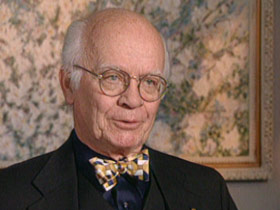
Father Andrew Greeley Extended Interview

Read more of Judy Valente’s interview with Andrew Greeley:

Q: Father Greeley, what is the essence of being an American Catholic? What makes a Catholic distinctive?

catholicism-post03-greeley

A: I think it’s the stories. If we get you in the early years of your life and we fill your head with all of the Catholic stories, then it’s very hard for you to stop being Catholic. Catholics are Catholics because they like being Catholic. They like the stories — Christmas, Easter, May crowning, the souls in purgatory, the saints, the angels, the mother of Jesus. These are enormously powerful religious images. Some people might think they’ve become clichés through the century, and maybe for some they have. But for most Catholic lay folks, the images and the stories are what hold us in the Church despite, sometimes, our leadership.

Q: If you were trying to define the essence of American Catholicism, what would you say?

A: Well, I’d say that Catholicism in the United States has the distinct advantage of being in a pluralistic society, where your religion contributes something to your identity. So you tend to define yourself as a Catholic. I’m Irish, Catholic, a Democrat from the West Side of Chicago, and that’s pretty much my identity. But for most Americans, that relation is part of their identity, so you come to them and say, “Where are you from?” or “What are you?” when [they] move into a neighborhood, and they’ll say Protestant or Catholic or Jew. It’s the preprogrammed response. I don’t know how I would explain it to people who live in a country where everybody’s one religion, but I would try to say that religion is a part of who we are and what we are. It gives us something to belong to and something to believe in in our lives.

Q: What is the religious core of Catholicism? What is the kernel and what is the husk?

A: The kernel is the belief that God is love and, in Catholicism, God’s love is present in the world. It is in the sacraments, in the Eucharist, in our families, in our friends, in our neighborhood, and forgiveness in the touch of a friendly hand, in a rediscovered love God is there. God lurks everywhere. That’s the fundamental Catholic instinct on the imaginative and poetic level — that God is lurking everywhere. Right down the street, right around the corner, there’s God.

Q: You’ve used the term “communal Catholic.” What do you mean by that?

A: Well, I meant people who have decided they’re going to be Catholics on their own terms. They are Catholic, they’re strongly Catholic, they like being Catholic; but they’re not going to let Church leadership dictate the terms of belonging. Immediately after the Second Vatican Council, [there was] the euphoria and the effervescence of the council, the contagion [from] the council fathers to the people and to the lower clergy, and in a remarkably short period of time, they changed the Church. By 1975, all this had happened: birth control wasn’t wrong, premarital sex wasn’t wrong, priests leaving the priesthood wasn’t wrong, nuns leaving the religious life wasn’t wrong. You didn’t really have to go to mass every Sunday. You didn’t have to go to confession before receiving communion every time. All of these things, which they never really understood and they didn’t like, were just swept away. Now, a whole generation later, despite all the efforts of the present pope, they [the Church fathers] have not been able to restore the acceptance of those teachings. And I don’t see how they ever will. It may be good, [it] may be bad, but the sociologists say this is what’s happened.

Q: Where does the idea of “communal” come in, though?

A: Well, they’re part of the Catholic community, but they’re not necessarily obedient to the teaching Church. If you’re a Catholic in Italy when you’re born, it’s unthinkable to stop being Catholic. You just take the rules a lot more seriously, because it pervades your culture.

Q: Let me ask you about another phrase you’ve used — the “Catholic imagination.” What is the Catholic imagination?

A: The Catholic imagination is metaphorical or sacramental. It sees God as present in the world. The Protestant imagination, the dialectical imagination, wants to preserve God from the possibility of idolatry by identifying with His creatures. Catholicism has no problem with that. It sees God present in His creatures, in all of the creatures, and especially in those creatures that love us and that we love.

Q: What do you think are the most serious problems facing the American Catholic Church?

A: Women. And the woman problem is also a man problem, because men have stronger feelings about the rights of women in the Church than women do. Not much stronger, but some. The Church just has not been able to cope with the demands for fairness and equality from women, so they’re very angry. For a long time, the bishops could console themselves — and I think some still do — that these are just radical feminists. But the radical feminists include their sisters and their nieces and their mothers and all the women in their lives. They just don’t like the way the Church treats them. And this includes lots of parish priests. They are just awfully sloppy in their respect and sensitivity toward women.

Q: What else?

A: The next thing is the quality of preaching and worship. Thirty years ago, before the Vatican Council, Catholics didn’t know what liturgy was. Now they know what it is, and they want it [to be] good. They want good preaching and good liturgy. The parishes that provide those things flourish. But so many priests, for one reason or another, don’t do it.

Q: Christians, of course, make up the vast majority of people in this country; but there’s a growing religious diversity. Although Americans are tolerant of other religions, should Christians be evangelizing, trying to convert others to Christianity?

A: I think the only kind of acceptable evangelization is the evangelization of good example. The kinds of lives we live, the joy, the patience, the charitableness of our lives is the way we influence other people. The early apostles said, “See how these Christians love one another.” My colleague Rodney Stark at the University of Washington has done research on the spread of Christianity. He has empirically validated that finding. People came into the Church in the Roman Empire because the Church was so good — Catholics were so good to one another, and they were so good to pagans, too. High-pressure evangelization strikes me as an attempt to deprive people of their freedom of choice.

Q: Let’s take it a little bit further. Do you think Americans believe that there is truth in all religions? And, if so, does this violate the idea that the only way to salvation is through Christ?

A: Well, I think Catholic Americans had better believe there’s truth in all religions, because the Second Vatican Council said that. We don’t believe that we have a monopoly on truth. We believe what we have is true, but it’s not the whole truth. And we can learn a lot from the other religions if we listen to them respectfully. We don’t give up our heritage; we expand it. There’s the great story about Saint Augustine of Canterbury. He [went] to England when the Anglo-Saxons had taken over, and he liked them; they seemed to be good people. He wondered whether it was all right to adapt their customs to Christianity. And Gregory the Great, who was pope then [in] 600, wrote him a letter saying, “Well, of course. As long as these are good and true and beautiful, and there’s nothing unnatural about them, then of course they can be adapted for Christianity.” That’s been our policy ever since. Sometimes we’ve violated it, but that’s the official policy. We can learn from everybody. Catholicism means, “Here comes everyone.”

Q: But how can a Christian, a Catholic reconcile that with Christ’s saying, “I am the Way, and the Truth, and the Life; no one comes to the Father, but through Me”?

A: I don’t think Jesus was an exclusivist. He said, and we believe, that He is the unique representation of God in the world. But that doesn’t mean this is the only way God can work: “Now, God, you’ve got to work here and no place else.” Nobody puts constraints on God. She doesn’t like it.

Q: Are Americans tolerant of other religions, or merely indifferent to them?

A: Oh, I think they’re at least tolerant. It’s the viewpoint that everybody has the right to make their own religious choice, and we’re not going to challenge that right. I think we find some of the other religions interesting — not all of them, but some of them are interesting. We’re more than tolerant. I don’t think it’s indifference.

Q: What do you think is the best long-term response to terrorism that seems to be fomented by religious beliefs?

A: I don’t think we can really change the beliefs of the people who think we’re the “Great Satan” and have to be destroyed. We have to protect ourselves against them. We’ve got to be much better at both security and intelligence. But the long-term [response], I think, is forgiveness. If we are followers of Jesus, we say the Lord’s Prayer every day. We should realize what “Forgive us our sins as we forgive those who have sinned against us” means. We don’t earn forgiveness by forgiving. It’s not a barter deal with God. God’s already forgiven us. It’s our job to manifest that forgiveness of His, that implacably forgiving love of God’s, to the rest of the world by forgiving people who’ve hurt us. That doesn’t mean we don’t engage in self-defense, but it does mean that there is no room in a follower of Jesus of Nazareth for hatred or vengeance. We certainly have to engage in whatever military attacks are necessary to protect us from further assaults on our people. But we do so in the name of self-defense and not in the name of vengeance. Revenge, vengeance — this doesn’t fit the Christian tradition. Somebody said to me in a recent e-mail, “You’re just preaching that old Jesus drivel.” Well, “Jesus drivel” it may be, but Jesus said of the people who killed Him, “Forgive them, Father, for they know not what they do.” If we’re not willing to say that, then we’re not on the same path Jesus walked.

Q: Do you believe Americans’ religious beliefs are softening? Are people less wedded to creed and doctrine? And if you believe that, why is it happening?

A: I know that’s the conventional wisdom, and some of my sociological colleagues have been writing about [it]. I don’t believe it. I think that the core doctrines of Christianity — the incarnation, the resurrection, life after death — these are as strong as ever. In fact, the belief in life after death has increased in this century. I don’t think American religion is falling apart. Quite the contrary. I think the real problem for American religion are those minority of fundamentalists who try to identify political policies with religion. They’re offending people, and they’re responsible for some of the departure of younger Protestants from denominations. The Catholics we lose — it’s almost always over divorce and remarriage, of which problem we have made a real mess.

Q: What is turning people off to the Catholic Church?

A: Most people who are born Catholic are still Catholic, unless they’ve had a divorce and remarriage problem. I think the Church is just ham-handed in dealing with those people. They leave the Church because of something that’s happened to them in the process of getting a divorce and being remarried.

Q: Is that all it is, or is it the whole gamut of sexual issues?

A: There has always been a certain proportion of people who leave the Church on issues of authority and sex. That hasn’t changed since we started doing research on it back in the early 1960s. The increase comes from people who’ve had marriage problems. [Catholic University sociologist] Dean Hoge and his colleagues have done work on young Catholics, and they find that very few young Catholics don’t think of themselves as Catholic anymore. They want to stay even if they don’t go to church much.

Q: Let’s talk about the influence of Hispanics on the Catholic Church. What is their major impact?

A: I think they are a great grace for the Catholic Church in this country, because their religion has so much festivity and celebration in it. We European Catholics tend to be somewhat grim and dour and straightlaced. We shouldn’t have been, but we are. We can learn from the Latinos that Catholicism is a religion of festivity and celebration.

Q: Are Hispanic Catholics different in any other ways?

A: They have a very strong sense of family and local community. Now, of course, so do the Italians and the Irish. But I think it’s stronger. One Hispanic woman… was telling me about her religion, and all she was talking about were the parties, the festivals. And I asked, “But what does all this mean?” She would tell me about another party or festival. I finally said, “No, no. What’s the theology?” “Oh,” she said. “Well, I think we believe that God is part of our family. And when we have celebrations, God comes and celebrates with us.” I like that. I think we should have more of it.

Q: So many Catholics in this country disagree with fundamental teachings of the Catholic Church, especially those having to do with sex, gender, reproduction. And yet, they remain loyal to the Catholic Church; they would never join another church. Why is that?

A: Because once a Catholic, always a Catholic. If you’re a Catholic and are filled with Catholic images and stories in childhood, you don’t want give them up. You like being a Catholic. And how fundamental are these teachings? What’s more important? Life after death or birth control? What is more important? God’s forgiving love or premarital sex? The sexual ethic is important, but it’s not the only thing in Catholicism. I’m afraid sometimes our leaders — and the media, too — have made it sound as if the only unique thing about Catholicism is sexual teaching. The lay people know better.

Q: Why have people stopped going to confession? Why do they think it’s not necessary?

A: I think one of the conclusions that many Catholics drew from the Second Vatican Council is there’re just a lot fewer mortal sins than there used to be. So we don’t really have to confess them, and we can make a good act of contrition, as we used to say, and receive communion, and it’s fine. Part of it is just the decision that confession before communion isn’t necessary. This is a conclusion that the laity have reached. And the lower clergy have not disabused them of that notion, because they think the same thing. People still go to confession and the penitential services at Easter and Christmas. They’re very, very popular. But we realize now that we really don’t have to run to confession every Saturday afternoon if we want to receive communion on Sunday.

Q: What is the benefit of confession?

A: I can think of two benefits, and both have to do with reconciliation. One is you’ve been away for a long time, or you’ve done some terrible sins, and you want to do penance for them. You want to get them straightened out. You want to acknowledge that you were a sinner or a wanderer and eliminate that dimension from your life. For those kinds of people, the old kind of confession — maybe not in a box — is very, very helpful. It relieves a lot of stress and guilt and gives you a sense of beginning all over. For most of us, confession is a chance to be reconciled with the local community. Those priests who support the absolution services — that’s why they’re so popular, because people want to be reconciled with the community.

Robert Franklin Extended Interview

Read excerpts from Kim Lawton’s interview with Robert Franklin:

americanprotestants-post12-franklin

On the essence of Protestantism:
Martin Luther has given an enormous gift to western Christendom. He isolated the notion of faith as a force for change, as a force for revising inherited tradition. That’s at the core of the Protestant spirit — to embrace tradition, to respect and love tradition, but also to be willing to revise and challenge traditions, to adapt them to contemporary circumstances. Protestantism and the spirit of the Protestant ethic, if you will, is precisely to bring tradition into the modern world and be willing to risk letting go of those practices and doctrines that are not liberating.

On why Protestantism flourished in America:
Certainly the emphasis upon individualism — individual commitment to God; individual conscience and accountability for one’s action[s] and behavior; the essential notion that salvation happens person by person, one soul at a time, the individual as she or he stands before God — is the consummate American cultural tradition or ethos of radical individualism, freedom of will, the notion of unlimited boundaries for individuals who have a vision and the energy to act on those visions.

On the interaction between Protestantism and American culture:
Certainly Protestantism had a significant impact upon the shaping of American culture. When you consider the number of U.S. presidents [and] elected officials who were products of Protestant traditions, who articulated America’s story, who exemplified in their own leadership styles the American way of being in the world — so much of that [is] a function of individualism, activism, optimism, unlimited idealism. All of those features that find residue in dominant American culture were very much a part of Protestant doctrine, Protestant ideology that was being nurtured over the decades. While both [American culture and Protestantism] were influencing religion and culture… ultimately Protestantism had a greater impact on shaping the surrounding secular culture.

On what Protestant churches are facing:
There is a sense in which we are living, as many observers have argued, in a postdenominational era. The doctrine and practices that marked various Protestant traditions as distinctive are, in many respects, wearing thin. There is some erosion of denominational loyalty among American contemporary churchgoers. We are becoming a consumer church culture. People search for, in a congregation, an ensemble of ingredients or features that are user-friendly. So being Lutheran or Baptist or Episcopalian may be less important to that church consumer than having a terrific youth program or a great preacher or good music. I find this rampant consumerism is a significant trend that really challenges theologians and church leaders today. How do we reemphasize and retrieve the importance of tradition and loyalty to the tradition, while at the same time not losing our population?

On Protestant denominationalism:
On the whole, I’d say that there have been many negatives. Anytime a religion creates barriers over which people are likely to argue and fight, that is, for the most part, not good. If we can get to the core message of the radical love ethic of Jesus, it enables us, empowers us to set aside some of the more divisive denominational and human-manufactured practices in these religious traditions. I’m certainly one who believes in the spirit of innovation, of moving forward, of leaving behind those elements of tradition that incline people to argue and fight. We’ve just left behind a bloody century in which religious wars and denominational bickering have really distorted the true essence of Christianity, Islam, Judaism, and other great faiths.

On future challenges:
The challenge for the future is to adapt the truths that have been handed down to us to an ever-changing, dynamic reality — increased diversity in our population, certainly in our very pluralistic America; living with technology in a responsible way; trying to negotiate differences across the generations. All of these are going to continue to challenge the best leadership and thinking in our churches.

On other current trends:
One of the trends, and it is going to be an interesting one to follow, is a gender differentiation in religious devotion and religiosity. After the 1960s and ’70s, you began to see more dramatically what I’ve often referred to as a “male exodus” from the churches — men who felt that church was a space where women could have their identities affirmed and needs met. But men sought alternative spaces — fraternities and lodges and sports bars and other places where fellowship and affirmation of identity and collegiality could be experienced. And yet we now see, with Promise Keepers and these mass-movement efforts to attract men back to organized religion, that may be changing. We may be witnessing a reversal of the male exodus. On the other hand, related to this gender dynamics within contemporary American religion, is the phenomenon of women in leadership — women sharing power in religious congregations and communities, and in many traditions the tensions that new phenomenon introduces. A lot of men are not ready to share power. We all know quite a number of churches that do not wish to ordain woman or welcome women in positions of authority and leadership. That’s going to be a continuing fault line in our religious space.

On race and religion:
On one hand, one sees increased nationalism at work in many faith traditions — Latinos and Hispanics who want to preserve Spanish-language services and do not wish to have bilingual services; some African Americans who give even greater emphasis to separation and distinctiveness; heavy emphasis upon reviving [the] black nationalism of earlier years. We certainly see this in many immigrant[s] … who come to this country, who feel less pressure to assimilate [and] become a part of the American mainstream, if you will. On the other hand, you have a very exciting effort to address the historic problem of race, what W.E.B. DuBois called the problem of the 20th century, the color line — churches being honest about a history of racism and their complicity in supporting the race line. To have denominations like Southern Baptists and Methodists apologizing for their support of slavery [and] explicit efforts to reconcile racial and ethnic groups all motivated by the sense of oneness in Christ and devotion to a single God is very important and [a] very hopeful development. We see a tension at work with respect to the racial-ethnic divides — a reemphasis [on] and retrieval of ethnic loyalties, of nationalism and separatism by race supported by religion, and a greater emphasis on overcoming racial difference, of striving for racial reconciliation and finding common ground among various ethnic and racial groups based upon devotion to a single religious faith.

robertfranklin-extended-post02

On other significant trends:
How [will] we socialize young people, our children, into these faith traditions? We’re all fretting over the kind of antitraditional spirit we find among Generation X and Y and so on, and over something different and new emerging. There’s the usual adolescent rebellion against organized religion and the traditional pattern in American religious life of young people nurtured in the faith tradition. Once they reach college age or teenage years, there’s this dropping away, an exodus of teens. They tend to return once they get married or on the birth of the first child, and I think that pattern may be changing. Young people who have never had significant organized religious exposure, have no loyalty to a faith tradition, who have been out there on their own, piecing together a philosophy for living from a variety of pop cultural elements as well as bits and pieces of various faith traditions — it’s really quite a new phenomenon. There are a lot of young people today who are searching and cobbling together a homegrown theology that works for them. It’s going to be a real challenge for traditional faith communities to attract those young people into old structures that have fairly rigid boundaries and creeds.

On spirituality outside organized religion:
Individuals who are on their own paths seeking spiritual fulfillment and meaning will tend to vote with their feet and walk past the church, synagogue, or mosque as they continue to find meaning and make meaning for themselves. Many of the traditional religious communities have their standard liturgy and hymnals and ways of doing things, and when people arrive, they expect individuals to find their way into the liturgy, into the established patterns. Today’s spiritual seekers may not be as interested in adapting themselves or conforming to existing or preexisting patterns of worship and experiencing God. Every day they are in the act of searching and making meaning for themselves. If traditional religious denominations and organizations are going to reach these spiritual seekers, [they] are going to have to be far more fluid, open-minded, dynamic, and smarter than in the past in anticipating the challenges they will face, the intellectual resources that are needed to meet smart people who are searching for a meaningful life.

On what African American churches face:
Traditionally, black churches have had a solid hold upon two tensions within American religious life: a commitment to social transformation, the Social Gospel changing social structures, working for justice; and individual salvation, personal spiritual fulfillment, and relating individuals to the holy. Black churches have done a pretty good job of holding those together, but now, in the post-civil rights movement period, regrettably the two don’t often meet, and there’s been a loss of the wholeness that marked the religion of Martin Luther King and the theologian Howard Thurman. I think we’re going to continue to see that trend, that drift, that polarity. There’s also a lot of concern about the future of black worship. The traditional preaching, prayer, and song traditions are also eroding and giving way to gospel, rap — more pop culture finding its way into the black church faith, especially churches led by younger seminary-trained pastors. Many of us worry that we’re going to lose some of the poetic, lyrical, rhetorical genius that we’ve found in traditional black preaching as contemporary ministers adapt a more didactic teaching style — walking about with the open Bible and teaching line by line. That’s important, it’s valuable, but I’d hate to lose the tremendous gift of black preaching that the black church has given to all of America.

On culture as a threat to religious faith:
We all fret over the impact of materialism, the emphasis [on] and preoccupation with more things in our lives. The world of science and technology is phenomenal; it delivers new toys to us and new opportunities for distraction from the life of the spirit, the life of the mind. Another is the phenomenon of pleasure seeking, the avoidance of pain, suffering, conflict, and the desire for feel-good religious experience that matches the feel-good promises of the culture. And yet, there are messages in all of the great religious faiths that remind us that suffering is part of the human experience and has to be grappled with — that death and mortality are realities, and part of the burden of theology and of faith is to help one make sense of one’s brief life in the face of finitude, mortality, suffering, and tragedy. Today’s popular culture and too much of today’s superficial religion simply seek to avoid that entire dimension of the human experience.

On the dichotomy between religion and culture:
People try to give [the] right answer when they are asked a question by survey interviewers. But as you really observe how people live their lives, how they spend their time, how they spend their money, you find a very different set of responses. Religion is easier professed than lived. I love G. K. Chesterton’s wonderful quote that the Christian faith hasn’t been tried and found wanting; it’s been found difficult and left untried. For the most part, people simply leave untried the challenging ethical imperatives of mature religious faith. That’s about self-sacrifice. It’s about service. It’s about sharing prosperity, and it’s about fighting for justice on behalf of those who have no voice. Ultimately, it’s about speaking truth to power. In the culture, an alternative religious system supplants the historic faiths that we’ve come to cherish. And that’s a religion of politeness, of pleasure seeking, a superficial, make-it-through-the-day survivalism that is not particularly rich or satisfying. The great religions have to find their new voices. Yale historian Jaroslav Pelikan says that tradition is the living faith of the dead, but traditionalism is the dead faith of the living. All that we cherish in the great moral exemplars — Jesus, Buddha, Mohammed, Moses — that has enriched our lives and culture and transformed the world for good is certainly something we want to embrace and continue to learn from. But not all of those traditions liberate. It is finding the liberating vision and the liberating voice within those traditions in contemporary circumstances that is the burden of theology. The pressure is on contemporary religious leaders to listen to the culture, listen to young people, listen to people who are suffering, and listen to the great voices of the past and find harmony, find congruence that enables us to adapt the lessons of yesterday to today and tomorrow’s reality.

Nancy Ammerman Extended Interview

Read more of Kim Lawton’s interview with Nancy Ammerman:

What do you consider the essence of American Protestantism to be?

nancyammerman-extended-post01

Protestantism in the United States has from its beginning been characterized by the fact that people gather into voluntary local congregations — that a group of lay people get together and form a congregation on their own. Even if they have a bishop in the United States, one of the things that’s been really important is that lay participation, that lay control, that local sense of indebtedness in a particular, local congregation.

And how has Protestantism been tied up with the history of the United States?

Among the first settlers from the European continent who came here, of course, were people that we think of as the Pilgrims, the Puritans, who came here for religious reasons and were Protestants. [They] were very much a part of that voluntary tradition [and] came here to be able to set up a community of people who could worship together and live together under the dictates of their particular understanding of how they should live together as Christians. That pattern of people gathering into local communities and a congregation is one that has really formed the model, the template, that other religious traditions have tended to follow once they come here.

Is there something in the American ideal that fits so well with Protestantism, or is it the other way around? Did the Protestant tradition help form the American ideal?

I think it’s a little bit of both. It certainly is the case that throughout our history the fact that people have been gathering into these local congregations where they’ve been self-governing, where they have had to make decisions together — that has been an important school of democracy. Clearly [it is] one of the things that fed into the formation of the United States Constitution and the way this country is put together, and it continues to be an important part of our civic culture. People who participate in local congregations are more likely to vote. They are more likely to have the skills to be effective participants in the larger political process. The two things are really very closely tied together.

Protestantism began in Europe, but did America really become the key breeding ground for it?

Even in Europe, most of the Protestant churches were still tied to the state, tied to a particular place. Everybody in a particular area was Lutheran or, in Geneva, Calvinist. In the United States, what began to happen very early was that the tie between place and state on the one hand and religious tradition on the other began to get broken. We mixed things up in the United States much more than they ever did in Europe. There’s a very particular brand that the United States has placed on Protestantism, and Protestantism on the United States.

You talk about forming voluntary associations and about a democratic way of working things out together. But isn’t there also a rugged individualism to this brand of religion?

There certainly is. One of the things that Protestantism has stood for is the individual finding a relationship with God. Different kinds of Protestants put more and less emphasis on the individual or on the church as a mediator. But in all of Protestantism, the notion of the individual having that unmediated relationship with God is important. That has been very much a part of the American way of thinking about religion — that we each choose our religion. It’s not something that’s thrust upon us by birth, by where we are as children. Again, there is that back and forth between the American way of being, that rugged individualism, and the Protestant emphasis on the priesthood of all believers.

How did Protestant diversity develop, and what does it signify?

Once you let people make their own choices, and once you emphasize local communities really having some autonomy and the ability to gather together and form their own congregations, then what you open up is the possibility that when a new group of people comes along and doesn’t exactly fit with the old group that was there, they can go off and start their own congregation. They can start their own denomination. What we’ve seen over the course of U.S. history is an incredible proliferation of religious groups, particularly Protestant groups, and that ability to start something new if you don’t like what already exists has been the impetus. Today we do have just hundreds of different kinds of Protestants in this country.

What are some of the key trends driving Protestantism?

One of the most important things happening in Protestantism at this point is the increasing diversity of the American population. We have to go back more like 30 or 40 [years], really, to get a handle on how significant this change is. If you had asked most Protestant congregations 40 years ago about their own ethnic composition, the vast majority of them would have said that they are predominantly one race and, in fact, probably would have told you that they are exclusively one race, either black or white or a minority of Hispanic and Asian and other racial groups. But what we’ve found in the last few years is that very few congregations claim to be exclusively one race. Everybody wants to claim at least some diversity within their congregation. And the fact that that’s a badge of honor seems to me a real change in the way we think about congregational life. When we actually count them up and look to see whether they’re as diverse as they think they are, in some cases they’re not. But what we did find is that only about 60 percent of congregations in this country are predominantly white, to [the] point that they have 10 percent or fewer of some other racial category within them. There is actually more diversity within congregations today than there certainly would have been 10 or 15 or 20 years ago.

And what are the theological implications of that?

I think it’s more a matter of theology driving diversity than the other way around. Many American Protestants in the last generation simply became convinced that a racially exclusive congregation was not theologically defensible. They have become much more intentional about trying to be open to people who are different from themselves. That’s not at all to say this is an accomplished task. It’s just to say that we have come a very long way in a generation in this regard. But even more important than that, we still see É many, many congregations that are predominantly of one ethnic group or other, and, of course, with immigration that ethnic array has broadened much in the last generation as well. A bigger slice of the American Protestant pie is now Korean Presbyterian[s] and Hispanic Pentecostals and people who are coming from all over the world and becoming a part of the overall Protestant mix.

The RELIGION & ETHICS NEWSWEEKLY/U.S. NEWS & WORLD REPORT national survey found a high level of religious observance but also high levels of tolerance for religions outside one’s own. But while people said they were very tolerant, they also had high levels of ignorance about other religions. They didn’t even know people of other faiths. How do you explain all of that?

American society has established some pretty strong norms about tolerance that, with the most recent generations, have become even stronger. Even evangelicals, for whom proselytizing and trying to convert people of other faiths is central to who they understand themselves to be, don’t want to be obnoxious in their proselytizing. They want to be respectful and not push their faith on somebody else. There’s a very strong sense that we should respect each other, and that respecting each other includes respecting the religious traditions that other people have. Now that’s all fine in theory. And mostly what it does is let us get along where our particular religious beliefs aren’t at issue. It lets us live together in neighborhoods and work together in our communities. Our kids go to school together without any huge conflicts that are precipitated simply by a kind of blanket condemnation of people who are different from us. Am I going to want to worship together with somebody who’s from a different tradition? Probably not. Do I think they are right? Probably not, most Americans would say. Do I even know what they believe? Probably not, as most Americans experience it. It’s a kind of tolerance that allows us to work together without necessarily having to get into the fine points of, do we really agree?

Do you see this as a potential area of tension? As diversity grows, as we experience events like September 11, as members of some minority religious groups end up running for the school board or mayor, will this level of ignorance — and tolerance — really be challenged?

Inevitably we will run into situations where, out of people’s religious traditions, there are practices people find difficult to get along with. Already we are obviously running into all kinds of things. Is it O.K. for a Sikh young man to wear his turban? Is it O.K. for a Muslim young woman to wear the hijab? Is it O.K. for an airline employee to wear distinctively religious garb? There are all kinds of ways in which various religious practices impinge on that public space that we all share together and all kinds of ways that those things are being negotiated now. My sense is that there is going to be a really mixed picture. There will be times when tempers will flare, and we will have conflict. And there will be times when once we see why something is important to somebody, people will say, “Well, sure, that’s not a problem; we can work that out.” We’re just in for a generation or so of figuring out that balance between particularity and difference, on the one hand, and getting along and all looking alike and sounding alike and being alike.

What trends do you see in people’s ties to their denominations?

One of the things that’s probably new in the last generation is that the average Protestant church finds within its pews that at least half of the people there did not grow up within the denomination of that church. The average Protestant church is a mix of about half, or maybe a little more, of people who are cradle Episcopalians, or Lutherans, or Presbyterians, and people whom sociologists tend to refer to as “switchers.” It’s not only liberals who switch across denominations. This is really characteristic of Protestantism across the board. Every congregation is now faced with the question, “Are we simply going to be a generic congregation, or are we going to emphasize the particular denominational tradition of which we are a part?” If we choose the latter road, congregations have to get intentional about teaching their tradition in a way they would not have in the past. When everybody in the pew has grown up in the tradition, you can assume a lot about whether they know when to sit down and stand up, when to kneel, when to do this and that, how to find something in the hymnal, how to use the prayer book — they just absorb it as they’re growing up. If you grow up Methodist and join a Lutheran church, you’re going to have to learn some things if you are really going to be a Lutheran. One ironic consequence is that people who choose to teach people about their tradition end up with people who actually know more and, in many cases, value the particular denominational heritage in a way that the people who grew up in it don’t always do.

Along with lost denominational loyalties, is there an identity issue as well?

All Protestant denominations really are facing some very serious identity questions. I would be misleading you if I said they’ve all got them solved, and they’re moving in the direction of a renewed sense of identity. That certainly is not the case. We do find that the levels of switching among the denominations have a very real effect on the sense of identity and loyalty in those congregations. The congregations with the highest levels of switching are less likely to be loyal to their denomination. But it’s also important to say that’s not a universal trend, and there is a countertrend: those congregations that are the most mobile and the most full of switchers and the most highly educated, precisely the ones you think would say that denominations are passŽ, are saying no, I really want to know what it means to be an Episcopalian. I want to know what it means to be a Lutheran. I want to study about it, and I want to learn and really invest in an identity and a tradition. We see both kinds of things going on, both a re-valuing of identity and an erosion of identity.

Is it bad that people don’t have the ties and the loyalties, or could it also be positive? Divisions that kept people at odds for so many years may not seem that essential or important, and now people are coming together.

Certainly for most of the twentieth century, people have worried about denominationalism. They have worried that Christianity was divided up into all these branches or wings that were primarily defined by region or race or ethnicity rather than anything very theological. One of the movements over the course of the century was in the direction of reuniting, moving people back together, merging denominations, minimizing denominational differences. That’s one of the things that has made it possible to move back and forth across denominational lines. The people leading denominations and congregations have tended to minimize those differences and say, “What really matters is that we’re all Christians. That’s the most important identity.” You’ll certainly find many evangelicals, for instance, who will say, “What’s most important is I’m a born-again Christian. It doesn’t matter whether I’m evangelical, covenant, or Southern Baptist.” We find both a positive benefit to people not demonizing each other and not being separate from each other and declaring that all Methodists are going to hell — that certainly has been a step forward in minimizing these denominational differences. But at the same time we recognize that there are some particular stories and histories and traditions and rituals that each denomination had kept alive. And those stories and rituals and traditions are important for a sense of rootedness, particularly in a very mobile society.

What about the growth of nondenominationalism — people who don’t want to have any denominational ties whatsoever?

Certainly we do see that as a growing segment of American Protestantism. One of the things churches that declare themselves to be nondenominational are claiming is that a denomination is the sort of thing that divides people and is an evil to be avoided. What they want to do is simply put an emphasis on the basic Christian message, particularly the evangelical Christian message. We do see that as a growing segment of the American Protestant picture. One of the ironies is that there is a distinct identity to being nondenominational. It’s almost as clear a badge of where do I sit within Protestantism as if you were a Lutheran. To say “I’m a member of a nondenominational church” is not to say, “I’m without a particular identity within the larger picture of Protestantism.”

What about the tension between creeds and doctrines and experience? The RELIGION & ETHICS NEWSWEEKLY/U.S. NEWS & WORLD REPORT survey found that doctrines seem less important to people and commitment to beliefs seems to be softening a bit. Strong numbers of people still say doctrines are the most important reason for choosing a church, but there is also an emphasis on spiritual experience. How great a tension is that within Protestantism?

My hunch is that you would find some real difference depending on the particular stream within Protestantism in which you’re looking for answers to that question about doctrine and experience. Much of evangelicalism does, in fact, emphasize particular beliefs as really critical: it’s important that you believe that Jesus Christ is the only begotten Son of God. It’s important that you believe that Jesus rose from the dead. It’s important that you believe that the Bible is true. Those kinds of central doctrines and beliefs really define that community, and people within that community would be loath to join up with a church that didn’t affirm those beliefs. It seems to me that in much of Protestantism the experience of worship — the sacraments in the Episcopal tradition, for instance, the Eucharist — are also going to be very important to people. Likewise, within the Pentecostal wing of evangelicalism, the experience of the Spirit is going to be a central, defining component to understanding how belief takes shape. You can say all day long that you believe this, that, and the other, but if you haven’t been “baptized in the Spirit,” then for a Pentecostal it doesn’t really count. Protestantism today, it seems to me, is a real mix of different streams that emphasize belief or experience differently.

It’s not a contradiction for some Protestants to emphasize both?

My guess is that most clergy in most of Protestantism would tell you that belief is important. The clergy are, after all, the theologians. They are the ones who are going to make their livelihood by talking about beliefs and expounding on them. Even within traditions where belief is defined as the central characteristic, my hunch is that the people in the pews mix belief and practice or belief and experience a little more than what you would necessarily hear if you were simply listening to a sermon. Even if people in the pews say that belief in Jesus as my Savior is the most important thing, what’s also important is that I can pray to Jesus and experience Jesus’ presence in my life. For most people, that mix of belief and experience is just the way religion is for them.

Are there other key challenges you see for American religion in general and Protestants in particular?

Many American Protestant congregations were founded 100 or 150 years ago in the countryside, or in sections of cities that have gone through transition after transition. When a congregation is that old and has been through that many rounds of transition, it’s difficult to sustain. So much of what various Protestant denominations are dealing with is that they’ve got lots and lots of small congregations scattered all over the place — many of them full of people who are relatively old and can’t afford a full-time pastor. There are some organizational dilemmas that are demographic and historic that American Protestant denominations are going to have to deal with in the next 25 to 30 years. I think we’ll see a lot of organizational stress and strain within those denominational traditions, at the same time that we see new congregations being founded all the time and mega-churches growing up on the edges of the cities and new religious traditions coming into the picture and all of the rest. There is an enormous amount of vitality at the same time that there is stress and strain.

What about the interfaith future?

One of the things that September 11 really reminded us of is that we are living in a much more religiously diverse society. Protestants can’t assume that they’re in charge. They can’t assume that everybody around them is Protestant. They can’t even assume that everyone around them is either Protestant or Catholic. There is an awareness of the religious diversity in this country that really wasn’t there until September 11. Protestants are dealing with both that sense of loss and grief, of recognizing that they’re not in charge and not the center of things anymore, but [also] the positive side of recognizing that they do need to get into conversations and coalitions with people who have not typically been included in the circle of partners they have worked with. When people put together a coalition to work on homelessness or a task force to deal with teen drug problems, instead of simply calling the Methodist church and the Baptist church and the Episcopal parish down the street, the Catholics are going to be included, the synagogue may be included, the mosque may be included, the Hindu temple may be included. How do we really build those working coalitions and learn about each other in the process as we work together on problems we face together?

Some people say the extent of our religious diversity is overstated. Over 80 percent of the country is still Christian and still pretty powerful.

It is certainly the case that Christians are very much the majority. This country makes lots of Christian assumptions in our culture. Just the way we do things very much builds on the fact that we have been a predominantly Christian culture for a very long time. It would be a big mistake to assume that Hindus who come here can just fit in and be at home overnight. They know they are walking into a Christian culture probably far more than those of us who are Christian recognize all the subtle ways we have shaped the culture.

Do you think “we’re all Protestants now”?

There is a sense in which that Protestant model for how you think about individual religion and the local congregation is shaping the experience of all kinds of religious traditions in this country. The notion that a local group of people can get together and form a congregation, have a lay board of directors, and have some say over exactly how they program what they do in their local gathering of people — even the notion that you have programming, that you do something other than simply gather to participate in the particular religious rituals that are part of your tradition — is Protestant. Having a women’s group, for example, very much comes out of the Protestant model. The notion that an individual is going to choose how to be religious and how religious to be and which religious tradition to be a part of — that’s very much out of a Protestant notion of the individual having to be responsible for his or her relationship with God.

Martin Marty Extended Interview

Read excerpts from Bob Abernethy’s interview with Martin Marty:

On describing the central ideas of Protestantism:

martinmarty-extended-post01

The easiest way to do that is with a little chart: God on top. God comes through Christ, revealed through the scriptures. All Protestants (if they’re Protestants) believe in God. All of them believe God reaches us through Christ. All of them somehow relate to the scriptures. And they believe that God’s basic action to us is undeserved grace. The other Protestant idea is equal standing before God — all members. There’s no pope or hierarchy closer to God than all members. And equal obligation to and privilege to minister, to serve. You have functions, offices, and you give different reasons for following them. But in Protestant belief — equality before God and freedom. All Protestants will say that they experience the grace of God through Christ, and they learn about it in the scripture. They interpret scripture in different ways, but it’s always God’s undeserved grace that makes them equal before God. Clergy and laity are all called to be ministers, [but] all [are] free to be ministers, which means to serve others.

On softening beliefs and the importance of religious experience:

There’s great suspicion of ideology in the modern world. We’ve known fascism, communism, all the other isms. People are also suspicious of dogma, doctrine, stipulated rules. It doesn’t mean they disagree with them. It’s just that they aren’t so moved by them. They’re moved by story. All over the world Protestants are moved by the stories of Jesus — the Good Samaritan, the Prodigal Son. But they don’t only want to hear that 2000 years ago, interesting things happened. They want an experience of it now. And they share with almost all people in the world today that impulse to have experience. If beliefs are less important than experience, it means that no religious leadership can crack the whip and say, “If you don’t believe these things, you’re out.” You can, with a small denomination, do this; you can enforce it. But there’s always another place to go in Protestantism. Experience can’t be checked out so clearly. How do I know the authenticity of your experience? I have to trust you.

On mainline Protestantism:

The mainline is healthy in many tens of thousands of local bases, but it doesn’t have a single national profile any longer. For one thing, it used to get its profile because it was anti-Catholic. It isn’t that anymore; [it] doesn’t have that enemy. So you get into individual local churches — hundred-member churches, thousand-member churches. That’s where the pulse is. That’s where the vitality is. [Mainline Protestantism] suffers from the fact that, as one sociologist said, “You won.” So much of what it stood for became part of the larger culture, whereas if you are a fundamentalist or a conservative Catholic, you really stand apart from the culture.

On rising numbers of evangelicals and Pentecostals:

It hasn’t changed much from 1950, as far as how people identify themselves is concerned: 25% Catholic, 25% mainline Protestant, 8% African American Protestant, 25% evangelical — but it is the evangelical and Black sector (evangelical including Pentecostal, fundamentalist, Southern Baptist and so on) that has surged. In part it’s because they minister so much to the theme of experience. You just don’t have the old stories without your getting it, and then you have to tell somebody else about it. Most in the mainline took for granted that their children would follow them in their faith, and they didn’t.

On loosening denominational ties:

Protestantism was born all over Western Europe, and religion came with your genes and your turf. If you were Scottish, your children would be Scottish Presbyterians. If you were Swedish, your children would be Swedish Lutherans. If you were Dutch, your children would be Dutch Reformed. Today, geography doesn’t mean much; we’re all over the place. And genes don’t mean as much, because there’s a good deal more freedom. Mom and Dad can’t drill it into you. You rebel. You go off to college. You watch television. You meet friends. You go to that mega-book store. You pick up all these ideas. You don’t have inherited loyalties; they have to be won.

On denominational mergers:

Formal mergers are very few. The whole twentieth century talked ecumenism. In American Protestantism you really have only one or two [mergers] — the United Church of Christ, where you went across family lines; the others were the Presbyterians getting their house in order, the Lutherans getting their house in order. So merger is not big. People want to keep the integrity of what they’re about. The key word for most of what’s going on now is “full communion.” [People] would like to be present at the sacred rites of the other fully, equally, and to share ministers and ministries. That’s quite healthy. That’s moving along quite significantly.

On how Protestants choose a church:

Most people start out and the majority ends up in the faith in which they were brought up. They may test it. They may transform it. They may have different ties to it. But if you’re born Baptist, you’re likely to stay Baptist. The biggest change comes about in mixed marriages. If you marry someone from another denomination, normally if you’re both Protestant, you’re going to end up in one of the two. Here a number of things come in: the personality of a pastor; the greeting at the door; the social program (great numbers of Protestants want to serve the homeless); the music; the location, the parking lot. There are a thousand things. But over the long haul the test is, does it speak to my mind and my heart? Is this an authentic experience of God, and does it make sense to me?

On religion and class:

It’s a big marker in American religion, even though every Protestant group is — on paper and in [its] heart — democratic. They would like to include everybody. But somehow people do their own selecting.

On being a Protestant and an American:

Protestantism is the wallpaper in the mental furnishings department in which America lives. When you go back to the founders of the nation, they were reasonable sons of the Enlightenment. But they were all Episcopalian, Presbyterian, Congregational and so on, and that got so stamped in our culture. A century later, when modern industry and capitalism came along, they were all Protestants running the show. It got so fused with the environment that you don’t have to be Protestant to seem Protestant. No matter who comes to America, they take on that style. If I go to Honolulu, I go to a Buddhist church. That’s an oxymoron in Japan. But the Buddhist church has pews, it has an organ, it has envelopes for offerings, it has charity drives, it looks just like the Presbyterians down the block. So you can’t really escape it. Some scholars, like Kwame Anthony Appiah, say people want to be white Protestant; many of the features of the mosque and the Reform and Conservative synagogue take on that color. It’s just part of the life around you. Protestants had a headstart. They’ve been here 400 years. They have had overwhelming numbers through all the history. They only began to share space after three of their four centuries here. And with all that as a headstart, they could bond with the environment; they could shape it. They helped pass its laws, they helped found it in the Constitutional era, they helped give impulse to its businesses. Slaves became Protestant, with their own stamp on churches called Methodist and Baptist. There’s a [Protestant] style that just pervades. Partly it’s competitive. Partly it’s an impulse toward freedom and individuality. But you just cannot tear the two apart. You live there if you’re an American. You would have to begin with the central idea of Protestantism, that is, a gracious God. And that means that God is not going to devastate you. There’s a strong sense that you can be forgiven and start over. Today, Catholics and Protestants sign documents saying they both believe in that; they fought about it five centuries ago. All the religions know they can’t get anywhere just with hellfire and damnation and a punishing God: [it is] grace, grace, grace. We’re a scripted nation. The forefathers and founders of the nation would even read the Bible and say we’re pilgrims, we have Zion, a city on a hill — our presidents still invoke that. That all came from a Protestant reading. Protestants aren’t always faithful to that vision, but it means that others are going to catch it from them, too.

On the Catholic Church crisis:

The biggest impact is going to be on rebuilding trust and on revenge against a hierarchical cover-up of crime. Americans weren’t ready for the secret payoffs, the money, the protection of a system. Most people looking ahead do not expect radical revision of the system, partly because Rome isn’t enthralled about listening to what America wants. But there is going to be a tremendous amount of local adaptation — rebuilding in the parishes and dioceses and, over the long haul, questioning some of the practices, like clerical celibacy. But don’t expect a sudden change on that. Rebuilding trust is the whole [thing.] Most of the criticism is coming from Catholics themselves.

The secular world reports [it.] The Protestant world is not leaping on it; it has its own problems. This is the biggest crisis in Catholicism in centuries. I can’t think of anything that is, in the end, going to have touched more [people.] If you look at a map of all the nations that are now reporting problems, in cultures where reporting is not nearly as efficient as it is in Western Europe and the U.S., you can only say that this has been going on and now it’s been exposed, and it has to be faced by the church around the world. It’s not just an American situation.

On rebuilding trust in the Catholic Church:

You cannot rebuild trust the morning after… I think we will see many portrayals of self-sacrificing, devoted celibate priests. I am from Chicago, where a priest recently gave a part of his liver to a parishioner he didn’t even know, because that’s what Christ would have him do. Those are the stories that we’re going to be watching from now on, because that’s how you rebuild trust. You don’t do it by fiat. You don’t do it by the gaffs that many of the cardinals made in their own statements on television, which suggest that this hadn’t gone deep enough, really, to shake them.

On spirituality:

Thirty and forty years ago most of the intelligentsia predicted that the future of America would be secular, godless. No reference to the transcendent; no magic, mystery, mysticism. A lot of the churches asked, how secular we can get and still be Christian? All of a sudden we find that both the secular world and the already religious world are moving into a whole new understanding. They simply aren’t satisfied by the meanings they get from daily practical life. They think there must be some bigger story. And they have to experience that bigger story that will endow their own joys and sorrows and their own successes and failures with meaning. They are going to find it somewhere. If their own church doesn’t do it, they’re going to find it at a mega-bookstore, at summer retreats or weekend retreats. Of course, the churches have adapted greatly and have gone into much more of an experiential and exuberant approach to worship.

On being spiritual but not religious:

I appreciate the spiritual search of the non-churched, non-synagogued people as being full of imagination, discovery, and satisfaction of the individual. But I once saw a bumpersticker that said: “Spirituality doesn’t make hospice calls.” Spirituality remains, normally, individualistic. You may gather for a retreat, and then you disperse. You may gather at the coffee shop or the bookstore, and then you disperse. The people who are handling the homeless and dealing with addiction and trying to improve senior care and who care about the training of the young — they have to bond together. If they don’t do it in old-fashioned churches, they’ll do it in new-fashioned churches. But I don’t think it adds up to much unless there is some development of community.

On whether religion in the U.S. is holding its own:

American religion can experience earthquakes, but it moves the way glaciers move — you hardly notice it. Sept. 11 was an earthquake. This nation and nobody in it can ever be secure or live with the illusion of security. There are a lot of adjustments that go on and that will show in religion, but they won’t take a single form. Some of the challenges to religion will come from religion, and some from the secular world. The hard-line religions around the world and the hundreds of millions of people in those religions evoke a response among some of our people and leaders who say we have to be just as hard-line. That means a tightening up of the religious groups. The vast majority of religious groups do their adjusting on a different level. In the world that we call secular and material, most of them adapt. Once upon a time evangelicalism was “the religion of the disinherited,” said H Richard Niebuhr. Today, if you want to find evangelicalism, I’ll show you the parking lot of a Dallas church lot full of Jaguars and Lexuses. Christian rock is a billion-dollar-a-year business. The promotion of it is as secular as anything, but they give religious meaning to it. {Religion] is not going to easily move past the strong sense of individual adaptation, individual spirituality, and the non-churched. The leaders of church and synagogue will have much more challenge from the spiritual reform community than they will from the secular [community]. Somehow or other, people adapt. You can take any survey you want. Religious people in America aren’t worried about science; they are not worried about all these things that everybody thought would do them in. They are adventurers on their own, explorers on their own, and [they] are often losing the sense of community. That’s going to be the challenge for religious leadership, lay and clerical, today and tomorrow.

On the future of religion in America:

We’ve been measuring religion from the 1780s to the 1990s, and there always was an upswing in people’s assessment of how religious they are and what they’re about. It will go up one year and down one year, but it’s always been on the upswing. You can hardly go higher than we are now, though. It’s so bonded with American life that I think it’s going to stay there. Even the religiously disaffected and alienated pick up something that looks a lot like religion. This is still a nation where it’s very hard to be utterly removed from religion or utterly opposed to it. But there’s very little instinctive response to particular forms of it, as there was a century ago. We should be watching the glacier carve a slightly different landscape all the time. It will keep moving. There will be changes. There might be global warming, if you will, that heats up religion. There might be new ice ages that freeze it a little bit. But that motion on the larger landscape is very constant.

On the future of Protestantism:

Protestantism with a capital “P” has no constituency at all. There are almost no organizations in the phone book that are called “Protestant.” There are very few ways you can offend someone by calling them “Protestant.” You have mainline Protestants, you have evangelicals, and they may have a somewhat different fate. They are going to keep holding their own in the population. The huge Hispanic move keeping Catholic numbers high has a big spill-off into Pentecostal and Baptist Protestantism, too. So it tends to hold its own there. But it doesn’t have the power to rally. There is no banner that people are going to come and fight for. They’re going to put a distinctive spin on it. Don’t make a fundamentalist mad; don’t insult Pentecostalism. But how do you insult Protestantism as such? That would be very hard to do. That means, therefore, it is going to need stealth campaigns; it is going to make its way without your realizing it is going to make its way.

On mainline growth:

Mainline Protestants, from 1950 when they ran the show to 2000 when they no longer ran the show, have made most of the adjustments they’re going to make. They have more search for authority, tradition; a stronger sense of building identity; a readiness for experience. But their drastic shift was less trust of what the denomination will say without your leaving the denomination and more impulse on what the body of people near you are doing. That’s where its strength is going to be. The same percentage of people are going to identify with it. Its future will depend on how effectively it can rally those people who say they are open to being rallied. Whenever reckoning about the Protestant future, we have to pay attention to that multi-million membership in the Protestant churches that is African American, Methodist, Baptist, Pentecostal, and in storefronts. When the city goes dark at night, the lights are on in these churches. When disaster comes to the city, they are the relief agencies, and they are facing many of the same problems — the crime problem, the youth disaffection problem. But if I want to go to any city and find 400 high school kids singing, I’m going to go to the Black churches. This is one of the ways Protestantism-at-large is redeveloping. A lot of white Pentecostals got their impulse from Black Pentecostals. You can go into a high Episcopal church and hear spirituals being sung. That influence is there and is going to remain, with all the odds against it. It is strategic, and it is key to the fate of the city, the fate of Protestantism and, I think, the fate of the nation.

Diana Bass Excerpt

In STRENGTH FOR THE JOURNEY: A PILGRIMAGE OF FAITH IN COMMUNITY (Jossey-Bass, 2002), author and churchgoer Diana Butler Bass suggests that a new kind of mainline Protestant congregation is emerging in America. Read an excerpt adapted from the book:

The intentional congregation is non-geographical, and those who attend choose to do so for a particular reason. Intentional churches welcome lay participation, are not clerical or hierarchical, are creative with music and worship, and de-emphasize doctrinal uniformity. Intentional congregations, however, do not draw members primarily because of programs and are not primarily seeker oriented. People come because the church lays out a theologically meaningful (but not dogmatic) vision in worship and Christian formation, giving them the ability to see their work, relationships, and the world with spiritual insight. Intentional congregations draw newcomers because of something transcendent — a connection with God embodied in the spiritual practices of a distinct tradition in the context of particular community. They are pilgrim congregations — communities that practice faith in the world yet live at some tension with the surrounding culture.

The higher the sense of cultural tension, the greater the sense of spiritual journey or pilgrimage. With a clear call to living as a pilgrim, congregations attract members who take faith seriously and engage in distinctive spiritual practices to enrich their journey and deepen their connection to God. This spiritual purposefulness breeds congregational vitality. A committed core of spiritual practitioners will reach out and bring in new members who, in turn, embrace the practices and continue the cycle.

I believe the emergence of a pilgrim mentality in the old Protestant mainline is a stunning and perhaps revolutionary change in American religious life. And I think the pattern of intentional churchgoing is far more widespread than most people have noticed. It has taken a while for the Protestant mainline to understand these shifts and the development of this new congregational pattern. But once the reality sinks in, we can expect even greater change in the old mainline.

Mainline congregations are appropriating, reclaiming, and recreating their own traditions in imaginative and innovative ways. Much of this has been an internal challenge, and no sense of the public witness of such mainline congregations has emerged with any real clarity. The mainline public voice has been quite as these inner processes have been unfolding. Part of the difficulty in identifying intentional congregations is that they engage these tasks of change and renewal without much fanfare. You need to be on the ground — on in the pew — to know what has been happening.

Update on Cardinal Meeting at Vatican


BOB ABERNETHY, anchor: As speculation continued to swirl about the future of Boston Cardinal Bernard Law, Roman Catholics in the U.S. — and around the world — are assessing this week’s extraordinary Vatican meeting on the sexual abuse crisis in the American church.

cardinalsupdate-post01-johnpaul

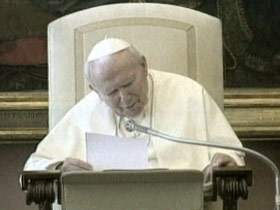
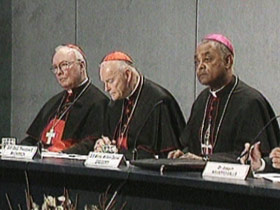
Twelve U.S. cardinals and two bishops joined Pope John Paul II and other Vatican officials for two days of discussions about the problem and possible solutions. John Paul told the group there is no place in the priesthood for those who harm the young. At the end of the meeting, U.S. officials released what they called the “skeletal outlines” of a new national policy to dismiss sexually abusive priests. The cardinals recommended a special process to defrock priests guilty of “the serial, predatory sexual abuse of minors.” They did not endorse a “zero-tolerance” policy for all past offenders, although some said that may still come. The specifics of the new policy must be worked out at the U.S. Bishops’ meeting in June and ultimately approved by the Vatican.

Here at home, some experts said the meeting was unusually frank and open — for the Vatican. But representatives of victims’ groups criticized the gathering for not going far enough. Kim Lawton has more on the meeting.

cardinalsupdate-post02-cardinals

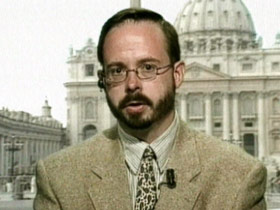
KIM LAWTON: Joining me is John Allen, Vatican correspondent for the NATIONAL CATHOLIC REPORTER. John, the cardinals left a lot of work still to be done by the bishops in the June meeting. How much debate are you expecting at that meeting?

JOHN ALLEN: We’re expecting a lot of debate and a lot of controversy. This summit painted in very broad strokes, agreeing in broad terms to a zero-tolerance policy, for example, but leaving a lot of the details to be worked out in June.

Another interesting thing that will create debate is that they took sides in what has been the sort of competing ways of explaining this crisis. Liberal Catholics have explained it in terms of mandatory celibacy and the ban on women’s ordination and the whole understanding of sexuality. Conservatives have explained it in terms of doctrinal dissent and tolerance of a homosexual subculture in the priesthood. The summit essentially ratified that second view, and that too, I’m sure, will generate debate when the bishops get together.

LAWTON: Was this meeting a matter of the Vatican telling the cardinals, “Go home and figure out a solution,” or did the Vatican officials really tell the cardinals what solutions they need to take?

cardinalsupdate-post03-allen

ALLEN: Well, I think it’s a little from column A and a little from column B. The Vatican has taken the position that this has to be fixed at the local level, and I think a lot of what happened was the Americans bringing their ideas. On the other hand, the Vatican also understands that whatever the American bishops come up with will be imitated all over the world and certainly wanted to get their two cents in. So what I think you had here was a give and take.

LAWTON: And very briefly, what do you see about the role of the laity in light of all this crisis?

ALLEN: Well, I think the cardinals and bishops all talked extensively about bringing the laity much more into decisions on governance and personnel, but it’s striking that in the final documents that were released this week, there was no mention of that point. The cardinals at a press conference called that an editing mistake, but I’m sure that’ll rub some Catholic laity in the States the wrong way.

LAWTON: Do you think they’re expecting to have a greater role?

ALLEN: Well, yeah, I think what has happened is this story has shifted from being just a sex-abuse story to being an accountability story, and I think a lot of ordinary, Mass-going Catholics think one of the ways to fix the accountability problems is to bring the people, that is the laity, more into the decision-making process.

LAWTON: All right. John Allen of the NATIONAL CATHOLIC REPORTER. Thank you.

ALLEN: Kim, it’s my pleasure.

Robert Wuthnow Extended Interview

Read more of Bob Abernethy’s interview with Princeton sociologist Robert Wuthnow:

Q: When Americans talk to pollsters about their religious beliefs and practices, what they say can sometimes be exaggerated. Describe that phenomenon briefly and tell us how big you think it is and why it exists.

religiousamerica-post13-wuthnow

A: When you look at surveys that ask about church attendance (some of the most common ones are done by the Gallup poll, and others are done out of the University of Chicago and [by] a few other pollsters), they give varying numbers. Often you get numbers [that] around 40 percent of the public has been to a religious service in the past week, or something like 35 percent claim to go almost every week. People have looked more closely at communities. They’ve gone around and looked in church parking lots, and they’ve asked people to fill out time-use diaries during the past week and have talked to ministers. They have trouble making the numbers come up to that high a level. Nobody knows quite how exaggerated the numbers might be. I’m guessing, for example, from what I’ve seen, that if 40 percent say they’ve been there in the past week, it’s probably closer to 28, 29, maybe 30 percent. Some of it is that people want to appear involved in something as respectable as religion, and some of it is they just want to be cooperative with the person asking the surveys. So if the answer seems to be, “Well, yes, we want you to say ‘yes,'” well, then people cooperate and say “yes.”

Q: Could it also be that people believe it’s the truth when they’re saying it?

A: Some people do. They may say, “Yes, I’ve been there in the last week,” and they’ve forgotten that, well, last week they were sick, or last week they were on vacation. What they do remember is that they’re active in their church. They go to church regularly. And so they give themselves a little bit of slippage, and that allows them to say what they want to say, which is, “Yes, church is important for me.”

Q: Even discounting the exaggeration of poll data, what can be said about the prevalence of religion in America?

A: That we’re a very religious country, certainly compared with Europe, where participation rates are much lower. We really are a quite remarkable country in that respect.

Q: And why is that?

A: There are a lot of reasons. Some of them are historical. We have a tradition of being a religiously pluralistic country — competition, lots of churches, a tradition of voluntarism… The important thing is that churches have maintained themselves pretty well by providing programs that are of interest to people. I’ve always been surprised at how religious we are. You know, you hear stories about how we’re not a very religious country, we’re materialistic, we’re secular — but we’re really very, very religious.

Q: You and others have suggested that traditional religious beliefs — creeds and doctrines — may not be quite as important for many people as they used to be. What’s going on?

A: If we look back over a 50-year period, when we’ve been able to do research, it looks like religious beliefs just aren’t as important as they used to be. Why is that? One thing may be that the churches are not emphasizing beliefs and doctrines as much as they did in the past. Another may be that we’re a more skeptical society. We’ve had so many different beliefs — not just religious beliefs, but scientific, philosophical, popular beliefs. We’re not sure that those fine points of belief matter so much anymore. We’re more convinced that it’s practice, it’s experience, it’s having some kind of relationship with God that matters. I’m thinking in particular about a woman we interviewed a couple of years ago as part of a research project. We asked her to summarize her religious beliefs. And she mentioned a few standard things — belief in God, belief in Jesus, belief in life after death, belief in the Bible. She said, “You know, what’s really important to me is practice, not doctrine. It’s what I pray about. It’s what my religion does for me when I get up in the morning. It’s what it does for me when I go to work and how it helps me with my family. That’s what’s important.”

Q: What takes the place of the old, central importance of belief?

A: People are very interested in religious experience, whatever that may mean. They will talk about a time when they were sitting in church and just felt that God was with them, or a time at the bedside of someone who was dying and [they] felt that an angel or God was close to them, or being out in nature and feeling just awe-inspired by the beauty of nature. And somehow, that’s what affirms to them both the existence of God and the fact that God cares for them personally.

Q: What would be your definition of “spirituality”?

A: My definition of “spirituality” comes from talking to a lot of people and asking them what their definition of “spirituality” is. Most people define it very simply, and they say it’s their relationship to God. A few people will use some other word — a “higher power,” or “divine being” — but [for] most people, it’s that personal relationship with God. And then spirituality is everything that builds up around that — their prayer life, their attempts to be of service, their attempts to be faithful. Spirituality is very personal, but it has that transcendent connection. That’s the important thing.

Q: Describe and evaluate, if you can, the growth in recent years of interest in spirituality.

A: One of the surveys that I did about a year ago showed that 43 percent of the public said their interest in spirituality had been increasing in recent years. Only 7 percent said it had been decreasing. The rest said it had stayed about the same. That’s one indicator that spirituality is just of much more interest now than it was maybe five or 10 years ago.

Q: Is it something that people pursue both within traditional religious institutions and outside them?

A: Yes, people experience spirituality and find ways to pursue it certainly within their religious traditions — Catholics, Protestants, Jews. Organized religion continues to be very important to people’s spirituality. Other people have found that it just doesn’t quite work that way for them, so they’re off on the road someplace. They’re going to retreat centers, or they’re reading books, or they’re meditating on their own. Both of those are going on.

Q: In recent years, there’s been a big increase in the number and the visibility of non-Christian religions in the U.S. — Islam, Buddhism, Hinduism, and others. How do you sum up the reaction of American Christians to having more and more people of other religions in their midst?

A: I would sum up Christians’ reactions to other religions in one word at this point: indifference. It really surprises me. You talk to people and you say, “Okay. Your son’s best friend in school is Hindu, or Muslim. “Your neighbor is a Buddhist,” or a Hindu. “The building right across the street from your church is a Hindu temple. What are you doing about it? How do you think about this?” People haven’t thought about it. They just exist side by side with these people. They block out the religious identity and don’t pay much attention to it.

Q: You couldn’t call it “tolerance”?

A: You could call it tolerance and, of course, people use the language of tolerance, because when you press them, then they’ll say, “Well, of course, a Hindu, or a Muslim, or a Buddhist has every right to practice, just as we do.” They flip into the language of rights — civil rights, civil liberties, and so forth. Push people, though, and say, “Well, but theologically, what do you think? They really believe something different from you.” And it’s, “Well, that’s okay. That may be true for them. What I believe is true for me.”

Q: What does that mean? What does this indifference or tolerance mean about commitment to truth, or feeling that your religion is the truth, or at least more true than anyone else’s? What does it mean about that?

A: As a culture we’re only beginning to face up to the sense of doubt that we have — within the Christian community, especially — about “truth” as it’s traditionally been defined. For many, many centuries, Christians have thought that they had the truth, and that other people didn’t have the truth in the same way. And now, Christians are not quite so sure of that. They’re more likely to say, “This is true for me. I know it from my experience, but I’m not willing to say anything about anybody else.” And that radically changes the meaning of truth, when it’s just true for you and not necessarily true for somebody else.

Q: What about white evangelical Protestants who feel that they have a mission from Jesus to spread the gospel, to preach it to everybody, to convert others out of love so that they can have eternal life? They feel a real obligation and duty to convert non-Christians. How do they put that on one side together with, on the other, the desire to be hospitable, or the desire to be tolerant? How does all this cut for somebody who feels a real duty to proselytize?

A: Evangelical Protestants I’ve talked to fall into two categories. There are those, often in leadership positions, who say, “Yes, as an organization, denomination, or church, we have that responsibility to proclaim the Christian gospel.” And then there’re the others at the grass-roots level — the members — who may be very firm in their beliefs, but they say, “That’s not really my role to get out there. I can live as a good Christian. Hopefully, they’ll see something in my lifestyle. Or perhaps, if they’re really in need, they’ll come to me. But I’m not going to go out of my way. That would be an intrusion on their rights. That would be a lack of respect. So all I can do is be an example and leave it at that.”

Q: Do you feel that down the road there’s going to be much more of a sense of these “new” religions being a challenge to the “true” Christianity?

A: Oh, I think so, yes. At this point, it’s often easy, still, for churches to treat new religions with the “out of sight, out of mind” principle governing. They just may be able to ignore the fact that there are large numbers of other religious people in their community, but that’s changing very, very rapidly. You know, we’re not in a situation where we can only look to some other country and say, “Oh, well, there’re Hindus,” or Muslims, “living there.” They are living in our own neighborhoods, and in increasing numbers.

Q: What effect do you think these new religions will have down the road on this country?

A: It’s hard to tell at this point. One scenario, at least, that makes a lot of sense is that we will have a kind of leavening of the religious spirit in this country — meaning that there will be, on the one hand, more tolerance and acceptance; but, on the other hand, more attempts to look back within our own religious traditions and say, “Well, what does it really teach? What do I really believe?” Because once you start comparing it with another one, then you have to look at some of those questions.

Q: In the survey you did about mainline Protestants, you got two clearly opposing answers on this question of “my truth” versus somebody else’s truth. Christians thought Christianity was, indeed, true. But then a couple of questions later, it turned out that they also thought that there was truth in other religions — and by about the same proportion. That seems to reflect a good deal of confusion.

A: We did a national survey in April 2000 of about 5,000 people. And one of the statements we asked people to agree or disagree with was, “Christianity is the best way to know God.” About two thirds of the public said, “Yes, we agree with that.” But then just a little bit later in the survey, we asked them to respond to another statement that said, “All religions are equally true.” And about two thirds agreed with that statement, too. These were two seemingly contradictory statements. Lots of people were agreeing with both.

Q: And what did you make of it? How do you explain that?

A: What that left me with was just a huge question mark about how much are people thinking deeply about the truth of their own religion, their belief in Christianity, and what they mean by other religions being true. I don’t think a lot of people have really sorted that out, and I think that’s going to be a big issue for people in churches, pastors, people in seminaries — to start sorting out or providing some clear guidance.

Q: What do you think that sorting-out process will cause?

A: It will cause people to be much more concerned about what’s true and what’s not true, both in their own tradition and in other traditions. I don’t think it’s likely to lead to a kind of religious universalism or people saying, “Oh, we all believe in the same thing, and we just do it in different ways.” When you talk to people who have thought seriously about these questions, they begin to say, “Oh, these religions really are pretty different when you get right down to it.” And then they continue to struggle with, “Well, there might be some truth,” and “How is that possible?” and “Does Christianity really teach that it’s the only true religion, or have we just misinterpreted it?” Lots of questions come out of that.

Q: Overall, how do you think the battle is going between religion, in general, in this country and, on the other hand, the power of science, secularism, popular culture’s overwhelming emphasis on the material, and the importance of individual rights?

A: I tend to vacillate between being a cautious optimist and a cautious pessimist. On my good days, I look at religion and say, “Well, the trends seem pretty good, mostly.” Around most neighborhoods there are vibrant churches doing important things in their community. You figure there’s truth being taught, preached in those churches. So that leads me to be optimistic. At the same time, though, maybe on my bad days, I look at some of the trends that suggest things aren’t going so well — surveys of teenagers, for example. You find that there really is not much serious commitment to religion among teenagers. Some studies suggest that the depth of activity in churches has been diminishing. And then if we look at it strictly from the standpoint of the secular society — marketing, advertising, higher education, government, science, tremendously powerful institutions that command billions and even trillions of dollars — they have an enormous impact on shaping the culture, compared to what the churches can do. I will say that I’ve been surprised that religion is doing as well as it is. And the reason I’m surprised is that there are so many trends working against it. For example, some of the trends going on in the family — just something as simple as the rising divorce rate over the last 30 or 40 years. Divorced people go to religious services much less often than married people do. Separated people do, too; and single people do, too. One would think that trend, that change in the family, would work against church participation, and [it] probably is. And yet, there are other things that seem to be making up the difference, so that church participation is continuing. Other factors have the same effects. That’s just one example.

It appears to me that religious commitment in our society — however you think of that — is holding its own against enormous odds. So many things are working against it, and yet it’s doing fairly well.

religiousamerica-post08-wuthnow

Q: Could you tick off the most important of those things that are working against it?

A: The rising divorce rate. And, as it turns out, the inclusion of women in the paid labor force has worked against it, because women used to do all the volunteer work around their congregations. Another factor has been the change in neighborhoods. People don’t participate in their neighborhoods or know their neighbors as much anymore. Yet most churches — in the past, at least — have been neighborhood-based. And then another change is that we have experienced some decided trends in belief. The number of people, for example, who believe that the Bible is literally true has dropped remarkably since the 1960s. And people who don’t believe that don’t participate in their religious organizations nearly as much as people who do. So that may be a kind of broader crisis of belief. All of those things work against religious participation.

Q: And science? And the growth in the number of people who might be described as secular? And that gets us to politics and policy and Washington.

A: I remember one religious leader I talked to said he thought the big trend was that people don’t care about what happens in Washington anymore. What they care about is in their own neighborhood, so that often means that they do one-on-one social-service activities — help their neighbors, help the poor. Maybe through their church they even get involved in the local school board election. But they’re just indifferent to what goes on in Washington, and that may be hard to measure and hard to understand. Because we, of course, have pressure groups — whether they be Christian Coalition, or mainline organizations, Catholic organizations — in Washington. But those organizations often don’t have much of a direct line back to local churches and synagogues.

Q: Is there such division within religious communities that there is no one voice, that one religious voice cancels out the other and, therefore, it’s hard for people to know what people of faith might want in terms of politics?

A: Oh, sure. Look at almost any issue, and there are different religious positions on it — most recently, stem cell research. [There are] lots of different positions, including ones in the middle, “we don’t know,” and so forth. In my mind, that’s how it should be. Religious communities ought to be grappling with these issues and coming up with different answers. But as a people, we’ve been taught that there ought to be an answer. I think maybe we’ve been taught that by science. You ought to be able to go out, investigate, and come up with a single answer that everybody agrees on. These kinds of moral and ethical and theological issues don’t fall out that way.

Q: So how would you evaluate the influence that religion has had, and is having, on the society as a whole?

A: If you could imagine a society like ours without religion — just strip away all those 300,000 local congregations — we’d be in a big mess. If you look at it that way, religion does help people in their communities; in their family lives, their personal lives; gives them meaning; gives them attachments to their neighbors, and so forth. We’d be in big trouble without religion. On the other hand, if you say, “But, compared to what?” Compared with advertising, or the power of government, the power of business, religion is pretty weak. I’d say it’s a vital player, but it’s one player among many. Sometimes it’s David among a whole bunch of Goliaths.

Q: How can you describe the influence of mainline Protestants these days?

A: We did a big study that took us several years. Mainline Protestantism, we concluded, is much stronger than a lot of people thought. People have been looking at declining memberships. Well, those declines pretty well ended in the early 1990s. Mainline memberships have been pretty stable for about 10 years now. There are many, many vibrant churches, well-educated clergy, people who are involved in their churches; even at the national level, [there are] a lot of interesting activities going on, often behind the scenes, and yet that are making a difference in terms of some of the good things that we want done in this society.

Q: Why did the mainline decline so much?

A: Well, the mainline declined mostly in the 1960s and early 1970s, studies now are telling us, largely because of what’s been called the “demographic factor.” People who belong to mainline churches tend to be more middle-class families. That meant that they had their children later, and they married later, in the first place — had their children later, had fewer of them. There were just fewer children coming along to replace the members that were gradually leaving those churches.

Q: There’s a theory, going back to the maps used on election night 2000, about the blue states and the red states — red states being everything in the middle and blue states being on the edges. The theory is that the country is deeply divided by religion. What do you make of that idea?

A: I don’t think there’s much to that theory. We are divided by other kinds of social factors — small town versus big city, heartland versus coast, certain kinds of occupations, race, ethnicity, and so forth. But on religion, if you look at people who are staunch evangelicals, let’s say, versus people who are staunch members of more liberal congregations, there’s often as much crossover in what they think and how they vote as there are differences.

Q: You’ve looked at religion and the arts, and what have you found?

A: Religion and the arts is a fascinating subject now, because participation and interest in the arts has increased enormously over the past 30 years or so — partly through school programs, partly through museums and galleries and symphonies, partly just because we’re an affluent society and we have more time to spend on the arts. What’s puzzling to people is the following question: Is this interest in the arts working against religion in some way, becoming a substitute for it? Or do the two go hand in hand? The answer seems to be that they go hand in hand. The more interested people are in the arts, the more they also are in spirituality. And if they’re especially interested in spirituality, then they start getting involved in their churches and synagogues again. An example of this would be a woman we talked to in California as part of a research project. Early in her marriage, she’d had a very severe personal crisis that left her emotionally a basket case. Through therapy and counseling, she started to be involved in some kind of artistic activity. She wasn’t a professional artist at all, but it was a way of expressing some of the deep pain and anguish that she had felt — making pots, painting, things like that. She eventually recovered and went on to be much more active in her church. She was just so angry at God for a while that she couldn’t participate in the church at all. Today, she’s running a center that helps abused women, and she uses the arts as one of the ways to help these women.

Q: So it is not just an interest in the arts as a spectator. It is participation in artistic activity that does it.

A: Yes, it’s very much hands-on participation — writing poetry, making pottery, playing the piano, whatever it might be. It seems what this does for people is to transport them out of that busy, hectic life they lead at work and [in] their family, [and] gives them a chance to meditate and reflect. When they start doing that, then they find spirituality is a big part of that.

Q: What’s the source of the idea that “We’re all Protestants now”? Is there something about the culture that is so deep and so strong that it affects all religions and makes them more individualistic and pragmatic than they otherwise would’ve been?

A: Oh, sure. The culture affects everybody. You talk to some Muslims who’ve recently immigrated into the United States, and they’ll say, “Well, our practice of religion’s a little bit different.” Sometimes they’ll say it’s more individualistic. I’m not sure what they mean by that. Hindus sometimes say the same things. Often, what they mean is that those broader community ties that made such a difference before, where the whole neighborhood would practice together and go to daily prayers together — that’s gone. Maybe even the family is divided. So people have to go to the mosque or the temple by themselves and pray by themselves.

Q: How serious do you think it is for religion, generally, that there has been apparently over recent years a slow, steady increase in the number of people who say they are not religious?

A: I’ve seen these statistics, and they suggest an edging up in that number. It’s not a large percentage of the population by any means. Most of us still find a way to say that we’re religious. But it has become more socially acceptable to say that you just don’t have a religious preference. For some of those people, they may be atheists or agnostics, if you push them. For others, it may be that they are just shopping around at the moment. If we think back to the 1950s or ’60s, Madalyn Murray O’Hair was the symbol of atheism. [It was] very unpopular to be an atheist. Nowadays, people don’t talk so much about atheists, but it is okay at least privately for people to say, “I’m not sure what I believe. I don’t feel attached to any religion. [It] doesn’t mean that I’m disinterested entirely, doesn’t mean that I’m lacking in spirituality, but I’m just alienated from organized religion at this point in my life.”

Q: “I’m spiritual, but not religious”?

A: Right.

Q: What about the growing number of nondenominational churches? That’s a big phenomenon. If all the nondenominational churches were part of one denomination, it would be the third largest denomination in this country, after Catholics and Southern Baptists. What’s going on there?

A: I’m surprised that the number of nondenominational churches has grown as much as it has. There are a lot of notable, large churches. What’s impressed me more is that even churches identified with denominations have, in fact, become nondenominational. You drive past them, [and a] big sign out front says “Grace Church.” In the fine print may be “Presbyterian” or “Lutheran” — like we don’t want to admit that we have a denomination. That’s because people themselves may be from different denominations. They may have married somebody from a different denomination, or moved in from another community. Their ties to a denomination just aren’t as important. So there’s an advantage to being nondenominational at this point.

Q: Can you say anything about the extent to which people find in religion an answer to the question about what is the good life and how to lead it?

A: That kind of moral question — being kind to one’s neighbor, loving one’s neighbor — is something that people claim to find in their religion almost without respect to what that religion is. That’s one thing that people say religion really does for them. It gives them that sense: “This is what a good person should be.” They will say, “I don’t always live up to it,” but this is the standard. Now, it may be that they would have come to that view anyway. But having it as part of the religious tradition, maybe having that example of Jesus, a moral figure, in their mind, at least, helps them.

Q: Talk a bit about the phenomenon of the small group in pursuing spirituality.

A: Small groups are an amazing phenomenon. Something between 35 and 40 percent of the public is involved in some kind of small group. Two thirds of those people are involved in a group that’s connected to a church or synagogue. We’re talking about Bible study groups, prayer fellowships, self-help groups like Alcoholics Anonymous, men’s groups, women’s groups. They’re enormously important. They give people a sense of community. They give people a way to talk about their spiritual life. People come together, pray together, study the Bible together. And they also learn how to be better people. We just finished a big study on forgiveness, and small groups are one of the main ways in which people now learn about forgiveness. They go there, they talk about it. They may study little booklets that tell about forgiveness. And, sure enough, they’re better able to go out and work on relationships in their own lives.

Q: What do people tell you these days about the reasons they attend a particular place of worship?

A: The reasons are very pragmatic: “It’s close by, so I don’t have to drive clear across town.” “It has a program for my kids.” “I like the pastor. He’s really interesting, gives great sermons.” “It has wonderful music.” “It’s big. It’s got a beautiful building.” “It’s got lots of programs, so if I get bored with this, I can go do something like that.” It’s usually not doctrine. It’s usually not denomination. People shop around, and they just sense that it feels right.

Q: So how religious are we, really?

A: One way to answer is to divide the public into four categories. Roughly the top quarter of the public, I would say, is very committed. They take their spiritual life very seriously, pray routinely, are active in their religious organizations, and so forth. The second quarter, and even the third quarter — the middle 50 percent of the public — is sort of religious. They’re involved. They go once in a while. They pray once in a while. They believe some of the right things. They may even think it’s pretty important to them, but they don’t make a big commitment to it. And the remaining quarter say they’re pretty much just indifferent to religion. My guess is that may not be terribly different than the way it’s been for a long time.

Q: What is the essence of being a mainline Protestant?

A: One thing has often rung true for me in comparing mainline Protestants and evangelicals: evangelicals look at an issue — particularly a theological issue, a religious issue — and say, “It’s really simpler than you thought. Jesus is the answer,” or, “It’s right here in the Bible.” A mainline Protestant looks at it and says, “It’s really much more complex than you thought. You’ve got this, and you’ve got that, this side and that side.” I think, in a way, that captures, for me, some of the difference.

Q: And the essence of being a Catholic?

A: For Catholics it’s harder because it’s a large, very diverse community. I’ve often been attracted, though, to Andrew Greeley’s term “communal Catholic.” The tradition, the liturgy is what really makes it stick.

Q: Once upon a time religion and spirituality seemed to be of a piece. We make a distinction between them now. What happened?

A: Organized religion lost its monopoly over spirituality. If you go back, say, to the 1950s, there weren’t many places to shop for spirituality, unless you went to an organized church or synagogue. Nowadays, you can go to the local bookstore,or a retreat center or some kind of New Age center, or you can order up tapes or CDs, or go to a concert. In other words, other parts of the society got in the act and found that they could supply some of our spiritual views. You can look at people and almost make a judgment of how hard they work at their spirituality. Of course, this is bad theology, because it’s all supposed to be grace. But some people think that, whatever their theology is, it really does require some commitment. And they actually spend considerable time every day praying or reading the Bible or being of service to other people or preparing lessons to teach at their church. That does take a lot of time and commitment, and that kind of commitment runs against the grain of our society that tells us we ought to be able to get fast food, instant meals, instant gratification. The rest of what goes on in American spirituality is catering to that impulse to get things as quickly and easily as possible.

Religious Diversity by Steve Prothero

To Live and Die in Gwinnett County

An in-law of mine once worked as a pastor at a small Lutheran church in Gwinnett County in suburban Atlanta. Each time I got off the interstate and bent my car toward her home, I seemed to pass more signs with Asian scripts. Asian immigrants have been coming to the United States in huge numbers ever since Congress lifted immigration restrictions in landmark legislation in 1965, and by the 1990s they had clearly discovered Gwinnett County.

The rapid influx of these immigrants into a Southern Baptist stronghold (where not long ago Lutherans were considered eccentric) led to the proverbial white flight. Soon my in-law’s parishioners had moved farther out, and her church had closed its doors. The last time I visited the area, I passed a new Islamic center, the Masjid Omar bin Abdul-Aziz, not far from the old church. Although I had been studying America’s religious diversity for over a decade, I was surprised that Muslims had come so quickly and in such numbers even to the Bible Belt.

Islam is now widely regarded as one of the fastest growing religions in the United States. Estimates of the number of Muslims in the country vary widely, but those Muslims who are here are building mosques (known in Arabic as “masjids”) at a dizzying rate. According to a recent study sponsored by Hartford Seminary’s Hartford Institute for Religious Research, there are now over 1,200 mosques in the United States. How many Muslim cemeteries there are in the United States is difficult to determine. But this much is sure: every one of metro Atlanta’s estimated 60,000 Muslims is going to die some day, and each one will need a place to be buried.

Currently most of the Muslims who die in Gwinnett County are being laid to rest in the only Muslim cemetery in metro Atlanta, near Lovejoy in Clayton County. Yet that site is filling up fast, prompting the Georgia Islamic Institute of Religious & Social Sciences to propose a 1,500-plot cemetery a few miles from its mosque in Lawrenceville, Georgia. Their proposal was slated for review at a meeting of the Gwinnett County Municipal Planning Commission on September 18, 2001. But terror intervened and, as it is said, everything changed, including zoning procedures in suburban Atlanta. As the nation reeled from the events of 9/11, the September 18 meeting was cancelled, pending a reevaluation of matters as mundane as water pathogens and as sacred as the meaning of Islam.

Over the last few months, as proposed hearings have been scheduled and cancelled again and again (once because of a rare Atlanta snow), residents of Gwinnett County have joined President Bush in discussing Islam. Their particular focus, however, has been Muslim death rites. Like Jews, Muslims typically do not embalm. They bury their dead quickly, within twenty-four hours of death, in a simple shroud and without a coffin or a vault. They then top their graves with modest markers rather than fancy headstones. Given these customs, their cemeteries can look quite different from the typical American memorial park. Open graves are not unusual, given the requirement to bury within a day of death. And because Muslims eschew coffins and vaults, gravesites can sink over time, leaving small impressions in the earth.

Local opponents of the Muslim cemetery did not say they wanted their neighborhood free of the Muslim dead. They argued instead that Muslim burial practices represented a public health hazard and an eyesore: pathogens from unembalmed corpses would leak into the groundwater and imperil their children, and an unkempt cemetery would imperil their property values.

The First Amendment, of course, guarantees the free exercise of religion. At least in the popular imagination, it also erects what Thomas Jefferson famously referred to as “a wall of separation” between church and state. Yet Americans are not free to do absolutely anything they want religiously, and the wall separating church and state resembles a modest picket fence more than the Great Wall of China. To put it another way, the limits of religious exercise are constantly being tested, as are the limits on church-state collaboration.

Most observers of those tests and those limits have trained their sights on Washington, D.C., and the Supreme Court. Like politics, however, religion is local. The pope speaks for Roman Catholicism, but Catholics go to Mass in their local parishes; and while the Dalai Lama speaks for the Buddhist tradition, Buddhism takes place, literally, on the ground at Buddhist temples. Observers of church-state (and mosque-state) relations would do well to listen, therefore, not only to President Bush and Chief Justice Rehnquist but also to local zoning officials and town selectmen. At least as much as presidents and Supreme Court justices, those officials determine what we can and cannot do religiously — where Buddhist monks can live, whether Sikhs — can wear ceremonial swords, and even how Muslims bury their dead. The determinations of local officials are in turn influenced by popular opinion, which at least as much as legal precedents shapes interactions between America’s Christian majority and its many and varied religious minorities.

As the Muslim cemetery drama played out after September 11, a predictable array of characters emerged. Muslims invoked the First Amendment and reminded local politicians that Islam was not a cult, but, as President Bush had insisted, “a religion of peace.” Rednecks equated Atlanta’s Muslims with the killers of Wall Street Journal reporter Daniel Pearl. New South politicians mediated between the two camps, looking for an artful compromise.

In the end, John Dunn, of the Gwinnett County Commission was unable to satisfy everyone, but he and his fellow commissioners did fashion a compromise. By a 4-0 vote, they approved a special-use permit for a scaled-down 1,276-plot cemetery. They did not insist on embalming, but they did mandate wooden caskets and stone or metal grave markers, and they outlawed open pits. Opponents had requested a ten-foot-high brick wall surrounding the site. The commissioners gave them an eight-foot-tall wooden fence. “These are all Americans,” County Commissioner John Dunn told a reporter from the Atlanta Journal and Constitution, “and they should have all the rights and privileges afforded American citizens.”

Like every other county in Georgia, Gwinnett County is dominated by Baptists. Islam may be growing quickly there, but Baptists predominate. In this respect, Gwinnett County looks a lot like the rest of the United States. The United States may be, as Harvard professor Diana Eck has recently argued, “the world’s most religiously diverse nation,” but it is at the same time undeniably and overwhelmingly Christian. In fact, the United States now has more Christians inside its borders than has any other country in the history of the world. According to an important telephone survey just released by RELIGION & ETHICS NEWSWEEKLY and U.S. NEWS & WORLD REPORT, 83% of Americans describe themselves as Christians of one stripe or another.

This remarkable coexistence of radical diversity and Christian commitment is in my view a key paradox of American religion. The story of American religion is not, as Eck has implied, a tale of Christianity yielding to Islam, Hinduism and Buddhism. It is a story of a country that somehow became astonishingly diverse religiously even as it remained overwhelmingly Christian.

The implications of this new situation on civil society are no doubt significant but they are as yet unknown. So I am grateful that the RELIGION & ETHICS NEWSWEEKLY/U.S. NEWS & WORLD REPORT survey took pains not only to measure the numbers of Catholics, Protestants, Mormons, and Muslims in the United States but also to gauge their attitudes toward one another.

While I was teaching at Georgia State University in Atlanta, I was always surprised to learn how many of my Baptist and Methodist students had never met a Jew or a Catholic. This survey shows that despite the country’s growing religious diversity, Americans remain quite isolated religiously. Nearly half of the adults surveyed were not “personally acquainted” with a Jew. Nearly three out of every four respondents did not personally know a Muslim. Hindus and Buddhists were not known to more than four out of five. Given this lack of interpersonal contact, it should not be surprising that most Americans knew little about religions other than their own. While 95% were either “very familiar” or “somewhat familiar” with Christianity, only 35% were familiar with Islam, 27% with Buddhism, and 21% with Hinduism.

Although few of the survey respondents knew much about Islam, they nonetheless held opinions about it. When it came to their “general impression of Islam,” the respondents were fairly evenly divided. 36% had a favorable impression of the religion and 37% an unfavorable one. When asked whether Islam was, as President Bush has maintained, a peaceful religion, the respondents answered with considerable skepticism. Although 40% said that Islam harbored about the same number of violent extremists as other religions, 39% said Islam had more violent extremists and only 4% said it had fewer.

One of the most revealing questions on the survey gauged the diffusion of Samuel Huntington’s thesis that the world is gearing up for a clash of civilizations between Christianity and Islam. “What do you think the chances are of a bigger armed conflict sometime soon between the Christian countries of Europe and North America and Islamic countries?” the survey asked. More than two out of every three respondents (69%) answered that such a conflict was either very likely or somewhat likely.

As I finished exploring the results of this survey, I couldn’t help wondering whether Americans’ convictions about this impending Muslim-Christian battle were tied to our unfamiliarity with Muslims and Islam. In Gwinnett County, tensions arose when a rapidly growing Muslim population encountered a Southern Baptist majority. Some Christians refused to accept a Muslim cemetery of any sort, and, when the compromise went through, they put their homes on the market. Most citizens agreed to work things out. Muslims agreed to adapt their time-honored practices to American tastes and norms. Christians agreed to live, and perhaps even to die, alongside their Muslim neighbors. In the process, local citizens of all religions got to know Muslims and learned about Islam.

Professors are often naive about the virtues of education, and sometimes familiarity breeds contempt. Still, I can’t help hoping that, as more Americans come to know Muslims and come to learn about Islam, fewer Americans will see a civilizational clash between Christianity and Islam as inevitable. The coexistence of Christianity and religious diversity is one of the paradoxes of American religion. Another paradox is the ability of most Americans to mix heartfelt faith with a strong commitment to religious tolerance. For centuries, immigration has tested that commitment, and virtually every decade has been marred by some measure of religiously inspired violence. Nonetheless, the commitment to religious tolerance runs deep, in the United States and in Gwinnett County.

Stephen Prothero is an associate professor in the Department of Religion at Boston University, specializing in Asian religious traditions in the United States. His most recent book is PURIFIED BY FIRE: A HISTORY OF CREMATION IN AMERICA.

John Green Commentary

Read the comments of John Green, professor of political science at the University of Akron, on the RELIGION & ETHICS NEWSWEEKLY/U.S. NEWS & WORLD REPORT survey:

OBSERVANT, TOLERANT, AND IGNORANT? The contrast in this poll between high levels of religious observance and high levels of religious tolerance is most interesting. Both observance and tolerance are probably a bit overstated (they usually are in polls), but the results are striking. The United States is both a religious and a tolerant country. For starters, this suggests that the threat to religious conservatism may be overstated and, by the same token, the fear of religious conservatives that religion is threatened by modern society may also be overblown.

The findings also provide a valuable context for understanding 9/11 and Islam. Americans drew comfort from religion after 9/11 in large part because they are religious, and they do not hold Islam responsible for 9/11 because of their religious tolerance.

Why is this? The poll provides three suggestions, and they are not entirely benign. First, the survey shows that most Americans are woefully ignorant of other religious groups and report very little contact with other religious people. So the observant/tolerant pattern may be the result of ignorance. Simply put, it is easier to tolerate people when you don’t know their peculiar beliefs and practices.

Second, the poll suggests that many Americans appear to be loosely tied to religious doctrines and beliefs — the very things that spark the most disagreement among religious people. Indeed, people may impute to others some version of their own faith. It could be the dominance of the “spiritual” element of religion that fosters both high levels of observance (perhaps of a highly personal nature) and tolerance of other people’s (highly personal) observance.

Third, the poll reveals that religion is only one of many influences that are relevant to how people lead their lives. Religiously observant Americans may be tolerant precisely because their faith is less relevant to many aspects of their lives.

So the United States is observant and tolerant, but this pattern may be based in part on ignorance, a lack of doctrinal commitment, and the limited relevance of faith to people’s lives.

SPIRITUAL EXPERIENCE TRUMPS RELIGIOUS BELIEFS?

The poll also offers a good story about religious beliefs versus experience. It is interesting, for example, that only one quarter of Christians say beliefs and doctrines are that most important part of religion, and almost one third name beliefs, doctrines, and creeds as their first reason for choosing a church. It could be that we have a group of “believers” and a group of “experiencers” — and perhaps a group that is a bit of both. Perhaps one set of factors goes into choosing a house of worship and a different set of factors goes into religion as a broader phenomenon.

Beliefs and doctrine pop out as particularly important for born again Christians, especially as the most important reason they choose a church to attend (two fifths of born agains select it as their first choice). On all mentions, they also do better, but the other religious groups catch up.

BIG DIVIDES IN AMERICAN RELIGION

The data suggest that race matters, and that there are several big divides in American religion. Born again Christians and black Protestants seem to be on one side of the divide and mainline Protestants on the other, with Catholics and others in the middle (and Catholics sometimes have distinctive positions).

There are striking differences between the responses of white born again Christians and other white Protestants/Christians. In religious terms, the born agains and the black Protestants often look alike, with mainline Protestants being much less religious — at least in these terms. White Catholics typically fall between these groups. A good example is the survey questions on the importance of religion.

Asked about the importance of religious faith in dealing with 9/11, black Protestants rate it highest (78% say it is “very important”), followed by born agains (73%); mainliners rate it low (37%) but still more than twice as high as seculars (15%). The same holds true for the question about whether 9/11 strengthened their faith in God.

The question about frequency of experiencing God’s presence or the presence of a spiritual force question also shows striking differences: 64% of white born agains and 71% of black Protestants report having had such a spiritual experience “many times.”

The questions about knowing people of other faiths also reveal some significant differences: 57% of the born agains and 68% of black Protestants don’t know a Jew. In contrast, only 31% of the mainline Protestants gave this response.

Information about other religions seems uniformly low across all faith groups. White Christians seem the least affected by contact with other faiths, but this is less true for black Protestants and other religions.

Interestingly, white mainline Protestants are the least likely of the religious groups to see Christians as very tolerant.

The born again Christians are less tolerant than other groups and most likely to believe their faith is the only true one. They are the most threatened by religious diversity, but here black Protestants are a close second. They are also the most likely to stress the importance of doctrines and beliefs. And when asked about a duty to convert others to Christianity, born agains (37%) and black Protestants (32%) put the most stress on conversion.

Asked about what influences their decision making, the numbers who chose the Bible and church teaching are very large for born again Christians and black Protestants, and lower for other groups.

To some extent, these kinds of patterns are to be expected. The difference is that there is overall a level of religious tolerance in all the groups.

WHAT THREATENS RELIGIOUS FAITH?

The number of Americans who see materialism as a threat (57%) is impressive, as is the number who are not threatened by a scientific worldview (67%). There is considerable worry about the mass media and “evil,” a concept that may be especially real to people because of 9/11. No one surveyed likes evil. Born again Christians demonstrate a special dislike of both popular culture (59%) and a nonreligious world view (53%), and they join with white Catholics in disliking materialism (both over 60%). These basic frequencies are revealing, but it might also be interesting to see if there is an underlying pattern. For instance, is concern over materialism connected with concern over the media? Is this because the media sells things, or just because it sells sexuality?

James Merritt Extended Interview

Read excerpts from Jeff Sheler’s interview with Southern Baptist Convention President James Merritt:

jamesmerritt-extended-post01

On diversity and Southern Baptist evangelism:
If you trace back to our history, especially in the fifties and maybe somewhat even the early sixties, I think we saw a tremendous explosion of growth. We probably had even more of an emphasis on evangelism than we have now. Quite frankly, as president, that is a concern I have — that we keep our focus on evangelism. That’s been one of our hallmarks. One of the distinctive marks of Southern Baptists is our emphasis on evangelism and sharing the gospel, the belief that Christ is the only way to Heaven. If we ever get away from that, quite frankly, no matter what else we believe or what else we do, that’s when we will begin to slide in terms of growth and reaching people. There’s no question that there’s far more religious diversity. When I was growing up, you were either Baptist or Methodist. Today, that’s no longer true. There are Muslims here, Buddhists here, Hindus here — every ilk and every type of religious persuasion that you could imagine. Even here in the buckle of the Bible Belt, I have seen a trend in that direction. I’ve also seen, quite frankly, an increasing secularization, even here in the Atlanta area. It’s more difficult now, I believe, to reach people for Christ, in one sense, than it was 15 years ago or so, because of, number one, the increasing secularization of the culture we live in. Number two, we are living in a postmodern society where we’ve gone from saying, “Well, maybe there’s truth and maybe there’s not,” to saying, “Well, even if there is truth, really, it doesn’t matter.” We’re going to have to do a better job, from a pre-evangelism and an apologetical standpoint, to really impact the culture for Christ. I mean softening hearts, making hearts more open to the gospel. It used to be that 20 years ago, most everybody at least owned a Bible, or had read a Bible at some time or other. You could quote Scripture passages and people would be very familiar with them. That’s no longer the case today. I just came back from Louisville, and a man from Denmark got on the plane with me [and] struck up a conversation. [He was] very interested in religion, but as I began to share the gospel, immediately he began to question whether or not Christ was even a real, historical figure — began to question even the truth and veracity of the Scripture. Thirty years ago, 65 percent of the American public agreed with the statement, “The Bible is the true word of God.” Today, only 32 percent of America agrees with the statement. You had more common assumptions with people, in general. That’s no longer the case today when it comes to Christ and Christianity.

On the challenges religious diversity poses:
One of the things that I’m grateful for in America is that we do have religious diversity. I made a statement on one of the news talk shows right after the 9/11 situation. I said, “You know, what really troubles me that the media doesn’t talk about very much is that Muslims can come over here and build mosques in America, which I will defend their right to do, but we can’t go to most of their countries and build churches.” They have religious freedom here, but we don’t have the same religious freedom they have. And I defend that freedom and welcome it.

Being a Christian, I believe that Christianity and the truth claims of Christianity — we’re ready to go toe to toe in the marketplace of ideas and hold our own against anyone. But I do think there’s a multifaceted challenge. Number one, obviously, is the challenge of reaching over [to] people of other religions and other faiths, such as Islam or Buddhism, for example, and winning them over to Christianity, to faith in Christ. I think that you have a lot of what I would call, at best, “nominal Christians” who are now willing to dabble and experiment in some of these other faiths and other religions, whether it be New Age or whatever. There’s a third challenge now that’s more important than ever — that we teach our own people what we believe and why we believe it. I think, quite frankly, that’s a weakness even in the Baptist Church. A lot of Baptists I don’t even think are really sure what they believe about a lot of things. And even if they are, they really can’t give an articulate defense of what they believe, which is part of our responsibility as Christians.

On participating in interfaith dialogue:
Historically, we have not. I’m certainly not opposed to being in a dialogue with others who want to honestly exchange ideas. But I think what you have to be careful of — a lot of times people take association as confirmation. And a lot of times what people are interested in, in these interfaith gatherings, is basically, “Let’s all come together and,” implicitly, “let’s affirm the truth claims of one another, and let’s affirm that we’re all equal and that your claim is no more valid than mine, and mine is no more valid than yours.” And, obviously, as a Christian, believing that Christ is not just a good way to heaven or the best way to heaven or even the baddest way to heaven, [but] that he is the only way to heaven, we can’t compromise that singular belief. So we have tended as Baptists not to engage in many of those types of activities.

On whether there is truth in other religions:
Oh, absolutely. You know, there’s a book that was written years ago by a philosopher that says all truth is God’s truth. For example, when a religion says we ought to be kind to one another, or we ought to help those in need — well, that’s obviously a truth. I don’t know of any Baptist or any real, informed Christian who says, “Well, we have all the truth, and no one else has any of the truth.” I do believe there is truth in other religions. However, I do believe that in most other religions there’s just enough truth, quite frankly, to be dangerous. This man from Denmark said, “One of the problems I have with Christianity is its exclusivity. You know, you believe that you have the truth of salvation and that Christ is the only way.” As I said to him — and this is what we say to others (I know, in a day of political correctness and diversity, it sounds arrogant to say it, but I’m not the one that said [it]): “I am the way, the truth and the life, and no one will come to God, unless he comes through me.” That’s what Christ said. And if I’m going to be faithful to him, in my faith in him I have to say the same thing that he said.

On tolerance and engagement:
Well, Jesus said you ought to love your neighbor as yourself. He didn’t say, “Only if he’s a Baptist neighbor or a Methodist neighbor.” He said, “Love your neighbor as yourself.” I lived next to a Muslim family from Pakistan until we just recently moved. I think they would tell you that we were good neighbors, we were kind neighbors. We did share our faith in Christ with them, shared a witness with them. But at the same time, their boys played basketball with our boys, and we treated them as friends and wanted them to be friends.
There is never an excuse for a Christian to be unkind, to be ungracious. I certainly believe that we ought to be tolerant — respecting other people’s faiths and other people’s right to believe the way they want to believe. All that we ask [is] that you be tolerant not only of our right, but our responsibility to evangelize and to share with you what we believe to be the real truth of salvation.

jamesmerritt-extended-post02

On targeting other religious groups for conversion:
First of all, I don’t really like the word “target.” At the same time, I would say the whole world’s our target. We’re not just targeting Jews or Hindus or Buddhists or whomever. I’m willing and able and eager to talk to anyone, anytime, at any place I can about Jesus Christ and how Christ can change their life. On the other hand, I think my biblical answer is we must obey God rather than men. Quite frankly and honestly, I don’t fear political correctness. We talk about tolerance, and I find it interesting that those who scream the loudest to be tolerant seem to be intolerant of what our biblical mandate is. I don’t talk to people about Christ just because I want to, though I do want to. I’ve been commanded to. The moment I became a Christian, I enlisted in the army, so to speak.One of my marching orders was to go into all the world and preach the gospel. We want to do it in a sensitive way. We want to do it in a way that is least offensive as possible. But Saint Paul talked about the offense of the gospel, and the cold, hard fact is that when you say, in this world that we’re living in today, “Jesus Christ is God’s only way to heaven” or “The cross is God’s only way of salvation,” you’re going to offend people.

I don’t care how kind you say it. I don’t care how much you smile when you say it. It’s offensive, but that’s a part of our message, and that’s a part of who we are. And we cannot back away from preaching that message. I define a good Christian as someone who follows the teachings of Christ and obeys the commands of Scripture. And evangelism for the Christian is not an option. It’s an obligation. I am as obligated to share my faith in Christ as you and I are obligated to pay taxes on April 15th. Now, quite frankly, I get a whole lot more joy out of evangelizing than I do out of paying taxes. But the fact of the matter is both are responsibilities, and it’s incumbent upon every Christian to share his faith in Christ.

On sharing the faith:
If what I believe is true, the most civil thing that I can do is to share my faith in Christ. The most uncivil thing I can do is to say, “Well, even though Christ is the only way, and even though you’re going to wind up eternally separated from God if you do not receive Christ, I’m going respect you to the point that I’m not going to share with you how to go to heaven — even though the Golden Rule says I ought to do unto you the way I’d want you to do unto me.” If the gospel is true, and if you were a Christian and I were not, the Golden Rule would say you ought to share Christ with me, because that’s what you want me to do for you. That never gives us an excuse to do it in an arrogant fashion, an insensitive fashion. The man I was talking to on the plane — every time I went to dialogue with him, I always asked his permission. I had my Bible. The reason he asked me about Christ [was] I was reading my Bible. He says, “I see you’re reading the Good Book,” and so we got to talking. Every time I wanted to share a truth with him, I would say, “Could I show you something in the Bible?” He would say, “Yes.” There have been times I’ve been on airplanes and struck up a conversation. A man would say, “You know, I’m really not interested. I don’t even want to talk about that.” I stop. I respect his right, and so there’s no need to cross over that line. But at the same time, we ought to take every opportunity we can in a gracious and loving fashion to share the gospel of Christ.

On religious truth:
As a Christian, I have to measure any so-called “truth” from another source by the truth I find in the word of God. If there is any truth I find that lines up with the word of God, then I would have no problem with that. In one of the religions, they believe in the virgin birth. And they believe Jesus was a great prophet. But they deny that he literally died on the cross, and they deny that he was literally raised from the dead. And yet, they call him a great prophet. Well, the fact of the matter is if Jesus Christ really did not die on the cross, and he really was not physically raised from the dead, he’s not only not a great prophet, he’s the greatest liar in history, because he is the one who said he was dying for our sins, and he is the one who claimed to have been raised from the dead. When I say that in a lot of religions there’s that small amount of truth that will hook you, there’s [also] that great amount of error that can deceive you.

On seeking out the unchurched:
One of the greatest ways (it will always be; it’s been this way for 2,000 years in Christianity) is for Christians to develop relationships with non-Christians. One of the greatest assets, for example, our church has — or any church — is people who work in the marketplace, people who work for CBS, or Delta Airlines, or IBM. They can be “salt and light” where they are, and they can begin to develop friendships and relationships and, hopefully, use that relationship and friendship as a bridge to begin to talk about Christ, to begin to invite people to church.
Another way that we relate to the unchurched is by offering ministry to hurting people. One thing that is true about this world — no matter whether you’re Baptist, Methodist, Buddhist, or Hindu, or whatever — the world is full of hurting people. It doesn’t matter whether you’re in Bethlehem or whether you’re in Birmingham. People are hurting. They battle sorrow, they battle suffering, they battle sickness, they battle loneliness. I just did a series of television messages called “How to Deal with How You Feel” — things like depression, bitterness, anger, and so forth. We had some of the absolute greatest response of people calling in and saying, “I want to receive Christ as my Lord,” because you’re touching a need, and you’re touching a nerve where people are hurting.
I think the third thing that we need to do is make sure that we’re relevant to where people are. The Bible is relevant. We don’t have to make the Bible relevant. But even in the messages that we preach and the way we package the message, we need to show people how the message that we preach can not only get you to heaven — that is true. But the message that we preach can even help you live the best life you could possibly live on this planet right now. On the prospect of softening Christian beliefs in the face of growing religious diversity:
Do I fear that on a massive scale? No, I don’t fear that at all. What I do believe, though, and what I do fear for our people is this constant hammering on the theme of diversity and tolerance and political correctness — on not trying to emphasize that “we have the truth,” that there are truths in all religions, that your opinion is as good as mine; your faith is as good as mine, all that matters is that you be sincere in what you believe, and I be sincere in what I believe. You hear it all the time. You hear it from every nook and corner. It’s like a Chinese water torture. I mean, it wears on you after a while.
I have some concern that there might be those who, quite frankly, are more influenced by the culture than they are by the church and by the Scripture. But I would say for the vast majority of our people who regularly attend our fellowship and are under the strong teaching of Scripture, that is not a concern for me at all.

On viewing other religious faiths as competitors:
Oh, no question. The sad thing is that, in a sense, not all these other religions do try to evangelize as we do. But, obviously, there are some who do. And you know, that doesn’t surprise me. It’s [been] going on for thousands and thousands of years. And as long as the church is here, we’re never going to have a monopoly on the market by any stretch of the imagination. We’re just like everybody else. Jesus said the kingdom of God is taken by force. When I say “aggressive,” I don’t mean that in a militant sense, but I do mean that in a methodological sense. We’re going to have to be aggressive. We’re going to have to be courageous. We’re going to have to be fearless, compassionate. But at the same time, we’re going to have to have a determination that the gospel is God’s message of salvation; that Christ is God’s way of salvation. As the Apostle Paul said, “I am not ashamed of the gospel of Christ. It is the power of God and the salvation to everyone who believes.” And we’ve got to continue just to keep preaching that message as much as we can.

On the prospect of American culture becoming less Judeo-Christian:
This country was founded on the Judeo-Christian ethic. The coin that says, “In God We Trust” — the common understanding is that is the God of Abraham, Isaac, and Jacob. That is the God of the Ten Commandments. That is the God of the Bible. Even though I welcome Muslims and I welcome Buddhists and I welcome Hindus into the country, I hope that we can somehow stop what I see as a potential balkanization of this country. Theodore Roosevelt said, “I don’t believe in hyphenated Americanism.” He said, “I’m an American, period.” I would say to anyone who comes in this country, whether they’re of my religious faith or not, “I’m glad you’re here. We welcome you with open arms. We think you have much to offer our nation. I want you to know that I would shed my blood for you to believe what you believe and to practice your religion the way you want to practice it. At the same time, there is a culture here, there is a morality, there is an ethos here that has been here for over 200 years. It was the [Judeo-Christian] ethos upon which this country was founded. And we would hope that, as a good American, you would adopt that same ethos, which has served us so well.”