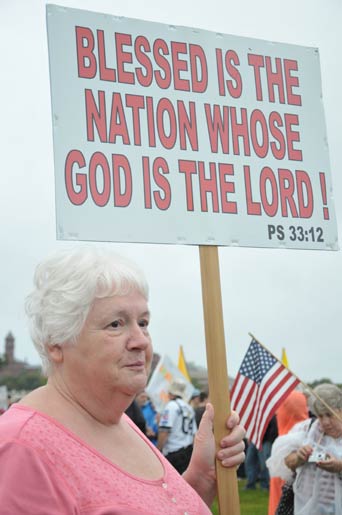
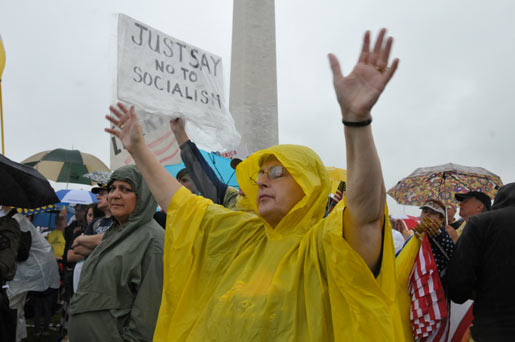
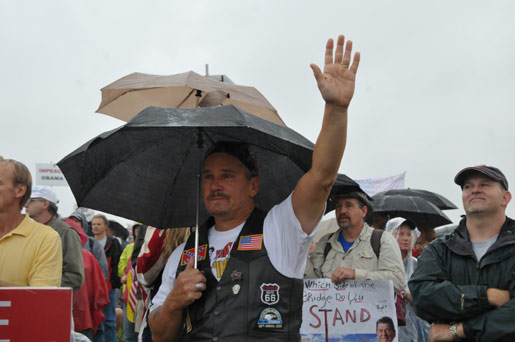
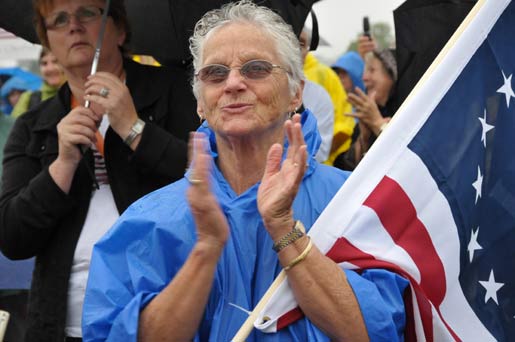
View a gallery of pictures from the Tea Party’s September 12 demonstration on the National Mall. Photographs by Sam Pinczuk.
|
|
|

|
|

|

|

|

|

|

|

|

|

|

|

View a gallery of pictures from the Tea Party’s September 12 demonstration on the National Mall. Photographs by Sam Pinczuk.
|
|
|
|
|
|
|
|
|
|
|
|
|
|
|
|
|
|
|
Two religious conservatives offer their views on political involvement, Glenn Beck, evangelical Christianity, and more. Watch excerpts from Kim Lawton’s conversations with Tony Perkins, president of the Family Research Council, and Rev. Russell Moore, dean of the Southern Baptist Theological Seminary.
“There is some new energy for religious conservatives that’s growing out of the Tea Party,” says George Mason University political scientist Mark Rozell. He calls the relationship between the two groups “mutually reinforcing, even though they are not necessarily all the same people.” Watch more of Kim Lawton’s interview with him about the Tea Party and religious conservatives.
BOB ABERNETHY, host: The US Supreme Court opened its new term this week, and on Wednesday (October 6) dueling protests took place on the court steps as oral arguments began in a closely watched First Amendment case. The dispute centers on the highly controversial Westboro Baptist Church in Kansas, a small religious group that travels around the country protesting at military funerals. Members carry signs that millions find repulsive. They preach that America is being punished for its toleration of homosexuality. In 2006, Albert Snyder, the father of a Marine killed in Iraq, sued Westboro, claiming the church violated his privacy and inflicted emotional distress on his family by demonstrating near his son’s funeral. At the court on Wednesday, Synder called Westboro’s actions intolerable:
Albert Snyder: “All we wanted to do was bury Matt with dignity and respect.”
But Margie Phelps, counsel for Westboro and daughter of the church’s founder, Fred Phelps, argued that restricting their protests would have serious ramifications for free speech:
Margie Phelps: “There’s no line that can be drawn here without shutting down a lot of speech.”
We talk now about the major issues in the case with Kim Lawton, managing editor of this program, and Tim O’Brien, who covers the Supreme Court. Tim, the most despicable speech imaginable: no limits on it?
TIM O’BRIEN, correspondent: Well, there are limits on free speech. There can be time, place, and manner restrictions. You can’t go through someone’s neighborhood at four o’clock in the morning with a loud speaker. This is a content-based restriction, and that’s different. Even content–based restrictions are sometimes allowed. For example, you can sue somebody if they defame you. Obscenity is not protected by free speech. Fighting words are not protected. But here the words, the comments, the demonstration, as despicable as it was, might still be protected.
ABERNETHY: No matter how upset or sick it might make somebody else?
O’BRIEN: Consider this is an important issue. The rights of gay people, gays in the military—it’s a discussion. We might not like the way people come to this discussion or what they have to say about it. It’s still a legitimate discussion about an important public issue. Courts are loath to interfere with that kind of conversation.
KIM LAWTON, managing editor: And it’s always the question, too, of who draws the lines and on what basis do they draw the lines? And so what might be offensive to some people may not be offensive to others, and so it’s a very tricky thing for the courts to get into.
ABERNETHY: And Kim, there’s a religious angle to it too, isn’t there?
LAWTON: Well, this speech is religiously motivated, and this is a small church in Kansas—less than seventy members. Most of the people who go there are all from the same family. It’s an independent Baptist church, so it’s not affiliated with any other denomination or other movement, and in fact the Southern Baptist Convention, which is the largest Protestant denomination in the country, has taken great pains to say they are not related to us. The Southern Baptists also preach that homosexuality is a sin, but they say it’s a forgivable sin. So this Westboro church says God is punishing America for being tolerant of homosexuality. They’ve also picketed the Southern Baptists for being too liberal on the issue.
O’BRIEN: I don’t think the courts going to really care very much that it happens to be religious-inspired speech or how offensive it is. I think that what they are going to look at is what about this family’s privacy interests, what about the harm that it does to them emotionally to have this kind of a demonstration at this terrible time in their lives, and balance, try to balance those competing interests.
ABERNETHY: What about in a time when there’s, you know, the television and Internet and all kinds of ways that speech can be spread around the world. What—does that make any difference, should that make any difference in the content of what’s said?
O’BRIEN: Well, the Supreme Court has addressed that question as well. It says television, for example, and radio—they are entitled to the least First Amendment protection because it’s so uniquely accessible to children in the privacy of the home. The Internet, newspapers, demonstrations on the street, however—they’re entirely different, and the Court has accorded them the greatest protection.
ABERNETHY: And what about the feelings of people about, for instance, an Islamic center right near Ground Zero?
O’BRIEN: Bob, I think that is very similar to what we have here. We have something that many of us find offensive, and it may in fact be in bad taste. Perhaps it shouldn’t be there, but to say it may not be allowed there is an entirely different matter. We might not like it, but our Constitution protects it.
LAWTON: Well, and just to get back to the religion point, though, while this case is not directly about those issues, a lot of religious groups have found themselves in this case before the Supreme Court in an uncomfortable spot, because on the one hand they don’t want to be associated with the message of this group, and religious speech doesn’t get a special place in law so, yes, they haven’t spoken on it. But they are concerned. The notion of somebody restricting a religiously motivated speech makes them uncomfortable privately even though they don’t want to necessarily say that, and that’s not what may happen in this case, but it’s sort of out there—religious people worrying about what we can say in the public forum and what we can’t, and so that is one of the things they’ll be watching.
ABERNETHY: And does it bleed over into what might be said in a pulpit?
LAWTON: Well, obviously there’s some concern about that as well, although that’s certainly not what’s at stake here, and I think the courts have always given special protection, you know, to religious practice. But there is some worry about, you know, again, free speech when it comes religion on these tough issues.
ABERNETHY: And Tim?
O’BRIEN: As offensive as you find this conduct, the fact that it happened may make us all cringe, but that it’s allowed to happen is another matter. When you are in a country that doesn’t have anything like this, where everyone behaves, where discourse is always civil, where the press is always responsible—well, that might be the scariest scenario of all. You’ve left a democracy and entered a place that’s much less.
ABERNETHY: Tim O’Brien, Kim Lawton, many thanks.
FRED DE SAM LAZARO, correspondent: Tourism is big business in the Holy Land. Millions of Christians comes here for the chance to retrace the footsteps of Christ. Among their most sacred rituals is to be baptized in the Jordan River.
BRUCE STIBINSKI: Being baptized for the first time in the Jordan River, which is where Jesus was baptized, was just awesome. Words cannot explain how I felt.
SARA AUTUNES: I feel very freed. I feel at peace. My heart feels like it’s been opened up. I can’t put it into words.
GIFTY QUAINOO: No words to express why I feel very—I feel very happy and free, free.
 DE SAM LAZARO: What few of these tourists know is that unlike their faith, the river itself is in very poor shape. The immersions take place in a two-mile stretch of the Jordan, about the only place now considered safe enough for human contact. For much of the rest of its 140-mile journey, the Jordan has been reduced to a trickle as it meanders through a region riven by war and tension. Gidon Bromberg is with the environmental group Friends of the Earth Middle East.
GIDON BROMBERG (Friends of the Earth Middle East): Due to the conflict, due to the competition between the parties, between Israel, Jordan, Syria, Israel grabs half the water and a little more than a quarter is grabbed by Syria. A a little bit under a quarter is taken by Jordan and the demise is that 98 percent of the historical flow of the Jordan today no longer flows. We’re left with something around 2 percent, and this is not fresh water. This is a mixture of sewerage water, agricultural runoff, saline water. What’s left is this very, very sad sight of a river that is holy to half of humanity.
DE SAM LAZARO:And one that no longer flows into another fabled body of water.
BROMBERG: The Dead Sea is dropping by three feet every year. That’s from my hip down.
 DE SAM LAZARO: Only the ruins are left of a hotel veranda from where tourists use to stick their toes into the Dead Sea. Today the shoreline has receded more than a half s mile away. From their respective sides, Jordan and Israel further drain the Dead Sea as they mine it for potash, a valuable fertilizer.
BROMBERG: At the moment our governments are trying to do absolutely everything. We’re trying to maximize agriculture, we’re trying to maximize mineral extraction, and we’re trying to attract as many tourists as we can. Well, the two don’t—the three do not always correspond, do not neatly benefit each other.
DE SAM LAZARO: Israel is a mostly urban nation, but it also has developed a thriving farm sector, and even though it is efficient and recycles 70 percent of its water, agriculture is a huge consumer of water in one of the world’s driest places—one made even more so by several recent years of drought. Nowhere is that more apparent than in Lake Kinneret, the biblical Sea of Galilee, says environmentalist Bromberg.
BROMBERG: I should be completely under water. The Sea of Galilee behind us here should be five meters higher in depth.
DE SAM LAZARO: Even though it is much lower, the lake remains a major source of fresh water for Israel and also to preserve a pristine stretch of the lower river Jordan for the Christian pilgrims.
 BROMBERG: In order to keep just a small stretch of some 3 kilometers of the Jordan healthy because of baptism that takes place here and because of needs of agriculture, the water authority has built a dam wall here, and it’s pumping water from the mouth of the river just for a few kilometers.
DE SAM LAZARO: Near the baptismal site, Bromberg’s group recently organized what it calls a “big jump” with Israeli, Jordanian, and Palestinian mayors and other officials, hoping to draw attention to the stresses on the historic river, a cause that they say transcends regional boundaries, even if those boundaries are at the heart of so much conflict.
NADER AL KHATEEB (Friends of the Earth Middle East): We know the Jordan River means a lot, not only for the region. It is for the whole world, for humanity. The Jordan is very important for the three religions. We know what does it mean for the Christianity, the baptism site, and it is a dream of every Christian to be baptized in healthy water, not in polluted water like its nowadays.
Officials standing in Jordan River: One, two, three—jump!
 DE SAM LAZARO: Even as the big media splash brought hordes of reporters and cameras, the baptisms and the prayers of pilgrims went on undisturbed. Pastor Daniel Santos, who organizes regular trips for congregants of his church outside London, had not heard about the river’s pollution problems, and since this part is not affected he was unconcerned.
PASTOR DANIEL SANTOS: We’re not much in it and now because we came here for a spiritual purpose.
DE SAM LAZARO: So it doesn’t particularly bother you.
SANTOS: Yeah, because we also don’t take much time here.
DE SAM LAZARO: That comes as a relief to tourist operators here, worried that the publicity might drive away business. They point out that Israeli authorities regularly test the water to ensure it’s healthy. Gidon Bromberg says the publicity has led to the construction of sewage treatment plants in Israel and Jordan and greater awareness of the Jordan in parts of the river away from the tourist sites.
BROMBERG: We need to be striking a balance, a fair balance of sharing water amongst people—Israelis, Palestinians, Jordanians—and a fairer balance of sharing waters between people and nature. And we’re going in that direction, but we’ve still got a long way to go.
DE SAM LAZARO: For Religion & Ethics NewsWeekly, this is Fred de Sam Lazaro.
Listen to this episode now:
[powerpress]
BOB ABERNETHY, correspondent: At Harvard University, Arthur Kleinman is a medical doctor, a professor of both psychiatry and anthropology, and the director of Harvard’s Asia Center. Until 2003, life had treated him well. He was widely respected professionally, and he and his wife, Joan, a China scholar, had a happy marriage, with grown children and grandchildren—and then calamity. Joan Kleinman developed a form of Alzheimer’s disease that brought both dementia and blindness. Arthur Kleinman became her caregiver.
PROFESSOR ARTHUR KLEINMAN: It is love. It’s about the fact that you are there. This was the deal you made when you got married. The deal was to be there for that person, them for you. I helped her bathe, helped her dress, helped with feeding, and the feeling I had, I would say, was generally one of empowerment, to my—which was remarkable especially at the onset, that I just felt that as I learned to do the things and did them I felt a hell of a lot better, and I felt I was really contributing. I also felt it was self-strengthening in some way. It reaffirmed my love and my commitment to her, and over time, though, I think it drains you emotionally and physically as the requirements get greater, as you have to help your spouse out of bed, take them to the bath, make sure that they are safe in getting into the bath, getting out. You are constrained as the other person really begins to disintegrate in front of you, so my wife’s dementia led to a delirium in which not only didn’t she recognize me and the like, but she would be at times incoherent, flailing wildly, very paranoid about me and others because of the sense she couldn’t see and couldn’t understand what was happening.
 ABERNETHY: But Kleinman says his wife’s essential personhood did not disappear.
KLEINMAN: The memory may go. They may not recognize who you are, may not remember from minute to minute what you said. But you can still see, in the way they respond to you, feelings, deep feelings that represent the fact that they know you’re important in their life even though they’re not quite sure whether you’re the husband or the son or what your name is and the like.
ABERNETHY: I asked, did you ever feel angry?
KLEINMAN: Yeah, absolutely, and I think that anyone who says that they’re not angry in a situation like this at times is not fully honest.
ABERNETHY: But there was a feeling much stronger than anger.
KLEINMAN: I think it’s the sadness, the sense of a deepening despair—that you realize that this is not going to go away. This is going to get worse. You realize that this is a terminal illness.
ABERNETHY: As Dr. Kleinman balanced his work and his caregiving, he says he found great meaning in the Chinese Confucian tradition he and his wife had both studied.
 KLEINMAN: The deep commitment to family, the idea that family was central to everything that you did. The respect you have for somebody else—that your own humanness deepens as you engage the humanness of somebody else.
I found that that relationship became increasingly tied to my moral view of things—that I had enormous respect for her, that I felt that it was crucial for me to help her maintain her dignity. There is something remarkable about that feeling of being present with someone else, and I felt that for a long time in our relationship, and I felt that deepen as there were more acts for me to do. It was in the doing that I felt I was a caregiver. Not in thinking about it, not in talking to people about it, but actually doing it. The acts themselves I saw as moral acts.
ABERNETHY: Between the years 2000 and 2050, it’s estimated that the number of people 65 and over will more than double, and the number 85 and over will quadruple. And the longer people live, the more likely they are to suffer chronic diseases, failures of the body and the brain—to need care.
KLEINMAN: We have never seen the situation around the world, not just in the United States, look the way it is. We have left out of our thinking one of the cornerstones of society.
ABERNETHY: Kleinman recalled last year’s debate about health care reform.
 KLEINMAN: How much attention was given to the nitty-gritty of caregiving, the content of caregiving? I would say almost zero, okkay, almost no attention to that. And yet this is what families are going to face in the future.
ABERNETHY: Because he had bought long-term care insurance, Kleinman was able to hire a home health aide to help when he wasn’t there. He says she was indispensable. But by last summer Kleinman had come to realize that his wife needed more care than he could give. So, reluctantly, he moved her to a nursing home.
KLEINMAN: That was the most difficult thing. That is, that I had made up my mind that I would take care of my wife until the end, and I did it for seven to eight years until a point at which I recognized I couldn’t do it anymore. I couldn’t handle—and I’m a psychiatrist—I could not handle the agitation part of it, where she became so agitated and so distressed, and she really needed a safe place to be, etc., where she would be less paranoid and less threatened by things.
ABERNETHY: But then, new questions: how close to Joan could he continue to be? How often could he visit? How long should he stay?
KLEINMAN: When you’ve been deeply in love with someone for 45 years and greatly enmeshed together, that issue of distance is a recognition that someone is dying, that this is approaching the end, that you yourself are preparing yourself for the end, and I think it’s very difficult. I think it’s very, very difficult. I found it to be extremely, extremely difficult.
Editor’s Note: Joan Kleinman died on March 6, 2011. She was 71.
Video clip of Arthur Kleinman teaching the Harvard Extension School course “Health, Culture, and Community” is provided courtesy of the Harvard Extension School. Copyright 2010, President and Fellows of Harvard College.
“You cannot understand caregiving unless you do it,” says Arthur Kleinman. “Acts of caregiving come as close to what I think religion is as I could name.” Watch more of Bob Abernethy’s conversation with him.
DANI PASSOW (Religious Consultant, Sukkah City): The major ritual component of Sukkot is dwelling in booths, in these temporary houses for seven days. We learn that from the Torah, from the Bible, where we are told B’Sukkah teshvu shevat yamim, you should dwell in a sukkah for seven days. We leave our permanent dwelling, our home, and we move to this temporary dwelling to remember the transience of the Israelites and their journey from Egypt to Israel, and also to remind us that in some ways all of life is really temporary, and all of life, life is very fragile, and so that is what we do. We dwell in these sukkahs. We eat in them, we sleep in them, we try and spend as much time as possible within them.
The fundamental laws about a sukkah that make it kosher—it needs to have two-and-a-half walls. Just about anything can be used for walls. It can’t be material that will ultimately smell, which would cause someone to want to leave the sukkah, or can’t be something that will fall over in the wind. But aside from that, any material can really be used. There is a big distinction made between what’s allowed to be used for the walls and what can be used for the roofing material. The roofing material needs to be kosher roofing material, which is basically organic growth which has been cut from the ground. It needs to provide more shade than sunlight, and it also needs to be somewhat temporary, so it can’t be a full plank or a full roof. There is a custom to be able to see the stars through the roof. So we’re pretty careful to be sure that one can, at least in some way, see the stars.
There are minimum sizes for the sukkah. It has to be a minimum of about 28 inches by 28 inches. It has to be 40 inches tall. We see that here in these sukkahs that they conform to Jewish law. They conform to these strict, rigid limitations. At the same time, they don’t look like anything conventional because of the individual creativity and inspiration of the architects.
JOSHUA FOER (Co-Organizer, Sukkah City): So last night, in keeping with the tradition, I slept in one of the sukkahs, the one behind me. These structures commemorate a homelessness that occurred in a desert 3,000 years ago, and the idea of taking that and dragging it into one of the most urban places in America was exciting. Actually sleeping in a sukkah in Union Square Park was not only fun but a little bit scary.
Listen to this episode now:
[powerpress]
