Listen to this episode now:
[powerpress]

Listen to this episode now:
[powerpress]
by David E. Anderson
The poet Stanley Kunitz once told artist Mark Rothko he was “the last rabbi in Western art.”
Critic Robert Hughes described Rothko as belonging to the “theological” wing of the New York School of abstract artists in mid-twentieth-century America, while the headline of a New York Times review by Hilton Kramer of a major Rothko retrospective in 1978 read “Rothko: Art as Religious Faith.”
As curator and editor Glenn Phillips notes in Seeing Rothko, a collection of essays on the artist and the act of seeing, “Rothko’s work has variously been described as transcendental, tragic, mystical, violent, or serene; as representative of the void; as opening onto the experience of the sublime; as exhilaratingly intellectual; or as profoundly spiritual—to mention just a few examples.”
At the very least, Rothko and his paintings beg to be seen to some degree in religious or spiritual terms. This isn’t always easy for many viewers, especially with his signature paintings of stacked rectangles and pure abstractions that, while so easily identified as “a Rothko,” eschew all painterly narrative, even in their titles. They are simply called “No. 18” or “Untitled (Violet, Black, Orange on Gray).”
 Alfred Molina (as Rothko) and Eddie Redmayne in Red |
Forty years after his death by suicide in 1970, Mark Rothko seems to be everywhere. Recent exhibitions of his work have been mounted in Moscow and at the National Gallery of Art in Washington. “Red,” the John Logan play that explores an especially tumultuous period in the artist’s life, is currently on Broadway and received six Tony Awards, including one for best play. In September, Yale University Press will publish The Rothko Chapel: Writings on Art and the Threshold of the Divine by Dominique de Menil, a Rothko patron who commissioned him to create the paintings for the famous interfaith chapel her family established in Houston.
Mark Rothko was born Marcus Rothkowitz in 1903 in Dvinsk, now Latvia but then a part of imperial Russia. He was the youngest of four children. His father, a pharmacist, and two older brothers immigrated to the United States in 1910 and settled in Portland, Oregon. The rest of the family joined them in 1913, and Rothko’s father died less than a year later.
In 1921, Rothko entered Yale on a scholarship but left in 1923 without a degree and moved to Manhattan, drawn both to the theater and to art. He joined the Art Students League, began taking classes, and in 1928 was selected by a League instructor to show some of his work, mostly landscapes, in a group show—his first exhibition.
At the same time, Rothko did not give up his interest in the theater and continued to see and speak of his painting in dramatic terms. He made it clear over the years that even the most abstract works of his classic period should be understood in terms drawn from the stage, especially tragedy. An intellectual among the painters of his time, he was well versed in the Greek tragedies, especially Aeschylus, and later in Shakespeare. Nietzsche’s The Birth of Tragedy was an early and important influence. Rothko would speak of the subject matter of his paintings as “the human drama,” especially that part of the drama involving death. All art, he said, “deals with intimations of mortality.”
In the mid-1950s, Rothko discovered and read the Christian existentialist Soren Kierkegaard, especially Fear and Trembling, Kierkegaard’s interpretation of the sacrifice of Isaac story in Genesis 22. Rothko told one friend he “completely identified” with Kierkegaard’s portrait of Abraham as an artist. “Abraham’s act was absolutely unique,” Rothko said in a 1958 address to the Pratt Institute. “What Abraham did was understandable; there was no universal law that condones such an act as Abraham had to carry out,’’ adding that “as soon as an act is made by an individual, it becomes universal. This is like the role of the artist.” Art critic Dore Ashton, Rothko’s friend and biographer, has argued as well that Dostoyevsky’s struggle between faith and doubt helped the painter in his own struggle to maintain his faith in art.
 Painting from the Seagram series |
Rothko was a complex and contradictory human being, at times shy and reserved, at other times gregarious and arrogant. He could be charming or brusque, accessible or remote. He seemed deeply affected by his sense of being an immigrant, yet he did not become a US citizen until 1940, at about the same time he changed his name. He also seemed to regard his Jewishness as giving him outsider status. He vigorously resisted being categorized as a Jewish painter and would not, unlike some of his colleagues, accept synagogue commissions. He both scorned and longed for commercial success. The emotional agony he endured in accepting and then rejecting the commission for the so-called Seagram murals at the Four Seasons restaurant in New York’s Seagram Building—the episode around which Logan builds his play—is only the most extreme example of Rothko’s ambivalent attitude toward his paintings’ place in the world once they left the studio and in what kind of environment they should be viewed.
Equally complex and contradictory are the religious and spiritual threads that run through Rothko’s commentary on art and life, as well as the response of critics and lay viewers to his work and words.
It is impossible to speak with comprehensiveness about Rothko’s personal religious views or to precisely impute particular religious narratives to his classic abstract works. He would, at different times, both affirm and deny their religiosity or spirituality, just as he denied that he was either an abstract or expressionist painter.
While still in Russia, his father sent him to a cheder, a traditional Jewish school where Rothko was subject to a strict religious regime of instruction, prayer, translation, and memorization of Talmudic law. In his later life, he would speak angrily about his father imposing this on him. It seems he probably broke with organized religion sometime after his father’s death, and critics have described his work as “religious art without the religion, Judaism without the Torah.” But as Dore Ashton has observed, “He also was a child of his age, assailed by doubt and hungering for faith.”
Rothko’s rectangles developed after a long maturation process, in which his painting moved from an expressionist-grounded realism, through a surrealism in which classical, mythological, and Christian subjects provided the ground for exploring the unconscious, to the final form he arrived at with his breakthrough work in 1949 that culminated in the dark murals for the Houston chapel, painted between 1964 and 1967—“imageless art that sought great religious and moral depth,” as John Cook, now professor emeritus of religion and the arts at Yale University, has written.
While Rothko was concerned about the moral and religious content of his work from the beginning, his classic period arrived a moment in the history of art and religion in American culture when both were in crisis. Post-war America, in its burst of affluence, was going through what many saw as a secularization process, while art was experiencing a crisis of representation following the exhaustion of Social Realism (William Gropper) and American Scene painting (Thomas Hart Benton).
The poet Wallace Stevens, in a 1951 lecture at the Museum of Modern Art on “The Relations between Poetry and Painting,” pointed to one element of the crisis: “that in an age in which disbelief is so profoundly prevalent or, if not disbelief, indifference to questions of belief, poetry and painting and the arts in general are, in their measure, a compensation for what we have lost.”
But the other side of the crisis was that, with the waning of belief, art no longer had recourse to a pictorial language or subject matter with which to respond to contemporary life. Rothko acknowledged as much in a brief 1947 essay, “The Romantics Were Prompted”: “Without monsters and gods, art cannot enact our drama: art’s most profound moments express this frustration. When they were abandoned as untenable superstitions, art sank into melancholy.”
As one Anglican vicar told the Times of London a few years ago when the Tate Modern mounted an exhibition of Rothko’s late work, “For me the paintings are the tablets of stone of Mount Sinai, but with the commandments lost. They are icons of the absence of God.”
Rothko’s response was to try to figure his sense of the discomforting of transcendence without figuration, in the pure abstraction of luminous rectangles and their sensuous suggestion of portals, their hint that something existed, perhaps a kind of light, behind the surface. By emptying the canvas of obvious story Rothko could paint a more emotionally accurate “portrait of the soul,” as he sometimes called his paintings.
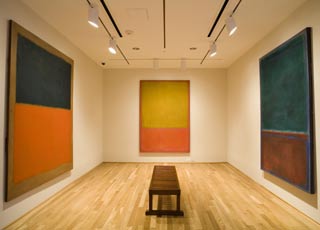 The Rothko Room at The Phillips Collection, Washington, D.C. Photo © Robert Lautman |
Like listening to a John Coltrane solo, seeing Rothko’s rectangles is always surprising. They may appear calm, even serene, inviting restful contemplation, but they are far more demanding. They require sustained attention, and what at first appears to be stillness is actually very alive, almost pulsating in the soft, undefined borders between the colors and the edges of the paintings. In his “Green and Tangerine on Red” at the Phillips Collection in Washington, the blocks of color invite you into an intimacy that draws you out of yourself, but at the same time the size of the painting requires you to keep your distance. There is the sense of a presence—beyond, behind, within—but it is invisible, ineffable. The paintings seem to be declaring, at least in part, the spirituality of sensuality—that materiality can glow with a transcendence that gives it a meaning without denying its physicality. Repeated encounters with what seems a repetitive motif are, in fact, different, and one’s response is altered every time. It is not true that if you’ve seen one Rothko you’ve seen them all, for each one offers a varying degree of the knowable but unnameable experience.
While the paintings are completely emptied of narrative content, Rothko insisted they were not formally abstract. “I’m not an abstractionist,” he said in an interview in 1956. “I’m not interested in relationships of colors or forms or anything else.…I’m interested in only expressing basic human emotions, tragedy, ecstasy, doom and so on—and the fact that lots of people break down and cry when confronted with my pictures shows that I communicate those basic human emotions.”
“The people who weep before my pictures,” he added, “are having the same religious experience I had when I painted them.”
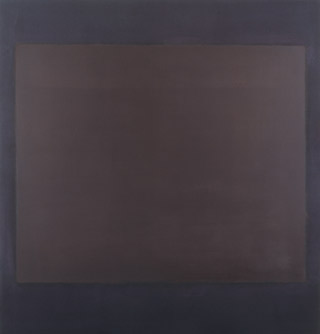 Mark Rothko, Untitled, 1964, National Gallery of Art |
His art, Rothko wrote in a personal statement for an exhibition in 1945, “is an anecdote of the spirit, and the only means of making concrete the purpose of its varied quickness and stillness.”
For some viewers, the shimmering rectangles and ambiguous relations between foreground and background, as well as the tensions among the blocks of color, suggest a mystical dialogue between absence and presence. Among intellectuals at the time, Zen Buddhist mysticism, best expressed in the work of D.T. Suzuki and Alan Watts, was increasingly popular. But Rothko resisted any such labeling. “People ask me if I am a Zen Buddhist,” he said during the Pratt Institute address. “I am not. I am not interested in any civilization except this one. The whole problem in art is how to establish human values in this specific civilization.”
As art historian and Museum of Modern Art curator John Elderfield argues in his Seeing Rothko essay, Rothko’s pictures are “designed to deliver transcendence, to provide access to hidden but immanent truths of the universe—not merely to struggle with that transcendence, those truths (that would be a doubter’s way) but actually to convey them. For Rothko, in an interpretation we can scarcely fathom now, a picture could offer immediate access to the divine.”
Contemporary art professor Anna C. Chave goes so far as to see in Rothko’s classic abstracts the coded forms or traces of traditional religious conventions used in painting pietas, crucifixions, or entombments: “I do not mean to suggest that Rothko deliberately recapitulated his entombments…five or 10 years after painting them (in his surrealism period) but rather that the pictorial codes he used and adapted in the 1940s continued to serve him in the 1950s and ’60s.”
“Religious imagery—which had attracted Rothko for the themes it addressed—especially lent itself to being transposed into abstract emblematic forms, because sacred art is particularly tradition-bound or prone to formal conventions,” Chave suggests.
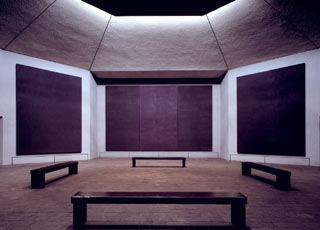 Rothko Chapel |
Rothko once described the ideal display situation for his paintings as one work alone in a “kind of wayside chapel, not one in the city where you could just drop in, but more out of the way, a destination, outside the city.” His culminating work was, indeed, meant for just such a place. Originally intended to be a Roman Catholic chapel on the grounds of the University of St. Thomas in Houston, the sacred space now known as the Rothko Chapel is independent and ecumenical. For the octagonal plan designed by Philip Johnson, Rothko created a suite of 14 paintings, including three triptychs. Chave reads Rothko as using the conventions of the Stations of the Cross, altarpieces, and the architecture of a Christian Orthodox church. Seven of the paintings are a dark, mottled blackish purple color; four—a triptych and a single painting—hold a greenish black rectangle set against a reddish black background, and three involve a black background and green rectangle with a darker green form inside it.
Dore Ashton says Rothko told his friend and fellow painter Robert Motherwell that “at first he had thought of his murals as pictures, but then had not wanted to distract visitors to the chapel with images; what they needed was ambience. He wanted, he said, to paint both the finite and the infinite.”
When Stanley Kunitz made his “last rabbi” comment, he said he meant there was in Rothko “a rather magisterial authority, a sense of transcendence as well, a feeling in him that he belonged to the line of prophets rather than to the line of the great craftsmen.” Rothko himself acknowledged he was “a prophet perhaps—but I don’t prophesy the woes to come. I just paint the woes already here.”
David E. Anderson is senior editor for Religion News Service.
KIM LAWTON, host: Repercussions from the Gulf Coast oil spill dominated the news again this week. President Obama pushed BP to do a better job of resolving the crisis and taking responsibility for the damages. Meanwhile, religious groups have been holding a series of prayer vigils across the country. Participants are praying for an end to the environmental disaster. They are also offering prayers for those who have been most severely affected. The crisis has taken a devastating toll on people involved directly and indirectly in the fishing industry. Several faith-based groups have been mobilizing to provide assistance. Joining me now is Margaret Dubuisson of Catholic Charities of the Archdiocese of New Orleans. Margaret, thanks for being here. Tell us a little about the needs you’re serving right now.
MARGARET DUBUISSON (Catholic Charities of the Archdiocese of New Orleans): Well, Kim, we have five centers set up in the fishing villages in the archdiocese of New Orleans. We’ve seen about 8,000 people so far, fishermen and their families who’ve come in just looking for help, looking for support, looking for financial assistance in some way. The BP claims process is a little cumbersome, and it is going to take some time. So Catholic Charities has been able to provide direct assistance and food much more quickly and put that in the hands of the fishermen through these five emergency relief centers.
LAWTON: What about the emotional needs, the spiritual needs? I imagine that those are very difficult as well.
DUBUISSON: Kim, it is. We have seen about 8,000 people in our five centers, as I said. Many of those people are receiving mental health assessments, where we ask very careful questions to see how they’re feeling and how they’re processing all of this. You may have heard this before, but this is much more than a loss of income for this particular group. This is loss of a way of life and a culture, and people are very fearful, very anxious, because no one knows how long this is going to go on, and the news just seems to get increasingly worse about it. So these fishermen and their families who for generations have made their living as fishermen, as a very independent group, they’re having a lot of difficulty dealing with the anxiety and uncertainty of the oil spill situation.
LAWTON: And what about for the broader community? Obviously, these people are directly—their livelihoods have been directly affected, but the greater area down there along the Gulf Coast, you all are still getting over Hurricane Katrina.
DUBUISSON: It’s been almost five years since Katrina and, yes, we are still definitely in the recovery period of that. So this was, this was an especially difficult blow at this time coming up on this five-year anniversary, when a lot of people felt like we were just beginning to get our heads above water, so to speak and, you know, making real progress toward the recovery, and then this oil spill comes. It’s almost like Katrina all over again and especially for the families of these fishermen, many of whom lost boats and homes in Hurricane Katrina and then in Gustav and Ike a year later. This has been, you know, a particularly difficult blow, a very, very anxiety-producing situation.
LAWTON: The churches down there are often the center for so much of the community. Do they have the resources they need to really deal with this crisis?
DUBUISSON: Well, we’re making the resources available, we’re gonna find the resources. We are reaching out to people who would like to help us in that, and anyone who would like to help can visit our website, which is ccano.org, and we have a secure website, and we’re set up to take donations there. But Catholic Charities and the archdiocese of New Orleans have been on the ground in these affected communities virtually since the beginning, like the archbishop went out the weekend that the spill occurred and met with parish leaders to find out, what do you all need us to do? He then gave Catholic Charities the green light to provide whatever services were necessary, and we’ve been doing that now for I think it’s fifty some odd days now since the spill first began, and we’ve been providing services to the fishermen ever since, and we will continue to provide services until it’s all over, and we’ll find the resources that we need to do that.
LAWTON: All right. Margaret, thank you very much.
DUBUISSON: Thank you, Kim.
Originally broadcast September 4, 2009
SAUL GONZALEZ, correspondent: Unlocking and interpreting the secrets hidden in DNA used to be the province of scientists and medical researchers. But now it’s a growing business, one that’s selling genetic information directly to American consumers, making a DNA test as easy to buy as housewares or clothing.
JACK LORD (CEO, Navigenics): You know, I think for the history of man people have always wanted to see something about their future, and now, through the power of genetics and genomics, we are able to look into the future in a science-based way.
GONZALEZ: Jack Lord is the CEO of Navigenics. It’s a California-based company that for a fee of $999 offers its clients a personalized DNA test, one that pinpoints genetic markers indicating possible future threats to their health.
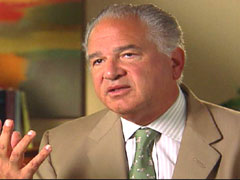 Jack Lord |
JACK LORD: It’s really simple. It’s some saliva that we collect. We analyze that and then give you a report that shows what your risks are compared to people in the population at large. So today we test for 28 conditions, and they range from chronic conditions like diabetes or heart disease, to cancers like melanoma or prostate cancer or breast cancer, to other conditions that are generally silent diseases like glaucoma and macular degeneration, celiac disease, to Alzheimer’s disease.
GONZALEZ: Navigenics is one of a growing number of new companies selling genetic tests directly to the public. All of them promise their clients better health and a better life by getting up close and personal with their DNA.
MIKE GODFREY (Navigenics Client): Once you log into the Navigenics site, you get a snapshot page here that just really outlines in these square boxes what you are at a high risk for, what you are at average risk for, and what you are at lower than average risk for.
GONZALEZ: Mike Godfrey, who works in corporate communications for a hospital in San Diego, is a Navigenics client. When he first got his DNA results back, Godfrey was surprised by his relative risk for several illnesses when compared to the rest of the population.
GONZALEZ (speaking to Mike Godfrey): …diabetes, Alzheimer’s disease, heart attack, brain aneurysm, obesity….
MIKE GODFREY: …atrial fibrillation, obesity…
GONZALEZ: That would seem to be a lot to be worried about.
MIKE GODFREY: …Graves disease, which I never even heard of before. So to be honest, in my initial reflection when I looked at this, I went whoa!
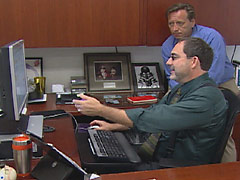 Mike Godfrey |
Personal trainer to Mike Godfrey: One more. That’s all you need. Just one more.
GONZALEZ: Although he says he’s not overly concerned, Godfrey’s DNA test results have spurred him to think more about his health and spend a lot more time at the gym.
GODFREY: When you look through all of those orange boxes that we went through and you take a look, almost all of them say that you should keep your weight down, that you should stay in shape, that you should eat better. It was validation to me that, yeah, that was the right move and your money is being spent in the right place and the work you are going through is going to be worth it in the end.
GONZALEZ: Lord says his company offers tests only for treatable or preventable illnesses, giving clients an edge in anticipating and avoiding future health problems.
JACK LORD: And it is with that information that they can start to understand what they might do today to prevent an illness. If you know that in advance you can start going to your doctor more frequently to be checked, or you might start a medication that prevents that condition much earlier than when you become symptomatic.
SARAH CROSBY-HELMS (Navigenics Client): It doesn’t say you are going to die, here’s why. It says here are some things you are prone to, and here’s how you can prevent them from showing up in your body later.
GONZALEZ: Sarah Crosby-Helms, another Navigenics client, discovered through her test that she had a higher than usual genetic risk for both colon cancer and Crohn’s disease. The information got Crosby thinking about how much she really wanted to know about future threats to her health.
SARAH CROSBY-HELMS: For me, I would rather know that I have this genetic predisposition than to not know, and if that means that…
GONZALEZ: Ignorance isn’t bliss?
SARAH CROSBY-HELMS: No, ignorance for me is not bliss.
 Sarah Crosby-Helms |
GONZALEZ: The direct-to-consumer genetics testing industry says it promises its clients a glimpse over their health care horizon, warning them of possible dangers and threats to come. But critics aren’t so sure. They worry that the technology is being oversold and that it raises a host of both ethical and public policy concerns.
ALEXANDER CAPRON (Professor of Law and Medicine, USC): We don’t know everything about the relationship between genes and diseases, and even what we do know doesn’t really tell you that much about what should you do now.
GONZALEZ: Alexander Capron is a professor of law and medicine at the University of Southern California and the former director of the ethics program at the World Health Organization. He’s concerned that as genetic tests become more common, a growing number of people will overemphasize DNA as the road to a long life and personal happiness.
ALEXANDER CAPRON: There are so many other things that are equally or more important and that are actually things that we should be more concerned about in our environment, in our human relations, in social justice, so that all people have an opportunity to have a life in which they can flourish and so forth, and not just narrowly, well, what’s your genetic code? I would also be aware that you could have some surprises that you really don’t want to know, that you would just as soon not have on your mind. What should you do now? What difference should this make in the way you behave, in the health care you get, in your relationships with loved ones, your plans for your future? Should you not take a certain job because the payoff in that job won’t come for ten or twenty years, and you have got a gene that says you have a twenty percent chance of getting breast cancer or something? What should you do with that information?
GONZALEZ: There are also concerns among some health experts about the regulation of direct-to-consumer DNA testing. Currently, no federal agency such as the Food and Drug Administration or Federal Trade Commission has come up with rules to monitor the companies’ marketing claims, testing practices, or the validity of results.
 Alexander Capron |
ALEXANDER CAPRON: I think we are still in early days on the regulation side, and the FDA has more work to do here. The field has grown, I think, faster than anyone expected.
GONZALEZ: Worried about the licensing, utility, and accuracy of direct-to-consumer genetic tests, some states, such as California and New York, have sent cease-and-desist letters to prominent DNA testing companies. Then there are the privacy worries and whether someone’s genetic information could leak out to insurance companies or employers. Lord acknowledges protecting genetic data is crucial to his company’s reputation and future.
JACK LORD: Privacy is to Navigenics like safety is to Volvo. We have to have — our brand is dependent on privacy and the integrity of privacy and security, and the visual that we use is imagine walking into a bank vault and inside that bank vault there are safe deposit boxes, and the only way you open that safe deposit box is if you have a key, and the bank has the key, and that’s the way we have built our systems. You have control over how that information is accessed, what it’s accessed for, and who actually has access.
GONZALEZ (speaking to Mike Godfrey): You’ve just shared a great deal of your genetic information with us. Do you have any privacy concerns, sharing it with us and by extension an audience across the country?
MIKE GODFREY: Obviously, I don’t.
GONZALEZ: Mike Godfrey’s confidence comes partially from the genetic nondiscrimination privacy act passed by Congress in 2008. It prohibits health insurers from denying coverage based solely on a person’s genetic predisposition.
MIKE GODFREY: My feeling is that those laws will be continued to be updated and that there won’t be much risk to me in the future or to anybody who does this. I think that this will become a pretty standard approach as you go into the future, for adults and maybe even for children when they are very young.
GONZALEZ: As he uses his genetic results to guide his heath decisions, Godfrey is also a test subject. He’s one of thousands of Navigenics clients who have volunteered to be monitored for the next twenty years as part of a scientific study. It’s purpose? To find out how—and if—people change their lifestyles after finding out what’s in their DNA.
Personal trainer to Mike Godfrey: Bring it all the way up.
For Religion & Ethics NewsWeekly, I’m Saul Gonzalez in Los Angeles.
Originally broadcast June 19, 2009
FRED DE SAM LAZARO (guest anchor): Earlier this month in France an annual event took place that has been described as perhaps the largest public expression of traditional Catholicism in the world. It is a three-day, 72-mile pilgrimage from Notre Dame Cathedral in Paris to the cathedral at Chartres. A history professor from New York City who has made the pilgrimage several times describes the experience.
 Dr. JOHN RAO (Associate Professor of History, St. John’s University, New York): My name is John Rao. I’m associate professor of history at St. John’s University. I’ve done the pilgrimage to Chartres about six or seven times. The regular preparations involve making sure you’ve got the right footwear more than anything else. Being a New Yorker and not owning a car, I walk a lot.
You’ve started from a point, Notre Dame, which has this extraordinary impact on you because of its beauty and because of the fervor of the people praying and singing in it. And what the architecture of the cathedral and the light passing through the windows does is it makes it clear that God, the Father of lights, provides us a world which was incredibly more diverse and beautiful than anyone might think.
The route to Chartres begins the first morning mostly in Paris and the surrounding areas.
When we’re talking about the people who make up the pilgrimage, the first thing to note is that probably about 70 percent of them are young people — people in their late teens and in their early 20s. There are people from all over Europe. The majority are French, of course, but from every country that I can imagine, from Africa, from Asia, from the United States.
A lot of these chapters are groups that stick together at home, and they have a lot of their own particular songs, which are not specifically religious but more focused on just subjects involving history and culture of the country as well.
It’s so clear, it’s so sunny. By the afternoon people are going to start suffering from heat. The big thing for people who haven’t done it before is to get them to drink water.
 The Mass on the first day is usually in a field. The Masses that are held during the pilgrimage and at Chartres itself are the traditional Latin Mass. In other words, the liturgy before the reforms that are associated with Pope Paul VI.
You have, perhaps, certainly at least 100 priests who are hearing confessions during all of this, and they’re scattered all through these lunch scenes and in the woods and in little deserted areas.
Their Catholicism is a fervent Catholicism, traditional in the sense that it’s very much focused on a spirituality that uses the traditional liturgy of the Church, takes that very seriously, the traditional devotions, the traditional Latin liturgy. And then they have to give communion to as many as 10,000 people.
The pilgrimage began in the Middle Ages. Chartres was always an important place and had great meaning in the life of the Christian world in the kingdom of France in the Middle Ages. Joan of Arc made this pilgrimage. Louis XIV, I believe, made the pilgrimage. After Vatican II there were — there was a lot of confusion that developed in Catholic believers’ minds about what they ought to be doing, what they ought not to be doing, whether they were putting too much of an emphasis on particular practices that somehow or other had become outmoded, and as a consequence things like pilgrimages ended up suffering. It resumed precisely due to the concerns of groups that, by this point, were calling themselves traditionalists who wanted to commit themselves to maintaining practices which they felt to be, spiritually, extremely beneficial.
The second day of the pilgrimage, the Mass is in the woods — same kind of Mass, beautiful music, priests hearing confession.
 MICHAEL MATT (speaking to pilgrims): My name is Michael Matt. I’m the head of the American contingent, the American chapter for the Chartres pilgrimage.
It’s definitely a youth movement. They very easily, in many instances, can really tap into this whole tradition, the foundation of the Catholic faith. It doesn’t matter that they don’t understand every word of the Latin. They’re attracted to the centrality of the liturgy. They’re attracted to the rubric and the ritual and to the idea of suffering for what you believe in.
PILGRIM: Can you smell the grass? Can you feel your feet? This is the real world, especially when you put rosaries into it, traditional Masses, allegiance to the Holy Father. This is the real world that we’re all seeking for.
Dr. RAO: The entire pilgrimage is of an impact that’s hard to describe. A pilgrimage is a microcosm of what life is. Life, from a Catholic standpoint, is a pilgrimage—from birth to death, from our birth to our ultimate, eternal experience with God—and what the pilgrimage does is it takes you, for a short space of time, to a time out of time. You’re out of your ordinary daily experiences. All of the ordinary things that bother one during the course of a day just disappear, even to the point in a physical way that, after a couple of days, you don’t care what you look like.
PILGRIM: I’m pretty tired, but other than that it’s invigorating. Spiritually lifted, that’s for sure. It’s amazing to be with tons of Catholics — thousands of them.
Dr. RAO: I find myself thinking about everything that I ought to do in life — everything that I have done wrong. I go back through all of the experiences of my life and where I thought that I should have done something better.
 The third day, the last day of the pilgrimage, everyone is exuberant, because if you’d made it to that last day you know you’re going to make it. You know you’re really going to make it. You’re in forests, you’re in fields — endless, endless fields. You at least get to see, after a certain point, the spires of Chartres in front of you. It can become particularly grueling because it takes a long time for that spire in the distance to really get truly bigger.
There was more of a, maybe a penitential spirit yesterday, but today it’s joy. It’s just joy. When you get onto the roads, in the real suburbs of Chartres, then you can see it looming more and more, and then you begin this walk, which is a last torturous walk up this long shaded path that takes you up into the town itself. That’s when you see it there, you know, in all of its glory.
What most stirs me up is the fact that you’ve managed to do it. You’ve managed to do it. You’ve finished it. When we’re at Chartres we have a solemn High Mass, and all of this is surrounded with a great deal of ritual and ceremony.
You could see 10,000, or 15,000 fervent Catholics, most of them young people, deeply committed to this traditional rite of Mass. These people who are part of the pilgrimage, and then who finish the pilgrimage with us as well, their spiritual fervor is accompanied with, again, a great love for music. By the time it’s over, the feeling of exaltation is hard to describe, just hard to describe.
The newer generation found what that old rite had to offer — spiritually satisfying, spiritually uplifting, and in a way that you could see almost in no other event that took place in the annual life of the church. The entire three days is emotional.
What to do in the future? This spirit of pilgrimage should be continued on the day-to-day basis for the rest of your life.
Listen to this episode now:
[powerpress]
Produced by Religion & Ethics NewsWeekly production assistant Fabio Lomelino and Web producer Fred Yi
In 1996, Tom and Kitty Stoner started the TKF Foundation in Annapolis, Maryland, to create spaces that would “offer a temporary place of sanctuary, encourage reflection, provide solace, and engender peace.” The foundation has helped develop more than one hundred sites, from urban community gardens to labyrinths and healing spaces at hospitals, medical centers, churches, prisons, and correctional facilities. Each project is developed in partnership with local community leaders. Watch founder Tom Stoner and executive director Mary Wyatt explain why these open spaces are also sacred places.
We visited some of the foundation’s faith-based partners in Baltimore to talk to them about how sacred places serve their communities.
Todd Marcus runs Newborn Holistic Ministries, a faith-based organization that works to revitalize Baltimore’s Sandtown-Winchester and Upton neighborhoods. He and a group of volunteers restored the empty lots around Martha’s Place, a center for women recovering from drug addiction.
In an alleyway behind Amazing Grace Lutheran Church in East Baltimore, the rubble from once abandoned row houses has become a prayer labyrinth and community garden. Pastor Gary Dittman and gardener Jessie Scott talk about the site as a place of meditation, transformation, healing, and hope.
Gloria Carpeneto is director of the Northeast Interfaith Peace Garden, located on the grounds of St. Anthony of Padua Roman Catholic Church in Baltimore. The labyrinth featured in this meditation garden and community sanctuary serves as a path for silent walking and contemplative exercises.
KIM LAWTON, anchor: This week marks the one-year anniversary of President Obama’s landmark speech in Cairo, where he promised better relations between the US and the Islamic world:
President Barack Obama (speaking in Cairo June 4, 2009): “So long as our relationship is defined by our differences, we will empower those who sow hatred rather than peace, those who promote conflict rather than the cooperation that can help all of our people achieve justice and prosperity. And this cycle of suspicion and discord must end.”
LAWTON: In that speech, the president acknowledged the Israeli-Palestinian conflict has been a major source of tension in those relations. He pledged a broader engagement with Muslims on that and several other issues. As one follow-up, the president appointed a special envoy to the Organization of the Islamic Conference or OIC, the umbrella group of 57 countries with significant Muslim populations. That envoy is Rashad Hussain, who joins me now. Mr. Hussain, thank you for being here. What has changed in the year since that Cairo speech?
RASHAD HUSSAIN (US Special Envoy to the Organization of the Islamic Conference): Well, the Cairo speech really set out the framework for—it’s a part of the dialogue that the president started as early as Inauguration Day, when he reached out to Muslim communities. On his second day in office, he appointed Senator [George] Mitchell to ensure that we’re doing everything we can to bring a resolution to the conflict in the Middle East, and it’s something that we have been persistent on, it’s something we’ll continue to be persistent on despite recent events. That event, I think you’ll see, will just redouble our efforts, our attempts to secure a peaceful resolution to the Middle East conflict. Of course, the president early on—one of the first interviews he did was with al-Arabiya. Then he traveled shortly after that to Ankara, where he made clear that the United States is not at war with Islam, and then in Cairo, where he really set forth the broad framework of dealing with Muslim communities in a comprehensive way and in a manner which addresses not just the political conflicts, one of which you mentioned, but also creates partnerships in a number of areas of mutual interest. And that’s really stemmed from the president’s belief that people all around the world, whether Muslim or non-Muslim or whether they live in a Muslim country or non-Muslim country, all share the same fundamental aspirations, and that is that they want to have access to education, they want to have the ability to pursue economic opportunity, to have health care, to raise their family in a secure way. And so part of the president’s message in Cairo was that we need to establish partnerships in a number of areas, including education, entrepreneurship, health, science, and technology, to have dialogue at the interfaith level, and we’ve continued to do that in a number of ways, and also while reaching out to the domestic Muslim community. The president sent one of his top advisers, Valerie Jarrett, to speak at the Islamic Society of North America, which is the largest gathering of American Muslims. [White House national security and counterterrorism advisor] John Brennan spoke at the Islamic Center at NYU and recently spoke to outreach to Muslim communities as a part of our national security strategy. We had recently an entrepreneurship summit. So this is really an ongoing dialogue, not an ad hoc approach, where we have a concerted effort to engage Muslim communities at all levels.
LAWTON: But what are the, you know, sort of real-world impact of that talk, and people said, well, the rhetoric is great, and talking is great but, you know, what is the real-world change that happens?
HUSSAIN: Right. Well, to go through the parts of the Cairo speech, of course, in Iraq we’re continuing and I think we’re doing exactly what the president said we would do in terms of transferring power over to Iraq and following the timetable we set out. I think we’re doing the same thing in Afghanistan. In the area of education, we’ve increased educational exchanges tremendously. In the area of entrepreneurship, the president hosted an entrepreneurship summit, and Turkey’s offered to host a follow-up summit next year, and we’ll see regional entrepreneurship conferences. In the area of health, we have an excellent cooperation with the OIC on eradicating polio. I was just in Nigeria, where the number of new cases in the first quarter of the year was down to three, which, I think, has been a tremendous success and it was recognized by the people on the ground there. Also in the area of health we’re expanding into maternal and child health as a part of the Global Health Initiative. We also had great cooperation on H1N1 before hajj, when there was a threat that it would spread amongst the people that were performing hajj and then taking it back to their home countries. In the area of science and technology, we’ve had our science envoys traveling throughout the region, and we’ve also had a Global Technology Innovation Fund, which potentially will invest two billion dollars for those projects, and it’s been one of OPIC’s [Overseas Private Investment Corporation] most popular offerings. We’ve had a major international interfaith conference in Jakarta, and so we’re really moving forward in all these areas as we address the tough political issues, and our view is that when we look back, we will hopefully see an administration that successfully dealt with those tough political issues, hopefully had a breakthrough in the area of the Middle East as we continue to be persistent on that, but also sowed the seeds for cooperation in a number of areas.
LAWTON: Well, just speaking of that—is there a danger that all of these things that you’ve been mentioning, all of that work will, you know, be jettisoned because of the difficulty of this Middle East issue?
HUSSAIN: No, because I think there is a track by which we recognize the importance of dealing with the political issues, and we’ll continue to deal with those, and at the same time we’re also establishing programs that really go towards the daily concerns that people have in the areas of education and health and entrepreneurship and the other areas that I mentioned. Those political issues are tough issues, but as the president has said, and I think that we’ve reiterated this message recently as well, although there are difficulties with that issue and it is a major issue of concern for Muslims all around the world, that’s something that we recognize, but we’ll continue to be persistent on that and hopefully come to a place where we can reach a breakthrough on that as well.
LAWTON: What is the role of the religious community here in achieving that?
HUSSAIN: Well, there—the religious communities, whether they be Muslims or people of other faith, you know, have definitely a role to play in—with regards to interfaith dialogue, and that’s something that’s occurred even before this administration. They have a role to play in informing the policies that the administration has, and the United States has a long history of that, and that is that while we have a separation of church and state, I think that the values that people—fundamental values that people have as a part of their religious beliefs can inform some of the goals that we’re trying to reach policy-wise, and that is, you know, people believe generally that you should have access to health care, that you should have access to education, that people should be treated fairly, and those are the same types of values, whether someone’s a Muslim or a Jew or a Hindu or a Christian, that will continue to influence the way they look at these issues.
LAWTON: All right, we’ll leave it there. Thank you very much.
HUSSAIN: Thank you so much.
In addition to confronting tough political issues in the Middle East, US agencies and departments across the government are targeting violent extremism, human rights, and civil rights at home and abroad, says the Obama administration’s special envoy to the Organization of the Islamic Conference.
Originally broadcast July 3,2009.
FRED DE SAM LAZARO: Aravind is the world’s largest eye care center, a one-stop shop that even makes many of the lenses and instruments used by its surgeons. It looks like any of India’s high tech centers where rich Indians and medical tourists can get first-world care at third-world prices. The surgical error rate is as low here as any place in America. The big difference at Aravind is that its patients are among the world’s poorest people.
Twenty years ago, I visited Aravind’s founder, Dr. Govindappa Venkatswamy. Everybody called him Dr. V. He had retired from a government hospital in 1976 and set out to tackle “needless blindness.” Worldwide, 45 million people still suffer from preventable or reversible blindness. Twelve million are in India alone, where the extreme sun and a genetic predisposition are blamed. Many people lose their sight—and livelihood—by their early 50s.
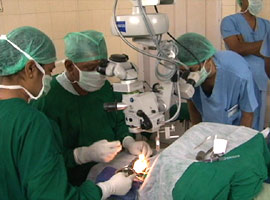 Dr. GOVINDAPPA VENKATASWAMY (Aravind Founder, speaking in 1988): There is nothing which disables a man more than cataract and poor eyesight, and there is nothing more easier than to mend it. You just do a small operation.
DE SAM LAZARO: Dr. V began with a simple idea in a sparse 11-bed hospital with four doctors, three from his own family. It would serve patients who could pay, but the profits would afford free care to the many more people who couldn’t afford even the bus fare. So Aravind set out to find patients, mainly through screening camps in surrounding rural areas. For those needing surgery, groups like the Lions Club provided buses to the hospital, where they entered a brisk assembly line operating room. Dr. V’s business role model was the American chain store.
Dr. VENKATASWAMY: In America you have models, whether it is Sears stores or McDonald’s hamburgers. You are able to open a chain of stores, restaurants, hotels, and you are able to organize them efficiently.
Dr. ARAVIND SRINIVASAN (Aravind Hospital Administrator): You spoke to him here. You were sitting here, and he was sitting there and talking about McDonald’s.
DE SAM LAZARO: Dr. V died in 2005, but his office is left untouched as a shrine to him. His nephew, ophthalmologist Aravind Srinivasan, manages a system that’s grown to five regional hospitals and 25 satellite clinics. This was the first one.
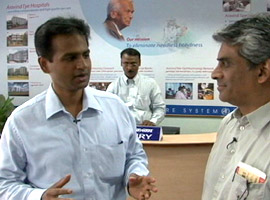 Dr. ARAVIND: This is a 32-year-old hospital, so we are probably geared to see about 700 patients a day. Today we are seeing about 1500 to 2000 patients a day.
DE SAM LAZARO: Each pays about one dollar for a doctor’s appointment. That helps fund an equal number of patients who go next door to a free eye hospital. There’s not much profit margin, so a heavy volume of paying patients—satisfied patients—is critical. Efficiency is also critical.
Dr. ARAVIND: We call this a clinic scoring sheet.
DE SAM LAZARO: Dr Aravind, who also has an MBA from the University of Michigan, has continuous productivity reports at his fingertips.
Dr. ARAVIND: This statistic talks about service time, what percentage were seen within two hours.
DE SAM LAZARO: Patients are promised a completed appointment in two hours. A brochure details what they can expect.
Dr. ARAVIND: Registration takes about 5 minutes, vision test about 10 minutes, refraction check about 10 minutes.
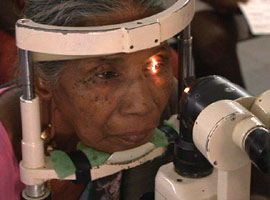 DE SAM LAZARO: This is sort of a patients bill of rights almost?
Dr. ARAVIND: Exactly. So they understand what’s happening.
DE SAM LAZARO: Aravind’s reputation is drawing patients from farther and farther away.
K.G. ANGENEYULU (Aravind Patient/Voice of Translator): Whenever you say eye operations everyone says go to Madurai.
DE SAM LAZARO: Fifty-five-year-old K.G. Angeneyulu had been in a three-year depression that started when cataracts began clouding his vision. He became completely blind three months ago. Angeneyulu and his wife Shobha endured a two-day train journey to get here.
Mr. ANGENEYULU (Voice of Translator): I was a sportsman. I used to swim. After the cataract, I could no longer move around. I got stuck at home, and I started eating. Then a leg injury made me even more immobile. I had problems being overweight, and I developed high blood pressure.
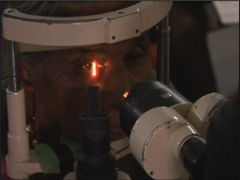 DE SAM LAZARO: By nine o’clock the morning after arriving here he was being prepared for surgery. Already dozens of patients had gone ahead of him
(to Dr. Aravind): So you’ve been going for two hours and done 16 surgeries?
Dr. ARAVIND: Yes.
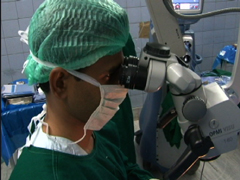
DE SAM LAZARO: Dr, Aravind and surgeons in several other operating theaters or OTs were first working the routine—mostly cataract—cases.
Dr. ARAVIND: The other OTs are not primarily cataract surgeons. They are primarily doing either glaucoma or cornea, and they also do some cataract to contribute to the main volume, so we are able to identify those cases that need a little extra attention are segregated from the pool.
DE SAM LAZARO: Angeneyulu was a high-risk case, given his hypertension and obesity.
Dr. ARAVIND: You just have a margin is about five to10 minutes to get the surgery done.
DE SAM LAZARO: About 10 nervous minutes later, Dr. Aravind had removed a particularly tough, leathery cataract.
Dr. ARAVIND: The cataract was a little obstinate, but things went on well. He’ll get about 95 percent vision tomorrow, so when you see him tomorrow you’ll see a very different man—more confident.
DE SAM LAZARO: By the end of this day, Dr. Aravind and his colleagues did about 300 surgeries, about half of them free of charge. Increasingly, however, patients are seen outside the hospital. Telemedicine connects doctors to satellite clinics, and today’s eye camps offer much more on site—from grinding eye glass lenses to digital scans. Near the camp a satellite truck beamed high resolution images to specialists at the hospital. Technology has improved care, and it has also brought down costs—notably for the intraocular lenses which are implanted during cataract surgery. They used to be imported.
 Aravind began making its own intraocular lenses back in the early 1990s. They used to cost between $50 and $100 each. Today they are made in this factory for as little as two dollars a piece. Aravind lenses are exported to 120 countries, and they own eight percent of the global market in intraocular lenses. This factory is an example of how Aravind turned a supply problem into an opportunity.
It’s not just business acumen that drives the mission, but also a firm spiritual basis, inspired by the teachings of Sri Aurobindo, a mid-20th century spiritual leader. He believed that good work and good ideas are a manifestation of the divine.
R.D. THULASIRAJ (Aravind Executive): Part of that is to recognize that whatever ideas you get, it’s not really your ideas. They are divine ideas. So how do you kind of act on it but are not taking the egoistic ownership to those ideas, like “I have don it?” So how do you train yourself to open up?
DE SAM LAZARO: One way Aravind has opened up, or shared its ideas, is by training some 250 hospitals in 40 nations to adopt its methods.
Mr. THULASIRAJ: In this institution we train organizations to become more efficient. We completely give our intellectual property or our store away. We open up our systems, processes, how we charge the patients, our records.
DE SAM LAZARO: It’s the ethos set by his uncle. Dr. V, who was single, never took a salary. In fact, he mortgaged his home to start Aravind, and he also coaxed or inspired 34 members of his extended family to work here, starting in 1976 with his sister Natchiar and her husband. Both left surgical careers in America to work here for about $20 a month.
Dr. G. NATCHIAR: Today, oh my God, we are very, very happy. In fact, at that time in ’80s we were not happy, even though Dr. V was happy. In the family, like me and my husband, two children, it was not easy for us. We could not even buy a cycle. At that time, we didn’t appreciate his far vision.
Mr. ANGENEYULU: God bless you, Madam.
Dr. NATCHIAR: God bless me? God bless the surgeon.
DE SAM LAZARO: She says the satisfaction of seeing patients like Angeneyulu restored to full lives makes up for any material privation, although over the years salaries have greatly improved for the 220 doctors and some 2500 other Aravind staff.
Mr. ANGENEYULU: My children are starting school on the first, so I want to get going.
Dr. NATCHIAR: We’ll give you some dark glasses just like a Hollywood actor.
DE SAM LAZARO: He’s one of 27 million patients who’ve been treated at Aravind and 3.4 million who’ve had surgery.
Over the next 20 years the goal is to raise that number ten-fold. That’s a measure of how ambitious the Aravind people are. It’s also a measure of how many people remain blind in the world whose vision can easily be restored.
For Religion & Ethics NewsWeekly, this is Fred de Sam Lazaro in Madurai, India.
