
Thomas J. Reese, SJ, senior fellow at Georgetown University’s Woodstock Theological Center, talks about white and Hispanic Catholic voters and suggests how President Obama’s own biography could help him connect with ethnic Catholics.
Author Archives: Fred Yi
End of Life Decisions
Originally broadcast October 9, 2009
KIM LAWTON, guest anchor: The president was on the road again this week trying to sell health care reform. Meanwhile in Washington, behind-the-scenes negotiations continued over several potential stumbling blocks, including funding for abortion coverage. Another controversial question in the effort to create affordable health care is how treatment at the end of life might become more humane and less expensive. Right now, in most states, when a dying patient can no longer communicate, doctors have no choice but to keep care going, even if it is painful for the patient, expensive, and unlikely to do any good. But is that necessarily the right thing to do? Betty Rollin has our report.
FAMILY MEMBER: She’s been fighting cancer for five years, twice. She has emphysema of the lungs real bad. It’s gotten worse, they said, since she’s been in here, and right now she is fighting a bad stroke. They are not sure, but they are saying something like it could affect her left side and maybe her brain.
BETTY ROLLIN, correspondent: Did she leave any instructions about what to do?
FAMILY MEMBER: No, she did not.
ROLLIN: And that’s a major problem, says Dr. Jeff Gordon, an internist at Grant Medical Center in Columbus, Ohio. Dr. Gordon has had dying patients who have not made their wishes known and haven’t realized that some extreme measures are almost always futile.
 DR. JEFF GORDON (Grant Medical Center): Most people think, that is for elderly people especially, that heroic measures like CPR and ventilator support is really effective, and the truth is, in older people with complicated medical problems, it just doesn’t work effectively, so the bottom line is people suffer needlessly at the end of life.
Ventilator–there is a plastic tube that goes through the mouth into the windpipe, and just imagine the gagging kind of feeling. Now we give high levels of sedation to inhibit that, but that alone, now think of yourself, these people typically have to be restrained so that they don’t just reflexively reach up and pull that tube out, and so they have their arms restrained. They can’t move freely, and think of yourself being on your back restrained, just the muscle aches and pains that you would develop.
ROLLIN: Dr. Gordon points out that sometimes aggressive treatment is a good idea.
DR. GORDON: Intensive care and heroic measures are awesome when they are used in the right people. The right people typically are younger people that have a chance of survival and having a good outcome.
ROLLIN: Dr. Philip Hawley, who is director of the intensive care unit, says the state mandate is to keep life going no matter the cost, so although doctors think their patients should be allowed to die peacefully, their hands are tied by custom and law.
DR. PHILIP HAWLEY (Grant Medical Center). We have people who are terminal on aggressive life support measures. Clearly they are not going to survive. We are spending all this time and money taking care of them. They are suffering, and it’s completely inappropriate.
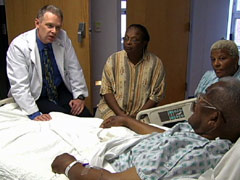 DR. GORDON: What people need to do is talk about this with their family, with their physician, in advance. If they get a life-threatening illness, a lot of times they won’t be able to. Maybe they won’t be coherent, or they’ll be on a life-support machine. They can’t express their wishes, then they put their family in a bind, so they feel guilty, they don’t know for sure, and then what often happens is the sort of default is, well, let’s do everything, as much as possible.
ROLLIN: And sometimes families disagree about what to do. It’s hard for some to let go, which complicates things further.
DR. HAWLEY: If we could get families to deal with this we would not have this problem. We feel we as physicians should be able to step in and say we’ve got to stop the madness.
DR. GORDON (speaking at church service): Lord, help us have perspective. That’s what changes lives. That’s what gives us hope.
ROLLIN: Dr. Gordon, who is also a nondenominational pastor, was surprised to find that patients who are religious often want more aggressive treatment at the end of life than others.
DR. GORDON: I have even encountered people that are people of faith, and they are, what I think, pursuing futile-type measures, and they say well, we are going to let God have his way here, and I try as gently as possible to say we are not really letting God have his way. We are forcing the issue here.
 (speaking to patient): Has anyone talked to you about this?
PATIENT: Oh, no.
DR. GORDON: No, no. It’s a topic that doesn’t get talked about.
ROLLIN: Dr. Gordon practices what he preaches by getting patients, as well as their families, to talk about what they want at the end of life while they still can, and he tries to make both patients and families aware of realistic rates of recovery.
DR. GORDON (speaking to patient): I just want you to understand is that those kind of things like CPR and breathing machines in somebody that’s got the problems that you have are not very effective. You need to decide whether that is something you would want or not, but you need to have all the facts about it, too.
ROLLIN: One of the reasons conversations like this rarely happen between patients and physicians, says Dr. Gordon, is that physicians are paid to treat, not to talk, which is not to say that some don’t talk anyway.
DR. GORDON: The person that needs to have this conversation is the primary care physician. They are going to have to call family members, they are going to have to gather these people, and besides that it’s a very difficult conversation, and so we are underpaying them. They are going to have to make a financial sacrifice to have this discussion, and then we wonder why it’s not happening.
ROLLIN: There are three things people can do to make their end-of-life wishes clear: Sign a durable power-of-attorney naming a person to make decisions if they are unable; sign a living will which is about long-term life-sustaining treatments; and deal with the DNR question—whether if your heart stops you want to be resuscitated or not.
 Jill Steuer, who has metastatic breast cancer and has been given four months to live, has decided to stop any kind of treatment and receive hospice care.
JILL STEUER, RN: I’ve been through all the chemotherapy, and there is no chemotherapy to help me anymore. I don’t want to be stuck. I don’t want to have any extra medications. I want to just go peacefully. The only medications I want are going to be the ones that are going to comfort me. That’s all I want.
ROLLIN: Jill Steuer is a nurse and researcher at Grant Hospital.
JILL STEUER: I’ve seen patients who have died horrible deaths, where their families wanted everything, the doctors wanted everything, but it was not to be, and that scared me. I’m not sure they realize that it’s okay to say “I’ve had enough.” Even now people will stop me in the hallway and they’ll say keep up the good fight, keep up the good fight, and I think some people are afraid that they are going to disappoint others if they just say let’s have nature take its course. I’m putting up a good fight, but my goal is not to live a long and painful year or two. I would much rather say at this point in time I want the next four months to be as interesting as the last 57 years have been.
For Religion & Ethics NewsWeekly, I’m Betty Rollin in Columbus, Ohio.
LAWTON: Shortly after we produced that story, Jill Steuer passed away.
More than Sparrows, Less than Angels
by Daniel P. Sulmasy
 Respect for intrinsic human dignity encompasses an acknowledgment that while we human beings are of inestimable value, we are not of infinite value. We are worth more than sparrows but less than the angels. We are made in the image of God, but we are not gods. As the psalmist says, we are made “a little lower than God.”
Thus, while there might be an absolute prohibition on killing, the duty to maintain life is finite. “Extraordinary” means of care are what the Roman tradition has called life-sustaining treatments that go beyond what a finite human being can be obliged to bear. We respect human life, but we do not worship human life. While we cannot make death our aim, we can forgo measures that forestall death, realizing that death will likely follow as a consequence. In fact, in some cases striving to stay alive at all costs can be inconsistent with respect for one’s own dignity—if it is rooted in a refusal to accept the finitude that is characteristic of the kinds of things we are as human beings. What Basil of Caesarea wrote concerning his monks’ use of medicine in the fourth century is instructive:
Whatever requires an undue amount of thought or trouble or involves a large expenditure of effort and causes our whole life to revolve, as it were, around solicitude for the flesh must be avoided by Christians. Consequently, we must take great care to employ this medical art, if it should be necessary, not as making it wholly accountable for our state of health or illness, but as redounding to the glory of God and as a parallel to the care given the soul. In the event medicine should fail to help, we should not place all our hope for the relief of our distress in this art, but we should rest assured that He will not allow us to be tried above that which we are able to bear.
Withholding or withdrawing life-sustaining treatments when they are futile, burdensome, costly, or complicated, or when their use would interfere with our ability to carry out other moral obligations, is perfectly consistent with respect for the intrinsic dignity of the human. Respect for intrinsic dignity implies that we should act in a manner consistent with our true intrinsic value, neither clinging vainly to this life nor denying the intrinsic value of this life.
Daniel P. Sulmasy, OFM holds the Sisters of Charity Chair in Ethics at St. Vincent’s Hospital in Manhattan and serves as professor of medicine and director of the Bioethics Institute of New York Medical College. This excerpt is from his essay in LIVING WELL AND DYING FAITHFULLY: CHRISTIAN PRACTICES FOR END-OF-LIFE CARE edited by John Swinton and Richard Payne (Eerdmans, 2009).
The Monastic Life
Originally broadcast October 30, 2009
JUDY VALENTE, correspondent: Seventy-eight-year-old Sister Phyllis is near death. Over a period of three days around the clock, the sisters have been taking turns keeping vigil at her bedside.
SISTER ANNE SHEPARD (Prioress of Mount St. Scholastica): In our monastery, sisters do not die alone. We stay with the sisters night and day, so that they know, they’re comforted by the fact that they joined a community, and as community they’re going to go home—the real home that we’ve been waiting for.
VALENTE: The sisters of Mount St. Scholastica die much as they live—peacefully, prayerfully, and surrounded by community. It’s a way of life that Benedictine monasteries have shown the world for more than 15 centuries, and it’s a message that still resonates.
 SHEPARD: When I look at the condition of the world today, I see a world where there’s violence, one where there’s greed, one where there’s selfishness. But also one where there’s a craving for a rejuvenation of family life, a rejuvenation of spiritual life. It speaks to me of the need more than ever of a monastic presence in this world.
VALENTE: Monasteries such as this one stand in contrast to the prevailing culture. They value community over competition, service over self-interest, and in a world of Internet, cell phones, and 24-hour talk, they stress listening and silence.
SHEPARD: It’s a way of life here. It’s an absence of noise and clutter, and we come together first, and we’re just silent. We’re in the presence of God. It’s not a deadly silence. It’s a very reverent and beautiful silence. We don’t need noise to be productive. It’s just the opposite. We don’t need noise to communicate. It’s just the opposite.
Monastic life is a life of living together in prayer and community. We as Benedictines, we monastics—we’re not founded to do a particular work. The particular work of a monastery is community, and believe me, that’s hard work. Living with 165 women is hard work.
Sister saying grace at mealtime: Ever faithful God, bless the food we are about to eat and unite us in mind and heart to your son, Jesus Christ our Lord.
SHEPARD: The common table is central to who we are. You listen, and you listen with the ear of your heart. You listen with what’s inside you. That’s what it means to be a listening person, and that’s going to happen in the dining room.
VALENTE: Sister Anne says these and other practices at the monastery can be applied to family life and even to the professional world.
SHEPARD: You bring in everybody into a decision and learn from the newest members, as well as the wisdom of the older members and everything in between. So you have prioresses and former prioresses and PhDs in English and math doing dishes along with those that just entered, that don’t have those same higher degrees. That’s a radically different way than a top-down way of doing business.
 VALENTE: The monastery reflects a spiritual way of life, but one that also contains practical wisdom.
SHEPARD: A major countercultural difference is that we hold things in common. That is a major thing, that it’s not the greed, that if I have a computer, if I have a laptop, it’s because it’s for the use of the community. For us, the less we have the more single our purpose. We don’t need things. We need the gospel call, and we need one another.
VALENTE: The sisters do a variety of work. They teach at Benedictine College. They operate a women’s center in nearby Kansas City, Kansas, where volunteers teach money management…
Sister teaching money management class: Budgeting is simple but it will bring, you know, a little bit of the peace of mind to your house.
VALENTE: …English as a second language…
Sister teaching language class: Out? Ought. Ought? Ought.
VALENTE: …and provide child care for mothers taking classes. Others work in the medical profession or in massage therapy. Until recently, one was even a firefighter; another, a funeral director. But the most important work of the monastery is prayer.
SHEPARD: We use the words of the Psalms and of the scriptures that nurture us, that give us life, that give us meaning. Our life is about seeking God together and bringing that God into our hearts. It’s so profound, it’s hard to even explain. But it’s the daily-ness of the prayer. It’s that we need the prayer.
VALENTE: Monastic life began to flourish after the fall of the Roman Empire. Men and women retreated to the desert to live solitary lives of prayer and penance. In the sixth century, Benedict of Nursia, known for his spiritual wisdom, left the solitary life behind and founded communities where like-minded individuals could seek learning, find security, and live a life of prayer. Today, every monastic order in the world, whether Benedictine or not, follows Benedict’s model to some extent.
A young woman comes to the monastery for music lessons from Sister Joachim Holthaus, a composer. Ever since the time of St. Benedict, monasteries have been important centers of learning and culture. This is Sister Paula Howard. Eight years ago, at age 77, she discovered her talent for creating icons, which the monastery then sells. She’s done nearly 200.
 SISTER PAULA HOWARD: Well, I think all appreciation of beauty lifts your heart—that beauty belongs here. It’s a foretaste of heaven, we hope, and I just think that beauty is an image of God.
VALENTE: Both artistic beauty and the beauty of nature.
SHEPARD: A contemplative life is being in tune with the spirit, in tune with nature, in tune with creation. It’s a communion with all that is around you. It’s a sense that everything we do is significant—the way I plant a garden and care for the garden. Everything that we do has meaning, and it has meaning because we’re intentionally trying to be more prayerful. You can live a contemplative life outside of a monastery. As a matter of fact, that is our hope, that people can come here and find a sense of peace.
VALENTE: The sisters earn some income by offering spiritual retreats. These high school girls are spending several days here. The monastery has 70 lay employees and an annual budget of $4 million. Most of it goes toward operating a nursing care facility for elderly sisters. The monastery also receives donations and bequests and government funding for its nursing home. Another source of income: the salaries of sisters who do outside work, like Sister Mary Palarino, a clinical social worker.
VALENTE: You could do this work as a lay person. I’m wondering what you think being a sister brings to this.
SISTER MARY PALARINO: You know, I really don’t think I could do it as holistically and as comprehensively unless I were a member of my community and living the Benedictine way of life.
VALENTE: Mount St. Scholastica is nearly 150 years old. Some 2,000 women religious have passed through its doors. Today the vast majority of the sisters here are over the age of 55.
PALARINO: I do get concerned about people not joining us, and I don’t understand that, I mean, because it seems like young people today are—they seek, and they have a hunger for community, for prayer life, for social justice issues. They have a hunger, you know, to follow something greater. We have that.
VALENTE: Sister Anne Shepard:
SHEPARD: Where it’s going to go in the future? It’s going to go wherever God takes us. We’re going to be smaller. We’re going to be just as vibrant. But it’s not easy. Any genuine commitment isn’t easy. That gift of unselfishness is the reason we make a promise to be faithful for all our lives, every day of our lives.
VALENTE: These sisters believe that as long as there is a need in the world for quietude, simplicity, balance, prayer, and community, there will always be a purpose to monastic life.
For Religion & Ethics NewsWeekly, this is Judy Valente at Mount St. Scholastica in Atchison, Kansas.
Listen Now
Listen to this episode now:
[powerpress]
Obama Faith Council: Final Report and Recommendations
In February 2009, President Obama appointed 25 prominent religious and community leaders to spend one year advising him on policy issues including global and domestic poverty, climate change, the promotion of responsible fatherhood, and interfaith cooperation. The panel also studied partnerships between the government and faith-based social service organizations. On March 9, the advisory council presented its final report, including more than 60 policy recommendations, to the president and senior administration officials. Watch several council members discuss their work, including Melissa Rogers, Wake Forest University Divinity School; Jim Wallis, Sojourners; Rabbi David Saperstein, Religious Action Center of Reform Judaism; Peg Chemberlin, National Council of Churches; and Eboo Patel, Interfaith Youth Core.
Joshua DuBois: Relations with Faith Community “Strong”
On March 9, President Obama’s 25-member faith advisory council presented its final report and recommendations to the president and senior administration officials. This council now disbands, although the administration says it will “soon” appoint a new faith council to continue the work. Religion & Ethics NewsWeekly managing editor Kim Lawton talks with Joshua DuBois about the administration’s relationship with the faith community and plans for the future.
Thomas Farr: Obama Must Appoint Religious Freedom Ambassador
A 1998 law mandates that the US government have an Ambassador-at-Large for International Religious Freedom to advance religious liberty around the world as part of American foreign policy. But the Obama administration still has not appointed anyone to this post, even though in his landmark speech to the Muslim world from Cairo in June 2009 President Obama said religious freedom is an American priority. Thomas Farr, associate professor of religion and international affairs at Georgetown University and former director of the State Department’s Office of International Religious Freedom, discusses his concerns about Obama’s lack of action, the qualities he’d like to see in the ambassador, and the importance of the office to US foreign policy.
Humanitarian Challenges in Chile and Haiti
KIM LAWTON, anchor: It was a demanding week for global humanitarian groups as they raced to get emergency help to Chile even as they continued relief efforts in Haiti. More than 800 people were killed and two million left homeless by last weekend’s earthquake and tsunami along Chile’s coast. Faith-based groups were among those delivering immediate aid and assessing the potential long-term needs. At the Vatican, Pope Benedict XVI offered special prayers for the victims in this predominantly Catholic country. Meanwhile, work continues in Haiti after the devastating earthquake there. Heavy rains have been complicating efforts to provide shelter to hundreds of thousands of displaced people. The dual catastrophes are posing major challenges for humanitarian groups. Joining me to talk about that is Richard Stearns, president of the US offices of World Vision. World Vision is the largest US-based international relief and development organization.
Rich, let’s start with Chile. What are the major challenges there right now? How are you working there?
RICHARD STEARNS (President, World Vision): Well, I think one of the challenges that we’re facing in Chile is that the damage is very wide spread. In Haiti it was very concentrated in Port-au-Prince, but in Chile it’s spread out over hundreds of miles of coastline. But the challenges we’re facing are typical of an earthquake. You’ve got a lot of homeless people that are living outside of their homes. They may have lost their homes or they’ve been compromised. Power has been cut off, water and sanitation have often been cut off, and of course now they are dependent on aid organizations and the government for food, water, and sanitation and those kinds of things. So, as we know, this was one of the biggest earthquakes of the last 50 years, and it did quite a bit of damage.
LAWTON: Are we seeing the same kind of mobilization that there was for Haiti?
STEARNS: Well, certainly organizations like World Vision are mobilizing. The Chilean government, the US government are mobilizing to help. But the donor response has been just a fraction of what we experienced for Haiti. Unfortunately, I think donor fatigue, these two disasters being so close together, we believe that Chile is not going to see nearly the level of donations that we experienced for Haiti.
LAWTON: Well, I was going to ask you about that. How does an organization like yours deal with that, when you’ve got these two really major disasters going on at the same time? How do you allocate resources and figure out where to put all of your energy?
STEARNS: Well, believe it or not, World Vision responds in a typical year to about 75 natural disasters around the world. Most of them aren’t on the scale of Haiti or Chile, but we have a global response team that’s kind of like the Navy Seals, and we are staffed so that we can respond to two massive catastrophes simultaneously. So we sent a huge team into Haiti. We sent about 50 people in. We’ve got about 1,000 people in country in Haiti responding right now. Many of them were there before the earthquake. Chile—we had 100 employees in Chile before the earthquake, and we are now sending in relief teams. We have prepositioned supplies in warehouses all over the world just ready to ship in for a catastrophe just like this. So a lot of it is preparedness, and organizations like World Vision are structured to be prepared to respond to multiple disasters.
LAWTON: And then how do you address that donor fatigue that you mentioned, so that you have the resources continuing to come in, not just for Haiti and Chile but for all the other problems around the world as well?
STEARNS: Well, that is a challenge, but World Vision has about one million US donors, and we probably have about four million donors worldwide who give to our organization. So we can usually count on them to step up and be generous when we contact them and talk to them about what we’re doing to respond. But the general public—we are concerned in this case that the general public is not going to respond at the same level that they did for Haiti or anywhere near that level. So that means we will probably have to rely more on government grants from donor governments to help us in the response.
LAWTON: Alright, Richard Stearns with World Vision. Thank you so much.
Richard Stearns Extended Interview
Watch more of our conversation with World Vision president Richard Stearns on dual catastrophes in Chile and Haiti, the military’s role in humanitarian relief, and the Obama White House Office of Faith-based and Neighborhood Partnerships.
