
Author Archives: Fred Yi
Selecting a New Pope: Conclave Preview
KIM LAWTON, correspondent: Since Monday, the cardinals have been gathering for a series of meetings—what they call “congregations”—to discuss the future of the Catholic Church.
REV. THOMAS REESE, S.J. (National Catholic Reporter): That’s where they meet and have speeches, listen to each other, do some logistical planning for the conclave. Some of it’s very boring. But the important part that they do there was actually talk about some of the issues that face the church and what they think is needed.
LAWTON: Father Thomas Reese is doing analysis of the papal transition for National Catholic Reporter. He says the cardinals’ most essential work this week took place outside the meetings.
REESE: Over the coffee breaks, over dinner and lunch where the cardinals have a chance to talk to one another, get to know one another, asking them, you know, what do you think are the issues facing the church, who do you think would be a good pope?
LAWTON: Many cardinals said they didn’t want to be pressured to begin the conclave too quickly.
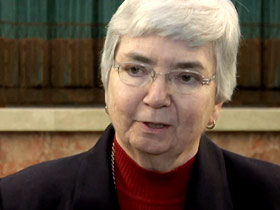
SISTER MARY ANN WALSH (US Conference of Catholic Bishops): Well, this is a huge moment. Leadership comes from the top and you’re electing the top leader, the man who’s going to set the tone for the church. That’s very important.
LAWTON: There was controversy after some Italian media leaked detailed accounts of the cardinals’ meetings.
WALSH: That made them say, “What’s happened to the freedom to speak in the congregation? If you don’t have confidentiality, you don’t have freedom.” And so everybody took the position—it happened the last time too—well, we’d better just not give interviews at all. And so the cardinals agreed to that.
LAWTON: The media blackout meant that US cardinals had to stop holding their general media briefings.
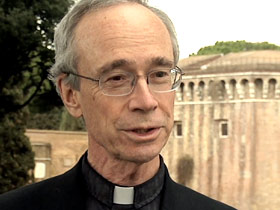
REESE: The American cardinals of course came to Rome, and they wanted to do things just like they do in the United States, so they called press conferences to help the media do their stories, to feed some stories to the media because if you don’t feed the beast, it will devour you. So they were pretty smart, I thought, in having these stories. In other parts of the world, this just isn’t done, and in Rome, they don’t like this.
LAWTON: Some 5,000 journalists from around the world have sought media credentials to cover the transition. But the cardinals’ voting process for the new pope is supposed to take place under the strictest of secrecy.
REESE: When it comes to the conclave, they’re going to be actually locked up inside, no phones, no internet, no email, not even letters, so that’s going to be really isolating. Now once they come out, typically what happens is the stories start to leak out, about who was leading and how the votes went and we’ll probably find out that soon after the conclave is over.
LAWTON: People around the world are watching it all with a sense of keen anticipation.
WALSH: Somebody wrote me a note today saying they are praying for an inspired choice. I think everyone is.
LAWTON: Catholics believe the pope is part of an unbroken line of church leaders that stretches directly back to St. Peter. And despite the challenges, they say electing Peter’s successor is indeed a momentous occasion.
I’m Kim Lawton at the Vatican.
Same-Sex Marriage and the Supreme Court
TIM O’BRIEN, correspondent: Four years ago, voters in California approved Proposition 8, an amendment to the state’s constitution banning same-sex marriage in the state, only to have it overturned two years later by a federal judge who said the amendment denied gays and lesbians the equal protection of the law guaranteed by the U.S. Constitution.
THEODORE OLSON (Attorney for plaintiffs in Prop 8 case): “Today, we are more American because of this decision…”
O’BRIEN: …a huge decision that would require all states to recognize gay marriage should the U.S. Supreme Court agree.
The second case involves the federal Defense of Marriage Act—DOMA, for short. The law denies same-sex couples who marry the same federal benefits routinely accorded heterosexual marriages, including many tax benefits like the right to file a joint return.
 DOMA is being challenged by Edie Windsor, whose relationship with Thea Spayer spanned more than 40 years. They had met in the early sixties and were at one another’s side for decades. They registered in New York City as domestic partners as soon as they could in 1993. But they wanted much more.
Edie Windsor: “We want to do the vows and we want to exchange rings.”
O’BRIEN: Spayer had been stricken with multiple sclerosis, and her health was failing. But that did not keep her and Edie from hopping a plane to Toronto, Canada, where in 2007 they were wed.
Thea Spayer: “I Thea Spayer, choose you…until death do us part.”
O’BRIEN: Two years later Thea passed away, leaving the bulk of her estate to Edie, now 83, which resulted in an estate tax bill of $363,000. Even though New York recognized their marriage, Edie did not qualify for the marital deduction allowed heterosexual marriages because of the Defense of Marriage Act.
 A federal appeals court in New York found that also violated the guarantee to equal protection, but went much further. After noting a long history of discrimination against gays and lesbians, the court concluded any law that makes distinctions based on sexual orientation must be subjected to “heightened scrutiny,” and the government must present “exceedingly persuasive” proof that the distinctions further “an important government interest.” Should the U.S. Supreme Court agree, it would be much more difficult for Congress or any city or state to discriminate against gays and lesbians on anything, not just marriage.
The Justice Department ordinarily defends laws passed by Congress, even those it doesn’t like. But after the New York court’s decision, President Obama said his Justice Department would no longer defend DOMA in court:
President Barack Obama:“DOMA, the Defense of Marriage Act, is unconstitutional, and so we’ve said we cannot defend the federal government poking its nose into what states are doing and putting the thumb on the scale against same-sex couples.”
O’BRIEN: Those who had fought for passage of the Defense of Marriage Act were understandably dismayed.
 Tony Perkins (President, Family Research Council): “This is about what our children are going to be taught in elementary school. It is about stepping in between a parent and their child and imposing a new morality, or absence thereof, upon our children.”
O’BRIEN: Republican leaders in the House said they would defend the law themselves:
John Boehner (Speaker of the House): “I raised my hand to uphold and defend the Constitution of the United States and the laws of our country, and if the Justice Department was not going to defend this act passed by Congress, well, then we will.”
O’BRIEN: Whether the House has the legal right to defend the law in the Supreme Court is unclear. A similar question arises with Prop 8 in California, where the state has also decided not to defend that law, giving the justices an easy out for a narrow decision or to sidestep the issue altogether if they choose.
Historically, the court moves very slowly on social issues—following the trends, rarely leading them. The court took the lead in 1954, desegregating the nation’s schools, igniting the civil rights movement. Resistance was massive, however. It wasn’t until 1967 that the court got around to addressing interracial marriage in the case of Richard and Mildred Loving, who were convicted of violating Virginia’s law against interracial marriage, a felony punishable by prison.
 Richard Loving (Plaintiff in Loving v. Virginia): “They sentenced us to one year in the state penitentiary. Then they suspended for 25 years and said that we had to leave the state.”
The Supreme Court ruled 9-0 to throw out their convictions, Chief Justice Earl Warren writing, “The freedom to marry has long been recognized as one of the vital personal rights essential to the orderly pursuit of happiness.”
Virginia’s law “had no legitimate overriding purpose independent of invidious racial discrimination.” The decision went against public opinion. Interracial marriage was illegal in 16 states at the time, and a Gallup poll showed 73 percent of those surveyed disapproved of it. Race relations have come a long way since 1967, and proponents of same-sex marriage see similar progress for gays and lesbians.
LEE SWISLOW (Executive Director, Gay & Lesbian Advocates & Defenders): I think this is an area in which we’ve seen tremendous movement over the last 15 or 20 years, and people are on a journey. I mean, as a lesbian I had to go through my own journey when the community first started talking about marriage, and I was, like, are you kidding? Marriage? It’s not for us. That’s never been for us. And yet, as I thought about it I realized I do want to get married. Once I let myself believe it was possible, I want to marry the woman I love.
 O’BRIEN: The court will not be writing on a blank slate. Twenty years ago, the justices threw out a constitutional amendment in Colorado that would have prevented cities from protecting gays from discrimination, and in 2003, the court rejected a Texas law that made gay sex a crime. Justice Anthony Kennedy, whose vote could be critical on the same-sex marriage question, wrote both decisions and in striking down the Texas law said this about gays and the gay lifestyle:
Justice Anthony Kennedy audio: “The petitioners are entitled to respect for their private lives. The state cannot demean their existence or control their destiny by making their private sexual conduct a crime. Their right to liberty under the due process clause gives them the full right to engage in their conduct without intervention of the government. It is the promise of the Constitution that there is a realm of personal liberty which the government may not enter.”
O’BRIEN: Justice Kennedy insisted the court’s opinion did not directly apply to same-sex marriage, but dissenting Justice Antonin Scalia saw it differently:
Justice Antonin Scalia audio: “At the end of its opinion, the court says that the present case ‘does not involve whether the government must give formal recognition to any relationship that homosexual persons may seek to enter.’ Do not believe it. Today’s opinion dismantles the structure of constitutional law that has permitted a distinction to be made between heterosexual and homosexual unions.”
O’BRIEN: A federal appeals court in Boston agreed with Scalia’s interpretation and last May became the first federal appeals court to throw out DOMA, citing Kennedy’s decision in the Texas case as authority. The rules governing marriage, like the rules governing divorce, have historically been left to the states, and they differ from state to state, like how old do you have to be to get married, and what do you do to get out of a marriage? The issue of same-sex marriage is widely expected to divide the court along liberal-conservative lines, but not necessarily. Lee Swislow of Gay & Lesbian Advocates & Defenders says there is a “state’s rights” component in the case that could win over some conservative justices.
SWISLOW: When a state says you’re married, does the federal government, as it has always done in the past, agree with that state definition? This is the first time that the federal government has ever reached in and said, “We don’t care what you say, state. We’re going to have our own definition of marriage.” And we don’t think there’s any legitimate reason for the federal government to take this unprecedented action.
O’BRIEN: Throwing out DOMA would not require all states to recognize gay marriage, but striking Prop 8 possibly could. A number of mainstream religious groups do not support gay marriage.
JIM GARLOW (Founder, Pastors’ Rapid Response Team): Authentic, biblical, historic, orthodox Christianity has always affirmed marriage being one man and one woman.
O’BRIEN: And the court in New York addressed the religious concerns, distinguishing civil marriage from holy matrimony. Judge Dennis Jacob wrote “the law is not concerned with holy matrimony. A state may enforce and dissolve a couple’s marriage, but it cannot sanctify or bless it. For that, the pair must go next door.” That the country has become more tolerant of homosexuality would seem to be unmistakable, and it may also be irreversible.
For Religion & Ethics NewsWeekly, I’m Tim O’Brien in Washington.
BOB ABERNETHY, host: For more on religious groups and same-sex marriage, I am joined by Kim Lawton, managing editor of this program. Kim, this is a tremendously powerful and divisive issue for religious groups, isn’t it?
KIM LAWTON: It is and these cases are going to be really, really important for these religious groups. They’re going to be very involved on both sides of the issue. Some of the strongest opposition to gay marriage at the legislative level, at the court level, has come from religious groups, especially evangelical groups, Roman Catholics; the Roman Catholic bishops have been speaking out in favor of traditional marriage. So I expect there’s going to be a robust amount of activity not only in terms of these religious groups writing friend-of-the-court briefs and telling the High Court what they think about the issue, but also at the grass roots. I’ve already been getting emails about prayer campaigns that are being organized. For example, the bishops after Christmas are doing a prayer campaign to support what they call traditional marriage, life, and liberty.
ABERNETHY: And how do they divide up? Catholics and evangelicals are one, but it’s not all one or the other, is it?
LAWTON: Exactly. There are growing movements within the religious community in support of gay marriage. There are religious groups who look at this as a matter of equality and justice. Jewish groups have been—Reform and Conservative Jews have been very supportive of gay marriage. Orthodox—not in the Jewish community; in the Christian community a little more complicated. Certainly while the Roman Catholic Church at the hierarchy is opposed, you have grass-roots groups, like there’s a group called Equally Blessed that says you can be a faithful Catholic and still support this on an equality issue. And then a lot of the mainline denominations really torn over the issue. United Church of Christ and Unitarians support gay marriage, but a lot of the other ones still define marriage as between a man and a woman.
ABERNETHY: And I think about conflict within one congregation, for instance, not only within the members of the congregation, but the bind the pastor can be in if the state says one thing and the Bible says another.
LAWTON: Well, exactly. This has been an issue in some cases where in states that have legalized gay marriage and the pastors are in denominations that don’t recognize it, and so congregants who are gay come to them and say we want to be married in a church, but the pastor says, well, our denomination doesn’t allow that.
ABERNETHY: Kim Lawton, many thanks.
None of the Above: Political Implications
KIM LAWTON, correspondent: In the battleground state of Ohio, volunteer Monette Richards is making calls for state and local Democratic candidates. She wants to encourage liberal voters, and especially those who support abortion rights, to get out to the polls next month.
MONETTE RICHARDS (Activist): We get the government that we deserve because we get the government that we vote for. And right now it’s not good enough for me.
LAWTON: Richards is part of a growing force on the political scene: the 46 million Americans who say they are not affiliated with a religion. Their numbers have been rising rapidly, and they are heavily Democratic.
PROF. JOHN GREEN (University of Akron): Something like a quarter of people who identify with the Democrats or lean towards the Democratic Party are in this unaffiliated category. That’s a lot of votes. That’s a major group.
 LAWTON: Professor John Green directs the Bliss Institute at the University of Akron and has long studied the relationship between religion and politics.
GREEN: Religious affiliation has often been closely associated with the major party coalitions, with the Democrats and the Republicans each drawing on different religious communities, and sometimes fighting over religious communities that are pretty evenly divided between the two parties. Well, as people are less involved in organized religion, then those relationships change.
LAWTON: The religiously unaffiliated, often called “the nones,” are about twice as likely to describe themselves as political liberals than as conservatives, and they strongly support legal abortion and same-sex marriage. In a breakdown by faith group, the religiously unaffiliated are now the largest constituency for Democrats, outnumbering black Protestants, white mainline Protestants and white Catholics.
GREG SMITH (Pew Forum on Religion & Public Life): In 2008 about three quarters of religiously unaffiliated voters voted for Barack Obama over John McCain. This group, the religiously unaffiliated, was as heavily supportive of Democrats and Barack Obama as evangelicals are of Republicans and as they were of John McCain.
 LAWTON: Although people of faith all together still make up the majority of the Democratic coalition, for many years, the Democrats battled a perception that they were not as friendly toward religion as the Republicans. As director of faith outreach for the Democratic National Committee, Reverend Derrick Harkins has been working to change that perception.
REV. DERRICK HARKINS (Democratic National Committee): People of faith make up a significant and important and valuable part of who we are as Democrats and that’s across the spectrum of faith traditions.
LAWTON: Green says the growing number of religiously unaffiliated voters could complicate those efforts.
GREEN: How do they for instance get the black Protestant churches to mobilize voters and to be very enthusiastic about their platform and their candidate without turning off unaffiliated voters, and how do they appeal to those people and get them involved and excited about the candidate without alienating some of the religious communities that support the Democratic Party? It’s a really interesting problem.
LAWTON: Harkins asserts that the Democratic tent is wide enough to accommodate all.
HARKINS: In having respect for that broad spectrum of faith traditions, we also certainly have respect for people who may not practice. The president often says himself that we need to honor and respect those who certainly practice faith and indeed those who may not.
PRES. BARACK OBAMA (in inaugural speech): We are a nation of Christians and Muslims, Jews and Hindus – and nonbelievers.
 LAWTON: The rising number of religiously unaffiliated may be posing new challenges for the Republicans as well. Although they still make up only about 11 percent of the GOP, a disproportionate number of them are young. About a third of all adults under the age of 30 are “nones.” At the University of Akron, these members of the College Republicans say they aren’t affiliated with any particular faith. They worry that their party’s close relationship with the Religious Right could weaken its viability in the future.
BRAD PHLIPOT (Student): With the Republican Party focusing so much on religion and getting the religious vote, I think it might kind of burn out the people in my age group who are like “well you know I’m not really that religious and if they’re focusing so much on religion, you know, maybe that’s just not me.”
MATTHEW MONEYPENNY (Student): It’s more about what they believe politically rather than religiously because that doesn’t really have an effect on society as much as it used to in my opinion.
LAWTON: According to our new survey with the Pew Forum on Religion & Public Life, almost 70 percent of the religiously unaffiliated say that churches and other religious institutions are too involved in politics. Only 46 percent of the general public agreed with that.
SMITH: People who say they’re not religiously affiliated are much more likely than others to say that they think religious organizations are too political, they are much more likely to say that there’s been too much religious talk from politicians, they’re much more likely to say they think churches and other houses of worship should keep out of political matters.
 RICHARDS: When you can’t get into office unless you profess your religion and talk about how religious you are, it’s a very big problem for us.
LAWTON: Like most religiously unaffiliated voters, Monette Richards doesn’t want to hear politicians quote from the Bible or make other overt religious appeals. She believes candidates can eliminate the God-talk without alienating faith-based voters.
RICHARDS: I don’t know that there should be any offending or marginalizing the religious just simply because they aren’t pandering to them anymore.
LAWTON: But most Americans still do see a role for religion in politics. About two-thirds of the general public say it’s important for a president to have strong religious beliefs. A majority also say it doesn’t make them uncomfortable when politicians talk about their faith. In today’s politics, Republicans can’t win without strong support from evangelicals. And in this election season, several groups have been waging an active campaign to mobilize religious conservatives through churches and other religious institutions. The Faith and Freedom Coalition’s Ralph Reed has been spearheading efforts to turnout the evangelical vote.
 RALPH REED (Faith and Freedom Coalition): It’s one out of every four voters and if they turn out in huge numbers, they could really change the outcome of this election.
LAWTON: While both parties have projects to reach out to faith constituencies, many religiously unaffiliated voters say despite their growing numbers, they still feel neglected by politicians.
RICHARDS: We’ve been pretty much erased from any kind of election talk.
LAWTON: But how do you reach out to people who aren’t at the same place at the same time every week talking about their shared beliefs?
PHLIPOT: Religion it’s a great place for politics to find people is at church. So maybe that’s something we’ll have to figure out. You know in the future it’s going to be social media you know Facebook groups, stuff like that, Twitter handles. I think that’s something we should use more to utilize the people who are not church going.
 BRIAN CRISAN (Student): Religions have a very, they have a structure to their communities and a support network and though I don’t agree with many religious beliefs, I do believe having a support network is important.
LAWTON: Brian Crisan is part of the University of Akron’s Secular Student Alliance, which tries to provide that support to nonbelievers. This spring, Crisan and several other alliance members came to Washington, D.C. for the Reason Rally, which organizers billed as the largest secular gathering ever in America. One of the goals was to demonstrate their potential clout.
BRYAN POOLE (Student): There are definite political movements growing for atheism or people who particularly do not have religious affiliations and those particular organizations can help people basically find identity.
LAWTON: Richards also attended the Reason Rally and says she came away more inspired than ever to be politically engaged. She says she gets frustrated that religious conservatives have co-opted the term “values voters.”
 RICHARDS: It’s interesting that we still equate values sort of with piousness and piety and we need to change that association for us, so that we can move past that and know that values is just, you know, ethics and morals and just good people doing the right thing as opposed to, you know, reading the right book.
LAWTON: What values do you apply to your politics?
RICHARDS: Progressive, social justice. We’re all in this together kind of thing, it doesn’t have to be a me against you, Democrats vs. Republicans or anything. It’s, you know, move forward, help the people that need help.
LAWTON: Unaffiliated Republicans say they also want to be known as values voters.
NICK CASTRO (Student): There’s many people that are out there who I’m friends with who I know who do not believe in anything, who are not affiliated with any religion, but they believe in that strong economical growth, they believe in that strong values just they don’t take it from the values from God or from whoever, they take it from the values of themselves.
LAWTON: One challenge may be getting those religiously unaffiliated voters to the polls. In recent elections, the “nones” voted at lower rates than their religiously affiliated counterparts. But given their rising numbers, experts say a politically organized and active movement of the unaffiliated could play a key role in the political landscape for years to come. I’m Kim Lawton in Akron, Ohio.
John Green Extended Interview
“Candidates do often benefit from talking about their personal faith, but once that becomes politicized it can create some real problems for them, so they tend to stick to other sets of issues.” Watch more of our interview with University of Akron professor John Green on the political implications of the rising numbers of religiously unaffiliated voters.
Greg Smith on Politics and the Unaffiliated
“In our data for 2012 we are finding that the religiously unaffiliated outnumber white mainline Protestants, white Catholics, and even black Protestants among Democratic and Democratic-leaning registered voters.”
Listen Now
Listen to this episode now:
[powerpress]
Sister Mary Ann Walsh: Papal Election “A Huge Moment”
The US Conference of Catholic Bishops’ media department has set up an office in Rome to assist journalists and the cardinals during the papal transition. Sister Mary Ann Walsh is director of the office. Managing editor Kim Lawton is in Rome and spoke with Walsh about the decision of the College of Cardinals on Wednesday (March 6) to stop all media interviews; what the cardinals are doing before the conclave starts; and the importance of this papal election.
Selecting a New Pope: U.S. Catholic Voices
Watch a March 1, 2013 panel discussion held in Mullen Memorial Library at the Catholic University of America in Washington, D.C., and moderated by Religion & Ethics NewsWeekly managing editor Kim Lawton and Catholic News Service reporter Pat Zapor. Panelists are Ambassador Miguel Diaz, University Professor of Faith and Culture at the University of Dayton and the most recent U.S. ambassador to the Holy See; Dr. Margaret Melady, vice chair of the board of trustees of Catholic Distance University and former president of the American University in Rome; Dr. Stephen Schneck, director of the Institute for Policy Research & Catholic Studies at the Catholic University of America; and Kim Daniels, coordinator of Catholic Voices USA.
Full Episode
