Visit Your Local PBS Station PBS Home PBS Home Programs A-Z TV Schedules Watch Video Support PBS Shop PBS Search PBS
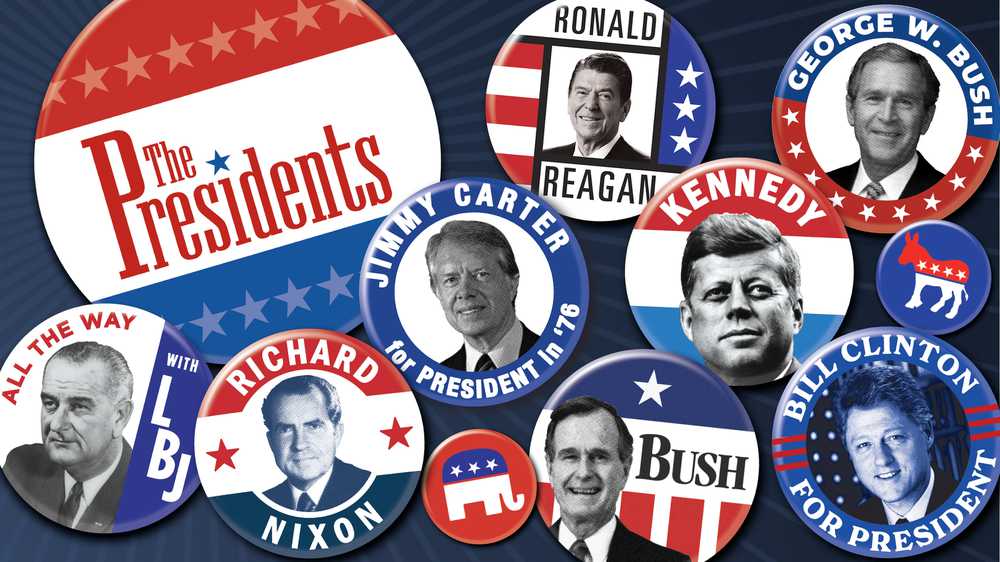
The Presidents Connect today's election issues with the past


Chapter:

Reelection and Controversy (11:13)
Roosevelt wins the 1936 election. Overconfident, he makes the mistake of trying to reshape the Supreme Court.

Now
Playing

FDR
Truman
LBJ
Nixon
Carter
Reagan
G H W Bush

Related Clips


REAGAN, Chapter 21

Transitions (10:40)
Reagan loses his oldest advisers. Mikhail Gorbachev becomes the new Soviet leader, and Reagan embarks on a fateful secret course with Iran.
Watch Now

TRUMAN, Chapter 8

Truman Proves Himself (9:07)
Truman works hard to understand the workings of the Senate and finds sucess.
Watch Now

NIXON, Chapter 16

The Fall (9:36)
Nixon is re-elected in a landslide while the investigation into Watergate burglaries begins. After Nixon orders intensive bombing in Vietnam, peace talks lead to a cease-fire.
Watch Now

LBJ, Chapter 9

The Civil Rights Act of 1964 (10:49)
Johnson waits out the longest Senate filibuster in history to achieve the bill that makes racial segregation illegal.
Watch Now

Chapter 1

CreditsHead credits for part one of the television program.
Watch Now

Chapter 2

Introduction (5:06)
Part one of a biography of Franklin D. Roosevelt, the 32nd president.
Watch Now

Chapter 3

The Center of the World (11:41)
Born to wealth and privilege, Roosevelt is sent to boarding school, then attends Harvard University.
Watch Now

Chapter 4

Eleanor is an Angel (13:17)
Roosevelt marries his distant cousin Eleanor, the niece of his hero Theodore Roosevelt. They move next door to his mother in New York.
Watch Now

Chapter 5

A Secret Ambition (12:32)
Roosevelt enters New York politics and finds an advisor in reporter Louis Howe.
Watch Now

Chapter 6

Rebellion (12:32)
Roosevelt becomes assistant secretary of the Navy. In Washington, he jeopardizes his job and his marriage. Eleanor develops her own political interests.
Watch Now

Chapter 7

Polio Strikes (11:37)
Roosevelt contracts polio and loses the use of his legs.
Watch Now

Chapter 8

Denial (10:52)
Roosevelt escapes to a Florida houseboat, the Larocco. Eleanor tends to his political interests but also develops independence.
Watch Now

Chapter 9

Recovery (10:49)
Roosevelt finds purpose in Warm Springs, Georgia, where he creates an innovative polio treatment center.
Watch Now

Chapter 10

The Return (7:25)
After learning to appear to be walking, Roosevelt returns to politics and is elected governor of New York.
Watch Now

Chapter 11

Government's Duty (6:28)
Governor Roosevelt's bold Depression relief programs position him to challenge President Herbert Hoover.
Watch Now

Chapter 12

A Better Day (5:31)
As the Depression worsens, Roosevelt is elected president and promises "a new deal for the forgotten man."
Watch Now

Chapter 13

CreditsProduction credits for part one of the television program.
Watch Now

Chapter 14

CreditsPart two of a biography of Franklin D. Roosevelt, the 32nd president.
Watch Now

Chapter 15

An Electrifying Leader (9:10)
Roosevelt inspires the Depression-ravaged nation at his inauguration, saying, "...the only thing we have to fear is fear itself."
Watch Now

Chapter 16

Above All, Try Something (13:43)
Roosevelt uses experimental Federal policies to try to end the Depression. Eleanor advocates for the needy, redefining the role of First Lady.
Watch Now

Chapter 17

Hard Times (8:05)
With no economic recovery in sight, Roosevelt's relief programs meet opposition.
Watch Now

Chapter 18

Loving and Hating FDR (10:35)
Roosevelt's New Deal draws the ire of the rich, but devotion from ordinary citizens.
Watch Now

Chapter 19

Reelection and Controversy (11:13)
Roosevelt wins the 1936 election. Overconfident, he makes the mistake of trying to reshape the Supreme Court.
Watch Now

Chapter 20

The Fascist Threat (13:54)
The U.S. maintains its isolationism as German, Italian, and Japanese armies seize territory on three continents.
Watch Now

Chapter 21

The Juggler (15:25)
Roosevelt and Winston Churchill create Lend-Lease, a plan to help Great Britain fight the Germans, despite Congressional isolationism.
Watch Now

Chapter 22

America Goes to War (13:12)
Provoking an incident with a German U-boat, FDR leads the U.S. into World War II. The Japanese attack the U.S. fleet at Pearl Harbor.
Watch Now

Chapter 23

The Allies Wage War (13:36)
With Americans fighting the Germans in North Africa, Roosevelt and Churchill plan an invasion of continental Europe.
Watch Now

Chapter 24

D-Day (6:05)
The Allies cross the English Channel to attack the Germans in northern France. Roosevelt's health falters.
Watch Now

Chapter 25

Coming to an End (10:48)
Lonely and unwell, Roosevelt seeks out an old flame. After his reelection, he meets Stalin and Churchill at Yalta to discuss the postwar world.
Watch Now

Chapter 26

Laid to Rest (9:14)
After Roosevelt dies, mourners line the tracks to see his funeral train. The man who inspired them with his optimism is buried at his childhood home.
Watch Now

Chapter 27

CreditsProduction credits for part two of the television program.
Watch Now

Related Links


FDR
Learn more about Franklin D. Roosevelt.

FDR's Second Inaugural Address
Read the full speech.

Ringside Radio
Listen to the '36 and '38 Joe Louis-Max Schmeling fights.

Purchase Videos & DVDs

• See Comments

Loading comments...

You must log in to submit a comment. If you don't have an account at American Experience, you will need to register to comment. It's fast and easy to do!

Post a Comment (Limit 5000 Characters)

• View Transcripts •


Transcript: Chapter 19

Narrator: By 1936 government intervention seemed to be working. Unemployment was still high, but six million people had been put back to work. Corporate profits were rising. Detroit was now rolling out almost as many cars and trucks as were being produced before the Depression began.

At the Democratic Convention, there was little doubt that Roosevelt would be renominated by acclamation.

President Franklin Roosevelt: We are fighting, fighting to save a great and precious form of government for ourselves and for the world, and so I accept the commission you have tendered me. I join with you. I am enlisted for the duration of the war.

Narrator: The New Deal was at high tide and FDR was in top form. "There's one issue in this campaign," he told an adviser, "it's myself, and people must be either for me or against me."

Chalmers Roberts: The mood of the country was that something is happening. There was motion. I never had any doubt that Roosevelt was going to be reelected in '36. You could smell it.

William Leuchtenburg: Mile after mile, the Roosevelt entourage could barely get through the streets of well-wishers, and people could hear individuals call out, "He gave me a job," "He saved my home." In the freight yards in Denver, someone had scrawled in chalk, "Roosevelt is my friend."

Narrator: Roosevelt was so supremely confident that he never even mentioned his Republican opponent. He saved his fire for the leaders of big business.

President Franklin Roosevelt: Government by organized money is just as dangerous as government by organized mob. Never before in all our history have these forces been so united against one candidate as they stand today. They are unanimous in their hate for me and I welcome their hatred.

Narrator: The Republican opposition accused Roosevelt of turning class against class. Eleanor Roosevelt also came under attack for her tireless advocacy of New Deal reforms, and especially for her sympathies with the struggle of black Americans.

DOROTHY HEIGHT, National Council of Negro Women: For the things that we, as African Americans, loved her, there were too many Americans who hated her. Here was a woman coming from the top class in our country and here she was, moving into poor neighborhoods. Here she was, sitting in groups of people of all races and all backgrounds. She didn't have a program, but a lot that she did helped to lay the groundwork that we could build upon in later years in civil rights. And of course, many hated her for it.

ANN COTTRELL FREE, Journalist: The whole thing was a paradox. She was loved and despised both, depending on where you sat, you might say, what your needs were. Was she filling your needs or was she stepping on your toes?

William Leuchtenburg: On election night, Franklin Roosevelt was at Hyde Park, and when the first returns came in, he let out a puff of cigarette smoke and said, "Wow." It was the first indication of a landslide victory. Roosevelt would carry every state in the country except Maine and Vermont.

Narrator: It was the biggest popular margin in history.

SINGER, New Lost City Ramblers: [singing] No more bread lines, we're glad to say / The donkey won Election Day / No more standin' in the blowin' snow and rain / He's got things in full sway / We're all a-workin' and a-gittin' our pay / We've got Franklin D. Roosevelt back again.

Narrator: FDR had changed the American political landscape. Wherever African Americans were allowed to vote, they abandoned the party of Abraham Lincoln to vote Democratic. Inner-city immigrants, working men and women, white Southerners -- Roosevelt had created a new Democratic Party coalition.

Eli Ginzberg: Roosevelt became overconfident from that overwhelming victory. He thought he had the country in the palm of his hands. I think his guard was down.

Narrator: The president still faced powerful political enemies determined to undermine his programs. January 20, 1937, the day of his second inauguration -- he had already developed a plan to take them on.

Roosevelt was about to challenge the Supreme Court of the United States. "When the chief justice came to the words, 'defend the Constitution,'" Roosevelt later said, "I felt like saying, 'Not the kind of constitution your court has raised up as a barrier to progress and democracy.'"

The Supreme Court had been leading the opposition to the New Deal, rejecting one Roosevelt law after another. Now, Roosevelt feared that the court was preparing to strike down the Social Security Act and the law that gave unions the right to collective bargaining. Immediately after his inauguration, Roosevelt vented his anger at a Democratic Party dinner.

President Franklin Roosevelt: The Democratic administration and the Congress made a gallant, sincere effort to raise wages, to reduce hours, to abolish child labor and to eliminate unfair trade practices.

William Leuchtenburg: Roosevelt not only wanted a court that would rule favorably on New Deal legislation, he wanted a measure of revenge, because he took personally a number of the opinions, a number of the actions of the court.

President Franklin Roosevelt: And I defy anyone to read the opinions concerning the AAA, the Railroad Retirement Act, the National Recovery Act, the Guffey Coal Act, and the New York Minimum Wage Law and tell us exactly what, if anything, we can do for the industrial worker in this session of the Congress with any reasonable certainty that what we do will not be nullified as unconstitutional.

Eli Ginzberg: He was upset -- he had good reasons to be upset -- but one of the few times in his life, I think, that he miscalculated.

Narrator: To save the New Deal, Roosevelt proposed a radical piece of legislation -- a bill to give him the power to appoint additional justices to the Supreme Court and outnumber his opponents. On Capitol Hill, critics argued that Roosevelt's bill challenged the Constitution itself.

Sen. FREDERICK VAN NUYS, (D), Indiana: I shall not be a party to breaking down the checks and balances of the Constitution.

Rep. SAMUEL B. PETTENGILL, (D), Indiana: A packed jury, a packed court and a stuffed ballot box are all on the same moral plane. This is more power than a good man should want or a bad man should have.

Sen. ARTHUR H. VANDENBERG, (R), Michigan: This is a non-partisan battle to preserve an independent Supreme Court.

Narrator: Determined to win votes for his court plan, Roosevelt was now in the congressional fight of his life. He dangled promises of federal projects, hinted at judicial appointments, threatened to withdraw patronage. At a picnic for Democratic congressmen, he turned on all his charm. This time it didn't work. On July 20th, he asked his vice president, Jack Garner, what his chances were with Congress. "Do you want it with the bark on or off, Captain?" Garner replied. "The rough way." "All right, you're beat. You haven't got the votes."

David Ginsburg: And the price that he paid was very high. It was a loss of confidence on the part of the country. It was a recognition by his opponents in politics that they could beat him. It was a recognition on his part that he had lost some measure of power.

Narrator: And then the economy snapped. The stock market crashed again, businesses failed, and by December, two million more people had lost their jobs. His opponents called it "the Roosevelt recession." An aide observed that Roosevelt seemed depressed. "His face is heavily lined," a member of his Cabinet wrote. "He is distinctly more nervous, punch-drunk from the punishment he has suffered, a beaten man."

back to top


Major funding provided by the National
Endowment for the Humanities and the Corporation for Public Broadcasting

NEH Corporation for Public Broadcasting


Any views, findings, conclusions, or recommendations expressed in this Web site do not necessarily represent those of the National Endowment for the Humanities.