Visit Your Local PBS Station PBS Home PBS Home Programs A-Z TV Schedules Watch Video Support PBS Shop PBS Search PBS
 
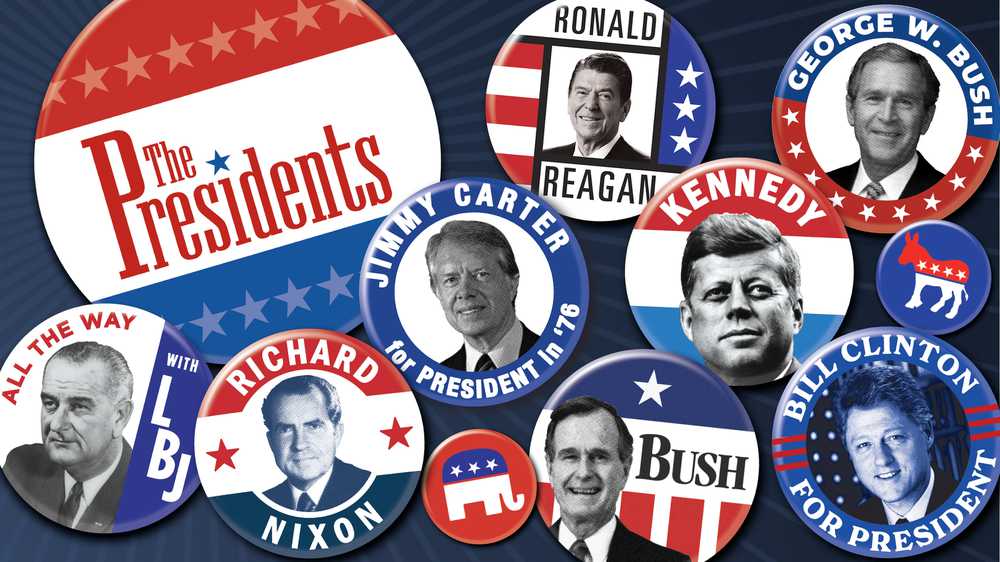
The Presidents Connect today's election issues with the past


Chapter:

The Juggler (15:25)
Roosevelt and Winston Churchill create Lend-Lease, a plan to help Great Britain fight the Germans, despite Congressional isolationism.

Now
Playing

FDR
Truman
LBJ
Nixon
Carter
Reagan
G H W Bush

Related Clips


TRUMAN, Chapter 26

Fighting Communism (10:10)
Facing the Communist threat, Truman shows U.S. strength with an airlift to blockaded Berlin and air strikes and infantry in Korea.
Watch Now

LBJ, Chapter 18

Voting Rights for African Americans (10:41)
Civil rights protesters force Johnson's hand on voting rights for African Americans. Their cause is helped by national media coverage of brutal police attacks.
Watch Now

NIXON, Chapter 12

Mr. Nixon's War (8:56)
The country remains bitterly divided over the Vietnam War as Nixon escalates attacks into Cambodia, trying to reach "an honorable end."
Watch Now

Chapter 1

CreditsHead credits for part one of the television program.
Watch Now

Chapter 2

Introduction (5:06)
Part one of a biography of Franklin D. Roosevelt, the 32nd president.
Watch Now

Chapter 3

The Center of the World (11:41)
Born to wealth and privilege, Roosevelt is sent to boarding school, then attends Harvard University.
Watch Now

Chapter 4

Eleanor is an Angel (13:17)
Roosevelt marries his distant cousin Eleanor, the niece of his hero Theodore Roosevelt. They move next door to his mother in New York.
Watch Now

Chapter 5

A Secret Ambition (12:32)
Roosevelt enters New York politics and finds an advisor in reporter Louis Howe.
Watch Now

Chapter 6

Rebellion (12:32)
Roosevelt becomes assistant secretary of the Navy. In Washington, he jeopardizes his job and his marriage. Eleanor develops her own political interests.
Watch Now

Chapter 7

Polio Strikes (11:37)
Roosevelt contracts polio and loses the use of his legs.
Watch Now

Chapter 8

Denial (10:52)
Roosevelt escapes to a Florida houseboat, the Larocco. Eleanor tends to his political interests but also develops independence.
Watch Now

Chapter 9

Recovery (10:49)
Roosevelt finds purpose in Warm Springs, Georgia, where he creates an innovative polio treatment center.
Watch Now

Chapter 10

The Return (7:25)
After learning to appear to be walking, Roosevelt returns to politics and is elected governor of New York.
Watch Now

Chapter 11

Government's Duty (6:28)
Governor Roosevelt's bold Depression relief programs position him to challenge President Herbert Hoover.
Watch Now

Chapter 12

A Better Day (5:31)
As the Depression worsens, Roosevelt is elected president and promises "a new deal for the forgotten man."
Watch Now

Chapter 13

CreditsProduction credits for part one of the television program.
Watch Now

Chapter 14

CreditsPart two of a biography of Franklin D. Roosevelt, the 32nd president.
Watch Now

Chapter 15

An Electrifying Leader (9:10)
Roosevelt inspires the Depression-ravaged nation at his inauguration, saying, "...the only thing we have to fear is fear itself."
Watch Now

Chapter 16

Above All, Try Something (13:43)
Roosevelt uses experimental Federal policies to try to end the Depression. Eleanor advocates for the needy, redefining the role of First Lady.
Watch Now

Chapter 17

Hard Times (8:05)
With no economic recovery in sight, Roosevelt's relief programs meet opposition.
Watch Now

Chapter 18

Loving and Hating FDR (10:35)
Roosevelt's New Deal draws the ire of the rich, but devotion from ordinary citizens.
Watch Now

Chapter 19

Reelection and Controversy (11:13)
Roosevelt wins the 1936 election. Overconfident, he makes the mistake of trying to reshape the Supreme Court.
Watch Now

Chapter 20

The Fascist Threat (13:54)
The U.S. maintains its isolationism as German, Italian, and Japanese armies seize territory on three continents.
Watch Now

Chapter 21

The Juggler (15:25)
Roosevelt and Winston Churchill create Lend-Lease, a plan to help Great Britain fight the Germans, despite Congressional isolationism.
Watch Now

Chapter 22

America Goes to War (13:12)
Provoking an incident with a German U-boat, FDR leads the U.S. into World War II. The Japanese attack the U.S. fleet at Pearl Harbor.
Watch Now

Chapter 23

The Allies Wage War (13:36)
With Americans fighting the Germans in North Africa, Roosevelt and Churchill plan an invasion of continental Europe.
Watch Now

Chapter 24

D-Day (6:05)
The Allies cross the English Channel to attack the Germans in northern France. Roosevelt's health falters.
Watch Now

Chapter 25

Coming to an End (10:48)
Lonely and unwell, Roosevelt seeks out an old flame. After his reelection, he meets Stalin and Churchill at Yalta to discuss the postwar world.
Watch Now

Chapter 26

Laid to Rest (9:14)
After Roosevelt dies, mourners line the tracks to see his funeral train. The man who inspired them with his optimism is buried at his childhood home.
Watch Now

Chapter 27

CreditsProduction credits for part two of the television program.
Watch Now

  • FDR: Chapter 1
  • FDR: Chapter 2
  • FDR: Chapter 3
  • FDR: Chapter 4
  • FDR: Chapter 5
  • FDR: Chapter 6
  • FDR: Chapter 7
  • FDR: Chapter 8
  • FDR: Chapter 9
  • FDR: Chapter 10
  • FDR: Chapter 11
  • FDR: Chapter 12
  • FDR: Chapter 13
  • FDR: Chapter 14
  • FDR: Chapter 15
  • FDR: Chapter 16
  • FDR: Chapter 17
  • FDR: Chapter 18
  • FDR: Chapter 19
  • FDR: Chapter 20
  • FDR: Chapter 21
  • FDR: Chapter 22
  • FDR: Chapter 23
  • FDR: Chapter 24
  • FDR: Chapter 25
  • FDR: Chapter 26
  • FDR: Chapter 27
Choose a format

Choose a Video Format

Quicktime | Windows Media

Download a free player
QuickTime | Windows Media

Related Links


FDR
Learn more about Franklin D. Roosevelt.

Fallen Hero
Learn about Charles Lindbergh in the 1940s.

What Does America Really Want?
Nazi propagandist Joseph Goebbels attacks the U.S.

Purchase Videos & DVDs

• See Comments

Loading comments...

You must log in to submit a comment. If you don't have an account at American Experience, you will need to register to comment. It's fast and easy to do!

Post a Comment (Limit 5000 Characters)

• View Transcripts •


Transcript: Chapter 21

Narrator: Poland, Denmark, Norway, Holland, Luxembourg, Belgium, France had fallen. September 1940, German bombs were destroying London. England stood alone.

WINSTON CHURCHILL, British Prime Minister: Hitler knows that he will have to break us in this island or lose the war. If we can stand up to him, all Europe may be freed and the life of the world may move forward. But if we fail, then the whole world, including the United States, including all that we have known and cared for, will sink into the abyss of a new dark age.

Narrator: Prime Minister Winston Churchill inspired the British people, but he also beamed his message at a target in America. He desperately needed help from Franklin Roosevelt. The war would be Roosevelt's final test.

Title card: Part Four: The Juggler

Narrator: On November 5, 1940, with Nazi armies in control of Europe, Franklin Roosevelt won an unprecedented third term as president of the United States. The next day, he received a telegram from Winston Churchill. "I did not think it right for me, as a foreigner, to express any opinion upon American policies while the election was on, but I prayed for your success and I am truly thankful for it."

Month after month for over a year, Churchill had been sending secret messages to Roosevelt. "We must ask, as a matter of life or death, to be reinforced." "It has now become most urgent for you to let us have the destroyers for which we have asked." "Mr. President, with great respect, I must tell you that in the long history of the world, this is a thing to do now."

Roosevelt wanted to help, but most Americans were against involvement in any war. It would take all of FDR's political genius to get Churchill what England needed to survive.

President Franklin Roosevelt: We cannot and we will not tell them that they must surrender merely because of present inability to pay for the weapons which we know they must have.

Narrator: Congress had prohibited Roosevelt from sending weapons unless England paid in cash and England was bankrupt. The president would have to outmaneuver the lawmakers.

President Franklin Roosevelt: I do not recommend that we make them a loan of dollars with which to pay for these weapons.

Narrator: Roosevelt proposed a daring plan with an innocuous name, lend-lease.

Robert Dallek: Lend-lease was a way to give the British planes, tanks, guns, artillery, ammunition without them really paying for it. And reporters at a press conference asked him, "What does this mean? What does lend-lease mean?"

Narrator: Roosevelt explained that we would "lend" England the weapons and when the war was over, England would return them. It was like lending a neighbor a garden hose to put out a fire, he said. After the fire was out, the neighbor would simply return the hose.

Robert Dallek: Well, of course, it was patent nonsense. What were the British going to do, give us the tanks back that were blown up, the planes that were shot down? But Roosevelt's invocation of this homily about the neighbor and garden hose is a wonderful way for him to sell it to the public, and that was his political genius. That was something that he had a kind of sixth sense for. You can't understand it, you can't define it, you can't put it under any scientific rubric. It simply was something that the man had.

Narrator: On March 11, 1941, Congress passed and Roosevelt signed into law lend-lease.

Alistair Cooke: There was an emergency press conference called. This morning he'd signed the lend-lease bill. A reporter said, "Mr. President, have you got ships and material and tanks and things? Are they already-- you know, left the ports and crossing the Atlantic?" Well, my British supply man had told me that there were cargoes just about to arrive in Liverpool and Southampton. And Roosevelt looked up like an innocent child and he said, "Oh," he said, "we work fast but not that fast." And of course, it was-- I mean, if they'd known the truth, you know, the whole Atlantic was thick with all the things already on their way.

Narrator: The lend-lease lifeline stretched across the Atlantic. Roosevelt had bent the law, outflanked Congress and provided England with billions of dollars' worth of weapons and supplies, but as the great armada reached Britain's shores, opposition remained strong back in America.

CHARLES LINDBERGH: They dare not tell us that these steps mean war. They dare not tell us what war means.

Narrator: Democrats and Republicans, conservatives and leftists alike campaigned to keep America out of another European war. Charles Lindbergh expressed the concerns of many Americans across the country.

CHARLES LINDBERGH: I say it is they who are undermining the principles of democracy when they demand that we take a course to which more than 80 percent of our citizens are opposed.

Narrator: In fact, Lindbergh exaggerated, yet the American people were deeply divided, and Roosevelt, sending their indecision, was stymied. "It's a terrible thing," he later told an aide, "to look over your shoulder when you're trying to lead and to find no one there."

Doris Kearns Goodwin: The spring of '41 seems like one of the lowest points for Roosevelt. Public opinion itself is so incredibly confused and when public opinion was confused, Roosevelt himself lost his moorings. His genius was that he somehow could divine where the country was and help push it along, maybe a little ahead of itself, but he saw where the country was heading. In this period of time, the country seemed to be in such a maze of contradictions that he looked out almost as if he were staring into a fog himself.

Narrator: Eleanor Roosevelt was also at a crossroads. No one had fought harder for her husband's New Deal, but now his priorities had changed.

Doris Kearns Goodwin: She had had this wonderful decade of a partnership with her husband where they were both moving toward social reform, and the New Deal was the center of their hearts. Now, suddenly, she sees him totally preoccupied by war. When she comes back from her travels around the country, he doesn't really have time to talk to her anymore.

Curtis Roosevelt: My grandmother felt herself a little bit off to the side, less useful, with less reason to go and be with him as she always was early in the morning or at the end of the day. So this relationship from which she drew strength and a position no longer existed.

Narrator: All through 1941, the pressures on Roosevelt mounted. On one side of the globe, Japan threatened to spread its empire throughout the Pacific. "They hate us," Roosevelt said, "Sooner or later, they'll come after us." And across the Atlantic, Roosevelt increasingly feared for Great Britain's survival.

Curtis Roosevelt: Some people think that this great master politician was always on top of things, but he had to move in relation to public opinion and it was a major thing. It really got to him. He went to bed for 10 days out of exasperation from the pressures on both sides to intervene or not to intervene, and Britain was going down the tube.

Narrator: "If Great Britain goes down," Roosevelt said, "all of us in all the Americas would be living at the point of a gun."

Then, in early August, determined to do more for the British, Roosevelt headed out to sea for a secret rendezvous in U-boat-infested waters. Under cover of darkness, he slipped away from reporters, boarded an American warship and headed north to meet the British battleship, the Prince of Wales. On board was Winston Churchill. The course of the war would be determined by the convergence of these two extraordinary personalities.

Lady Mary Soames, Winston Churchill's Daughter: I was told, as a deathly secret, that this meeting was going to happen. It was perfectly clear to my father, perhaps also to the president, that of course it did matter very much whether they would see eye to eye.

Narrator: Churchill, his bodyguard later reported, "was as excited as a schoolboy." At stake, the prime minister believed, was the fate of western civilization.

The president was also on edge. He was not used to sharing the stage with any man, and Churchill was already a legend. A Roosevelt aide who knew both men worried about a clash of prima donnas.

With the Navy band playing The Stars and Stripes Forever," Churchill came aboard the American ship. "At last," Roosevelt said, "we've gotten together."

They talked for four days, two titanic egos, each taking the other's measure. Churchill was determined to bind the Americans ever more firmly to the British cause. Roosevelt was wary. He was unwilling to ask Congress for a declaration of war without the rock-solid support of the American people, but he was searching for some way to help Great Britain before it was too late.

Robert Dallek: What Churchill needed to do was to convince Roosevelt that Britain was not going to give up, and what Roosevelt was saying to Churchill was, "I understand what your needs are, I understand the importance of the danger to us, both of us, from Adolf Hitler, and we're going to stand together against this monster."

Narrator: On Sunday, Roosevelt was carried onboard the British battleship for a morning service. "If nothing else had happened while we were here," Roosevelt told an aide, "that joint service would have cemented us."

Lady Mary Soames: All the ships' companies all mixed up and sharing the hymn sheets and everything, and it really did seem rather wonderful and very moving. My father sat with the president. I mean, normally he would have stood during such a service, but he and the president sat and everybody else stood on the quarterdeck. My father chose the hymns very carefully -- his favorites.

Narrator: "The same language, the same hymns," Churchill said later, "It was a great hour to live."

Lady Mary Soames: It was sort of like a beam of brilliant sunshine, like a genuine ray of hope. And of course, now it's, I find, anguishing looking at those photographs because three months later, the Prince of Wales was under the waves with its entire ship's company.

Narrator: As the two men parted, a message flashed from the British battleship to the American cruiser: "God bless the president and the people of the United States."

When Churchill returned to England, he told his Cabinet that Roosevelt had made a secret promise that he would wage war against Nazi Germany but not declare it. Everything was to be done to force an incident.

back to top


Major funding provided by the National
Endowment for the Humanities and the Corporation for Public Broadcasting

NEH Corporation for Public Broadcasting


Any views, findings, conclusions, or recommendations expressed in this Web site do not necessarily represent those of the National Endowment for the Humanities.