Visit Your Local PBS Station PBS Home PBS Home Programs A-Z TV Schedules Watch Video Support PBS Shop PBS Search PBS
 
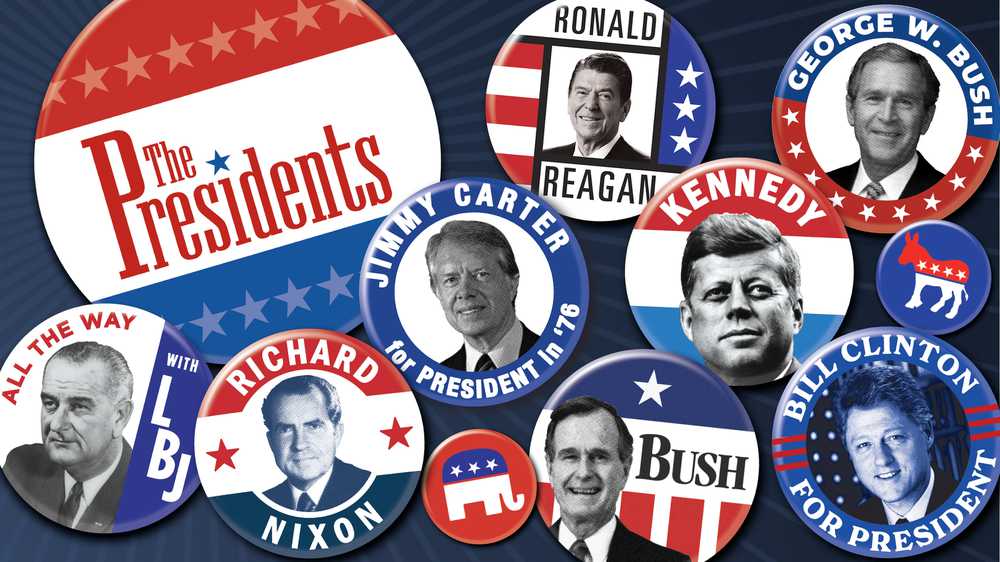
The Presidents Connect today's election issues with the past


Chapter:

West Texas (6:44)
Bush attends Yale, starts a family, and rejects a Wall Street career to become an oil wildcatter. The Bushes lose a young daughter to leukemia.
FDR
Truman
LBJ
Nixon
Carter
Reagan

Now
Playing

G H W Bush

Related Clips


FDR, Chapter 4

Eleanor is an Angel (13:17)
Roosevelt marries his distant cousin Eleanor, the niece of his hero Theodore Roosevelt. They move next door to his mother in New York.
Watch Now

TRUMAN, Chapter 6

Marriage and Politics (13:12)
After the war, Truman marries Bess Wallace and runs for public office.
Watch Now

TRUMAN, Chapter 19

The Post War Economy (10:59)
Truman faces domestic challenges. He takes a tough stance against striking railroad workers.
Watch Now

CARTER, Chapter 3

Naval Career (4:36)
Carter marries Rosalynn Smith and they have three sons. He rises quickly in the Navy, becoming senior officer of a nuclear submarine.
Watch Now

REAGAN, Chapter 3

Actor (8:39)
Starting out in radio and sportscasting, Reagan moves to California to pursue an acting career.
Watch Now

LBJ, Chapter 4

The Senate Campaign of 1948 (12:30)
Johnson runs a flamboyant campaign in a tough race. He wins the seat, dogged by rumors of fraud.
Watch Now

Chapter 1

Introduction (4:03)
Part one of a biography of George H.W. Bush, the 41st president.
Watch Now

Chapter 2

Combat Pilot (9:26)
Born into wealth, Bush volunteers as a combat pilot in World War II. He marries Barbara Pierce in 1945.
Watch Now

Chapter 3

West Texas (6:44)
Bush attends Yale, starts a family, and rejects a Wall Street career to become an oil wildcatter. The Bushes lose a young daughter to leukemia.
Watch Now

Chapter 4

A New Republican Party (9:25)
Financially secure, Bush enters Texas politics. To build the Republican Party, he welcomes ideological radicals and segregationists.
Watch Now

Chapter 5

Goldwater Republican (11:29)
Bush positions himself to the right and wins election to Congress in 1966. He votes for fair housing, outraging his most conservative constituents.
Watch Now

Chapter 6

The Personal Touch (9:25)
After a failed Senate bid, Bush is appointed Ambassador to the United Nations. He cultivates friendships with U.S. allies and opponents alike.
Watch Now

Chapter 7

Keeping the Republican Faith (6:29)
President Richard Nixon recruits Bush to lead the Republican National Committee, just as the Watergate scandal is about to break.
Watch Now

Chapter 8

A Race Horse Under Wraps (11:18)
Bush serves as ambassador to China, then CIA director. In the 1980 election, he becomes Ronald Reagan's running mate.
Watch Now

Chapter 9

Vice President (9:17)
Loyal to Reagan, Bush weathers the Iran-Contra affair and launches a second bid for president in 1988, trying to emerge from Reagan's shadow.
Watch Now

Chapter 10

The 1988 CampaignBush runs a vigorous -- some say negative -- race against Michael Dukakis and wins. He pledges to continue Reagan's conservative policies.
Watch Now

Chapter 11

A Kindler, Gentler Leader (8:15)
Bush distances himself from Reagan's legacy. He tackles a savings and loan bailout and the end of Communism in Eastern Europe.
Watch Now

Chapter 12

A New World Order (13:30)
Bush convinces Soviet leader Mikhail Gorbachev to allow reunified Germany to join the NATO alliance. Iraqi dictator Saddam Hussein invades Kuwait, provoking a crisis.
Watch Now

Chapter 13

CreditsProduction credits for part one of the television program.
Watch Now

Chapter 14

Introduction (2:47)
Part two of a biography of George H.W. Bush, the 41st president.
Watch Now

Chapter 15

Aggression Will Not Stand (7:28)
After Iraq invades oil-rich Kuwait, Bush launches Operation Desert Shield to protect Saudi Arabia, and reaches out to foreign leaders for their support.
Watch Now

Chapter 16

Challenging Totalitarianism (8:17)
During the Iraq crisis, Bush vacations at his family's home in Maine. He leads the U.S. toward a war that some fear could become World War III.
Watch Now

Chapter 17

The Tax Increase (9:23)
Bush supports two major domestic initiatives. Faced with budget troubles, he abandons Reagan's economic legacy and proposes raising taxes.
Watch Now

Chapter 18

Desert Storm (9:08)
The U.S. and coalition forces go to war in the Persian Gulf, expelling Iraq from Kuwait in just three days. They stop short of invading Iraq.
Watch Now

Chapter 19

The Perfect Storm (13:01)
Beset by critics, questions about Iraq, and a sluggish economy, Bush loses his high approval rating.
Watch Now

Chapter 20

Not Conservative Enough (9:27)
Bush runs for a second term. Challengers Pat Buchanan and Texas billionaire Ross Perot, running as an independent, reveal a split among Republicans.
Watch Now

Chapter 21

It's the Economy (10:54)
Bush, perceived as out of touch, loses the election to Democrat Bill Clinton. Conservative third party candidate Ross Perot takes 19 percent of the vote.
Watch Now

Chapter 22

Ceiling and Visibility Unlimited (7:00)
In his post-presidency, Bush sees two sons elected as governors, then one, George W. Bush, elected president. As history considers his legacy, he finds peace.
Watch Now

Chapter 23

CreditsProduction credits for part two of the television program.
Watch Now

  • GHW_BUSH: Chapter 1
  • GHW_BUSH: Chapter 2
  • GHW_BUSH: Chapter 3
  • GHW_BUSH: Chapter 4
  • GHW_BUSH: Chapter 5
  • GHW_BUSH: Chapter 6
  • GHW_BUSH: Chapter 7
  • GHW_BUSH: Chapter 8
  • GHW_BUSH: Chapter 9
  • GHW_BUSH: Chapter 10
  • GHW_BUSH: Chapter 11
  • GHW_BUSH: Chapter 12
  • GHW_BUSH: Chapter 13
  • GHW_BUSH: Chapter 14
  • GHW_BUSH: Chapter 15
  • GHW_BUSH: Chapter 16
  • GHW_BUSH: Chapter 17
  • GHW_BUSH: Chapter 18
  • GHW_BUSH: Chapter 19
  • GHW_BUSH: Chapter 20
  • GHW_BUSH: Chapter 21
  • GHW_BUSH: Chapter 22
  • GHW_BUSH: Chapter 23
Choose a format

Choose a Video Format

Quicktime | Windows Media

Download a free player
QuickTime | Windows Media

Related Links


GHW_BUSH
Learn more about George H. W. Bush.

Civil Defense in the Postwar Years
Historian Elaine Tyler May on life in the U.S. during the Cold War.

Generation T
Meet people in pursuit of the 1950s American Dream.

Purchase Videos & DVDs

• See Comments

Loading comments...

You must log in to submit a comment. If you don't have an account at American Experience, you will need to register to comment. It's fast and easy to do!

Post a Comment (Limit 5000 Characters)

• View Transcripts •


Transcript: Chapter 03

Narrator: After the war, Bush followed his father and his brother Prescott and entered Yale. Two and one-half years later, he had a degree in economics, Phi Beta Kappa -- and a son. George W. was born in New Haven in 1946. Like his father, Bush was tapped for Skull and Bones, Yale's most elite secret society. Henry Stimson, now retired as Secretary of War, presided over his initiation. Despite his admiration for his father and for Stimson, Bush did not follow them into the world of finance. All three of his brothers did.

Barbara Bush: He told me, "I want to work with something I can touch. I don't want to work on Wall Street with money, and I don't want to go into a sort of family business. I really want to work with something I can touch."

Ajax commercial (archival): Use Ajax, boom boom, the foaming cleanser.

Peter Roussel, press aide, 1970-74: One of his very first job interviews, maybe his first, was at Procter & Gamble. He had an interview. And he got rejected, got turned down for the job. And I asked him one day, I said, "Have you ever thought about that much, how your life might have been totally different? And he said, "I'd probably been a lousy soap salesman." Actually he said, "It helped me, because I thought: You know, I'm going to show these people that I do have the right stuff. I'm going to go out and make it somewhere else."

Narrator: Lured by the romance of a post-war oil boom, the Bushes headed to West Texas.

John Robert Greene: He wants an adventure. He wants a challenge. And there was nothing more challenging than Wildcatting oil. This is the greatest adventure you can have on the continent -- on the United States continent after World War II. It's the closest thing to uncharted territory that you can have.

Narrator: George Bush started in the oil business in Odessa in 1948 painting spare pumps for $375 a month. He was on a management track, but within two years, with two children to support, he struck out on his own as a wildcatter.

Herbert Parmet, biographer: George got investments from his uncle Herbie, his father, and people like Eugene Meyer of the Washington Post. It was not only a way to make a fortune. It was a way for him to stake out on his own.

Narrator: Bush's company Zapata Petroleum hit it big in 1954. Five years later George and Barbara moved to Houston, the headquarters of Zapata Offshore. George was prospering as its president, but there was a void in their lives. They hoped that Barbara, who was pregnant, could fill it. Their second child, Robin, had been born in 1949. She was diagnosed with leukemia when she was three. Their doctor advised them to let her die at home. Instead, they took her to New York's Sloan Kettering Hospital. Yale classmate Lud Ashley visited daily.

Lud Ashley, classmate: George was running the household back in Texas, flying up weekends -- flying from Texas when it used to take eight or nine hours to fly to New York. Barb was there all the time. Almost 24 hours a day. In all my years I've seen such a strength of character as she showed during that desperately difficult time.

Doro Bush Koch: My Dad told me that he had trouble looking into her eyes and comforting her and doing the things he wanted to do. My mom was the one who was able to hold her hand and love her and comfort her. But then later on, when my mom fell apart after Robin died, it was my dad who looked in her eyes and held her hand, and gave her the strength to go on.

Narrator: Robin died on October 12, 1953, two months before her fourth birthday.

John Robert Greene: I believe that the death of Robin sobered George Bush and turned him into an adult that could be an empathetic politician, that could be an individual who could strike on civil rights and disabilities for Americans. I really think that it was that important.

Narrator: In the late 1950s, after the birth of Jeb in 1953, Neil in 1955 and Marvin in 1956, Bush wrote a letter to his mother: "There is about our house a need. We need some starched crisp frocks to go with all our torn-kneed blue jeans and helmets. We need some soft blond hair to offset those crew cuts. We need a dollhouse to stand firm against our forts and rackets and thousand baseball cards. We need someone to cry when I get mad -- not argue. We need a little one who can kiss without leaving egg or jam or gum. We need a girl."

Jeb Bush, son: I read that letter in my mom's book, and actually listened to it on tape. I was driving home on I-95, the traffic was going crazy, and I started crying uncontrollably. I had to stop in the middle of this interstate. I called my mother up to tell her how much I loved her and how much I loved my dad, and she of course -- her immediate response was, "You didn't read the book. You had to wait for the tape to come out." She gave me grief for that. But it was pretty typical of my dad to write those kinds of letters.

Doro Bush Koch: I just learned this story a few years ago, on my birthday, when my mom wished me a happy birthday and she told me that she remembered the day I was born, that Dad came to the nursery and pressed his face against the glass and sobbed.


Major funding provided by the National
Endowment for the Humanities and the Corporation for Public Broadcasting

NEH Corporation for Public Broadcasting


Any views, findings, conclusions, or recommendations expressed in this Web site do not necessarily represent those of the National Endowment for the Humanities.