Visit Your Local PBS Station PBS Home PBS Home Programs A-Z TV Schedules Watch Video Support PBS Shop PBS Search PBS
 
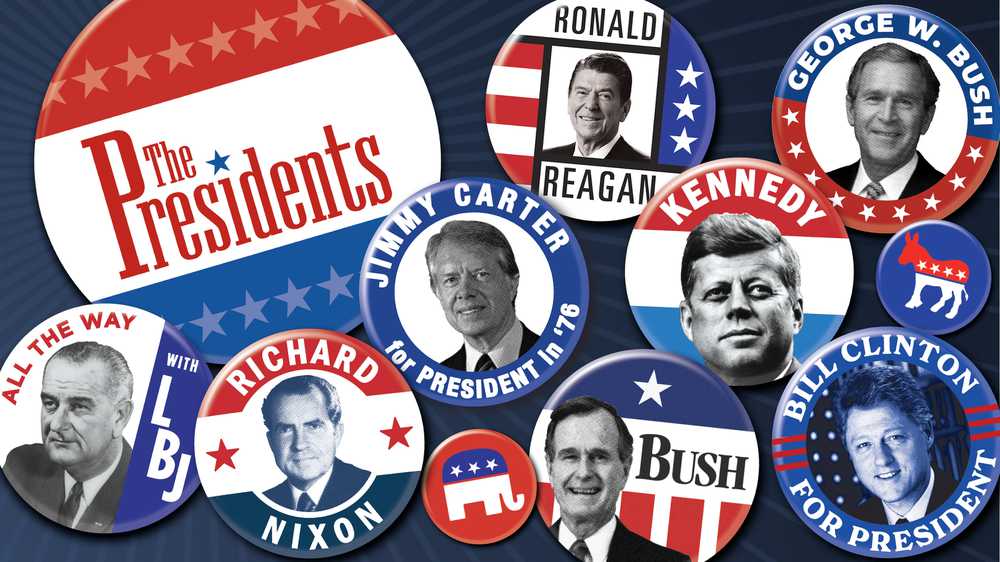
The Presidents Connect today's election issues with the past


Chapter:

A New Republican Party (9:25)
Financially secure, Bush enters Texas politics. To build the Republican Party, he welcomes ideological radicals and segregationists.
FDR
Truman
LBJ
Nixon
Carter
Reagan

Now
Playing

G H W Bush

Related Clips


FDR, Chapter 18

Loving and Hating FDR (10:35)
Roosevelt's New Deal draws the ire of the rich, but devotion from ordinary citizens.
Watch Now

LBJ, Chapter 6

The Civil Rights Act of 1957 (6:47)
Setting the stage for a presidential run, Johnson builds consensus to protect African Americans' voting rights.
Watch Now

FDR, Chapter 10

The Return (7:25)
After learning to appear to be walking, Roosevelt returns to politics and is elected governor of New York.
Watch Now

CARTER, Chapter 5

Politics and Integrity (8:19)
Carter challenges election fraud and wins a seat in the state senate. He becomes known for his integrity. In 1966 he narrowly loses the governor's race to a segregationist.
Watch Now

LBJ, Chapter 7

Johnson Becomes Vice President (9:09)
Johnson loses the 1960 Democratic nomination but is named Senator John Kennedy's running mate. He becomes president in 1963 after Kennedy is shot.
Watch Now

TRUMAN, Chapter 8

Truman Proves Himself (9:07)
Truman works hard to understand the workings of the Senate and finds sucess.
Watch Now

Chapter 1

Introduction (4:03)
Part one of a biography of George H.W. Bush, the 41st president.
Watch Now

Chapter 2

Combat Pilot (9:26)
Born into wealth, Bush volunteers as a combat pilot in World War II. He marries Barbara Pierce in 1945.
Watch Now

Chapter 3

West Texas (6:44)
Bush attends Yale, starts a family, and rejects a Wall Street career to become an oil wildcatter. The Bushes lose a young daughter to leukemia.
Watch Now

Chapter 4

A New Republican Party (9:25)
Financially secure, Bush enters Texas politics. To build the Republican Party, he welcomes ideological radicals and segregationists.
Watch Now

Chapter 5

Goldwater Republican (11:29)
Bush positions himself to the right and wins election to Congress in 1966. He votes for fair housing, outraging his most conservative constituents.
Watch Now

Chapter 6

The Personal Touch (9:25)
After a failed Senate bid, Bush is appointed Ambassador to the United Nations. He cultivates friendships with U.S. allies and opponents alike.
Watch Now

Chapter 7

Keeping the Republican Faith (6:29)
President Richard Nixon recruits Bush to lead the Republican National Committee, just as the Watergate scandal is about to break.
Watch Now

Chapter 8

A Race Horse Under Wraps (11:18)
Bush serves as ambassador to China, then CIA director. In the 1980 election, he becomes Ronald Reagan's running mate.
Watch Now

Chapter 9

Vice President (9:17)
Loyal to Reagan, Bush weathers the Iran-Contra affair and launches a second bid for president in 1988, trying to emerge from Reagan's shadow.
Watch Now

Chapter 10

The 1988 CampaignBush runs a vigorous -- some say negative -- race against Michael Dukakis and wins. He pledges to continue Reagan's conservative policies.
Watch Now

Chapter 11

A Kindler, Gentler Leader (8:15)
Bush distances himself from Reagan's legacy. He tackles a savings and loan bailout and the end of Communism in Eastern Europe.
Watch Now

Chapter 12

A New World Order (13:30)
Bush convinces Soviet leader Mikhail Gorbachev to allow reunified Germany to join the NATO alliance. Iraqi dictator Saddam Hussein invades Kuwait, provoking a crisis.
Watch Now

Chapter 13

CreditsProduction credits for part one of the television program.
Watch Now

Chapter 14

Introduction (2:47)
Part two of a biography of George H.W. Bush, the 41st president.
Watch Now

Chapter 15

Aggression Will Not Stand (7:28)
After Iraq invades oil-rich Kuwait, Bush launches Operation Desert Shield to protect Saudi Arabia, and reaches out to foreign leaders for their support.
Watch Now

Chapter 16

Challenging Totalitarianism (8:17)
During the Iraq crisis, Bush vacations at his family's home in Maine. He leads the U.S. toward a war that some fear could become World War III.
Watch Now

Chapter 17

The Tax Increase (9:23)
Bush supports two major domestic initiatives. Faced with budget troubles, he abandons Reagan's economic legacy and proposes raising taxes.
Watch Now

Chapter 18

Desert Storm (9:08)
The U.S. and coalition forces go to war in the Persian Gulf, expelling Iraq from Kuwait in just three days. They stop short of invading Iraq.
Watch Now

Chapter 19

The Perfect Storm (13:01)
Beset by critics, questions about Iraq, and a sluggish economy, Bush loses his high approval rating.
Watch Now

Chapter 20

Not Conservative Enough (9:27)
Bush runs for a second term. Challengers Pat Buchanan and Texas billionaire Ross Perot, running as an independent, reveal a split among Republicans.
Watch Now

Chapter 21

It's the Economy (10:54)
Bush, perceived as out of touch, loses the election to Democrat Bill Clinton. Conservative third party candidate Ross Perot takes 19 percent of the vote.
Watch Now

Chapter 22

Ceiling and Visibility Unlimited (7:00)
In his post-presidency, Bush sees two sons elected as governors, then one, George W. Bush, elected president. As history considers his legacy, he finds peace.
Watch Now

Chapter 23

CreditsProduction credits for part two of the television program.
Watch Now

  • GHW_BUSH: Chapter 1
  • GHW_BUSH: Chapter 2
  • GHW_BUSH: Chapter 3
  • GHW_BUSH: Chapter 4
  • GHW_BUSH: Chapter 5
  • GHW_BUSH: Chapter 6
  • GHW_BUSH: Chapter 7
  • GHW_BUSH: Chapter 8
  • GHW_BUSH: Chapter 9
  • GHW_BUSH: Chapter 10
  • GHW_BUSH: Chapter 11
  • GHW_BUSH: Chapter 12
  • GHW_BUSH: Chapter 13
  • GHW_BUSH: Chapter 14
  • GHW_BUSH: Chapter 15
  • GHW_BUSH: Chapter 16
  • GHW_BUSH: Chapter 17
  • GHW_BUSH: Chapter 18
  • GHW_BUSH: Chapter 19
  • GHW_BUSH: Chapter 20
  • GHW_BUSH: Chapter 21
  • GHW_BUSH: Chapter 22
  • GHW_BUSH: Chapter 23
Choose a format

Choose a Video Format

Quicktime | Windows Media

Download a free player
QuickTime | Windows Media

Related Links


GHW_BUSH
Learn more about George H. W. Bush.

Nelson Rockefeller
Meet a Republican who personified the East Coast establishment.

Defending States' Rights
Read about Southern political opposition to integration.

Purchase Videos & DVDs

• See Comments

Loading comments...

You must log in to submit a comment. If you don't have an account at American Experience, you will need to register to comment. It's fast and easy to do!

Post a Comment (Limit 5000 Characters)

• View Transcripts •


Transcript: Chapter 04

Narrator: The success of Zapata Petroleum, Bush recalled, "gave me the financial base to risk going into public life." George's father, Prescott Bush, was a Republican senator from Connecticut. "I knew what motivated him, "George would write, "He'd made his mark in the business world. Now he felt he had a debt to pay."

Richard Norton Smith: Noblesse oblige has become a pejorative, but it wasn't always a pejorative. The notion of an American meritocracy, which is what the wise men represent, that's the old Eastern establishment. It isn't simply the nexus of power. It's the obligation to use that power in a responsible way, not for one's own benefit, but for what you sincerely believe to be the benefit of your fellow countrymen. Prescott Bush represented that establishment. His son had one foot in that establishment.

Narrator: During his ten years in the Senate, Prescott Bush was a moderate, or Eisenhower Republican. He was pragmatic and non-ideological, believed in balanced budgets and was pro-business. He was also pro-civil rights and a social liberal. Prescott had joined the Senate when he was 57. His wife said if he had run earlier, he would have been President. His son would not make that mistake. George decided to enter politics when he was 38. He faced an obstacle his father never had. The Republican Party in Texas hardly existed.

Peter Roussel: You could probably have held a precinct meeting in a phone booth then. That's how many Republicans were around.

James A. Baker, III, friend: My first wife was from Ohio. And that's a big Republican state. And when we moved back here from Austin after law school, she conducted the precinct convention in my living room, and one guy showed up. I served him drinks. I mean that's how limited the Republican participation was in Texas back in those days.

Narrator: Houston's few Republicans, Bush among them, were members of the establishment -- country club Republicans. Their party was about to change. The radical anti-communist John Birch Society tried to take it over. Birchers thought President Eisenhower was a communist -- he had appointed a Chief Justice who turned out to be a liberal.

Richard Viguerie, conservative activist: The country club Republicans, the establishment, what I call the big-government Republicans even in those days, they would be uncomfortable with true believers. People who really had deeply held philosophical, ideological beliefs makes establishment Republicans uncomfortable, quite frankly.

Narrator: In 1962 Bush was asked to run for chairman of the Harris County Republican Party to keep the Birchers out. It was his first political campaign. "I'm not voting for 'nother country club asshole," one of the right-wingers said. "Y'can jus' fergit it."

Marjorie Arsht, political supporter: George stepped right into the middle of it. And you know, I have loved George Bush for 40 years, but he does have one failing. He does not recognize an enemy.

Barbara Bush: My dad at that time was president of McCall Corporation, and they printed and published Red Book, Blue Book, and McCall's. And they sent out -- one meeting we went to, the lights went out, someone was speaking, and papers were all passed down. When the lights went on, it said, "Mrs. Bush's father is a Communist. He prints the Red Book. Crazy. They said things like, " George is a Rockefeller plant," or, you know, "He grew up in the east. He's not one of us." "He's liberal."

Narrator: After he won his race, Bush wanted to give some Birchers positions in the party. "George, you don't know these people," a colleague warned. "They mean to kill you."

Victor Gold, friend: George Bush's instinct politically is to bring people together, to be a uniter. And so he didn't come in in a confrontational style, slam the door and throw all the Birchers out. His idea was, "Let's get the Birchers and have some common meeting ground with them, because if we want to beat Democrats, if we want to we need those people.

Narrator: Bush saw another opportunity to expand the party after groundbreaking legislation on civil rights was introduced in June 1963 by President John Kennedy.

John F. Kennedy (archival): Next week I shall ask the Congress of the United States to act, to make a commitment it has not fully made in this century to the proposition that race has no place in American life or law.

Narrator: Civil rights was about to tear the country, and the Democratic Party, apart. Many Democrats in the South were committed to segregation. As they saw their party support integration, they began to seek refuge in the Republican Party.

Herbert Parmet: Poor white workers in Texas and elsewhere felt there was a threat, of all these hordes of blacks becoming unleashed and competing with them for status and jobs. And so you have the mass turnover to Republican Party in the South, state after state.

Narrator: Among the disgruntled Democrats in Houston were dockworkers who felt their jobs would be threatened by African American workers. They sought out the new Republican chairman, George Bush.

Herbert Parmet: They were segregationists. They were trying to maintain conservative control over Harris County.

Marjorie Arsht: And I didn't like them being Republicans, because I thought it gave our party a bad name. George didn't see a thing wrong with it. He was eager to expand the Republican Party, and he felt the only way to expand it was to attract Democrats.

Herbert Parmet: Bush thought they were crazy. But he thought that politically he had to accommodate himself to them.

Marjorie Arsht: I didn't think they were crazy. I thought they were very dangerous. They wanted to convince the world that the Republican Party was now going to be a segregationist extension of the old Democrats. The Democrats called me up and congratulated me on getting those bastards out of their party.

Timothy Naftali: Throughout his political career, George Bush often seemed to lack a sense of principle. As a candidate, he often sacrificed principle for political gain.

Narrator: If he did something unsavory to advance his career and his party, the result would be momentous. The people Bush accommodated in 1963 would support Senator Barry Goldwater for President in 1964 and thereafter Ronald Reagan.

Richard Viguerie: And they become the nucleus of the new Republican Party, not only in Texas but across the country. And this was the beginning of the conservative movement, and to this day it serves as the base of the Republican Party.

Herbert Parmet: You could say that George Herbert Walker Bush was in on the creation, with this organization of Harris County Republicans, because that's where it began. Think of what that started.

Narrator: The party that George Bush created in Houston in 1963 grew into the party which he would lead -- and struggle with -- as president.


Major funding provided by the National
Endowment for the Humanities and the Corporation for Public Broadcasting

NEH Corporation for Public Broadcasting


Any views, findings, conclusions, or recommendations expressed in this Web site do not necessarily represent those of the National Endowment for the Humanities.