Visit Your Local PBS Station PBS Home PBS Home Programs A-Z TV Schedules Watch Video Support PBS Shop PBS Search PBS
 
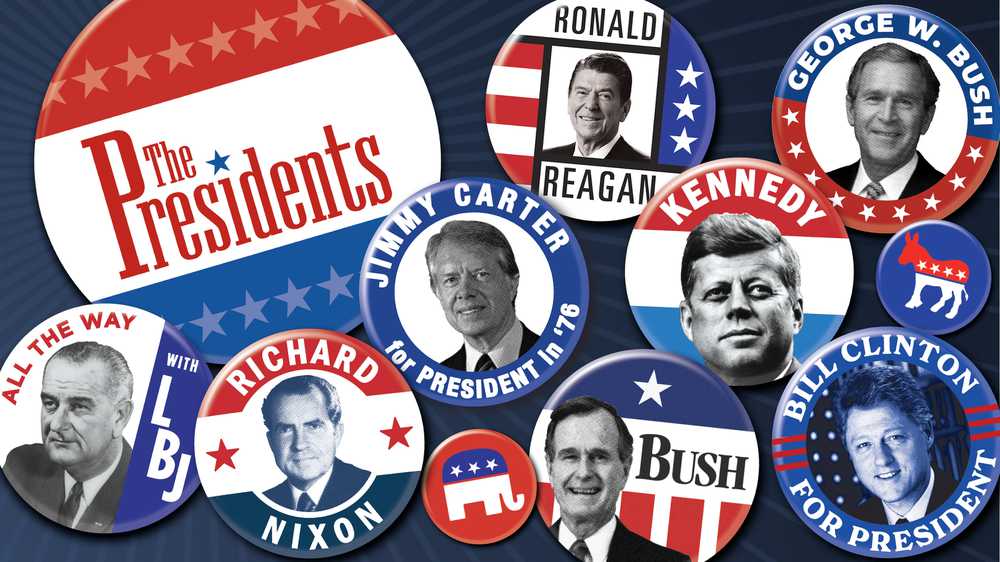
The Presidents Connect today's election issues with the past


Chapter:

A Politician from Birth (7:57)
Johnson grows up in poor, rural Texas hill country. Campaigning on a New Deal platform, he wins a seat in the U.S. House of Representatives.
FDR
Truman

Now
Playing

LBJ
Nixon
Carter
Reagan
G H W Bush

Related Clips


FDR, Chapter 3

The Center of the World (11:41)
Born to wealth and privilege, Roosevelt is sent to boarding school, then attends Harvard University.
Watch Now

TRUMAN, Chapter 2

Early Years (14:11)
Harry Truman grows up in Independence, Missouri. He gets his first taste of politics at the 1900 Democratic National Convention.
Watch Now

REAGAN, Chapter 2

The Lifeguard (11:21)
Ronald Reagan grows up in a small town and works as a lifeguard on the Rock River.
Watch Now

NIXON, Chapter 2

The Silent Majority (7:20)
Born to a Quaker family of modest means, Nixon grows up in a small California town. He shows an early ambition and interest in politics.
Watch Now

CARTER, Chapter 2

Georgia Childhood (7:31)
Carter learns to value hard work on his familiy's peanut farm. He attends the U.S. Naval Academy.
Watch Now

Chapter 1

Introduction (4:35)
Part one of a biography of Lyndon B. Johnson, the 36th president.
Watch Now

Chapter 2

A Politician from Birth (7:57)
Johnson grows up in poor, rural Texas hill country. Campaigning on a New Deal platform, he wins a seat in the U.S. House of Representatives.
Watch Now

Chapter 3

In Washington (11:11)
Johnson networks in Washington and Texas. He loses a Senate bid and learns hard lessons in the dark side of politics.
Watch Now

Chapter 4

The Senate Campaign of 1948 (12:30)
Johnson runs a flamboyant campaign in a tough race. He wins the seat, dogged by rumors of fraud.
Watch Now

Chapter 5

In the Senate (9:00)
Johnson becomes a power broker, developing a bargaining style known as "the Johnson treatment."
Watch Now

Chapter 6

The Civil Rights Act of 1957 (6:47)
Setting the stage for a presidential run, Johnson builds consensus to protect African Americans' voting rights.
Watch Now

Chapter 7

Johnson Becomes Vice President (9:09)
Johnson loses the 1960 Democratic nomination but is named Senator John Kennedy's running mate. He becomes president in 1963 after Kennedy is shot.
Watch Now

Chapter 8

Johnson and the Kennedy Administration (5:16)
President Johnson determines to fulfill Kennedy's programs.
Watch Now

Chapter 9

The Civil Rights Act of 1964 (10:49)
Johnson waits out the longest Senate filibuster in history to achieve the bill that makes racial segregation illegal.
Watch Now

Chapter 10

Prelude to War (6:48)
Following Robert McNamara's advice, Johnson okays covert commando attacks against North Vietnam to stop Communism.
Watch Now

Chapter 11

The Great Society (9:01)
Reaching back to his populist roots, Johnson declares war on poverty.
Watch Now

Chapter 12

Gulf of Tonkin (9:11)
Johnson claims that North Vietnam has attacked a U.S. destroyer. He uses the incident as the basis for expanding the war against North Vietnam.
Watch Now

Chapter 13

Landslide Victory (9:42)
Johnson defeats Barry Goldwater, winning the presidency by an unprecedented majority.
Watch Now

Chapter 14

Credits (3:00)
Production credits for part one of the television program.
Watch Now

Chapter 15

Introduction (3:40)
Part two of a biography of Lyndon B. Johnson, the 36th president.
Watch Now

Chapter 16

Johnson's "Real Presidency" (8:44)
Johnson pushes his Great Society agenda in a legislative avalanche. Advisors — the "best and the brightest" — counsel him to escalate the war in Vietnam.
Watch Now

Chapter 17

Negotiations (7:10)
The consummate political bargainer hopes to broker a deal with North Vietnamese leader Ho Chi Minh.
Watch Now

Chapter 18

Voting Rights for African Americans (10:41)
Civil rights protesters force Johnson's hand on voting rights for African Americans. Their cause is helped by national media coverage of brutal police attacks.
Watch Now

Chapter 19

The Decision to Expand the War (12:25)
Although defending South Vietnam now appears it will require many years and sacrificed American lives, Johnson decides to expand the war.
Watch Now

Chapter 20

Black Power (10:15)
Johnson's social aid programs bring about positive change, but some see his efforts as too little, too late. Urban riots erupt across the nation.
Watch Now

Chapter 21

Questioning the War (9:05)
As Americans watch the Vietnam War in their living rooms, support for it wavers.
Watch Now

Chapter 22

A Miasma of Trouble (15:14)
Johnson struggles to keep his dream of the Great Society alive while the country spins out of control.
Watch Now

Chapter 23

No Surrender (6:22)
The war in Vietnam looks unwinnable. Johnson's advisors counsel him to improve the public's view of the war. ,
Watch Now

Chapter 24

The Tet Offensive (10:11)
The North Vietnamese bombing of South Vietnam over the Tet holiday becomes a turning point in the war.
Watch Now

Chapter 25

A Continuous Nightmare (12:04)
Johnson decides not to run for re-election. His legislation has carried New Deal liberalism to its peak, but the war in Vietnam has defeated him.
Watch Now

Chapter 26

The Post Presidency (5:38)
Depressed, Johnson retires to his Texas ranch. He suffers a fatal heart attack just days before peace talks end the Vietnam War.
Watch Now

Chapter 27

Credits (3:01)
Production credits for part two of the television program.
Watch Now

  • LBJ: Chapter 1
  • LBJ: Chapter 2
  • LBJ: Chapter 3
  • LBJ: Chapter 4
  • LBJ: Chapter 5
  • LBJ: Chapter 6
  • LBJ: Chapter 7
  • LBJ: Chapter 8
  • LBJ: Chapter 9
  • LBJ: Chapter 10
  • LBJ: Chapter 11
  • LBJ: Chapter 12
  • LBJ: Chapter 13
  • LBJ: Chapter 14
  • LBJ: Chapter 15
  • LBJ: Chapter 16
  • LBJ: Chapter 17
  • LBJ: Chapter 18
  • LBJ: Chapter 19
  • LBJ: Chapter 20
  • LBJ: Chapter 21
  • LBJ: Chapter 22
  • LBJ: Chapter 23
  • LBJ: Chapter 24
  • LBJ: Chapter 25
  • LBJ: Chapter 26
  • LBJ: Chapter 27
Choose a format

Choose a Video Format

Quicktime | Windows Media

Download a free player
QuickTime | Windows Media

Related Links


LBJ
Learn more about Lyndon B. Johnson.

Surving the Dustbowl
An eight-year drought on the Southern Plains.

Riding the Rails
The Depression turned more than 250,000 teenagers into hoboes.

Purchase Videos & DVDs

• See Comments

Loading comments...

You must log in to submit a comment. If you don't have an account at American Experience, you will need to register to comment. It's fast and easy to do!

Post a Comment (Limit 5000 Characters)

• View Transcripts •


Transcript: Chapter 02

Part One: Beautiful Texas

President Lyndon Baines Johnson: [1964 Democratic Convention] My fellow Americans, I accept your nomination.

Narrator: The 1964 presidential campaign was all Lyndon Baines Johnson. After years of compromise and opportunism, he fired America with his vision of a great society.

President Johnson: Our first objective is to free 30 million Americans from the prison of poverty. Can you help us free these Americans? And if you can, let me hear your voices!

Narrator: He reached out to the poor, the dispossessed, to Americans who were left behind.

President Johnson: Do something we can be proud of. Help the weak and the meek and lift them up and help them dream and give them an education where they can make their own way.

Narrator: Campaigning with the energy of 10 men -- "As if he had an extra pair of glands," one aide said -- he sounded the battle cries of his political youth, echoing his very first campaign a quarter of a century before.

In the spring of 1937, Johnson was 28 years old, campaigning as an ardent Roosevelt New Dealer, reaching out to the working men and poor dirt farmers of the Texas hill country. He ran for office as if his life depended on it. He spoke in every town in his district, lost 40 pounds in 42 days, made 200 speeches and collapsed with appendicitis just two days before the election.

From his hospital bed, with his wife Lady Bird, he learned that he'd been elected one of the youngest members of Congress. His political ideals would waver, but for the rest of his life, he would display the same nervous intensity, the same obsessive drive to succeed and a talent for attaching himself to power.

One month after Johnson's election, the president paid a holiday visit to Galveston, Texas. Franklin Roosevelt was Lyndon Johnson's political hero. Now, the ambitious new congressman seized the opportunity to meet him.

Lady Bird Johnson: The governor was going down to pay his respects, so he called Lyndon and said, "I'd like to take you along because you ran so completely on Roosevelt's platforms that I think he ought to meet you." And Lyndon was there with his eyes out on stems, taking in every word and every gesture.

Narrator: They talked about fishing, about the Navy. Then, Johnson asked for an assignment to nothing less than the Appropriations Committee. The president said that would have to wait.

Robert Dallek: Here are the two great politicians in American history in this century, I believe, and they're sizing each other up. And Roosevelt gives him the name of Tommy Corcoran, Tommy "The Cork," the White House aide and the Washington fixer and he tells Johnson, "If you need anything when you get to Washington, you call up Mr. Corcoran." Well Roosevelt himself gets back to Washington and he calls up Corcoran, the story goes, and he says to him, "Tommy, I just met the most extraordinary young man down in Texas."

Eliot Janeway, Economist, Johnson Family Friend: "With any luck, if the chips go right and he hangs onto the friends he makes, this boy Lyndon Johnson one day can wind up being the president of the United States. He's got it." It was quite a call, wasn't it?

Narrator: In the Texas hill country, they said that Lyndon was born to politics. His grandfather had run for state office and his father, Sam Ealy Johnson served six terms in the Texas legislature. Sam was an old-time reform politician who voted to tax big business and, like his father before him, supported the eight-hour day. "I loved going with my father to the legislature," Lyndon said. "The only thing I loved more was going with him on the trail during his campaigns. Sometimes, I wished it would go on forever."

Robert Dallek: There are state legislators who remember Lyndon. They said it was uncanny how much he looked like his father, how much his mannerisms were like his father's and how they grabbed you by the lapels and pulled you toward them and were very physical. And there was a kind of warmth to it, a kind of very human quality. And he got the smell in his nose of politics and it just enthralled him.

Narrator: Johnson's mother Rebecca was a college graduate, cultured and ambitious. It was said that Lyndon got his drive and ambition from her. Nothing had prepared Rebecca for the hardships of life in the rural backwaters of Texas with no electricity or indoor plumbing. "Life is real and earnest," she wrote, "and not the charming fairy tale of which I had so long dreamed."

"The first year of their marriage was the worst year of her life," Johnson later said. "Then I came along and suddenly everything was all right again. I could do all the things she never did."

Doris Kearns Goodwin, LBJ Biographer: There was a certain depression that was in her which could only be relieved by putting all of her hopes and ambitions on this child. I mean, he would tell me that when his father was away at the state legislature, even when he was 11 or 12, that he was invited to stay in her bed at night to keep her company.

But then, when he came home with a bad report card, she would literally withdraw her love to the point where, he told me, that she wouldn't even speak to him for days on end, that she would talk to her husband or the other children and pretend he didn't exist. So that lack of consistent love, I think, was what made him feel always that he would only be loved if he performed.

Narrator: Fear of failure would haunt him all of his life. When Lyndon was in his teens, he watched his father go broke. Cotton prices plummeted. Sam was forced to sell the family farm. Neither Lyndon nor his mother ever wanted him to be like his failed father and it fired his drive to be successful.

The day Lyndon Johnson left for Washington to take his place in Congress, he bid his parents an emotional goodbye. His mother had told him his election was compensation for her own disappointments. "You have always justified my expectations, my hopes, my dreams. How dear to me you are you cannot know, my darling boy."

Johnson never forgot his father's parting words. "Now, you get up there, support FDR all the way, never shimmy and give 'em hell." Less than six months later, his father was dead.


Major funding provided by the National
Endowment for the Humanities and the Corporation for Public Broadcasting

NEH Corporation for Public Broadcasting


Any views, findings, conclusions, or recommendations expressed in this Web site do not necessarily represent those of the National Endowment for the Humanities.