Visit Your Local PBS Station PBS Home PBS Home Programs A-Z TV Schedules Watch Video Support PBS Shop PBS Search PBS
 
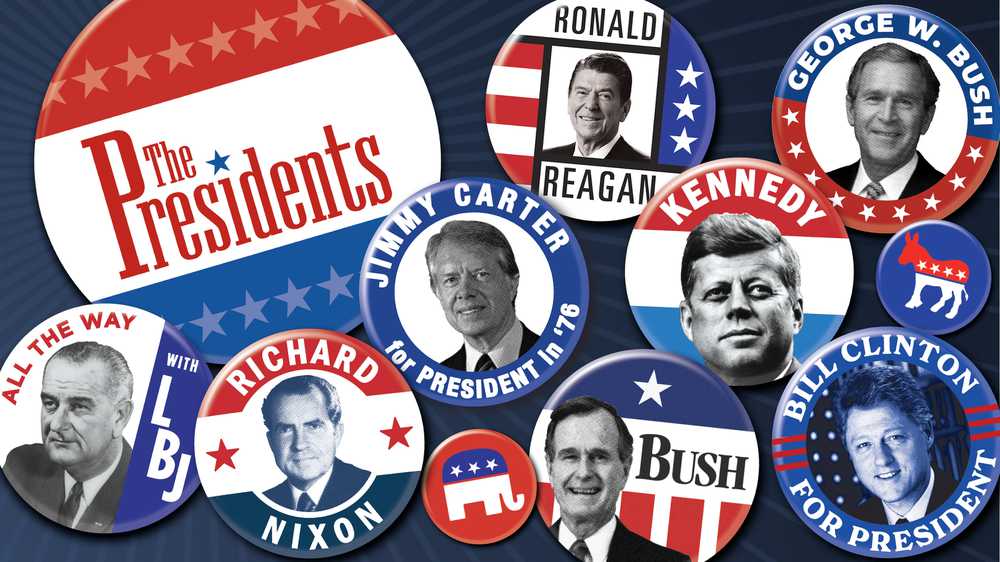
The Presidents Connect today's election issues with the past


Chapter:

Questioning the War (9:05)
As Americans watch the Vietnam War in their living rooms, support for it wavers.
FDR
Truman

Now
Playing

LBJ
Nixon
Carter
Reagan
G H W Bush

Related Clips


TRUMAN, Chapter 30

Dismissing MacArthur (6:58)
In a controversial move, Truman removes General Douglas MacArthur from his command for insubordination.
Watch Now

NIXON, Chapter 13

Living in a Bunker (9:19)
After National Guardsmen kill four students at Kent State University, tensions flare over the war. Nixon begins secretly taping White House conversations.
Watch Now

LBJ, Chapter 8

Johnson and the Kennedy Administration (5:16)
President Johnson determines to fulfill Kennedy's programs.
Watch Now

Chapter 1

Introduction (4:35)
Part one of a biography of Lyndon B. Johnson, the 36th president.
Watch Now

Chapter 2

A Politician from Birth (7:57)
Johnson grows up in poor, rural Texas hill country. Campaigning on a New Deal platform, he wins a seat in the U.S. House of Representatives.
Watch Now

Chapter 3

In Washington (11:11)
Johnson networks in Washington and Texas. He loses a Senate bid and learns hard lessons in the dark side of politics.
Watch Now

Chapter 4

The Senate Campaign of 1948 (12:30)
Johnson runs a flamboyant campaign in a tough race. He wins the seat, dogged by rumors of fraud.
Watch Now

Chapter 5

In the Senate (9:00)
Johnson becomes a power broker, developing a bargaining style known as "the Johnson treatment."
Watch Now

Chapter 6

The Civil Rights Act of 1957 (6:47)
Setting the stage for a presidential run, Johnson builds consensus to protect African Americans' voting rights.
Watch Now

Chapter 7

Johnson Becomes Vice President (9:09)
Johnson loses the 1960 Democratic nomination but is named Senator John Kennedy's running mate. He becomes president in 1963 after Kennedy is shot.
Watch Now

Chapter 8

Johnson and the Kennedy Administration (5:16)
President Johnson determines to fulfill Kennedy's programs.
Watch Now

Chapter 9

The Civil Rights Act of 1964 (10:49)
Johnson waits out the longest Senate filibuster in history to achieve the bill that makes racial segregation illegal.
Watch Now

Chapter 10

Prelude to War (6:48)
Following Robert McNamara's advice, Johnson okays covert commando attacks against North Vietnam to stop Communism.
Watch Now

Chapter 11

The Great Society (9:01)
Reaching back to his populist roots, Johnson declares war on poverty.
Watch Now

Chapter 12

Gulf of Tonkin (9:11)
Johnson claims that North Vietnam has attacked a U.S. destroyer. He uses the incident as the basis for expanding the war against North Vietnam.
Watch Now

Chapter 13

Landslide Victory (9:42)
Johnson defeats Barry Goldwater, winning the presidency by an unprecedented majority.
Watch Now

Chapter 14

Credits (3:00)
Production credits for part one of the television program.
Watch Now

Chapter 15

Introduction (3:40)
Part two of a biography of Lyndon B. Johnson, the 36th president.
Watch Now

Chapter 16

Johnson's "Real Presidency" (8:44)
Johnson pushes his Great Society agenda in a legislative avalanche. Advisors — the "best and the brightest" — counsel him to escalate the war in Vietnam.
Watch Now

Chapter 17

Negotiations (7:10)
The consummate political bargainer hopes to broker a deal with North Vietnamese leader Ho Chi Minh.
Watch Now

Chapter 18

Voting Rights for African Americans (10:41)
Civil rights protesters force Johnson's hand on voting rights for African Americans. Their cause is helped by national media coverage of brutal police attacks.
Watch Now

Chapter 19

The Decision to Expand the War (12:25)
Although defending South Vietnam now appears it will require many years and sacrificed American lives, Johnson decides to expand the war.
Watch Now

Chapter 20

Black Power (10:15)
Johnson's social aid programs bring about positive change, but some see his efforts as too little, too late. Urban riots erupt across the nation.
Watch Now

Chapter 21

Questioning the War (9:05)
As Americans watch the Vietnam War in their living rooms, support for it wavers.
Watch Now

Chapter 22

A Miasma of Trouble (15:14)
Johnson struggles to keep his dream of the Great Society alive while the country spins out of control.
Watch Now

Chapter 23

No Surrender (6:22)
The war in Vietnam looks unwinnable. Johnson's advisors counsel him to improve the public's view of the war. ,
Watch Now

Chapter 24

The Tet Offensive (10:11)
The North Vietnamese bombing of South Vietnam over the Tet holiday becomes a turning point in the war.
Watch Now

Chapter 25

A Continuous Nightmare (12:04)
Johnson decides not to run for re-election. His legislation has carried New Deal liberalism to its peak, but the war in Vietnam has defeated him.
Watch Now

Chapter 26

The Post Presidency (5:38)
Depressed, Johnson retires to his Texas ranch. He suffers a fatal heart attack just days before peace talks end the Vietnam War.
Watch Now

Chapter 27

Credits (3:01)
Production credits for part two of the television program.
Watch Now

  • LBJ: Chapter 1
  • LBJ: Chapter 2
  • LBJ: Chapter 3
  • LBJ: Chapter 4
  • LBJ: Chapter 5
  • LBJ: Chapter 6
  • LBJ: Chapter 7
  • LBJ: Chapter 8
  • LBJ: Chapter 9
  • LBJ: Chapter 10
  • LBJ: Chapter 11
  • LBJ: Chapter 12
  • LBJ: Chapter 13
  • LBJ: Chapter 14
  • LBJ: Chapter 15
  • LBJ: Chapter 16
  • LBJ: Chapter 17
  • LBJ: Chapter 18
  • LBJ: Chapter 19
  • LBJ: Chapter 20
  • LBJ: Chapter 21
  • LBJ: Chapter 22
  • LBJ: Chapter 23
  • LBJ: Chapter 24
  • LBJ: Chapter 25
  • LBJ: Chapter 26
  • LBJ: Chapter 27
Choose a format

Choose a Video Format

Quicktime | Windows Media

Download a free player
QuickTime | Windows Media

Related Links


LBJ
Learn more about Lyndon B. Johnson.

Student Antiwar Protests
They marched by the thousands.

Student Antiwar Protests
They marched by the thousands.

What's Your Bag?
Will you be a gun-toting radical or a pillar of society?

What's Your Bag?
Will you be a gun-toting radical or a pillar of society?

Purchase Videos & DVDs

• See Comments

Loading comments...

You must log in to submit a comment. If you don't have an account at American Experience, you will need to register to comment. It's fast and easy to do!

Post a Comment (Limit 5000 Characters)

• View Transcripts •


Transcript: Chapter 21

Narrator: In times of stress and tension in his life, Johnson was often struck down by illness. In 1965, he entered Bethesda Navy Hospital for surgery. With ten doctors and three Secret Servicemen in attendance, Johnson had his gallbladder and a kidney stone removed. After a two-hour operation, Johnson went right back to work.

He was never shy about conducting the nation's business from the most unlikely places. He could be earthy and crude, even vulgar. After his operation, he couldn't resist showing reporters his foot-long scar. One cartoonist transformed the scar into a map of Vietnam.

Johnson had gambled his political future and the lives of tens of thousands of men that he could win a quick victory, that when he sent American troops in force, Ho would turn tail and run, but the North Vietnamese refused to quit. Ho resisted Johnson's escalation with an escalation of his own, matching him soldier for soldier.

Four months after Johnson's agonizing decision to send the troops, he received an ominous private report from the man who had argued most fervently for the land war in Asia. Secretary of Defense Robert McNamara had begun to have second thoughts.

Larry Berman: In late 1965, we have minutes of meetings in which the Secretary of Defense Robert McNamara tells Lyndon Johnson that "We've been too optimistic. The war can't be won in the period of time that we've thought."

Narrator: Even with six hundred thousand men, McNamara told him, the odds were fifty/fifty that after a year or more there would be a military standoff.

Larry Berman: And I think the evidence is overwhelming that Johnson did not want to hear what the secretary of defense had to say, and from that moment on, the relationship between the two men deteriorated and was never the same.

George Ball: He wanted desperately to be told that things were going well, and he wasn't necessarily getting that advice. Well, I think it shook him a great deal, and I think that he felt that he had gotten a -- he was riding a tiger and he couldn't get off.

Narrator: The White House could keep these internal debates hidden, but there was no hiding what was happening in Vietnam.

Morley Safer, CBS Evening News: This is what the war in Vietnam is all about -- the old and the very young. The Marines have burned this old couple's cottage because fire was coming from here. We're on the outskirts of the village of Cam Ny with elements of the 1st Battalion, 9th Marines.

Narrator: Johnson bridled at what he saw. He knew the power of television and worried about how Americans would react to watching the war in their living rooms night after night.

Safer: Today's operation is the frustration of Vietnam in miniature. There is little doubt that American firepower can win a military victory here, but to a Vietnamese peasant whose home is a -- that means a lifetime of backbreaking labor. It will take more than presidential promises to convince him that we are on his side.

Narrator: Americans began to question the conduct of the war. At first, their numbers were small and Johnson dismissed them, but he could not ignore what was happening in the Senate.

Sen. Frank Church: I still think these principles upon which we rest our policy are subject to very serious questions.

Sen. William Fulbright: Well, I wish -- all I am asking for is clarification of what our objective is in this struggle.

Narrator: February 1966 Senator William Fulbright began to hold televised hearings. Fulbright had guided the Tonkin Gulf resolution through an obedient Congress on behalf of the president. Now he was leading Senate liberals in an anti-war revolt against the White House.

Sen. Church: You can look at the war in Vietnam as a covert invasion of the South by the North, or you can look at it as basically an indigenous war. But either way you look at it, it's a war between Vietnamese to determine what the ultimate kind of government is going to be for Vietnam. Now, when I went to school, that was a civil war.

ABC Announcer: We'll be back with more of the stormy Senate hearings when ABC's Cope continues in just a moment.

Narrator: Johnson was furious. He began referring to Fulbright as "half-bright" and cut him off entirely. Their twenty-year friendship was over. He placed Fulbright and several other Senate liberals under FBI surveillance. Johnson ridiculed his critics. He called them "cut-and-run people with no guts." "They're rather fight me than the enemy." He was beginning to hunker down, isolating himself from dissent.

Tom Paxton: [singing "Lyndon Johnson Told the Nation"] "I got a letter from LBJ | It said, 'This is your lucky day | Time to put your khaki trousers on | We've got a job for you to do | Dean Rusk has caught the Asian flu | And we are sending you to Vietnam.' Lyndon Johnson told the nation |'Have no fear of escalation | I'm trying everyone to please | Though it isn't really war | We're sending fifty thousand more | To help save Vietnam from Vietnamese."

Narrator: Johnson had taken the country into war and kept the American people in the dark. Now, as the fighting escalated, many began to challenge the morality of the war.

Ronnie Dugger: I didn't fully understand why I was opposed to the war in Vietnam. I just knew that it was wrong for a great, proud, abundant nation, technologically superior to anything in the world, going in and crushing a peasant society. In my opinion, it was like a decision to release the furies. I think the thing that the anti-war movement probably didn't understand is that once he had made it, he wasn't going to draw back.

Johnson actively argued with me that he was trapped, that he had tried to do everything to bring peace. "I don't want people to think I'm a coward," he would often say. "I don't want to be the first president who's lost a war." Well, what does it matter if he's the first president who's lost a war that shouldn't be fought anyway?

Anti-War Demonstrations: [chanting] End the war in Vietnam! Bring the troops home! End the war in Vietnam! Bring the troops home!

Narrator: By the summer of 1966, hundreds of thousands of Americans were in Vietnam. Still, his generals kept asking for more. Thousands were dead, Johnson's dream of a Great Society was in danger, and the end was nowhere in sight.


Major funding provided by the National
Endowment for the Humanities and the Corporation for Public Broadcasting

NEH Corporation for Public Broadcasting


Any views, findings, conclusions, or recommendations expressed in this Web site do not necessarily represent those of the National Endowment for the Humanities.